Mixed-species grazing is common in nature, and used to be a more common agricultural practice. Some PFI members are adapting this practice on their farms.
Over meals at field days, or at the annual conference the past couple of years, farmers have expressed curiosity about what goes into grazing a flerd. They'd heard about it but never tried it themselves, and they wanted to learn more from folks who have tried it.

But first, what is a flerd? This silly-sounding word is a portmanteau of “flock” and “herd” used to indicate when those two groups of livestock have been combined into one. Most often, this takes the form of a flock of sheep or herd of goats and a herd of cattle grazing and being managed together as an integrated unit. Here in the Midwest, the practice is less common than in other parts of the world – and even in the history of American agriculture. Language bears this out.
According to lexicographers at Merrian-Webster Dictionary, “a herd was any group of animals traveling or eating together, as was a flock, and this jumble continued on into the modern era.”
It's also worth noting that many languages past (Egyptian, ancient Greek) and present (Finnish, Georgian, Mongolian) don't distinguish between what types of animals assemble in herds versus flocks. A group of livestock is simply a group of livestock.
This lack of distinction is a hint that the practice of grazing sheep, poultry, cattle or other animals together is more common than one might assume. Though there is vocal interest from our members to learn more about flerds, it turns out that there are far fewer people actually doing it. But two brave souls volunteered to share their experiences.
George Heller, of Wadena, Minnesota, started out grazing sheep, added cattle and never looked back. He was inspired after learning from renowned grazier Greg Judy, who operates the grass-based livestock ranch Green Pastures Farm near Rucker, Missouri.
Greg has influenced many farmers and ranchers with his approach that's based on working with nature and keeping inputs to a minimum. Greg and his wife Jan have been grazing their St. Croix hair sheep together with their cattle for years.
“Cattle and sheep actually work in harmony together,” Greg says in a 2019 instructional video about mixed-species grazing on his YouTube channel (he also shared similar advice with PFI members during a short course before our 2024 Annual Conference). “They both eat different species and also act as dead-end hosts for each other's parasites. Sheep make cattle pasture better with reduced brush load.”
“The reason I'm doing any of this is because of Greg,” George says. “He's been the driving force behind this management. I just do everything as close to what he does on his farm.”
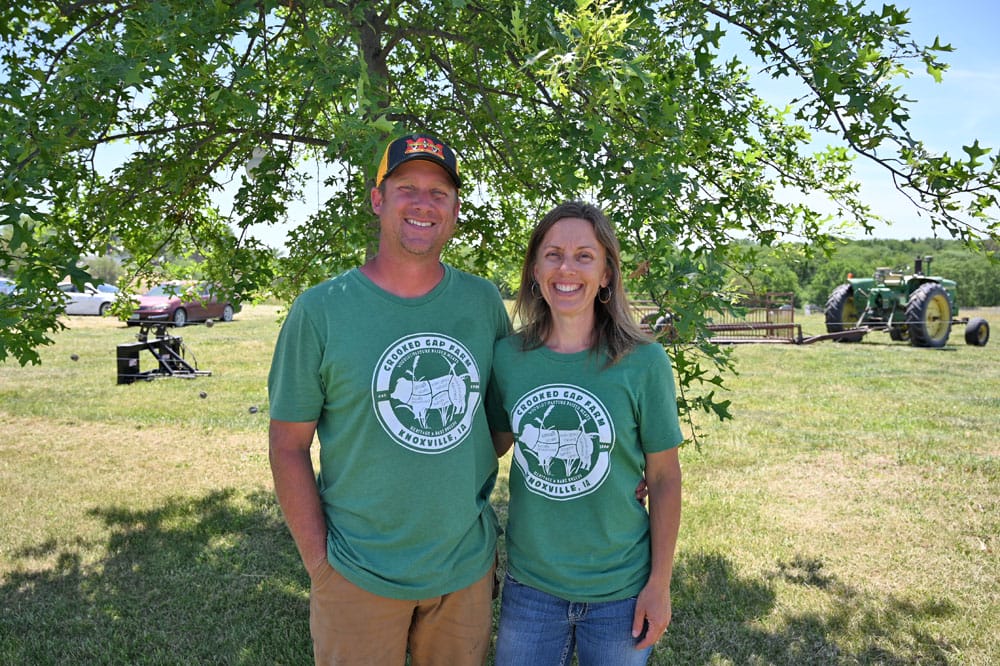
Ethan Book, who farms outside of Knoxville, Iowa, has also been grazing a flerd as long as he's had sheep and cattle. Due to limited infrastructure, Ethan keeps animals together on a field he describes as “a sacrifice area,” where the animals congregate and churn up the soil, near the house for easier care during the winter. Sharing this space together has meant the sheep and cows have bonded with one another – which has pros, such as protection from predators and more efficient use of land. But it can also create some challenges.
Mineral supplements are one challenge. Cattle mineral formulations contain levels of copper that are toxic to sheep. George has avoided this dilemma by simply not feeding minerals at all. He's looking at starting, however, and thinks that providing a free-choice, cafeteria-style system where each mineral is offered separately will let the sheep opt to simply avoid the copper.
Ethan feeds either a sheep-specific mineral mix, or an all-stock mineral that's suitable for both species. During lambing season, however, he separates the flerd and gives the cattle mineral specific to them that contains copper.
Fencing can also be a challenge. Ethan and George use two- to three-strand polywire, which is plenty for cattle but not for sheep determined to get through. To avoid sheep escapes, both George and Ethan move their flerds quickly. “When I have them together, I'm moving them a little faster than I otherwise would so that the sheep respect the fence,” Ethan says.
Mimicking Nature
Despite the challenges, practitioners of flerd grazing appreciate its benefits. George and Ethan both cite how grazing their cattle and sheep together results in better forage use and saves them time. “It's only one set of chores,” George says. “That's the number-one reason I do this. I wouldn't have the time to farm if I had them in separate plots.”
Ethan echoes this point: “It's not a big agricultural decision I'm making, so much as it's a time management situation for us.” For farmers like George, who wouldn't otherwise have the time to manage and move two separate groups of livestock, grazing cattle and sheep together makes it possible to diversify their incomes. Other flerd graziers appreciate the predator control that cattle can provide to sheep.
Central to the practice, however, is the link between mixed-species grazing and forage health. Historically, grassland ecosystems throughout the world evolved in concert with multiple megafaunal grazing species coexisting on the landscape.
In North America, Indigenous Peoples used fire to manage prairies for the vast herds of bison, which grazed alongside herds of elk and antelope before moving on to the next area of fresh grazing. These alternating periods of grazing and growing are the basis of today's managed rotational grazing practice, which gives plants time to recover in between grazing sessions.
In continuously grazed pastures, however, plants don't have a chance to regrow and store surplus energy. Because livestock have a taste for fresh, new leaves, as soon as plants start regrowing, the animal returns for a tasty second bite. This stress limits the speed at which a plant can regrow or can weaken the plant until it dies. Few species of palatable plants thrive in these conditions. Over time, low-producing, unpalatable and undesirable plants come to dominate continuously grazed pastures.
In intact grassland ecosystems, by contrast, overgrazing was rarely a problem. Animals grazed an area for preferred plants – and each species had its own particular foraging tastes. Instead of competing for food, different species complemented each other. Versions of these mixed-species migrations can be seen today on the Serengeti in Africa. Wildebeest, zebras, antelope and other grazers all move together and intermingle.
For advocates of flerd grazing, re-creating this natural dynamic is a big part of the theory behind the practice. On the North American Plains, now covered in farms, the role once played by bison, elk and antelope is now filled by domesticated farm animals. Bison, like cows, prefer a mix of 80-20 grass to forbs. Elk and antelope are more like sheep and goats, preferring at least 50-50 grass to forbs, up to an 80-20 ratio.
George puts it simply: “The grazing is better. The sheep will eat stuff the cattle won't. You get a more even graze. They complement each other well.”
This mutualism means farmers can raise more animals on the same piece of land, which can mean more profits without growing the size of the farm.
The practical benefits of flerds are many. But for George, there are intangible pleasures as well. Watching his flerd peacefully graze together, he tries to describe the visceral joy he feels. “Standing there watching them, hearing them rip up grass while they eat,” he says. “Listening to all the wildlife, the birds flying around, the insects. Just standing out there, in the quiet – being.”