About Roller-Crimpers
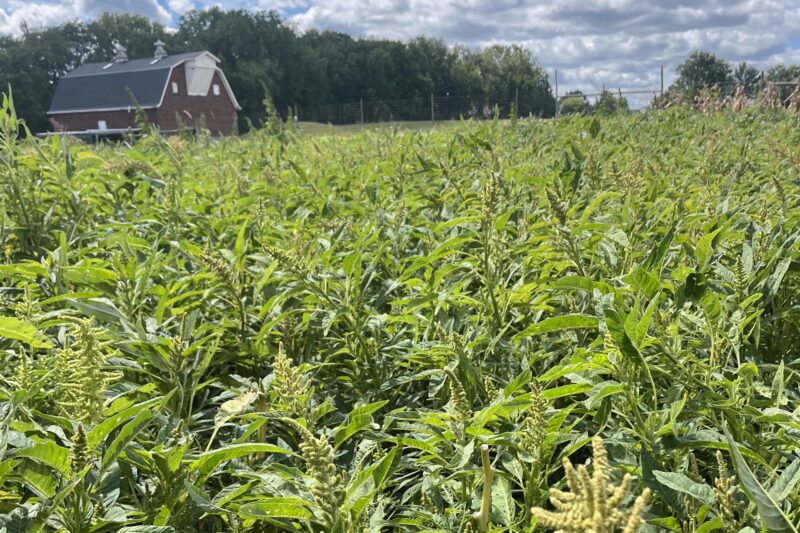
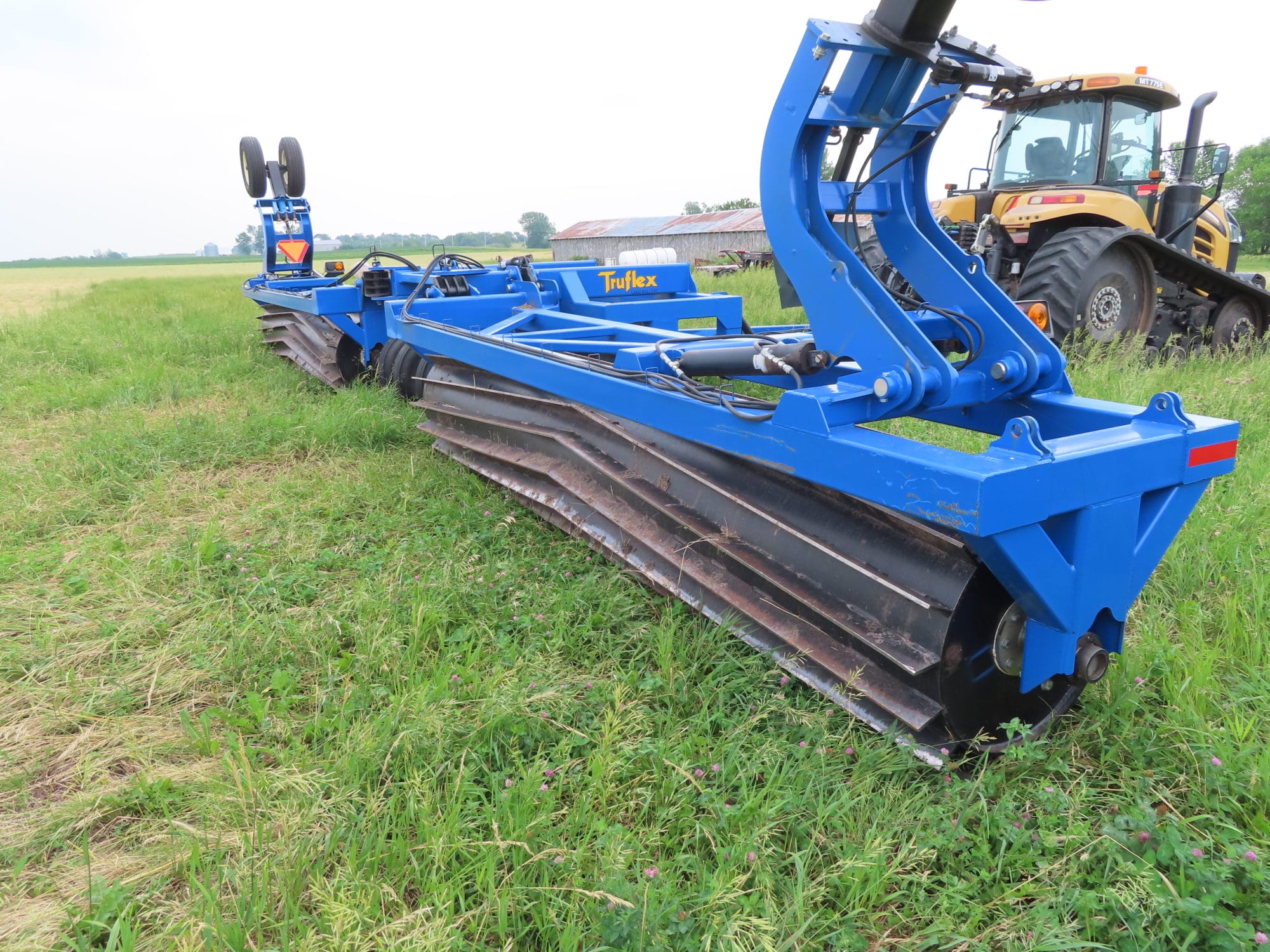
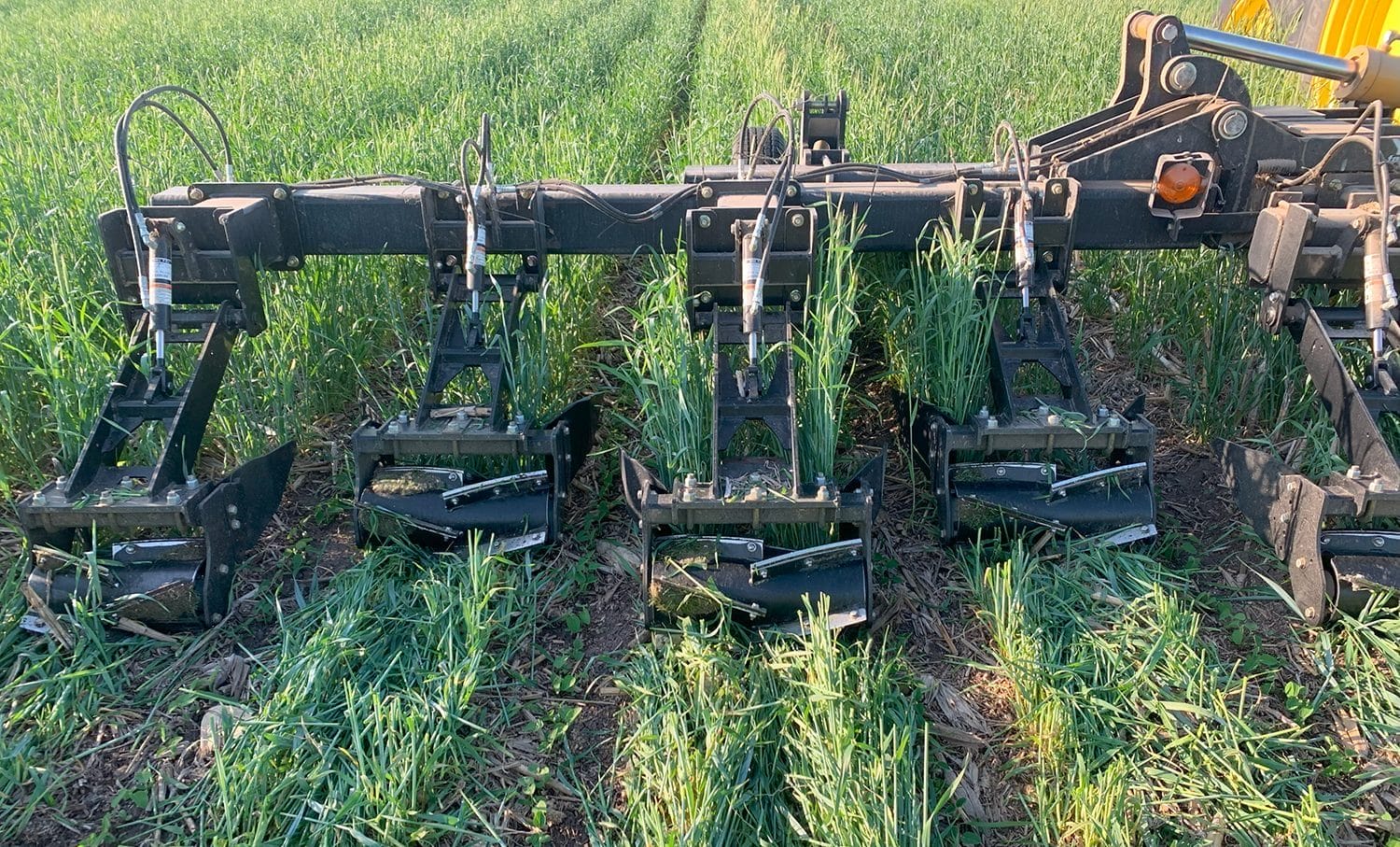
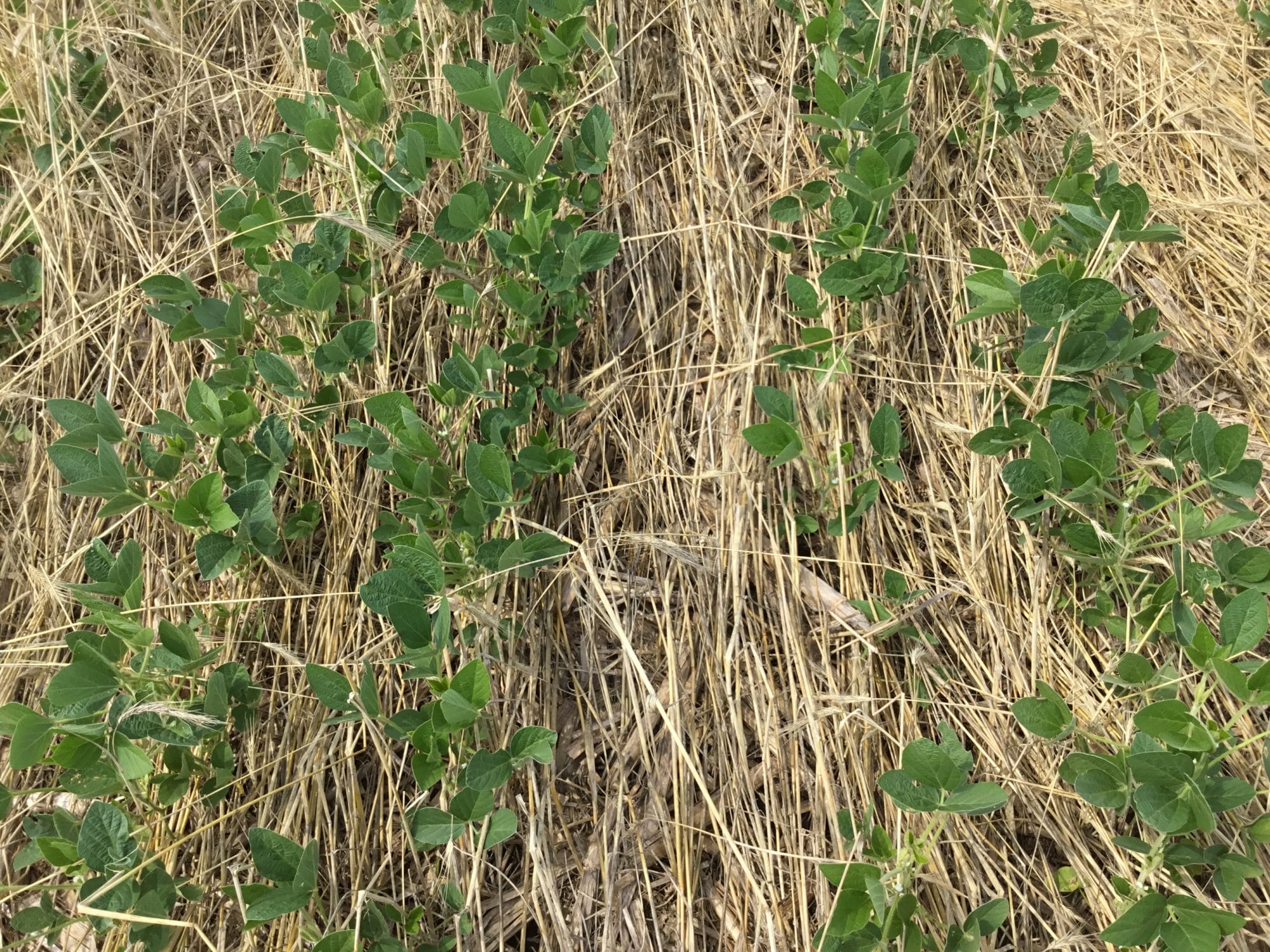
Roller-crimpers are heavy steel drums with blunt cutting blades that terminate annual cover crops by breaking their stems and flattening them to the ground (Photos 1, 2, and 3). Roller-crimpers allow both organic and conventional farmers to terminate cover crops without tillage, and the flattened cover crop mat covers the soil and reduces the need for weed management later in the season. Today, there are many different roller-crimpers available for a variety of row crop and vegetable production systems.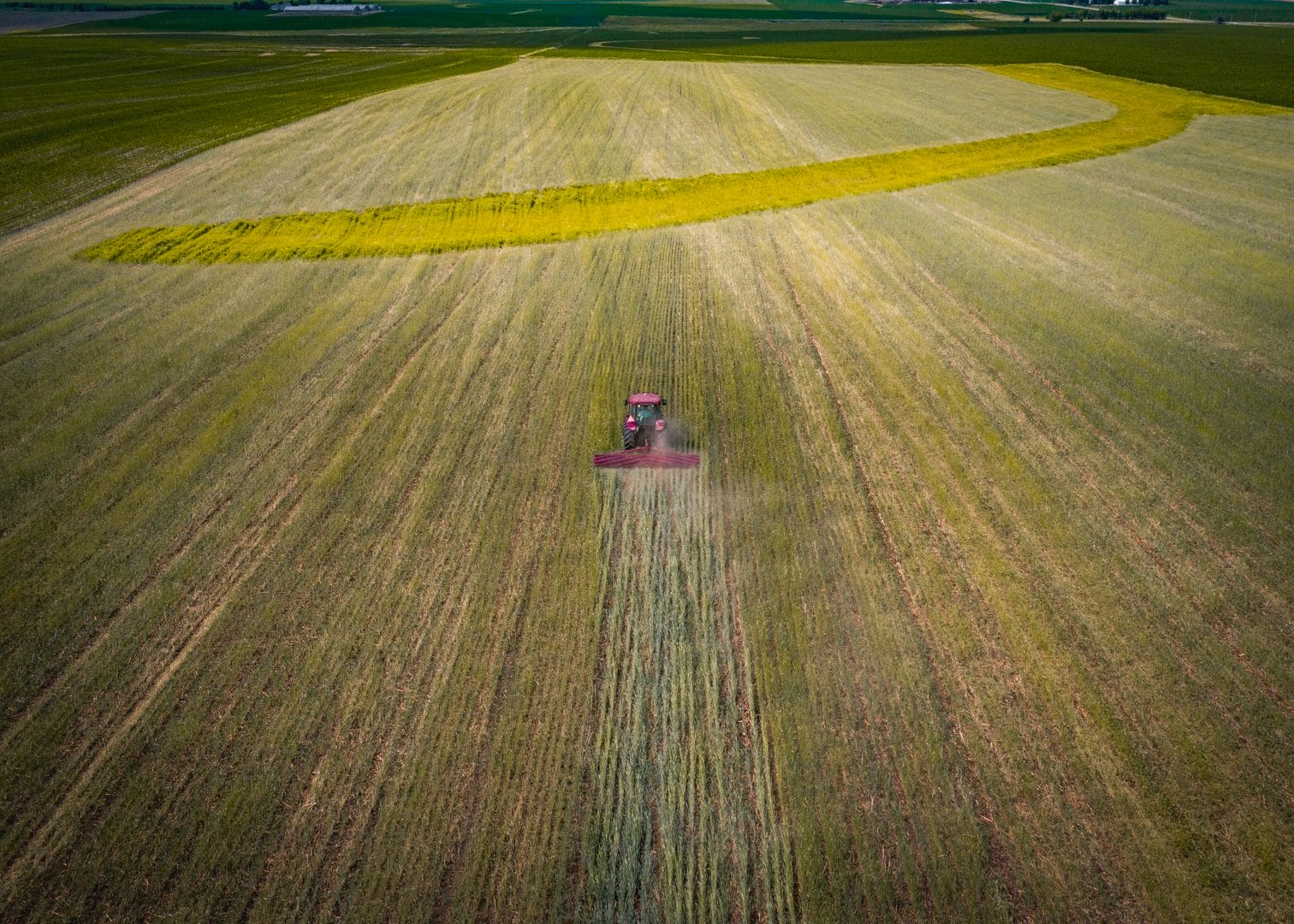
Summary of Research Trial Results
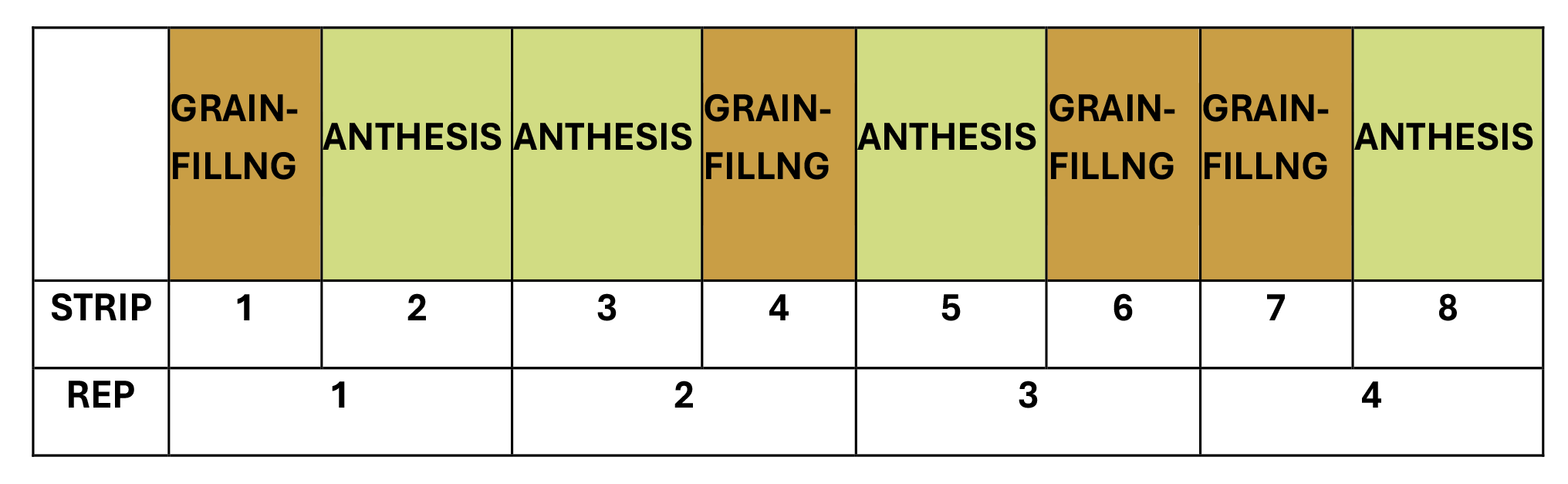
Since 2017, PFI cooperators have completed 15 different research trials related to roll-crimping rye in soybean systems. The questions these trials asked fall into two main categories: 1) Does roll-crimping result in soybean yield changes compared to terminating rye with herbicide? (Table 1), and 2) When is the best time to roll-crimp rye or plant soybeans in a roll-crimped system to maximize soybean yield (Table 2)? All trials followed standard PFI trial design which allows for the use of statistical analysis, except when noted. See Figure A1 at the end for an example trial layout.Roll-crimping With Herbicide Termination
Many conventional farmers wonder if roll-crimping combined with herbicide works as well as the herbicide they are used to using for no-till cover-cropped soybean production. Cooperators have completed four trials comparing a roll-crimping rye treatment to herbicide-only termination treatments (Table 1). The results varied between trials; in two cases, roll-crimping or in-row roll-crimping resulted in increased yields, in one trial decreased yields, and in one there was no yield difference between treatments. Individually, these trials have allowed farmers to see what works on their operations and feel more confident in choosing (or not choosing) to use roller-crimpers. For example, Michael Vittetoe notes that his trial confirmed for him that “the in-row roller is an integral part of my future plans for our farm operation.”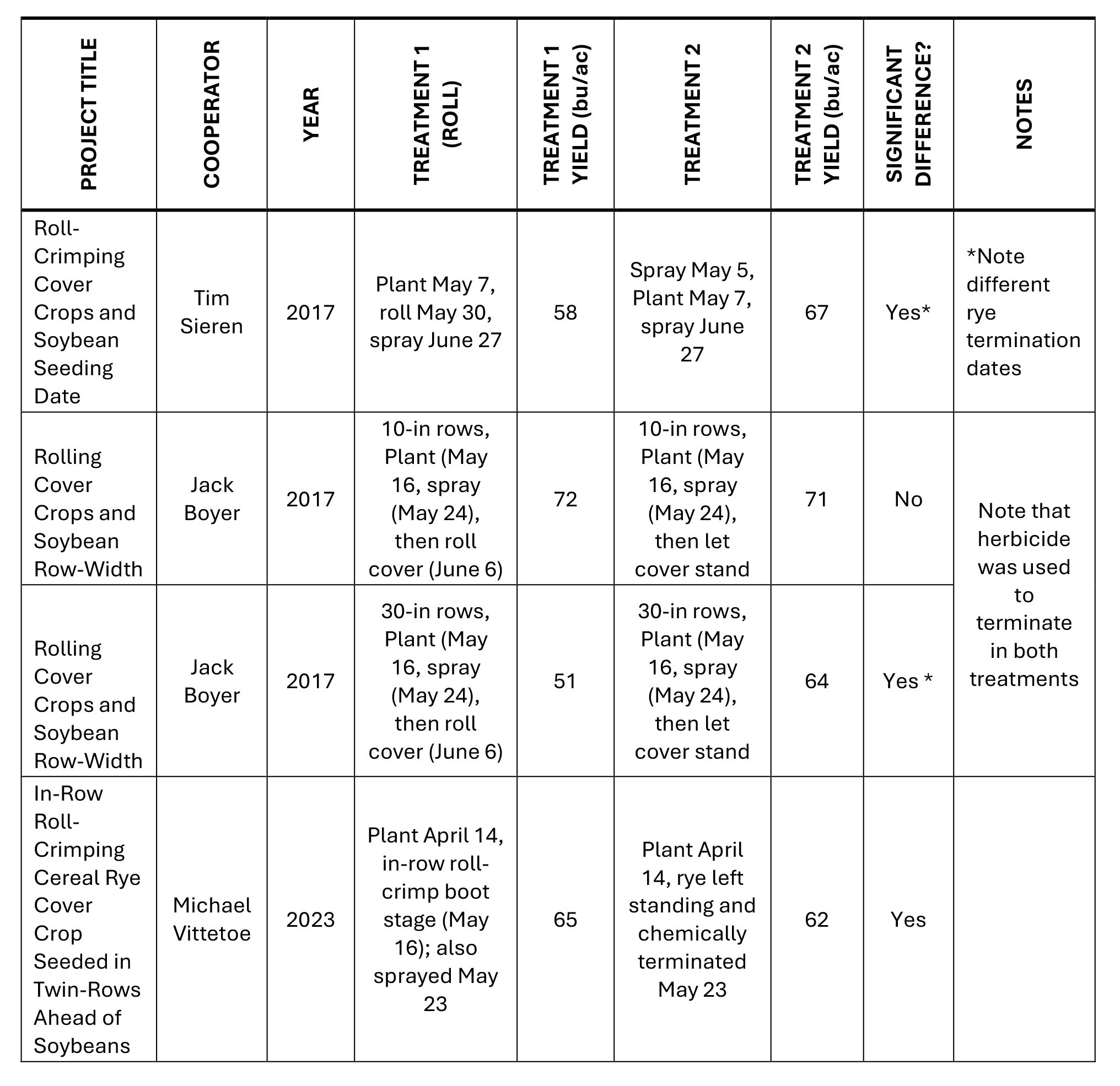
Termination and Planting Timing When Roll-crimping
If you roll-crimp too early in cereal rye's growth stage, it might not terminate well because the green stems don't break or the immature plants are still able to grow new tillers. If you wait too long, soybean yield might be impacted by shade and competition for water and nutrients from the cereal rye. There are two variables farmers can change to try to strike the perfect balance: when to plant the soybeans and when to crimp the rye. Results were mixed in three trials investigating soybean planting dates; trials by Jon Bakehouse and Tim Sieren both showed that waiting to plant soybeans until late May, when rye is more easily terminated by rolling, results in risk of decreased yields, while a third at Scott Shriver's showed that planting when rye was roll-crimped in early June resulted in increased yields (Table 2). In contrast, none of the eight trials on roll-crimping timing in 2023 found that delaying roll-crimping rye for more than a few weeks after soybean planting significantly reduced soybean yields. Many but not all of these trials observed a small (1-2 bu/ac), non-significant reduction in yield with roll-crimping. It is worth noting that all 2022 and 2023 trials spanned significant drought years, which could have affected the results. It seems that overall, roll-crimping timing within the timeframes these cooperators investigated is probably not going to significantly affect soybean yields.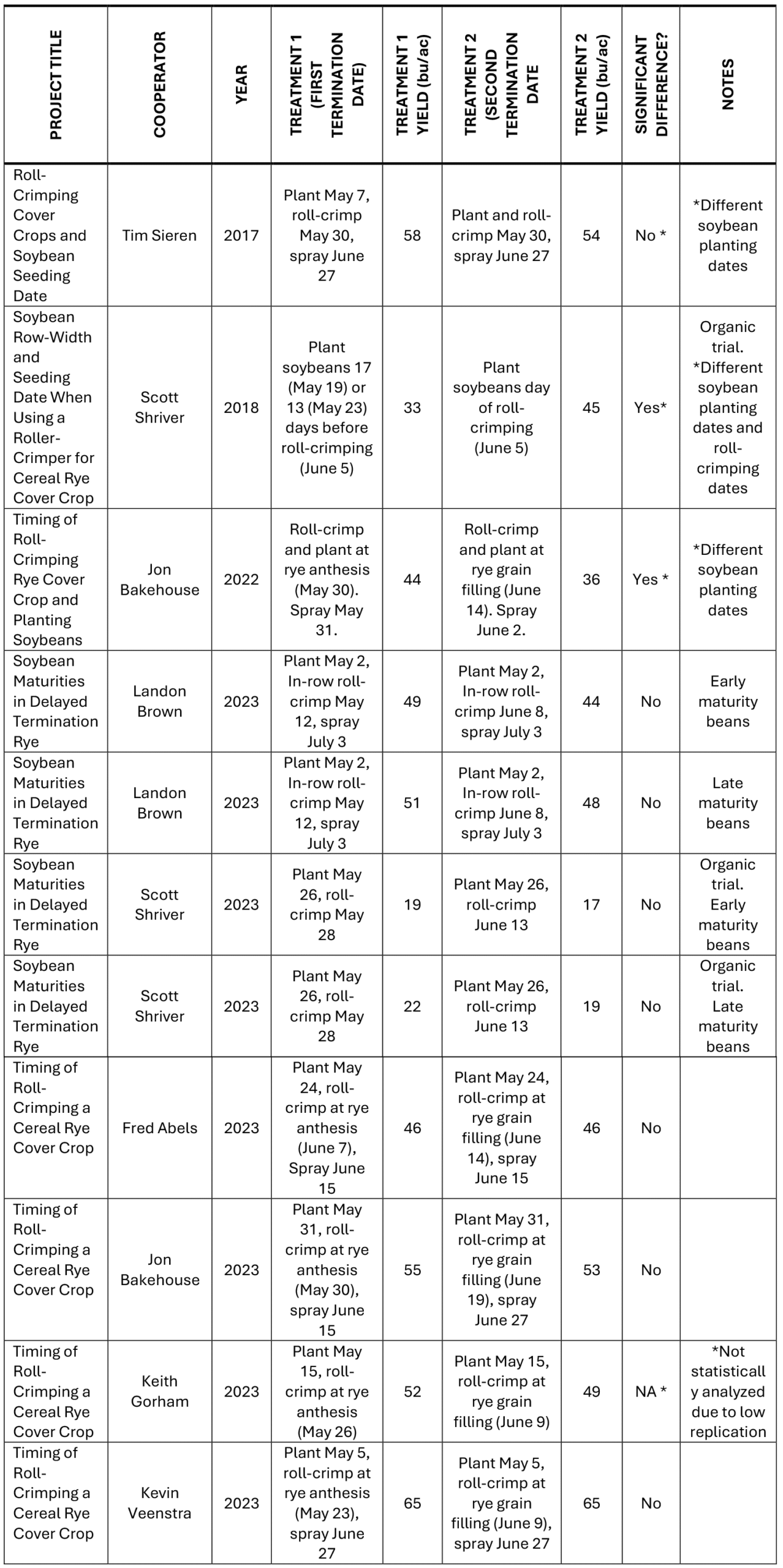
Scott Shriver - Organic
The way Scott Shriver sees it, there are three main factors at play in the success of his organic no-till soybean crop. In order of importance, they are:- When cereal rye is planted. Planting in September really improves early season weed control and makes no-till production viable.
- How well soybeans are planted. As an organic producer, Scott says achieving sufficient seed depth and coverage when no-till planting into a rye mat has been a learning curve for him.
- Roller-crimper timing. If you go way too early, it won't crimp. But imperfect crimping can be ok.
Jon Bakehouse - Conventional
Jon Bakehouse has been thinking for years about when to plant soybeans and roll-crimp rye to maximize yield in his no-till system. He's found that for him it's best to try to roll-crimp rye sometime after anthesis and try to plant soybeans late enough that they are not growing with the rye for longer than a few weeks, but also notes that best laid plans seem to always be thrown out the window by the weather. This spring, he had two new tools on his belt – a different variety of rye, ND Gardner, that seems to roll much better than the Elbon he used in previous years and a chart demonstrating rye growth stage by Growing Degree Days from Kansas State that helped him track the rye's growth. His rye crimped beautifully and provided a great mat for weed control, thanks in large part to ample growth from spring rain. Though in previous years he's seen soybean growth and yield hits from rye competition, this year he planted his soybeans a bit later and saw that they established well in the wet weather. Jon doesn't think that he will ever get full season weed control from rye planted in October, but this year he thinks he will be able to get away with only one herbicide plus residual application in late June. “Reducing to one herbicide application is a great way to combat herbicide resistance and costs,” Jon says. Roll-crimping also helps build flexibility with the timing of his first herbicide application, which he hires out and can be hard to schedule in the busy early season. In addition to in-season benefits, Jon likes to focus on the extended soil coverage benefits roll-crimping provides. “Roll-crimping is not just for this year but for next year – there is a much better biomass mat for the winter after soybeans, and this way there is 90-100% soil coverage going into the winter. [You gain] protection from the wind and heavy rain, and a beautiful seed bed to plant corn into.”Additional Resources
Archive of Cooperator's Program Reports on roller-crimping PFI videos about cover cropping: In-Row Roller Crimping for Earlier Soybean Planting Roller Crimping Cereal Rye in Soybean Production Shriver Farms – Roll-crimping Cereal RyeFunding acknowledgement This material is based upon work supported by the U.S. Department of Agriculture, under agreement number NR226114XXXXG004. Any opinions, findings, conclusions, or recommendations expressed in this publication are those of the author(s) and do not necessarily reflect the views of the U.S. Department of Agriculture. In addition, any reference to specific brands or types of products or services does not constitute or imply an endorsement by the U.S. Department of Agriculture for those products or services. How do I become a Cooperator? Contact Emma Link, Senior Research Coordinator, at (515) 232-5661 ext. 1045, or emma.link(at)practicalfarmers(dot)org, to find out how you can become an on-farm research cooperator. To become a cooperator, you first need to join Practical Farmers of Iowa.