In a Nutshell:
- The objective of this trial was to determine the most profitable and sustainable green manure system for planting between winter wheat and corn.
- Sloan compared cover crop biomass and corn yield among three treatments: two in which a clover blend was interseeded to wheat and terminated the following spring but with different herbicides, and a third in which a winterkill cover crop mix was drilled following wheat harvest.
Key Findings:
- Interseeding red and alsike clover to wheat then terminating it the subsequent spring –regardless of termination herbicide used – generated greater corn yields and a better return on investment by $80/ac compared to a winterkill cover crop mix drilled following wheat harvest.
Background
Since 2013, PFI member Dick Sloan has played with an expanded three-year rotation of winter small grains between soybean and corn. Among the small grains he grows are winter wheat and cereal rye, which he harvests and then plants as cover crops. The summer harvest of winter small grains provides a window of opportunity to grow soil nitrogen ahead of corn by means of establishing a green manure. Sloan has experimented with different interseeded clover mixes as well as summer-seeded winterkill mixes. Previous on-farm research conducted by himself and Wade Dooley showed that cereal rye followed by clover mixes led to greater corn yields and return on investments compared to following cereal rye with cloverless mixes.[1,2] However, while Sloan asserts “it’s hard to beat a medium red and alsike clover blend interseeded to established winter small grains,” he notes that “no-tilling corn into clover that has just been terminated doesn’t work well.” In an effort to fine-tune his clover management program, Sloan wanted to see if terminating clover in the fall rather than spring might facilitate easier corn planting. Additionally, Sloan wondered if reserving clover skip zones into which a winterkill green manure and then corn could be planted would also help. The objective of this trial was to determine the most profitable and sustainable green manure system to follow Sloan’s winter wheat crop. Sloan’s original intent was to compare fall-terminated red/alsike clover and spring-terminated red/alsike clover with a summer-seeded winterkill green manure mix; however, short on time to terminate clover in the fall, he terminated both clover treatments in the spring and compared the following treatments instead:
- Clover-Glyphosate –red/alsike clover interseeded with skip zones to winter wheat and terminated the subsequent spring with Glyphosate; winterkill cover crop planted in skip zones following wheat harvest
- Clover-Gramoxone – red/alsike clover interseeded with skip zones to winter wheat and terminated the subsequent spring with Gramoxone; winterkill cover crop planted in skip zones following wheat harvest
- Mix-Winterkill – winterkill cover crop mix seeded after winter wheat harvest
Methods
Design
Sloan initiated the trial by drilling winter wheat into soybean stubble on Oct. 21, 2018. He drilled the wheat in 7.5-in. rows at a rate of 120 lb/ac. The following spring, Sloan applied 45 lb N/ac, 20 lb P/ac and 30 lb K/ac to the trial plot.
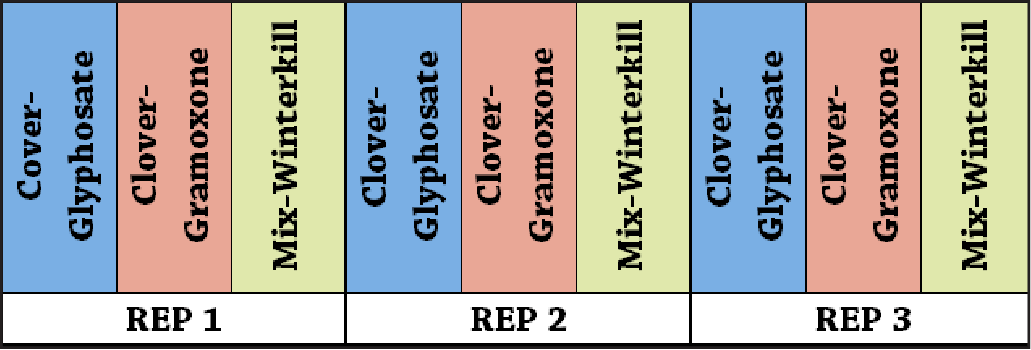
Sloan established treatment strips on April 9, 2019, by interseeding a 60/40 blend of red and alsike clover into 30-ft-wide strips of winter wheat that were pre-assigned the clover-glyphosate or clover-Gramoxone treatment (Figure A1). Sloan drilled the clover blend in those treatments in 7.5-in. rows at a rate of 7.2 lb/ac in 7.5 in. rows, leaving skip zones on 30-in. centers for a winterkill cover crop and then corn. Strips assigned the mix-winterkill treatment remained untouched at this point and consisted only of winter wheat.
On July 22, 2019, Sloan harvested wheat from all treatments. He then mowed the clover in both clover treatments.
On July 31, 2019, Sloan sprayed Tomahawk (1 qt/ac) in the mix-winterkill treatment strips for weed control. In the same strips, he planted the green manure three days later (Aug. 3). The mix was drilled in 7.5-in. rows at a rate of 28 lb/ac and consisted of forage pea (8.4 lb/ac), soybean (2.5 lb/ac), spring triticale (3.3 lb/ac), buckwheat (3.3 lb/ac), badger radish (1.7 lb/ac), crimson clover (4.2 lb/ac), berseem clover (4.2 lb/ac) and brown mustard (0.4 lb/ac).

clover appears green at four months after interseeding it to winter wheat. Photo
taken Aug. 5, 2019.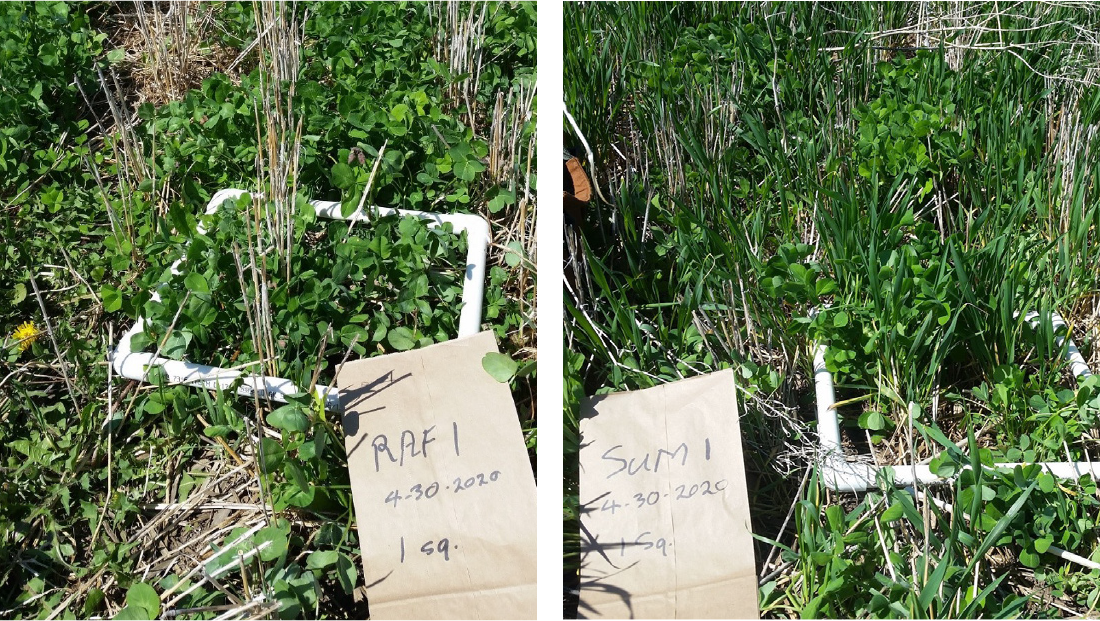
Results and Discussion
Green manure biomass – Fall 2019, spring 2020
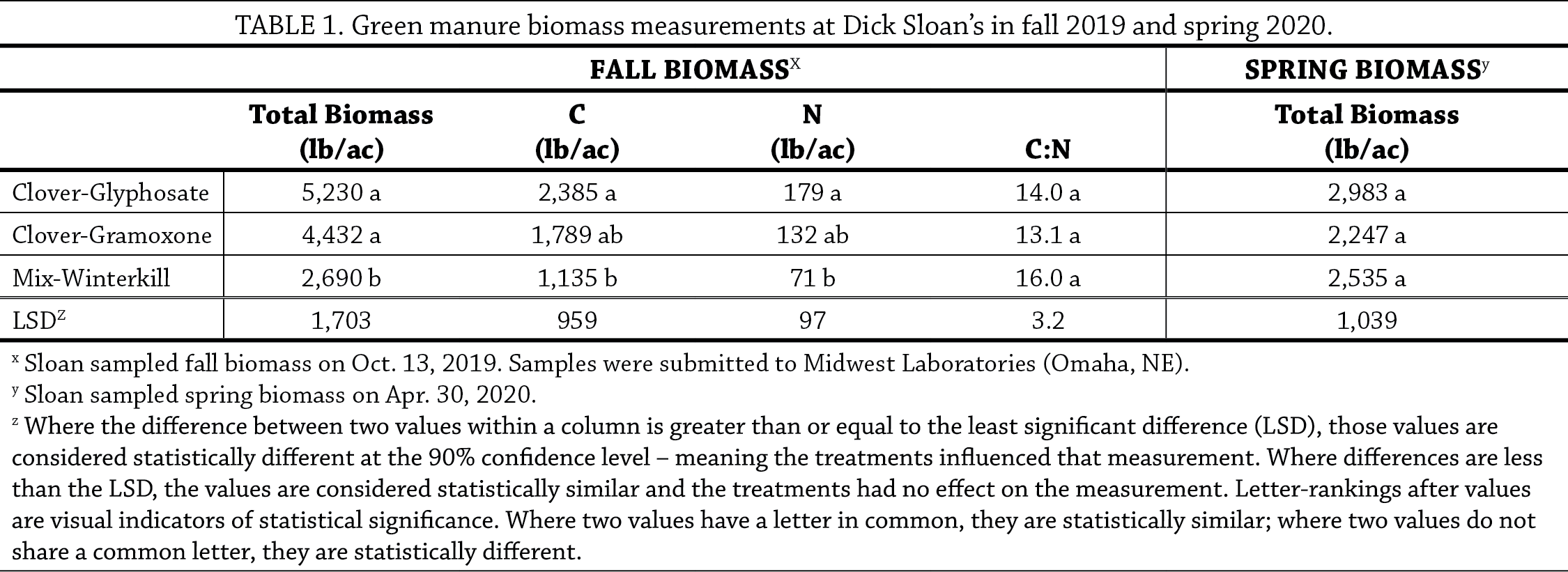
In fall 2019, the clover treatments produced more total biomass than the mix-winterkill treatment; however, only the clover-glyphosate treatment generated more carbon and more nitrogen than the mix-winterkill treatment (Table 1). The amount of carbon and nitrogen generated in the clover-Gramoxone treatment was statistically similar to the amount generated by the other two treatments.
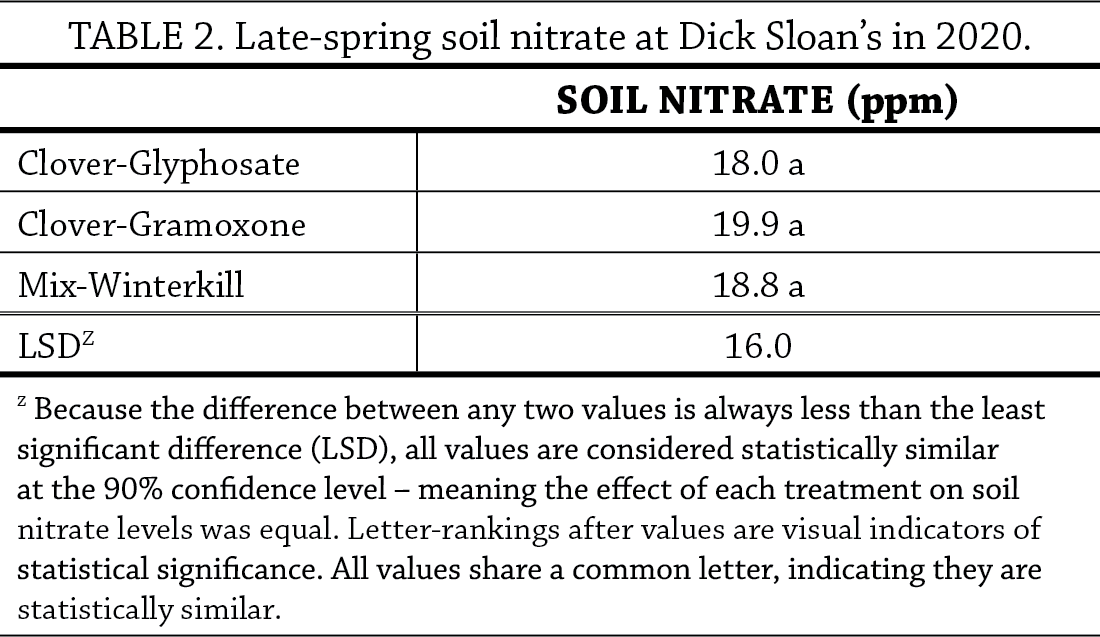 Stalk nitrate
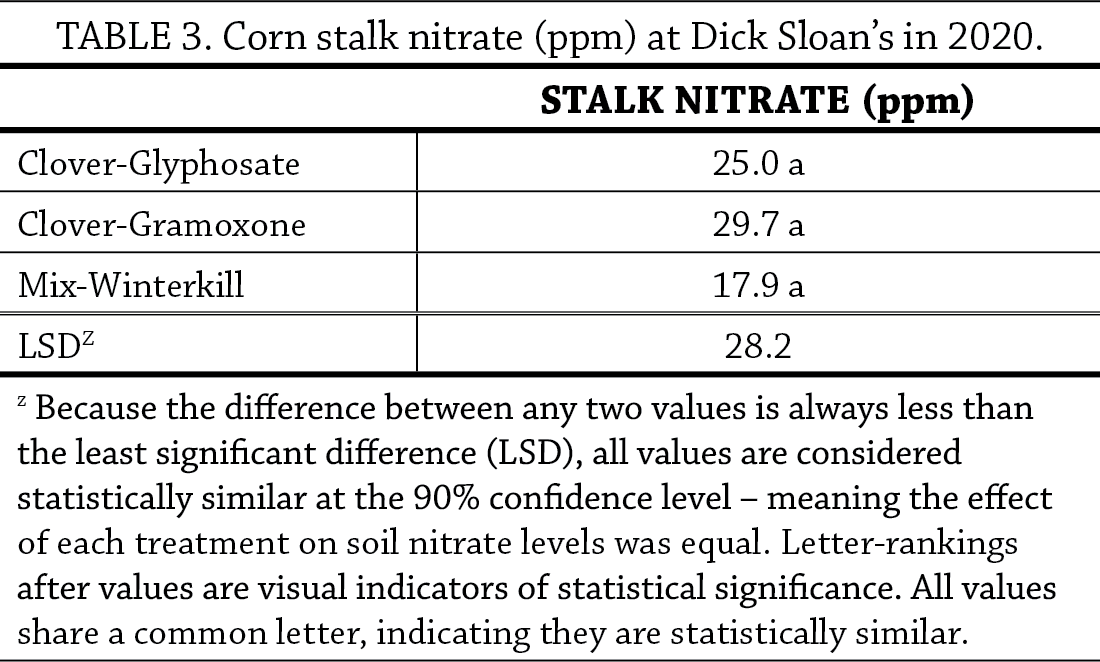
Corn stalk nitrate levels were statistically similar between treatments (Table 3). Stalk nitrate levels were below 250 ppm for all treatments, which indicates corn might have benefitted from additional nitrogen.[3] Nitrogen uptake might have been limited, however, due to periods of extremely low rainfall in July and August (Figure A2).
Stalk nitrate
Corn stalk nitrate levels were statistically similar between treatments (Table 3). Stalk nitrate levels were below 250 ppm for all treatments, which indicates corn might have benefitted from additional nitrogen.[3] Nitrogen uptake might have been limited, however, due to periods of extremely low rainfall in July and August (Figure A2).
 Corn yield
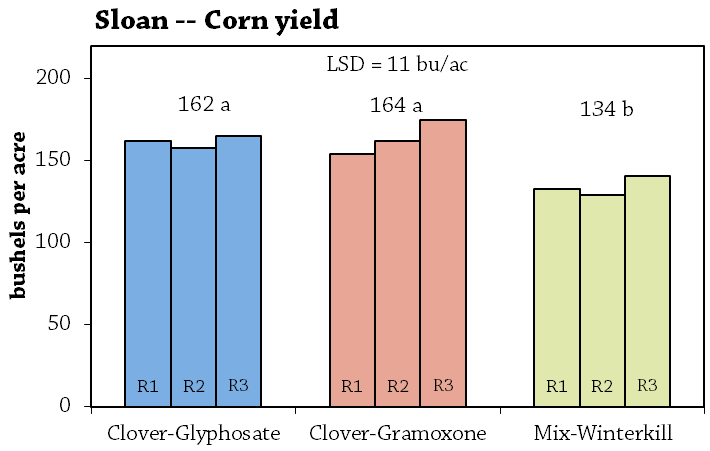
Corn in both clover treatments yielded significantly greater than corn in the mix-winterkill treatment (Figure 1). The clover treatments out-yielded the winterkill mix by roughly 30 bu/ac. Yields in all three treatments were lower than the Buchanan county average for 2020 (189 bu/ac) by more than 25 bu/ac.[4] It is worth mentioning that Sloan achieved the corn yields in this experiment with only 106 lb N/ac applied.
Corn yield
Corn in both clover treatments yielded significantly greater than corn in the mix-winterkill treatment (Figure 1). The clover treatments out-yielded the winterkill mix by roughly 30 bu/ac. Yields in all three treatments were lower than the Buchanan county average for 2020 (189 bu/ac) by more than 25 bu/ac.[4] It is worth mentioning that Sloan achieved the corn yields in this experiment with only 106 lb N/ac applied.
 Economic considerations
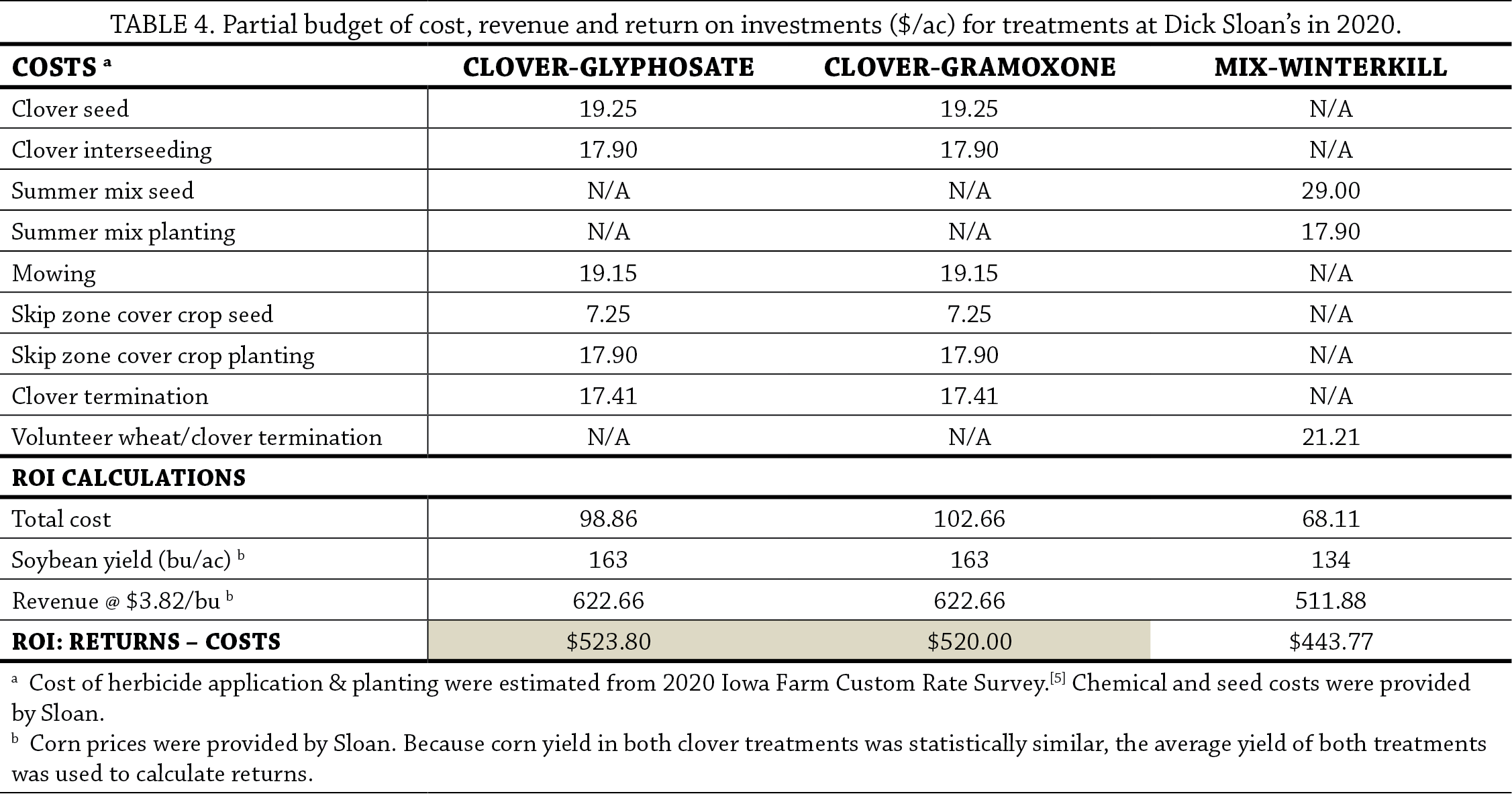
The return on investments (ROI) was greatest in the clover-glyphosate treatment ($523.80/ac); however, it differed from the clover-Gramoxone treatment ($520.00/ac) only by $3.80/ac (Table 4). The ROI in the mix-winterkill treatment was $443.77/ac – $80/ac less than the clover treatments.
Economic considerations
The return on investments (ROI) was greatest in the clover-glyphosate treatment ($523.80/ac); however, it differed from the clover-Gramoxone treatment ($520.00/ac) only by $3.80/ac (Table 4). The ROI in the mix-winterkill treatment was $443.77/ac – $80/ac less than the clover treatments.
Conclusions and Next Steps
Compared to planting a diverse cover crop mix after wheat harvest and allowing it to winterkill, interseeding red and alsike clover to wheat then terminating it the subsequent spring provided Sloan with better corn yields and a better return on investment by $80/ac. Sloan commented, “I like planting a diverse mix of cover crops in the summer following small grain harvest, but it just doesn’t give the same boost to the following year’s corn yields as the clover blend does.” Although Sloan was hindered from terminating one of his clover treatments in the fall as originally planned, he was satisfied this trial backed up his observations from previous on-farm research in which interseeding red and alsike clovers to winter small grains provided good weed control.
Appendix – Trial Design and Weather Conditions

References
- Gailans, S. and W. Dooley. 2016. Effect on corn of green manure cover crops established with cereal rye seed crop. Practical Farmers of Iowa Cooperators’ Program. https://practicalfarmers.org/research/effect-on-corn-of-green-manure-cover-crops-established-with-cereal-rye-seed-crop/ (accessed May 2021).
- Gailans, S. and D. Sloan. 2015. Corn Following Green Manure Cover Crops Established with Small Grain. Practical Farmers of Iowa Cooperators’ Program. https://practicalfarmers.org/research/corn-following-green-manure-cover-crops-established-with-small-grain/ (accessed May 2021).
- Sawyer, J.E. and A.P. Mallarino. 2018. Use of the End-of-Season Corn Stalk Nitrate Test in Iowa Corn Production. CROP 3154. Iowa State University Extension and Outreach. https://store.extension.iastate.edu/Product/5089 (accessed February 2021).
- Johanns, A. 2021. Historical Corn Yields by County in Iowa. Ag Decision Maker. Iowa State University Extension and Outreach. https://www.extension.iastate.edu/agdm/crops/html/a1-12.html (accessed April 2021).
- Plastina, A., A. Johanns and O. Massman. 2020. 2020 Iowa Farm Custom Rate Survey. FM1 1698. Ag Decision Maker. Iowa State University Extension and Outreach. https://www.extension.iastate.edu/agdm/crops/html/a3-10.html (accessed March 2021).
- Iowa Environmental Mesonet. 2021. IEM “Climodat” Reports. Iowa State University Department of Agronomy. https://mesonet.agron.iastate.edu/climodat/ (accessed March 2021).