In a Nutshell:
- Farmers conducted high tunnel tomato variety trials comparing hybrid varieties Big Beef and Bigdena, and heirloom varieties Black Krim and Italian Heirloom.
Key Findings
- At Lee Matteson and Rose Schick’s, Big Beef produced higher yield earlier in the season, but end-of-year cumulative yield was not different between varieties. Bigdena, however, better held its fruit size throughout the growing season. At Rob Faux’s, Italian Heirloom provided higher end-of-season yield than Black Krim, but the difference was not statistically significant.
- Both farms plant to continue using each of the trialed varieties, as they all performed well and are preferred by customers for different characteristics.
Background
Growing tomatoes in the high tunnel gives farmers an early jump on the tomato market, and can help protect the plants from some environmental stressors. Typically, farmers choose hybrid tomato varieties in the high tunnel (rather than open-pollinated or “heirloom” varieties) for the hybrids’ bred resistance to disease. This is the third year in a row of high tunnel tomato variety trials, but the first year to include both hybrid and heirloom varieties. Rob Faux of Genuine Faux Farm in Tripoli, said, “We would like to optimize our high tunnel tomato production, but we are committed to growing heirloom varieties on our farm. If we can better assess how well these varieties produce in the high tunnel, we can determine appropriate prices and determine whether we should investigate other varieties.” In 2016, two farmers compared Mountain Fresh Plus and Rebelski in the high tunnel, curious if the determinate variety, Mountain Fresh Plus, would provide a better yield in a short window. Yield at both farms was lower than reported in other published high tunnel variety trials, but Rebelski yield outperformed Mountain Fresh Plus; at Tim Landgraf’s by 1.4 lb/plant, and by 2.1 lb/plant at Mark Quee’s.[1] In 2017, three farms compared Big Beef to Rebelski, or Big Beef to Bigdena. No farms showed statistical differences in overall yield. The two farms that compared Big Beef and Rebelski both found that Rebelski produced more fruits and smaller fruits, consistent with the varietal descriptions. All farms decided to continue using Big Beef, and Lee Matteson and Rose Schick, who compared Big Beef and Bigdena, will continue using both varieties in the high tunnel.[2] Objective: Compare yield characteristics of select hybrid (Matteson/Schick) and heirloom (Faux) tomato varieties grown in high tunnels.
Methods
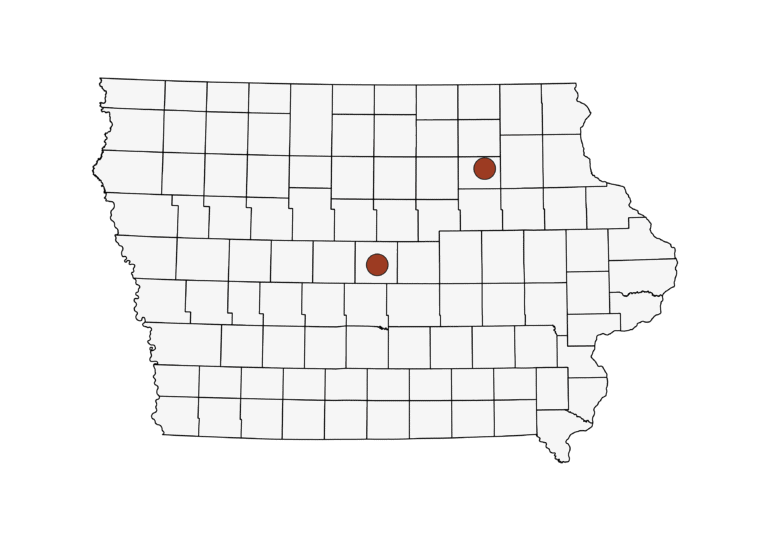
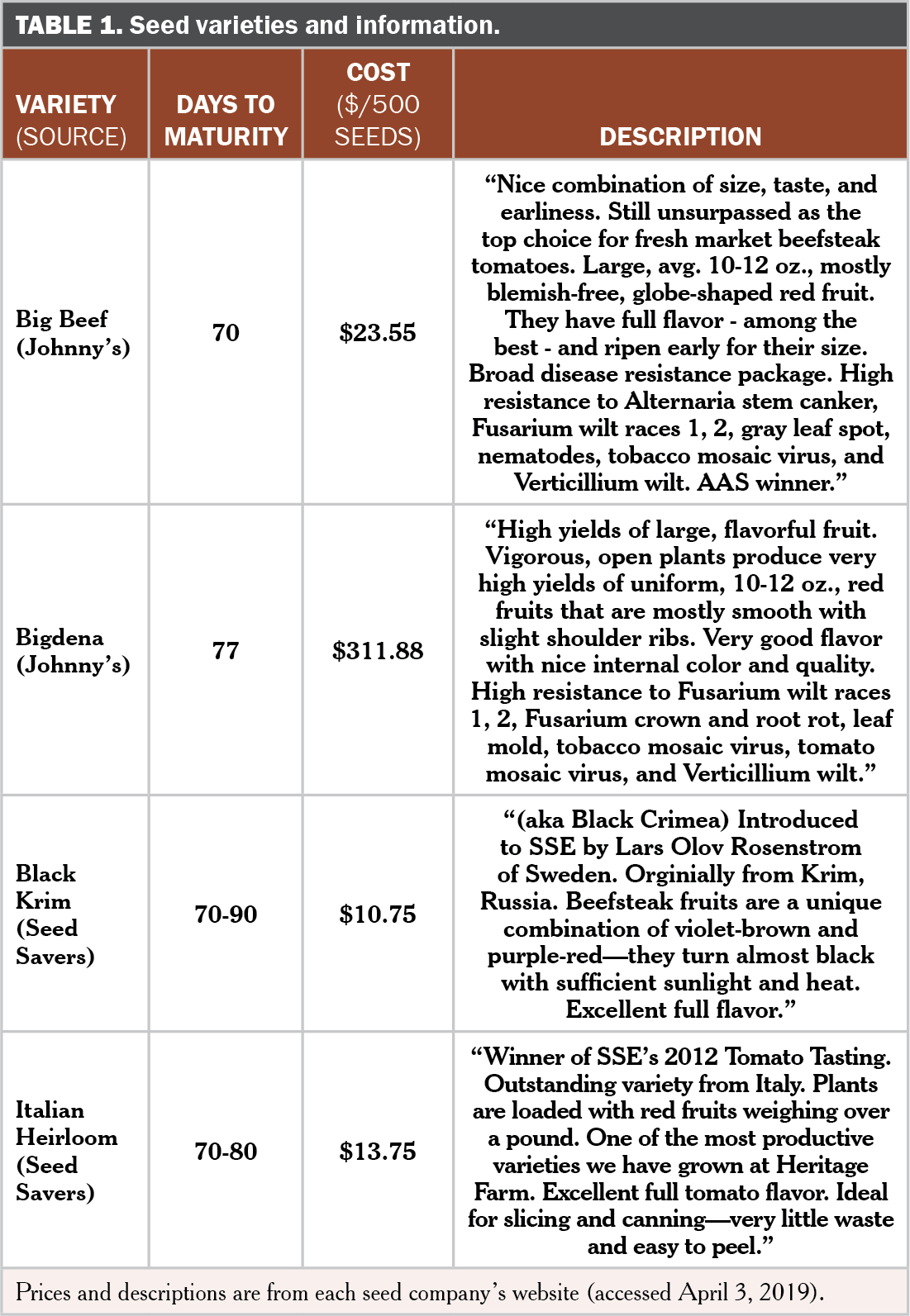
This project was conducted by farmers at two Iowa farms: Rob Faux (Genuine Faux Farm) in Tripoli and Lee Matteson and Rose Schick (Lee’s Greens) in Nevada. The farmers planted three or four replications of their preferred tomato varieties in randomized, replicated trials. Faux trialed the varieties Black Krim and Italian Heirloom, while Matteson/Schick collected their second year of data comparing Big Beef and Bigdena. Varieties were selected based on farmer preference. Seeds for this trial were from Johnny’s Seeds and Seed Savers Exchange. Catalog descriptions of the varieties are in Table 1.
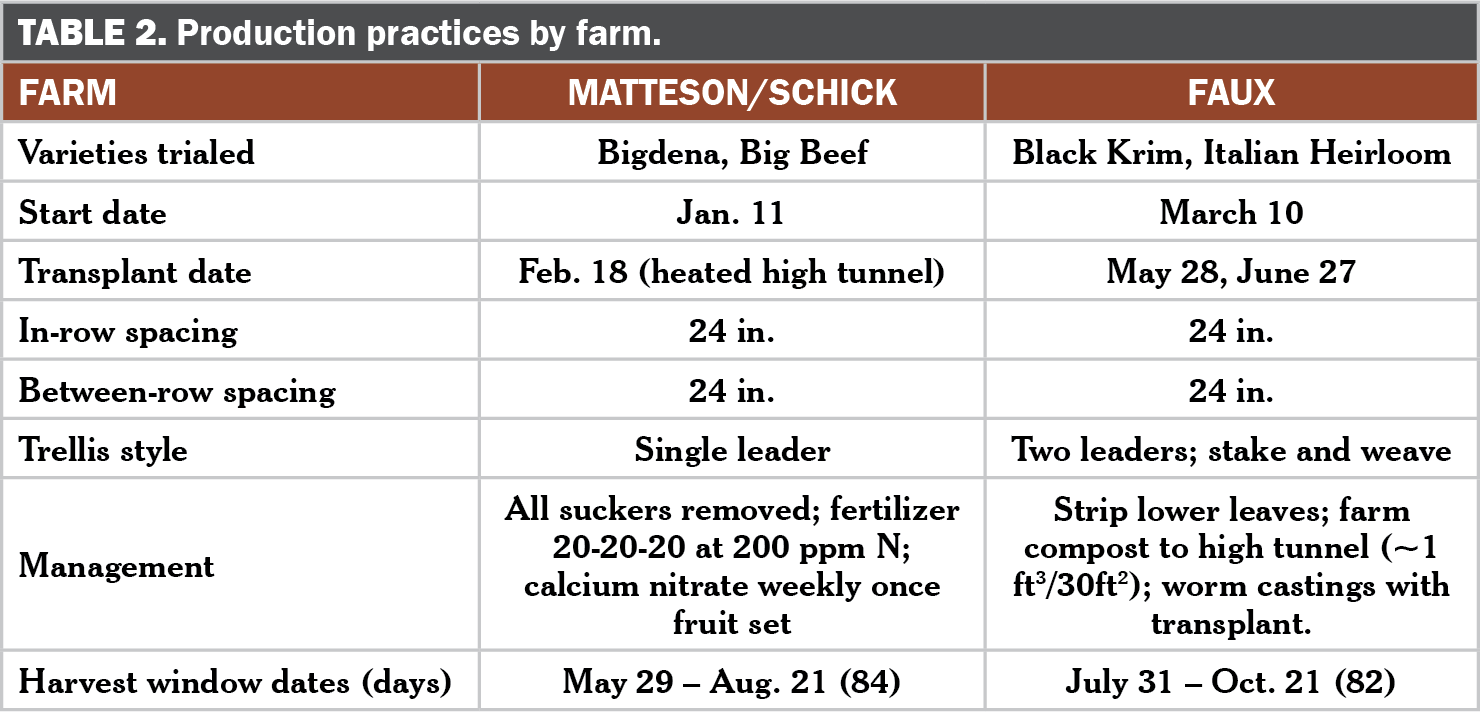
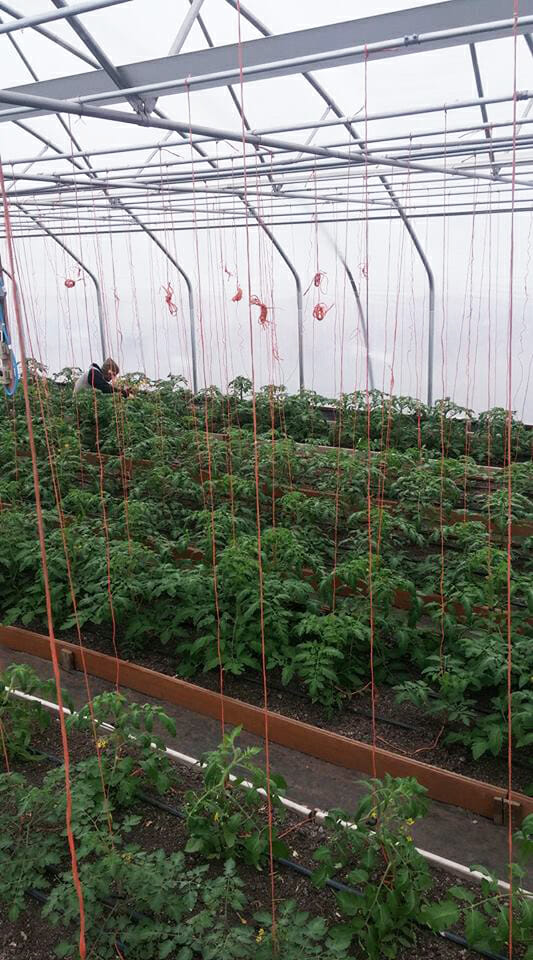
 Production practices including mulching, spacing, irrigation, planting dates and harvest dates were determined by farm and are detailed in Table 2. The number of plants per plot ranged from 16 to 20, and both farms used 24 in. by 24 in. spacing between plants. Both farms grew their own transplants, and transplanted in-ground in high tunnels; the high tunnel at Matteson/Schick was heated for early-season production.
 Farmers harvested fruit as it was mature and needed for market, counting number of fruits and weighing fruit by plot during each harvest. Data were analyzed using JMP Pro 13 (SAS Institute Inc., Cary, NC) statistical software. For Matteson/Schick, a repeated measures approach was used to examine the effects of harvest date, treatment, and their interaction on cumulative tomato yield. Due to irregular harvest dates among plots at Faux, repeated measures could not be employed. Instead, means separation among varieties was computed using Tukey’s least significant difference (LSD) to examine effects of variety on end-of-year tomato yield. Statistical significance is reported at the 90% confidence level.
Results and Discussion
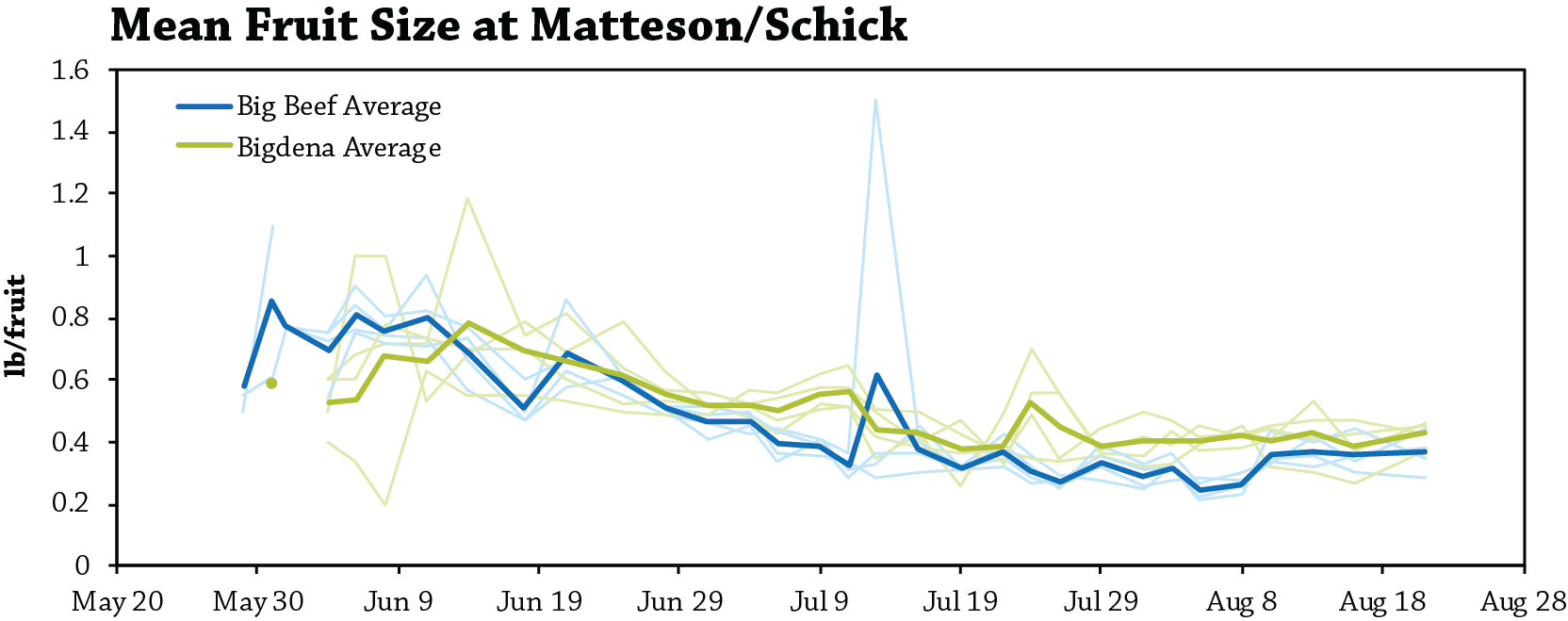
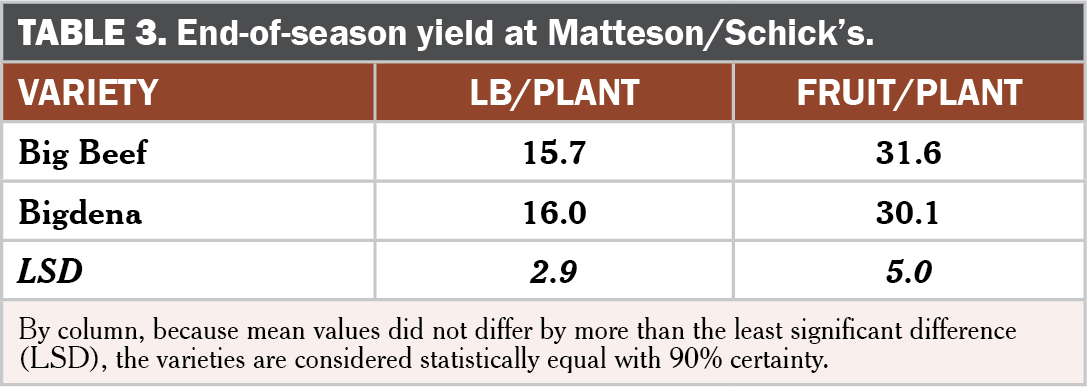
Matteson/SchickFigure 1 shows cumulative yields through the season at Matteson/Schick’s. Bold lines represent the varietal average and lighter lines show the individual plot yields. A repeated measures analysis showed that for the period of June 6 – July 9, Big Beef produced more pounds of fruit than Bigdena, but by the end of the season the production was not statistically different, with Big Beef producing and end-of-season average of 15.7 lb/plant compared to Bigdena’s 16.0 lb/plant.
 Faux
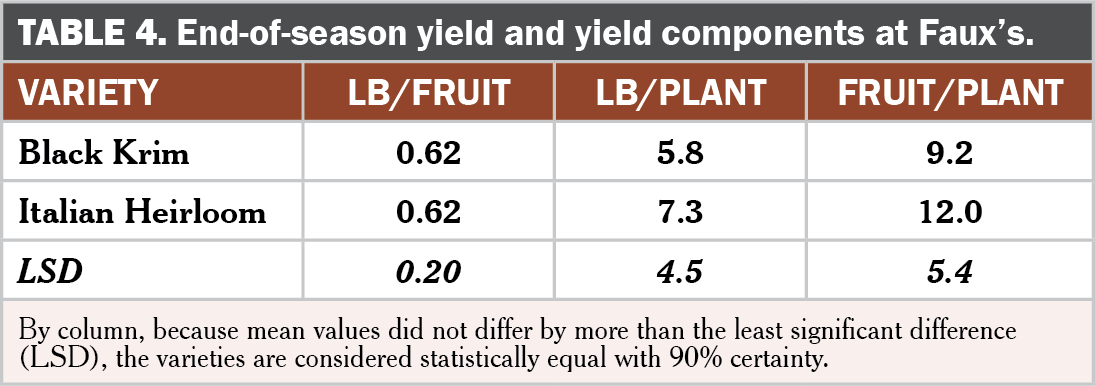
Due to irregular harvest dates among plots at Faux’s, only end-of-season values for yield characteristics are compared. Statistically, there were no significant differences in tomato yield (lb/plant or fruit/plant) or size of tomato (lb/fruit).
Faux
Due to irregular harvest dates among plots at Faux’s, only end-of-season values for yield characteristics are compared. Statistically, there were no significant differences in tomato yield (lb/plant or fruit/plant) or size of tomato (lb/fruit).
 Economic considerations
Enterprise budgets were not done for this project, but a back-of-the-envelope calculation provides some insight into the effect of seed cost on overall revenue. If all seeds purchased are successfully planted, the cost per seed (and thus, per plant) ranges from $0.02 for Black Krim to $0.62 for Bigdena. Table 5 shows the estimated revenue per plant, less seed cost, using the varietal yield at each farm.
Economic considerations
Enterprise budgets were not done for this project, but a back-of-the-envelope calculation provides some insight into the effect of seed cost on overall revenue. If all seeds purchased are successfully planted, the cost per seed (and thus, per plant) ranges from $0.02 for Black Krim to $0.62 for Bigdena. Table 5 shows the estimated revenue per plant, less seed cost, using the varietal yield at each farm.
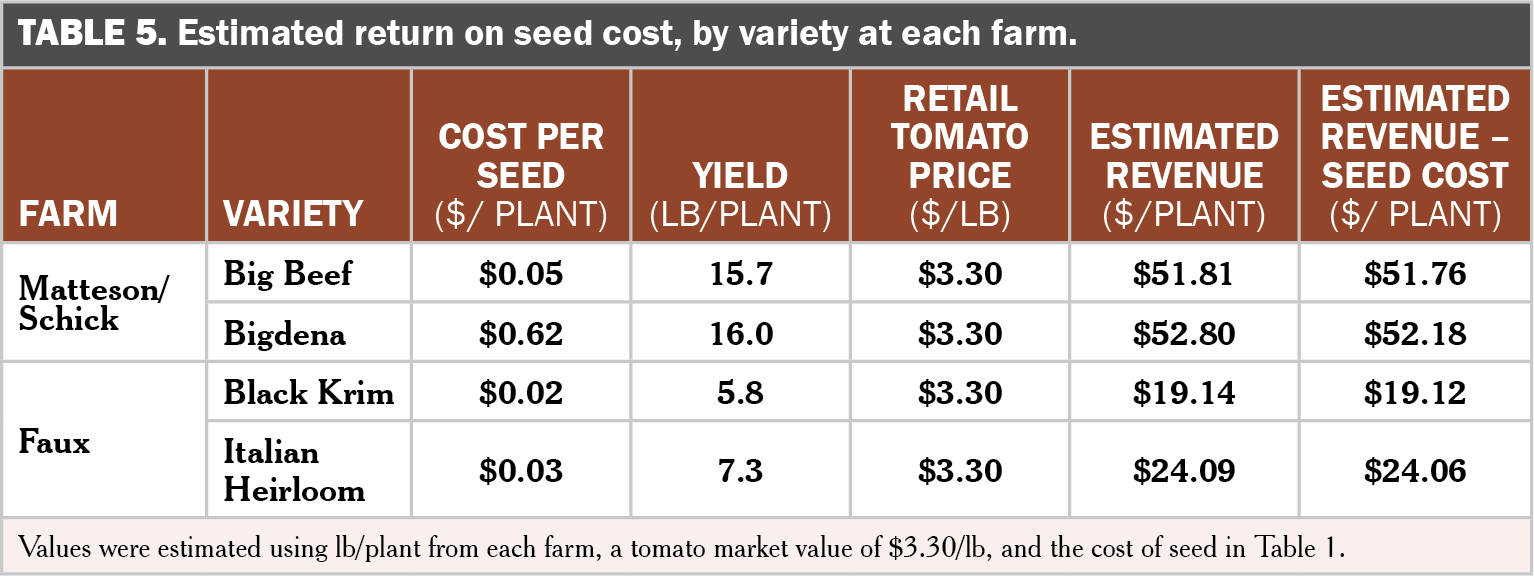 All of these are quality seeds, but Bigdena is a more expensive F1 hybrid. Though Bigdena has a higher price tag, Matteson/Schick achieved high enough yields such that seed cost equaled 1% of revenue; a small factor in production costs. However, if Bigdena seeds went unused or transplants failed, the seed cost would quickly diminish profitability.
Conclusions and Next Steps
Appendix - Weather Conditions
References
- Kolbe, L., T. Landgraf and M. Quee. 2016. Determinate Tomato in High Tunnel, Variety Trial. Practical Farmers of Iowa Cooperators’ Program. https://practicalfarmers.org/research/determinate-tomato-in-high-tunnel-variety-trial/ (accessed April 2019).
- Kolbe, L., T. Landgraf, L. Matteson, M. Quee and R. Schick. 2017. Tomato in High Tunnel, Variety Trial. Practical Farmes of Iowa Cooperators’ Program. https://practicalfarmers.org/research/tomato-in-high-tunnel-variety-trial/ (accessed April 2019).
- Iowa Environmental Mesonet. 2019. Iowa Environmental Mesonet. Iowa State University Department of Agronomy. http://mesonet.agron.iastate.edu/ (accessed March 2019).