In a Nutshell:
- Arugula is a popular crop in farmers markets and Community Supported Agriculture, but the risk of flea beetle damage is high. Emily Fagan, Hannah Breckbill and Jon Yagla tested the effects of row cover strategies on arugula quality.
- Fagan and Breckbill hypothesized that meticulously re-covering arugula between harvests would reduce damage compared to leaving plants uncovered after the first harvest. Yagla hypothesized arugula damage would be no different between treatments.
Key Findings:
- At both farms, re-covering the arugula after first harvest resulted in significantly fewer holes from flea beetle feeding.
- Fagan, Breckbill and Yagla concluded that re-covering arugula after first harvest is prudent when flea beetle pressure is heavy but may not be worth the effort when flea beetle pressure is minimal.
Background
Methods
Design
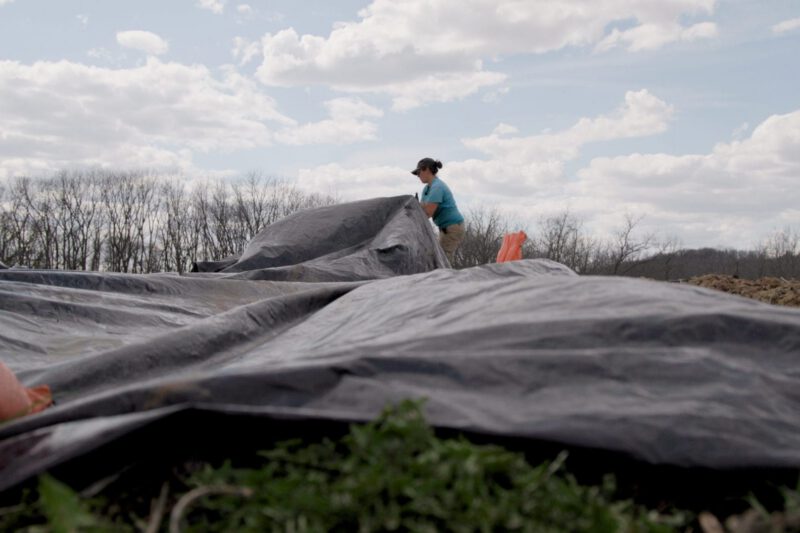
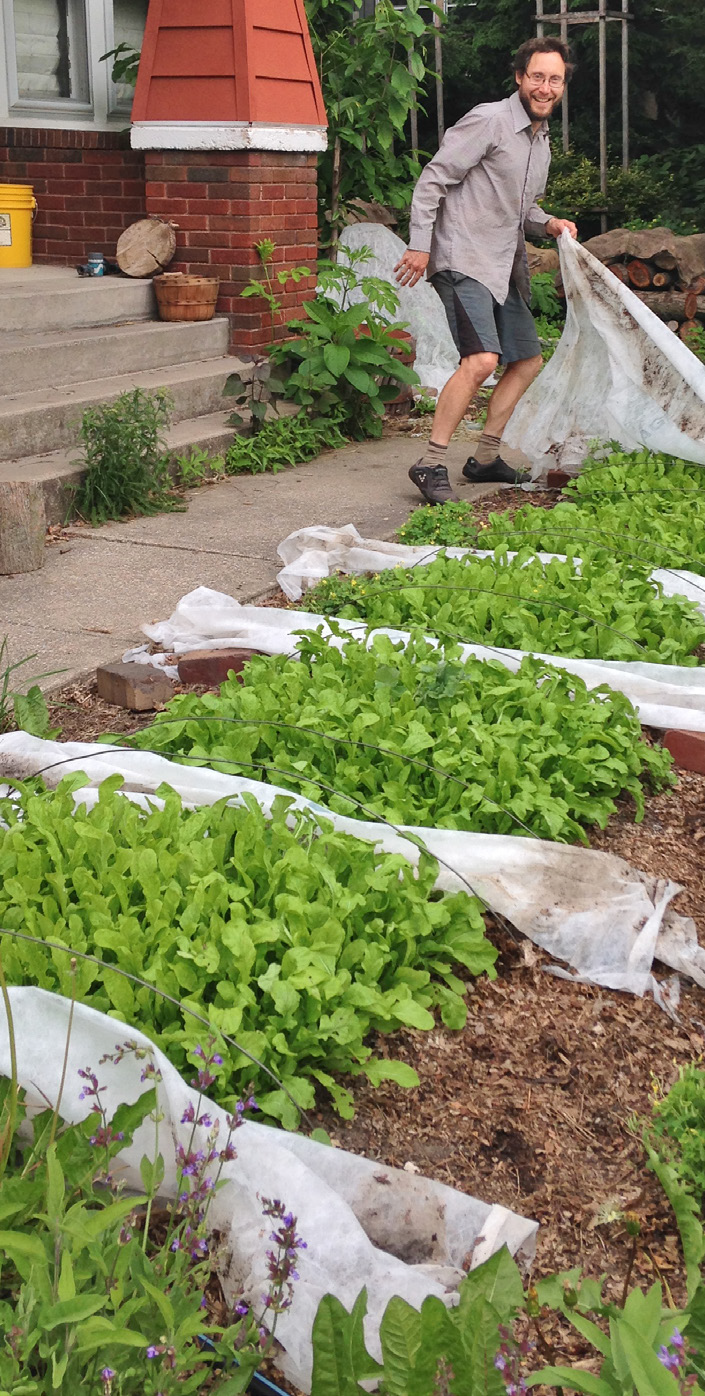
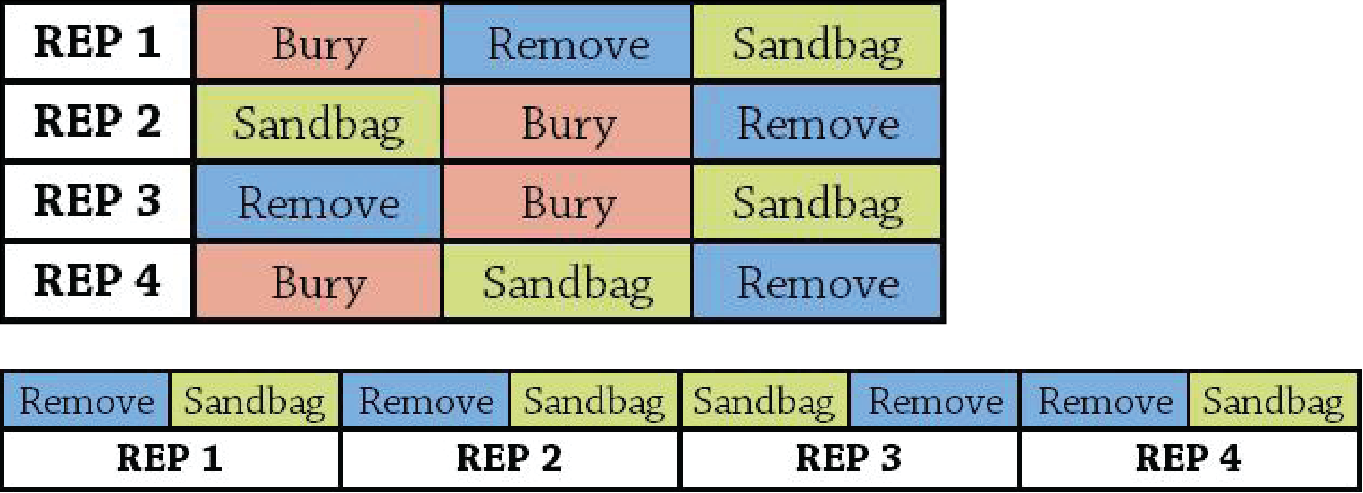
Management at each farm is detailed in Table 1. Cooperators direct-seeded arugula at the end of April and covered all plots immediately with row cover. At the time of first harvest in late May, they removed the row covers and harvested plots. After first harvest, the cooperators established treatments by leaving plants permanently uncovered in some plots (‘remove’) and re-covering plants in other plots then securing the row cover with sandbags or other weighted material (‘sandbag’). Breckbill and Fagan included an additional treatment in which they replaced row covers in some plots but secured the edges by burying them with soil (‘bury’). Cooperators replicated each treatment four times for a total of 8 plots (2 treatments × 4 reps) at Yagla’s and 12 plots (3 treatments × 4 reps) at Breckbill and Fagan’s (Figure A1). They assigned treatments randomly to single plots in each replication.
 Measurements
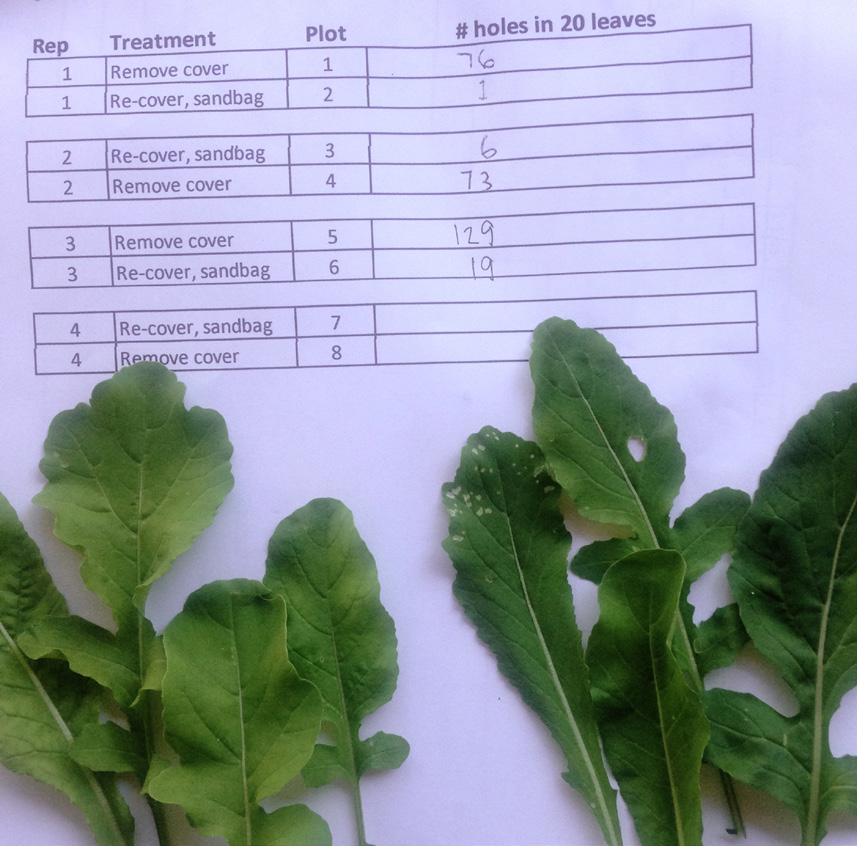
To measure arugula quality, cooperators counted the number of holes in 20 leaves collected from each plot during the final harvest (Table 1).
Measurements
To measure arugula quality, cooperators counted the number of holes in 20 leaves collected from each plot during the final harvest (Table 1).

Results and Discussions
Arugula quality
Results for Breckbill and Fagan confirm their hypothesis. Arugula quality was superior in their ‘bury’ treatment, as evidenced by significantly fewer holes per leaf than both other treatments (Figure 1A). Arugula in the ‘remove’ treatment experienced significantly more holes per leaf than the ‘sandbag’ and ‘bury’ treatments. Yagla hypothesized arugula quality would be similar between both treatments at his farm, but his data align with Breckbill and Fagan’s and show that re-covering plants after the first harvest (‘sandbag’) resulted in significantly fewer holes per leaf than leaving plants uncovered (Figure 1B).
Flea beetle pressure at Yagla’s was much lower than at Breckbill and Fagan’s. Even though arugula in his ‘sandbag’ treatment had greater damage, Yagla considered it still to be of very high quality and marketability. At Breckbill and Fagan’s, no arugula harvested from their ‘remove’ treatment was marketable.

Conclusions and Next Steps
Appendix - Trail Design and Weather Conditions

References
- Mahr, S. Arugula, Eruca sativa. University of Wisconsin-Madison Division of Extension. https://hort.extension.wisc.edu/articles/arugula/ (accessed August 2021).
- Delahaut, K. 2005. Flea Beetles. XHT1106. University of Wisconsin Garden Facts. University of Wisconsin-Extension.
- Brockman, R., R. Kuesel, K. Archer, K. O’Hearn, N. Wilson, D. Scott, M. Williams, R. Bessin and D. Gonthier. 2020. The Impact of Plant Essential Oils and Fine Mesh Row Covers on Flea Beetle (Chrysomelidae) Management in Brassicaceous Greens Production. Insects. 11:1–16. https://www.ncbi.nlm.nih.gov/pmc/articles/PMC7603271/ (accessed August 2021).
- Iowa Environmental Mesonet. 2021. IEM “Climodat” Reports. Iowa State University Department of Agronomy. https://mesonet.agron.iastate.edu/climodat/ (accessed August 2021).