Background
Methods
Both farms planted a six-species cover crop mix which included brassica, legume and grass species on no-till corn and soybean fields that had never been planted with cover crop prior.
Cover crops were either aerially applied in September or dilled in October each year from 2015 to 2017. Farmers grazed cover crops with cattle as forage was available and as weather allowed; stocking densities, stocking rates and timing of grazing periods varied. Cattle were fenced into cover crop fields using temporary, high-tensile, electrified fence. Water was provided in mobile troughs and supplemental hay was fed when needed.

Results and Discussion
Soil compaction
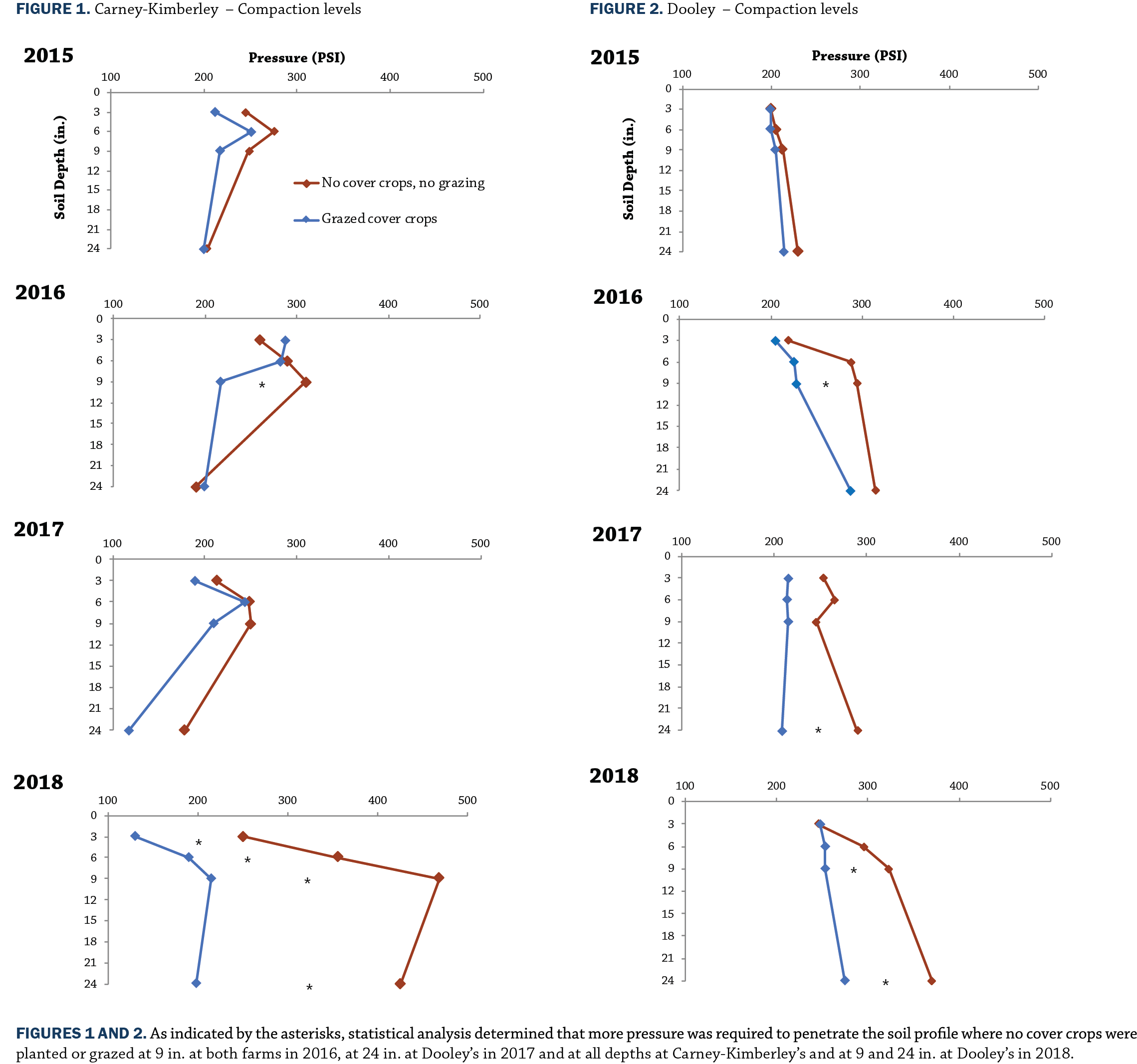
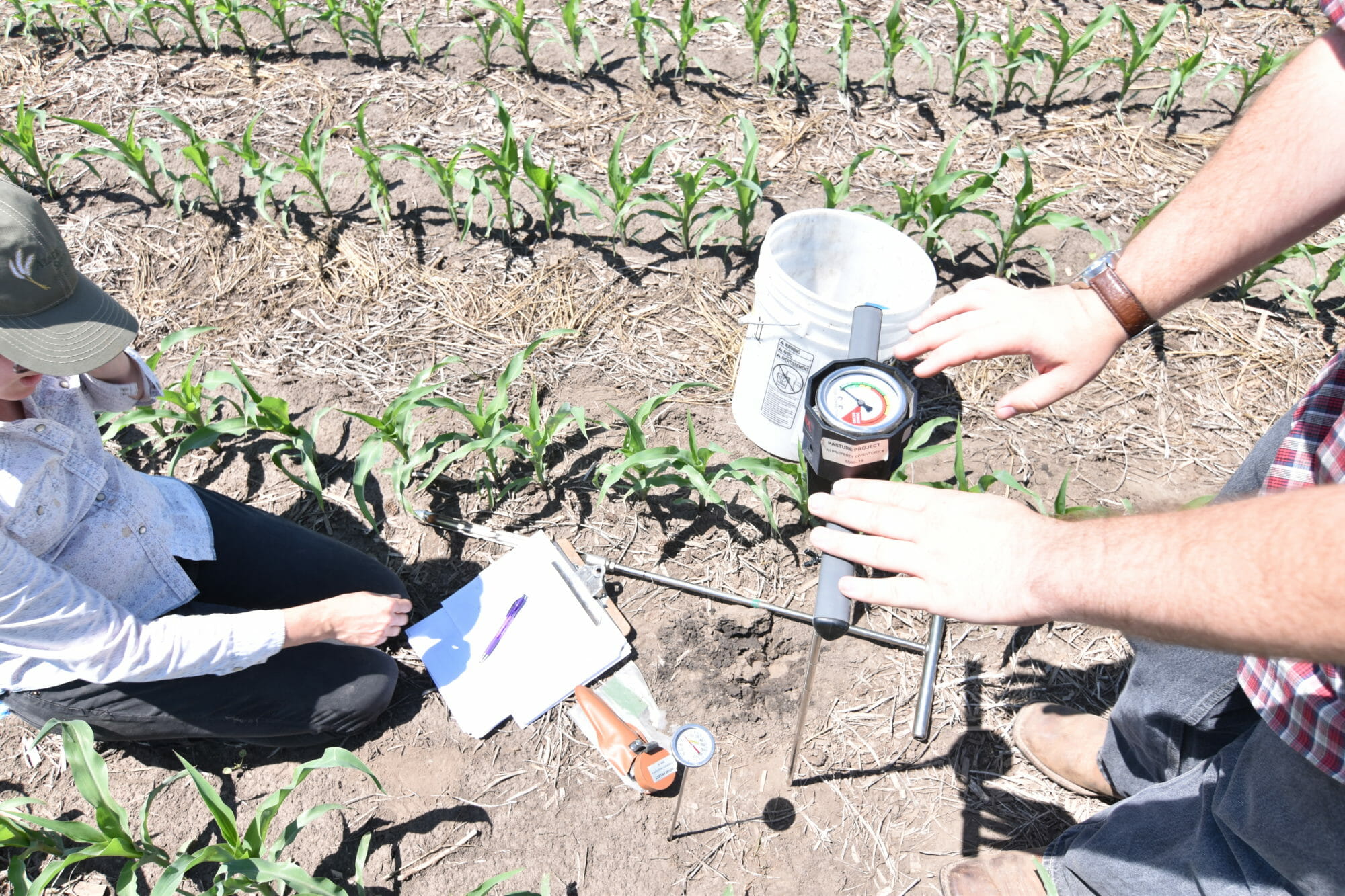
At both locations, four years of data show that grazing cover crops did not contribute to soil compaction in row crop fields (Figures 1 and 2). Baseline penetrometer readings were taken in 2015, showing both sets of fields at Carney’s and Dooley’s started with similar compaction levels. As the study progressed, compaction increased in the fields without cover crops or grazing. Compaction did not increase in the fields with cover crops that were grazed. As indicated by the asterisks in the figures, by 2018, statistical analysis determined higher levels of soil compaction where no cover crops were planted or grazed at all depths at Carney’s (Figure 1) and at 9 and 24 in. at Dooley’s (Figure 2). Dooley commented, “To begin with I was a little concerned that cows’ hooves would cause some compaction, but according to these results, it looks like that isn’t the case because the cover crops mitigate any issues the cows are causing.”
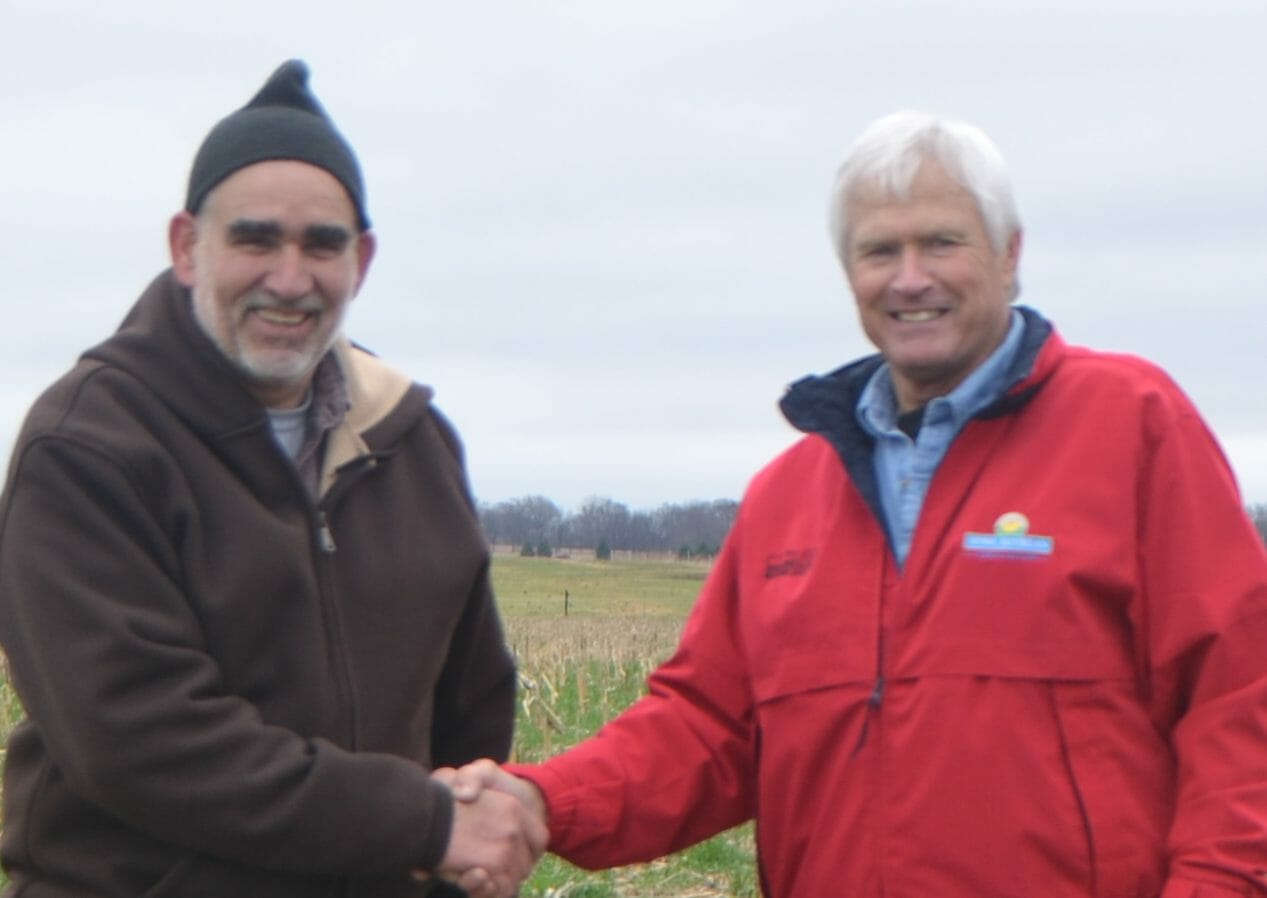
 Under Carney and Kimberley’s contract grazing agreement, best management practices were employed in order to avoid compaction. Bruce explained, “Rick’s biggest concern is compaction. Our deal is if it gets too wet, I move my cows off. If we get a half inch of rain or more, I usually move cows back onto my farm for a day, let it soak in and then go back out. That’s part of the conversation you’ve got to have. It has to work for everybody.”
Cover crop grazing days and animal units
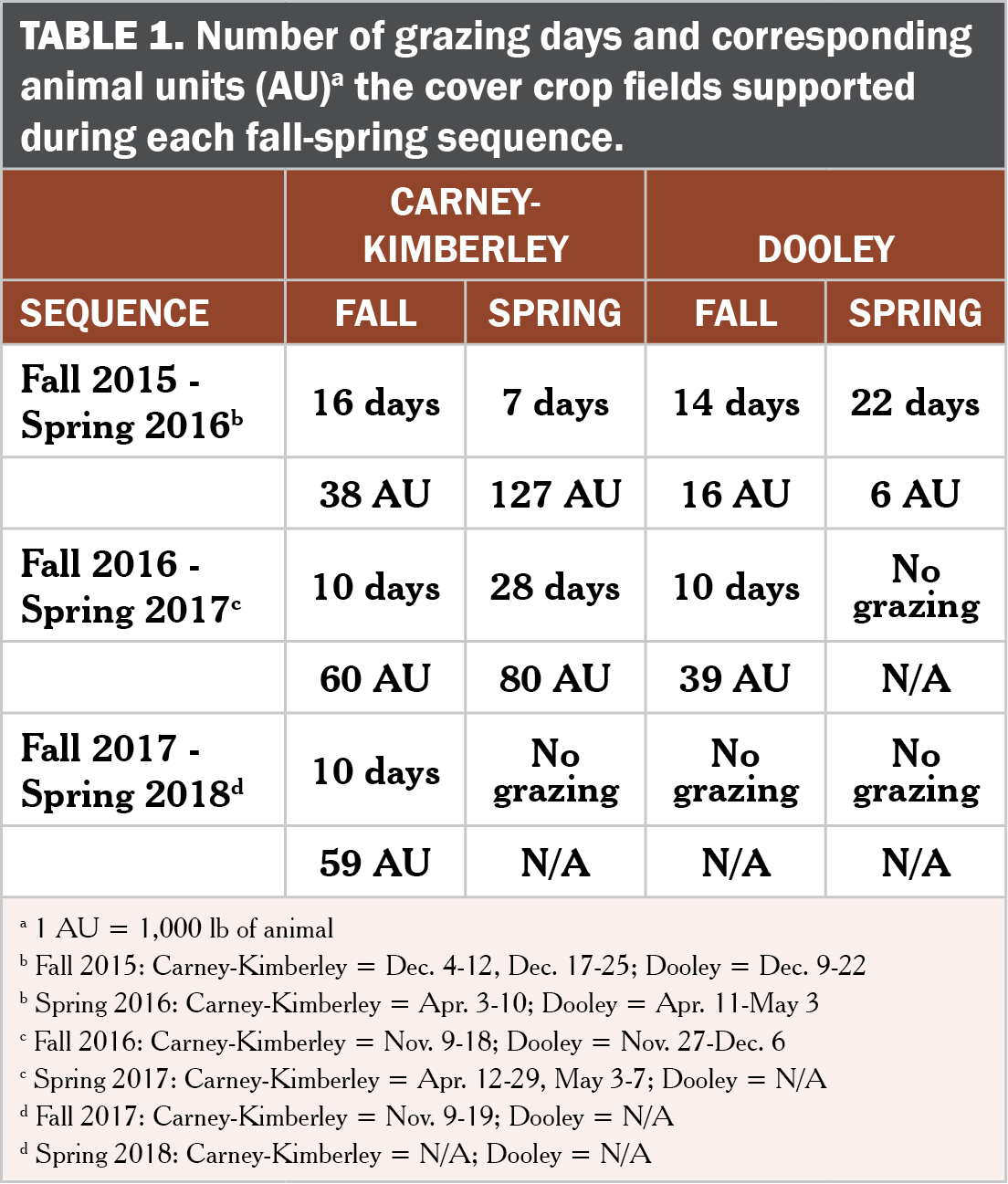
Cover crop grazing took place on cover crop (treatment) fields for a varying number of days each fall and spring over the course of the study (Table 1). While grazing cover crops, cattle had access to crop residue and were supplemented with hay as needed. In some years, cover crops were not grazed due to weather and soil conditions.
Under Carney and Kimberley’s contract grazing agreement, best management practices were employed in order to avoid compaction. Bruce explained, “Rick’s biggest concern is compaction. Our deal is if it gets too wet, I move my cows off. If we get a half inch of rain or more, I usually move cows back onto my farm for a day, let it soak in and then go back out. That’s part of the conversation you’ve got to have. It has to work for everybody.”
Cover crop grazing days and animal units
Cover crop grazing took place on cover crop (treatment) fields for a varying number of days each fall and spring over the course of the study (Table 1). While grazing cover crops, cattle had access to crop residue and were supplemented with hay as needed. In some years, cover crops were not grazed due to weather and soil conditions.
 Crop yields
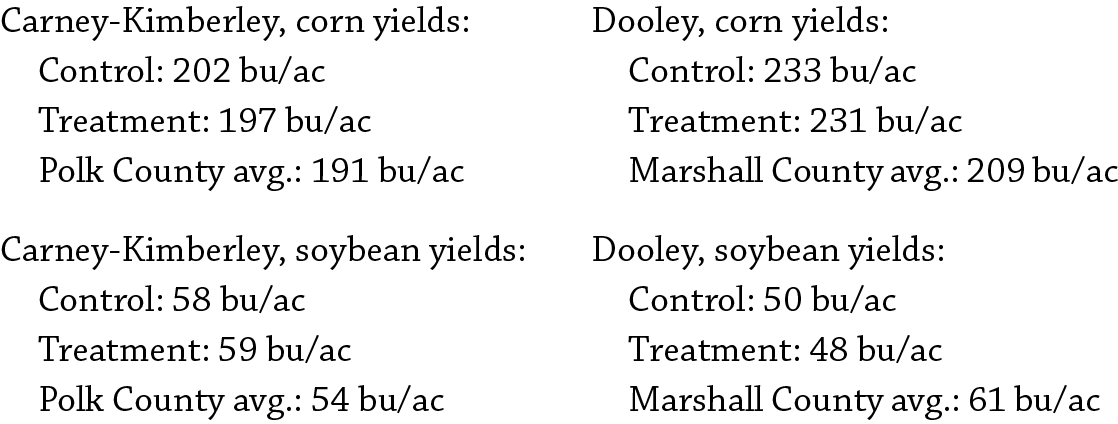
This project was not designed to specifically test the effect of grazing cover crops on corn and soybean yields. Average corn and soybean yields from the fields involved at both farms over the course of the study as well as the associated five-year county averages[5] are shown below. However, bulk harvesting of fields at both farms precluded statistical analysis (no replications) and prevented scientific comparisons of the yields between control and treatment.
Crop yields
This project was not designed to specifically test the effect of grazing cover crops on corn and soybean yields. Average corn and soybean yields from the fields involved at both farms over the course of the study as well as the associated five-year county averages[5] are shown below. However, bulk harvesting of fields at both farms precluded statistical analysis (no replications) and prevented scientific comparisons of the yields between control and treatment.
Conclusions and Next Steps
In this study, Carney, Kimberley and Dooley compared soil compaction levels in row crop fields where no cover crops were planted with fields where cover crops were planted and grazed by cattle. The farmers had prior experience planting and grazing cover crops and employed proper grazing management practices, such as avoiding excessive grazing during wet and muddy conditions.


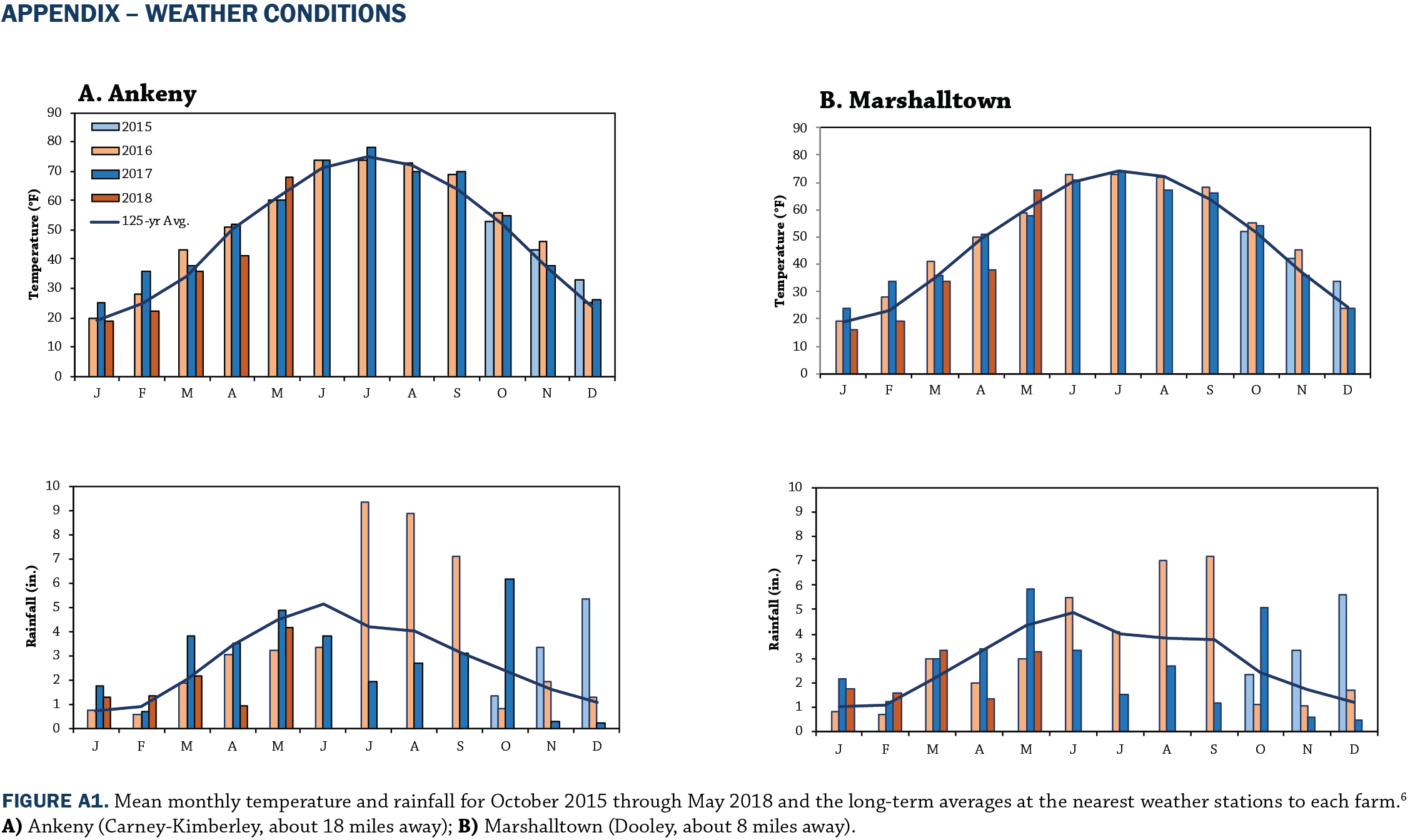
Appendix - Weather Conditions
References
- Hamza, M.A. and W.K. Anderson. 2005. Soil compaction in cropping systems A review of the nature, causes and possible solutions. Soil and Tillage Research. 82:121–145. http://beyondagronomy.com/cmsFiles/documents/document576af26740b85.pdf (accessed July 2019).
- Tracy, B.F. and Y. Zhang. 2008. Soil compaction, corn yield response, and soil nutrient pool dynamics within an integrated crop-livestock system in Illinois. Crop Science. 48:1211–1218.
- Franzluebbers, A.J. and J.A. Stuedemann. 2008. Soil physical responses to cattle grazing cover crops under conventional and no tillage in the Southern Piedmont USA. Soil and Tillage Research. 100:141–153.
- Grazing Cover Crops to Avoid Soil Compaction. https://practicalfarmers.org/farmer-knowledge/research-reports/2014/grazing-cover-crops-corn-ground/ (accessed July 2019).
- US Department of Agriculture-National Agricultural Statistics Service. 2019. Quick stats. USDA-National Agricultural Statistics Service, Washington, DC. http://quickstats.nass.usda.gov/ (accessed July 2019).
- Iowa Environmental Mesonet. 2019. Climodat Reports. Iowa State University. http://mesonet.agron.iastate.edu/climodat/ (accessed July 2019).