In a Nutshell:
- Organic soybean producers are interested in strategies to reduce tillage and control weeds following years during which fall conditions prevent implementation of weed control measures.
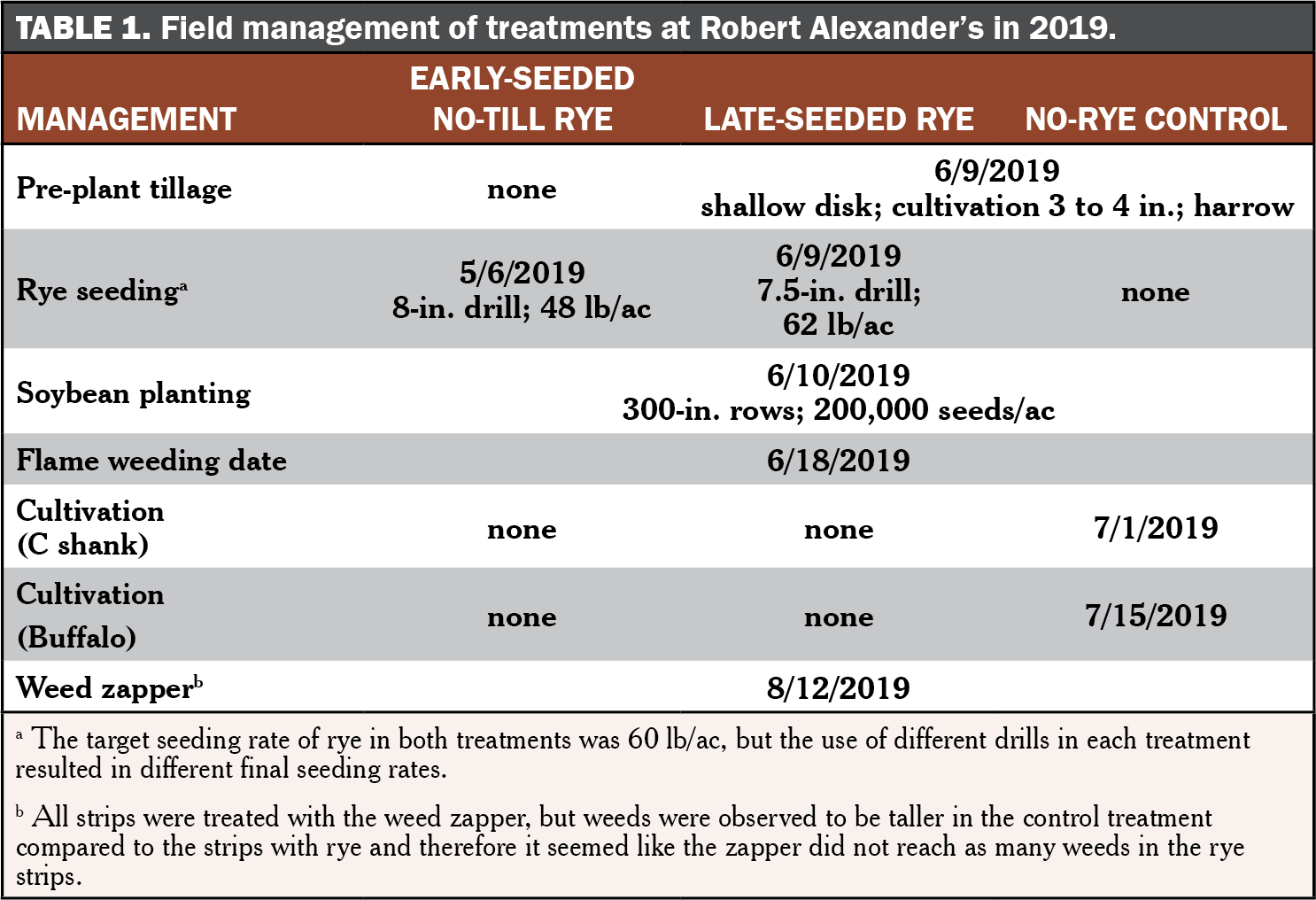
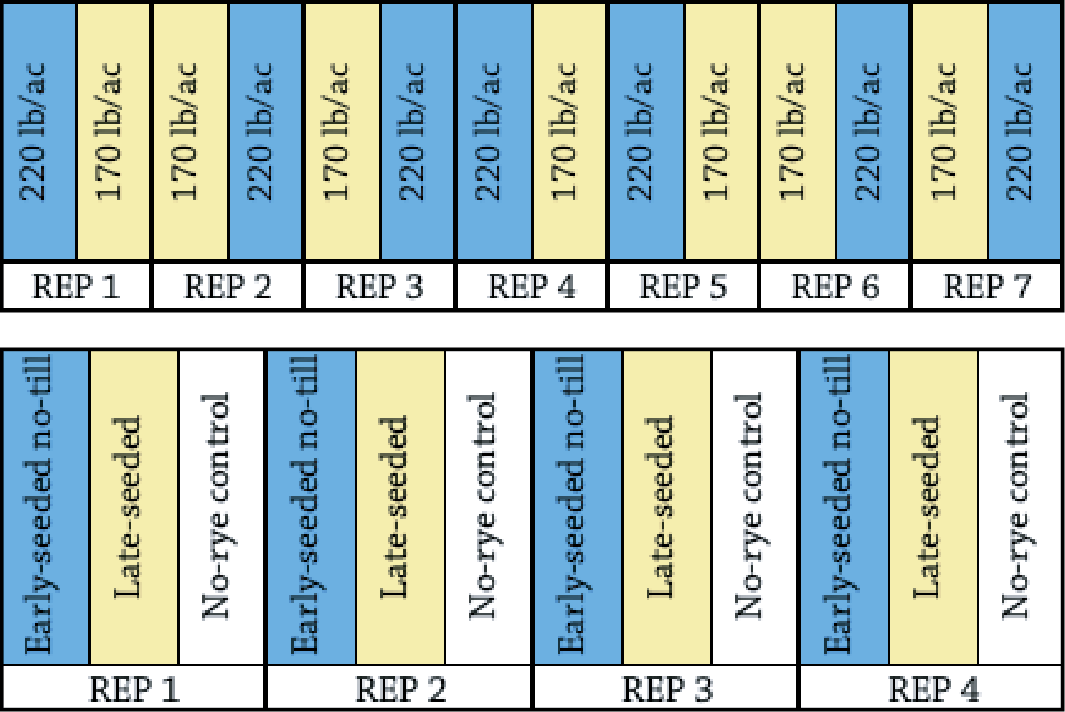
- Margaret Smith and Doug Alert investigated the effects of spring-seeding cereal rye at two different rates. Robert Alexander investigated the effects of spring-seeded cereal rye by comparing two weed management systems – early-seeded no-till cereal rye and late-seeded cereal rye – with a no-rye control.
Key Findings:
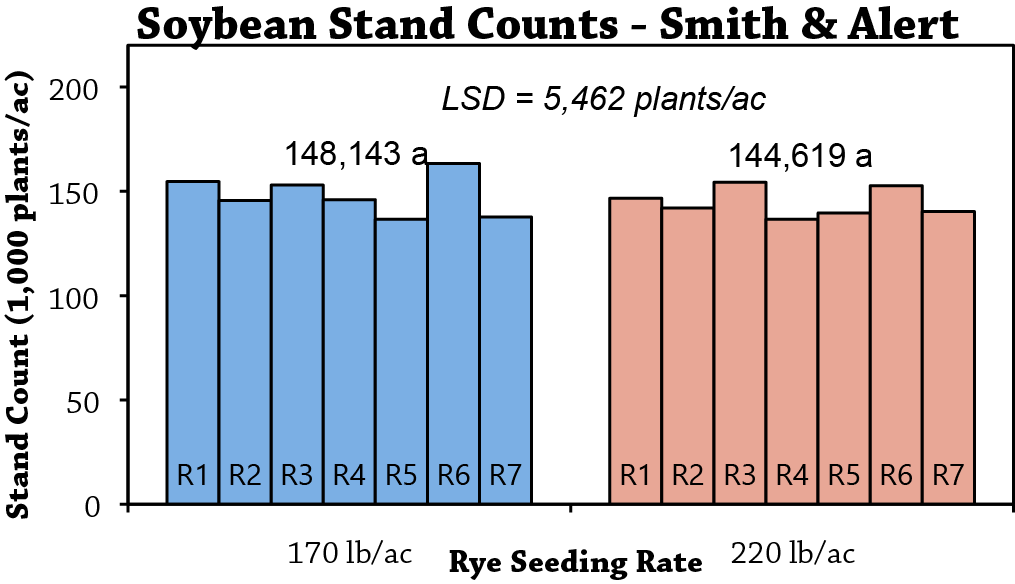
- Soybean yield, soybean stand counts and weed and cereal rye biomass were statistically similar between seeding rate treatments at Smith and Alert’s, but both treatments resulted in very low soybean yields and poor control of grass weeds, which necessitated cultivation.
- Soybean yields at Alexander’s were statistically similar among weed management systems, but the return on investment was least in the early-seeded no-till rye treatment ($648.75/ac), intermediate in the late-seeded rye treatment ($691.14/ac) and greatest in the no-rye control ($878.13/ac).
- While Smith & Alert were disappointed in soybean yields and weed control, Alexander was pleased to minimize tillage in the early-seeded rye strips without sacrificing yield and plans to continue the practice on acres with less grass weed pressure.
Background
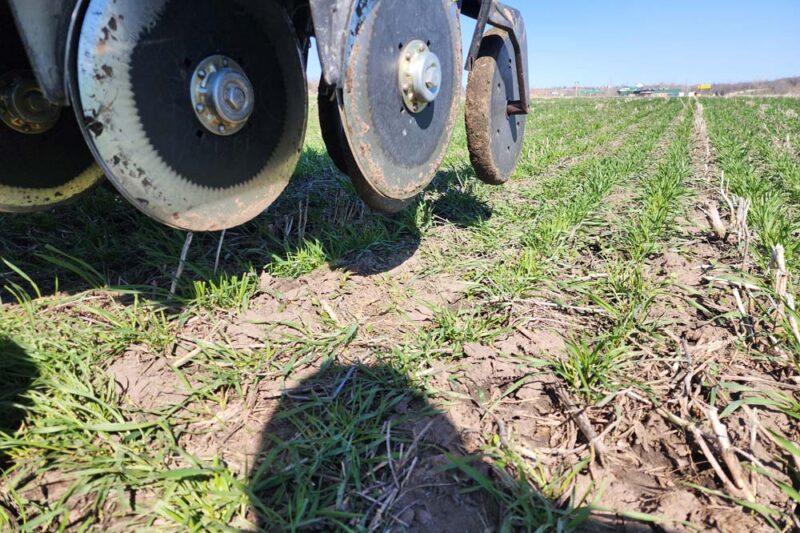
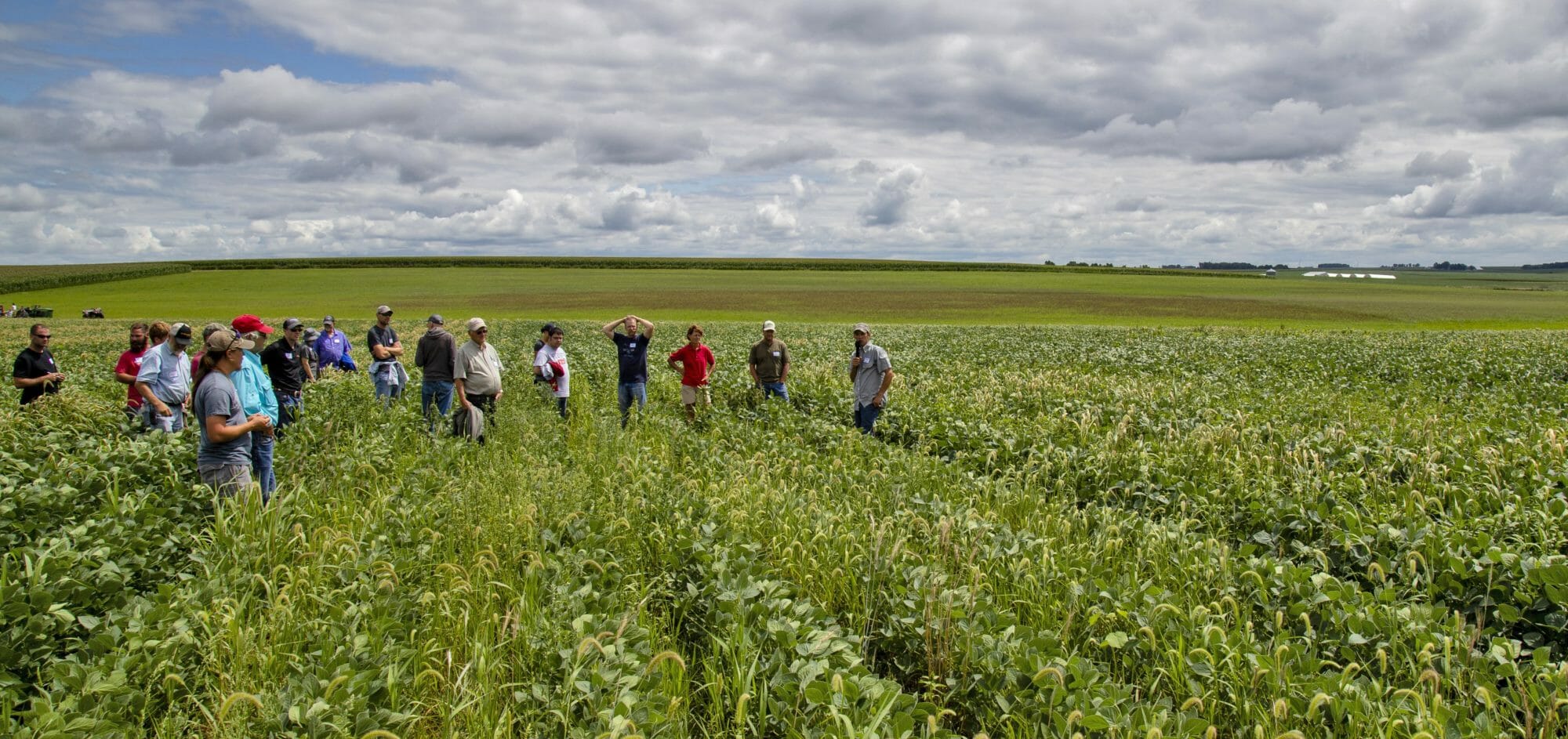
Spring-seeding cereal rye in soybeans is an appealing idea for organic row-crop producers who, due to weather or other uncontrollable circumstances, may be prevented from fall-seeding a cover crop for spring weed control. The practice appealed to Margaret Smith and Doug Alert as a means to improve weed control when conditions in June prevent them from building ridges in corn where soybeans will follow in their rotation. It appealed to Robert Alexander as a means to reduce tillage in his organic soybeans while also keeping the soil covered. Smith and Alert had heard about ongoing research documenting a rye seeding rate of 2 million seeds/ac and wondered if increasing that rate to 2.5 million seeds/ac would improve weed suppression. They hoped to determine which of the 2 seeding rates – 2 million seeds/ac or 2.5 million seeds/ac – would provide the best weed control with maximum profitability. Robert Alexander wanted to determine the best seeding date on his farm – the same date of planting soybean or approximately 1 month prior to planting soybean.
Methods
Spring seeding rates
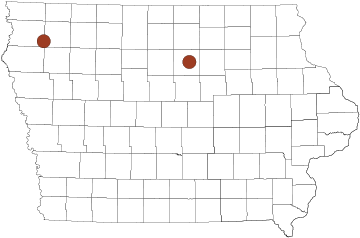
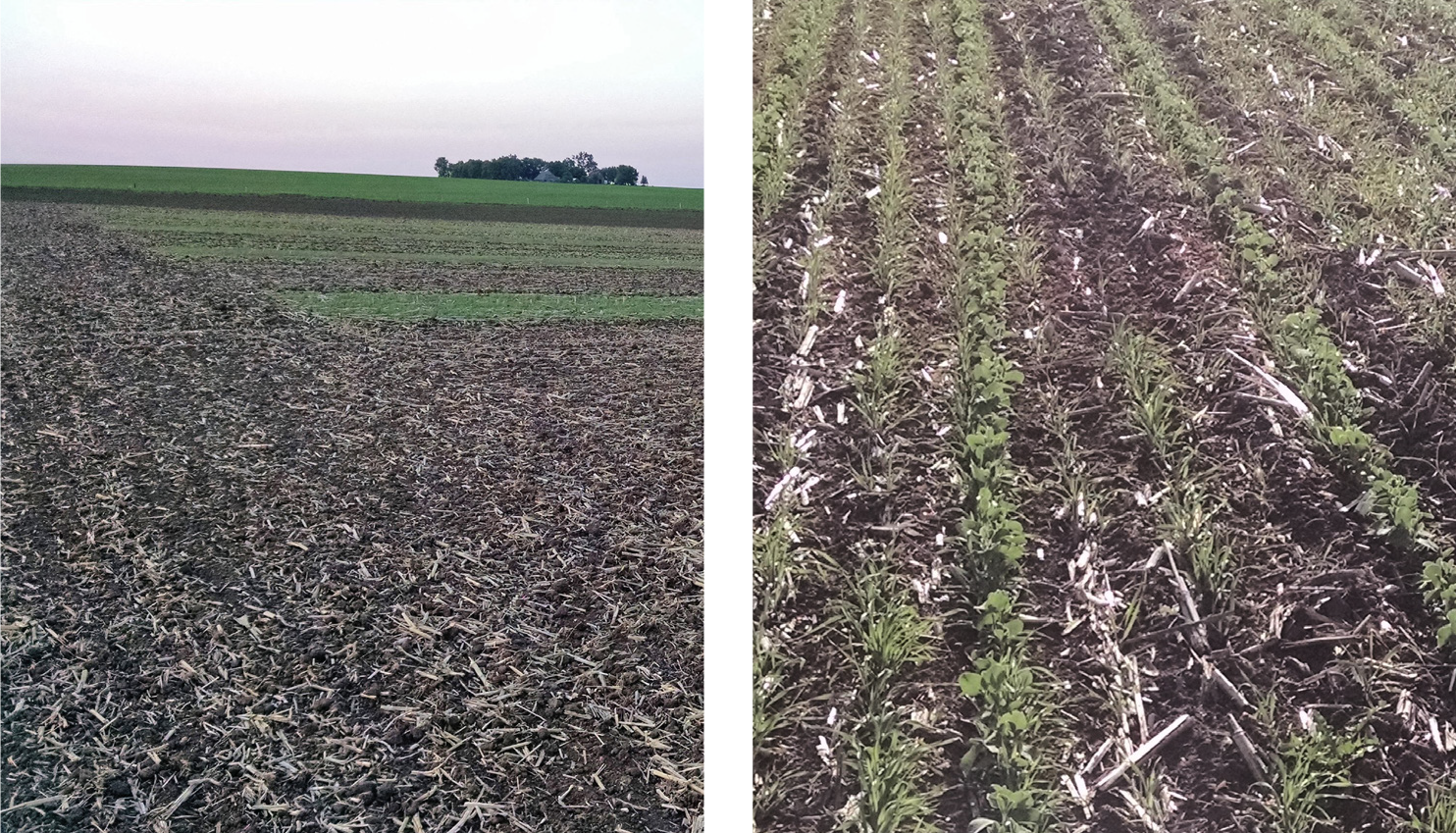
Margaret Smith and Doug Alert’s soybean crop followed corn, with no fall tillage. Spring weed control preceding the start of this experiment included disking on May 16, 2019, followed by a field finisher pass on June 7. Soybeans were planted on June 8 in 30-in. row spacing at a population of 180,000 seeds/ac. Treatment strips were established the same day by drilling rye immediately after planting soybeans but at a shallower depth and in 7.5-in. row spacing. Treatments consisted of two seeding rates of rye – 170 lb/ac (1,965,880 seeds/ac) and 220 lb/ac (2,544,080 seeds/ac). Treatments were arranged in a randomized complete block design with each treatment randomly assigned to one strip per block. Blocks were replicated seven times for a total of 14 strips, and strips measured 1,104 ft by 15 ft (0.38 ac). Subsequent weed control included row cultivation with cut away disks and a single sweep on July 15 and July 20 in all strips.
 Measurements
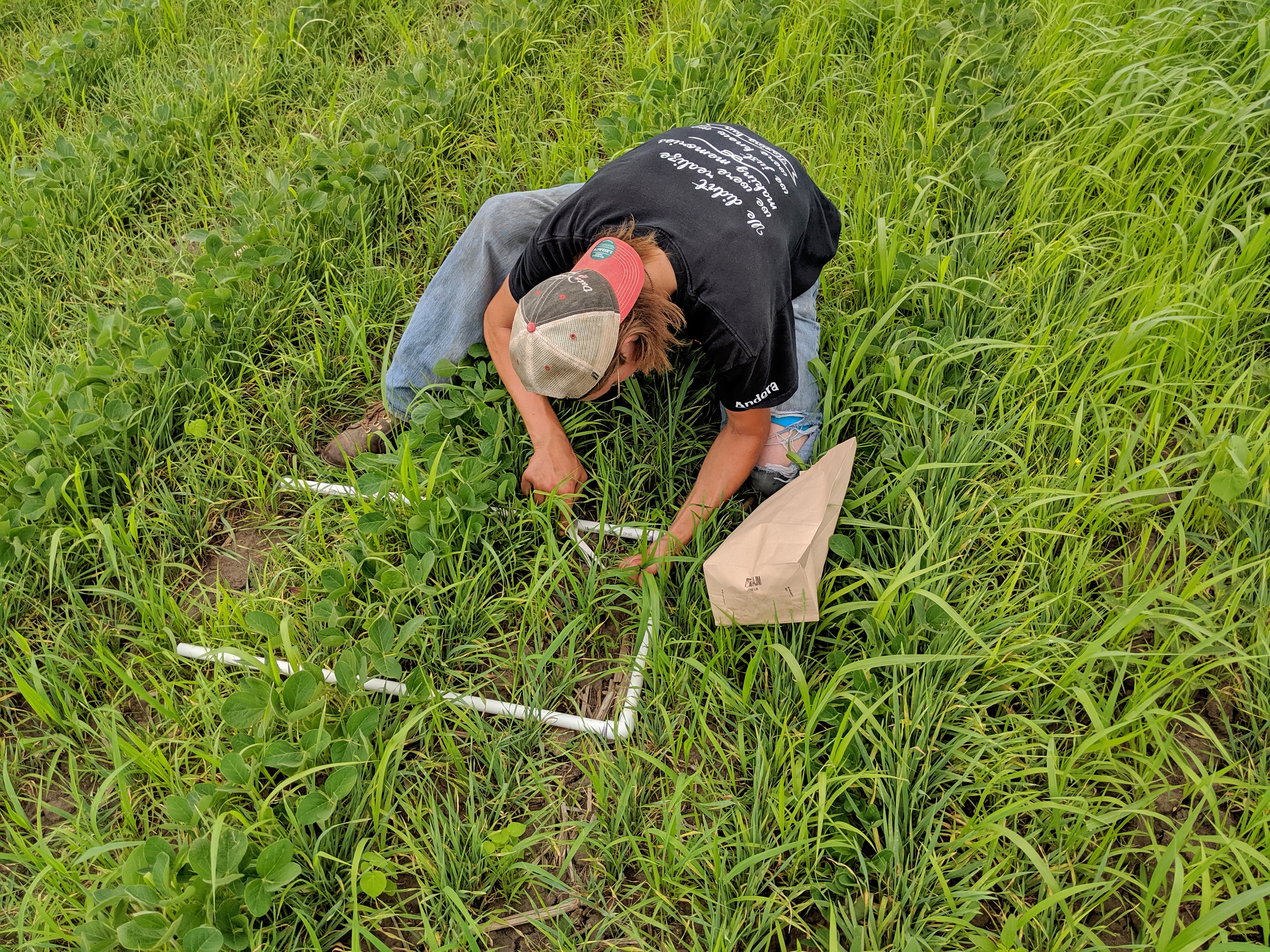
Cereal rye and weed biomass were collected at Smith and Alert’s on July 15, prior to cultivation on July 15 and July 20. Biomass was sampled by randomly placing three quadrats (30 in. by 15 in.) in each strip and clipping the non-soybean plant matter at the soil line. Biomass was separated into weeds and cereal rye then dried and weighed.
Soybeans were harvested in each strip at Smith and Alert’s on Oct. 18 and at Robert Alexander’s on Oct. 28. Yields were recorded for each strip and adjusted to standard moisture.
Soybean stand counts were carried out at Smith and Alert’s on Oct. 19, one day after harvesting soybeans.
Measurements
Cereal rye and weed biomass were collected at Smith and Alert’s on July 15, prior to cultivation on July 15 and July 20. Biomass was sampled by randomly placing three quadrats (30 in. by 15 in.) in each strip and clipping the non-soybean plant matter at the soil line. Biomass was separated into weeds and cereal rye then dried and weighed.
Soybeans were harvested in each strip at Smith and Alert’s on Oct. 18 and at Robert Alexander’s on Oct. 28. Yields were recorded for each strip and adjusted to standard moisture.
Soybean stand counts were carried out at Smith and Alert’s on Oct. 19, one day after harvesting soybeans.
Results and Discussion
Rye biomass and weed pressure
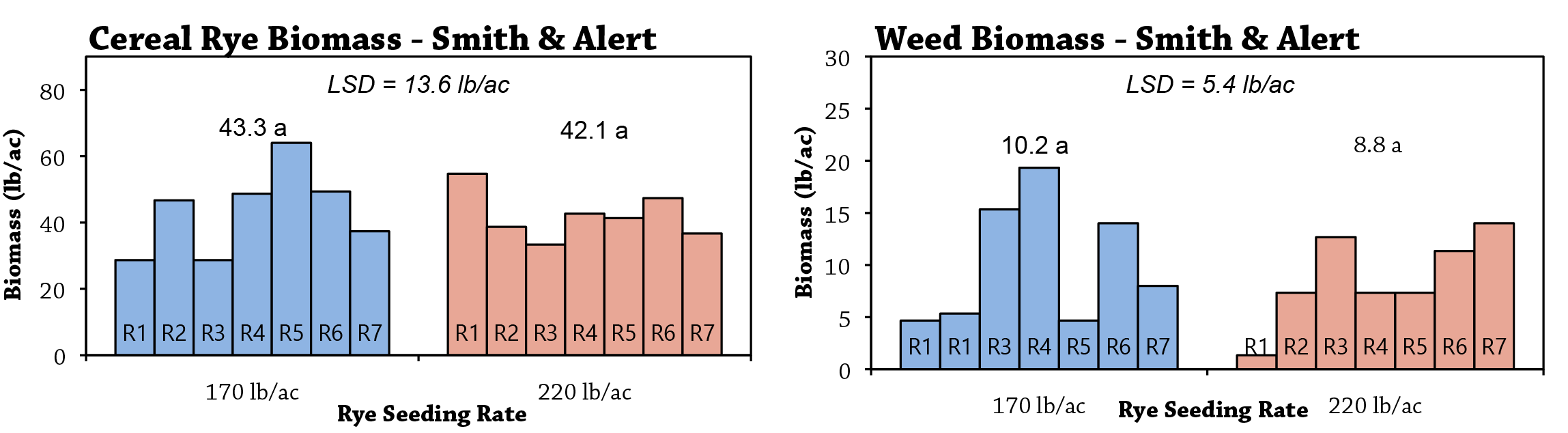
The seeding rate of cereal rye had no impact on rye biomass or weed biomass at Smith and Alert’s (Figure 1). Average rye biomass measured 43.3 lb/ac in the strips with rye seeded at the low rate and 42.1 lb/ac in the strips seeded with the high rate. Average weed biomass in the strips seeded at the high and low rate measured 10.2 lb/ac and 8.8 lb/ac, respectively. Though these weed biomass measurements were low on the July 15 sampling date, grassy weeds grew rapidly after that date. As noted by Smith and Alert, neither treatment provided satisfactory grass weed control. High weed pressure necessitated cultivation of all plots on July 15 and on July 20. Predominant weeds observed at Smith and Alert’s included foxtail with some lady’s thumb smartweed, velvet leaf and common ragweed.
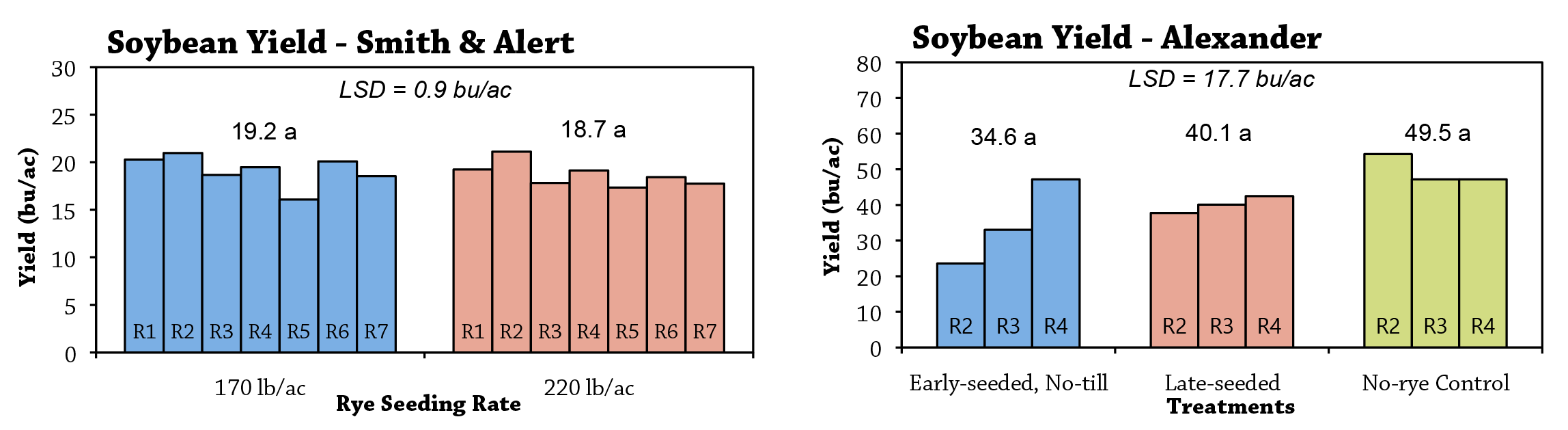
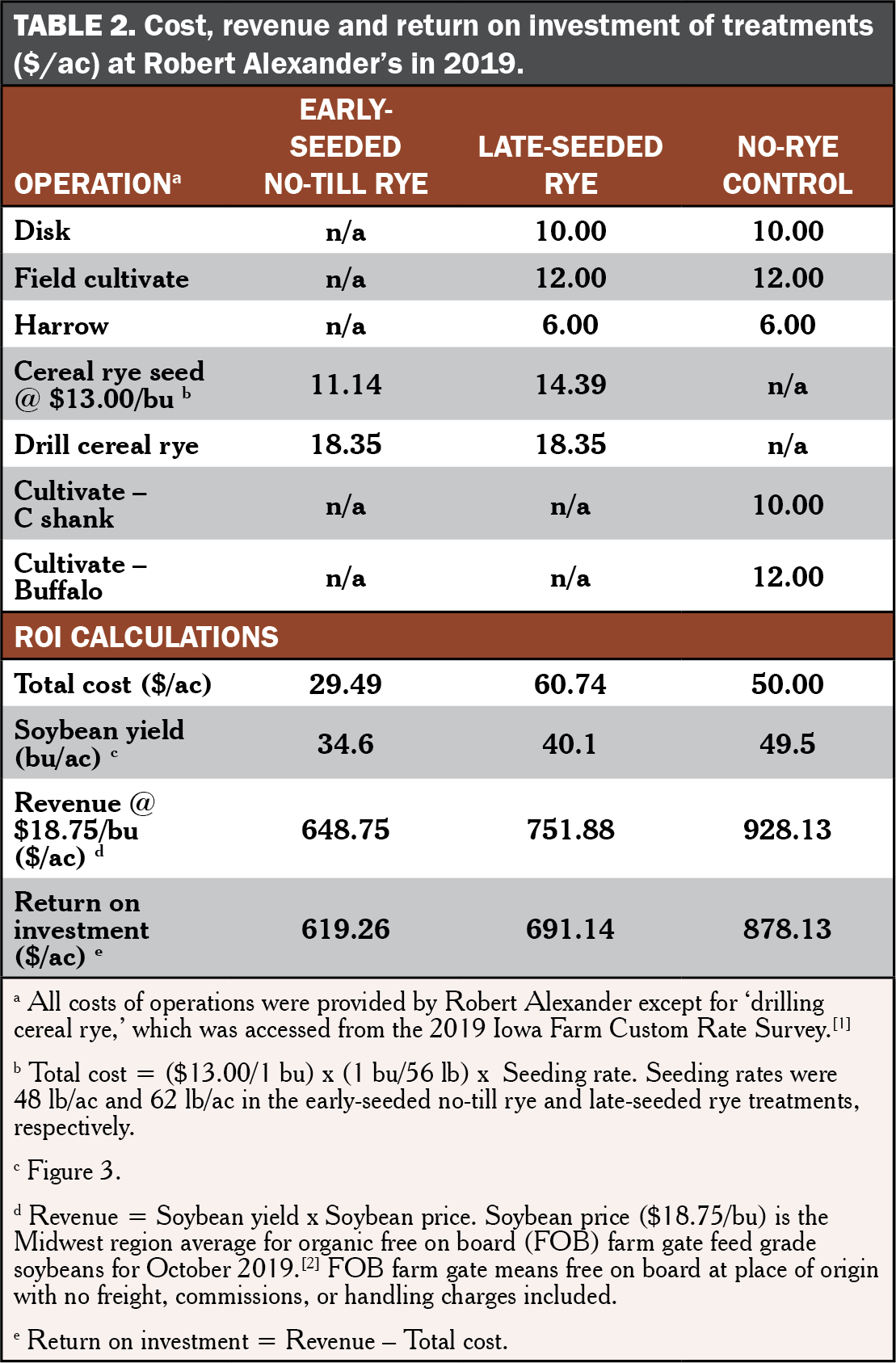 Similarly to Smith and Alert’s, soybean yields at Robert Alexander’s were statistically similar across treatments (Figure 3). Data from rep 1 were excluded from yield analysis due to mechanical issues during harvesting and cultivation. Based on yield data alone, it appears Robert Alexander was able to spring-seed cereal rye and till the least in the early-seeded, no-till rye treatment without sacrificing soybean yield; however, partial budget analysis indicates important differences in the returns on investments for each treatment (Table 2). Return on investment is calculated by subtracting the costs from the revenue for each treatment. The return on investment in the early-seeded no-till rye treatment was $619.26/ac and was the least of all treatments. The return on investment in the late-seeded rye treatment was $691.13/ac – $71.88/ac more than the early-seeded no-till rye. The no-rye control provided the greatest return on investment at $878.13/ac - $258.87/ac more than the early-seeded no-till rye treatment and $186.99/ac more than the late-seeded rye treatment.
Conclusions and Next Steps
Constrained by the challenge of seeding cereal rye early enough in the fall to develop an adequate stand for rolling in the spring or ridging the previous corn crop in preparation for ridge planting soybeans, Smith and Alert hoped spring-seeding cereal rye would afford them the opportunity to still utilize a cover crop to control weeds with less labor and tillage. Smith and Alert found neither of the two seeding rates compared on their farm provided adequate weed control in the presence of high grass weed pressure and stated, “The soybean yield and income loss was extremely disappointing.” A nearby soybean field planted the same day, with the same soybean variety, but managed with mechanical weed control, yielded more than twice that of the trial field. Based on their experiences and the results of this trial, Smith and Alert feel spring-planted rye is not an appropriate response to their challenges without some change to the system. Tine weeding both the rye and soybeans very early may be a strategy to help control grass weeds. Other farmers have used this strategy successfully up to three times during early crop growth. Robert Alexander’s goal was to find ways to reduce soil disturbance annually on his farm, and despite heavy grass weed pressure in this experiment, Alexander’s view is that spring-seeding rye one month before planting soybeans will be a good option to reduce tillage on his farm in areas where grass weed pressure is less heavy. Robert Alexander plans to spring-seed cereal rye ahead of soybeans again on a few acres in the coming years.
Appendix - Trial Design and Weather Conditions
References
- Plastina, A., G. Wynne and A. Johanns. 2019. 2019 Iowa Farm Custom Rate Survey. FM 1698. Ag Decision Maker. Iowa State University Extension and Outreach. https://www.extension.iastate.edu/agdm/crops/pdf/a3-10.pdf (accessed April 2019).
- USDA Agricultural Marketing Service. 2020. Midwest Regional Organic Grain and Feedstuffs Report. Livestock, Poultry, and Grain Market News. USDA Agricultural Marketing Service. www.ams.usda.gov/market-news/organic (accessed March 2020).
- Iowa Environmental Mesonet. 2020. IEM “Climodat” Reports. Iowa State University Department of Agronomy. http://mesonet.agron.iastate.edu/climodat/ (accessed March 2020).