In a Nutshell:
- To meet customer demand, Iowa vegetable farmers need to grow lettuce during the hot summer months when lettuce, a cool-season crop, is most difficult to grow.
- Six farmers compared four lettuce varieties – Concept, Cherokee, Magenta and Nevada – to determine which produce best during summer in Iowa.
Key findings
- Top-yielding varieties differed by farm and succession. Concept was the top-yielding variety (lb/ft2) in five of the 13 trials, though not always with statistical significance.
- Three farms reported that Nevada had the best flavor, while Cherokee was most often cited for bitterness.
Background
Methods
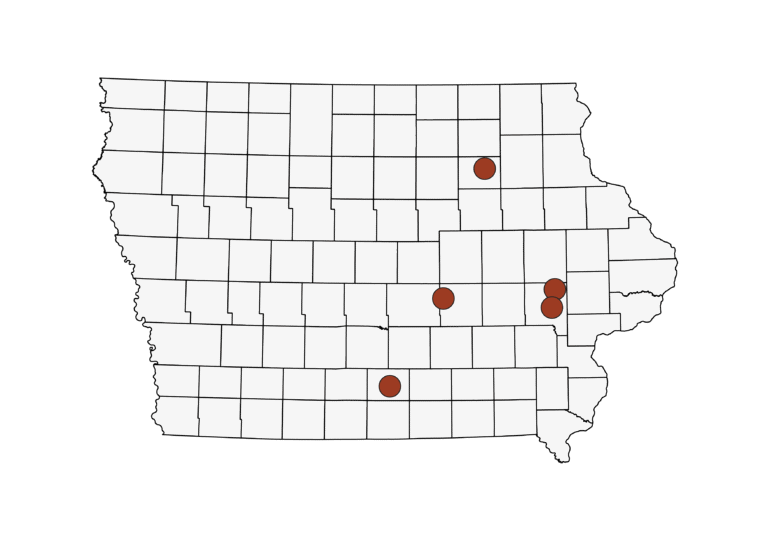
This project was conducted by farmers at six Iowa farms: Jill Beebout (Blue Gate Farm; Chariton), Carmen Black (Sundog Farm; Solon), Kate Edwards (Wild Woods Farm; Iowa City), Rob Faux (Genuine Faux Farm; Tripoli), Jordan Scheibel (Middle Way Farm; Grinnell) and Jon Yagla (Millet Seed Farm; Iowa City).
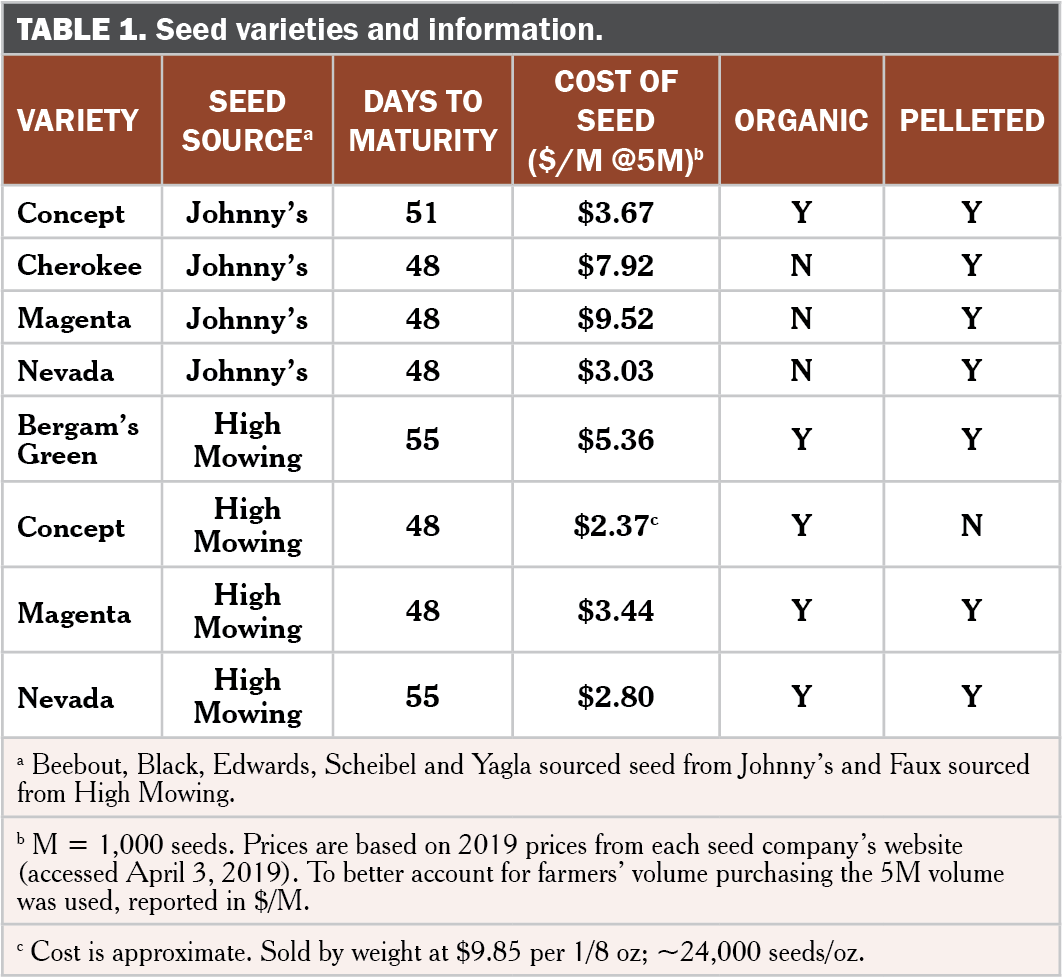
All farmers planted four replications of four lettuce varieties in randomized, replicated trials. Five farmers trialed the varieties Cherokee, Concept, Magenta and Nevada, and one farmer (Faux) substituted Bergam’s Green for Cherokee. Varieties were selected based on farmer preference, varietal similarities and availability of organic or untreated seed. Information about each variety is available in Table 1. Seeds for the trials were provided by Johnny’s Seeds (Winslow, ME) and High Mowing Seeds (Wolcott, VT). Farmers planted at least two successions of lettuce to better account for variation in summer weather and to mimic their normal production practices for consistent supply.
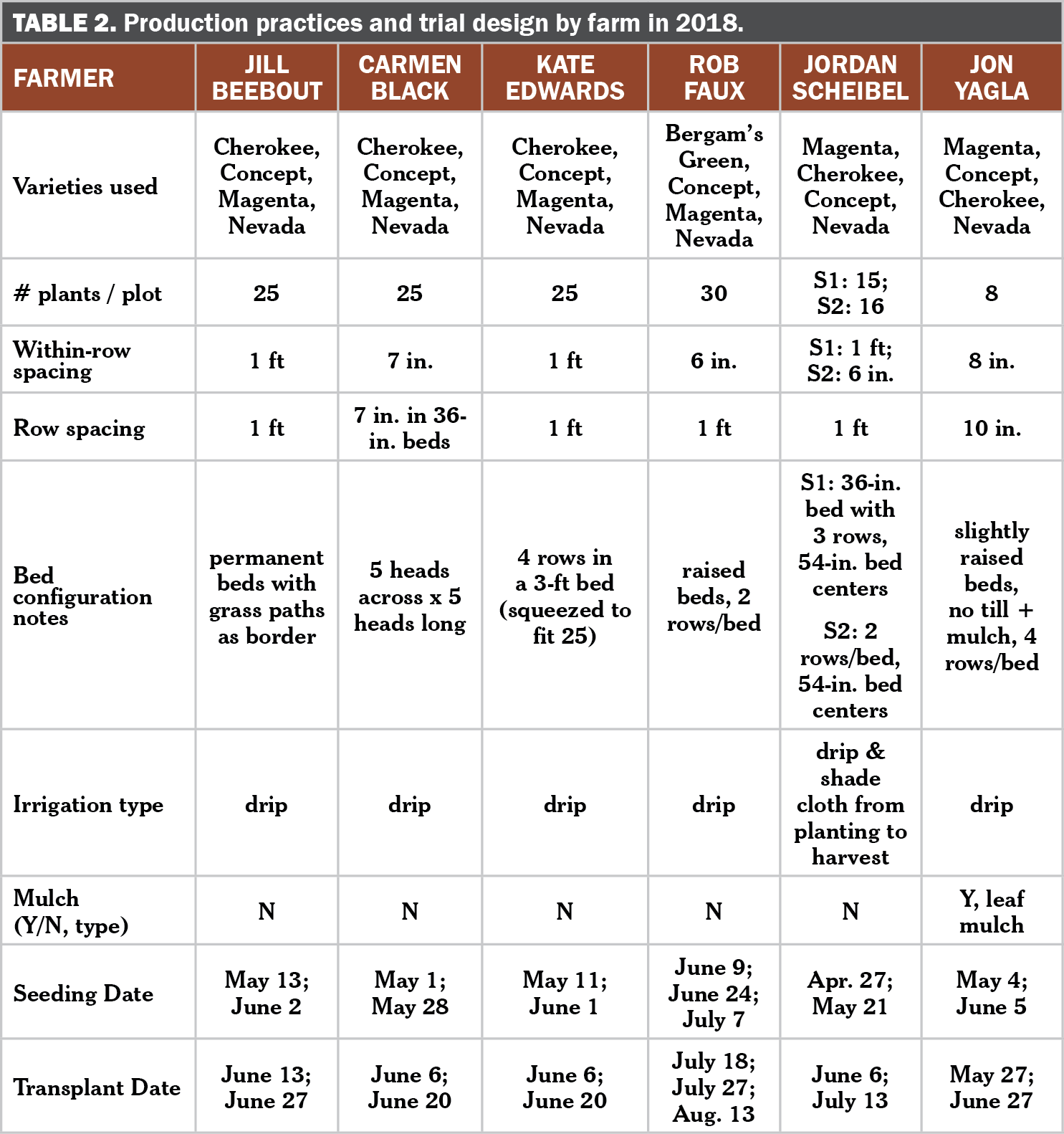
 Production practices including mulching, spacing, irrigation, planting dates and harvest dates were determined by farm and are detailed in Table 2. The number of plants per plot ranged from eight to 25, and spacing between rows and within rows did not exceed 1 ft on any farm. All farms transplanted lettuce to the field.
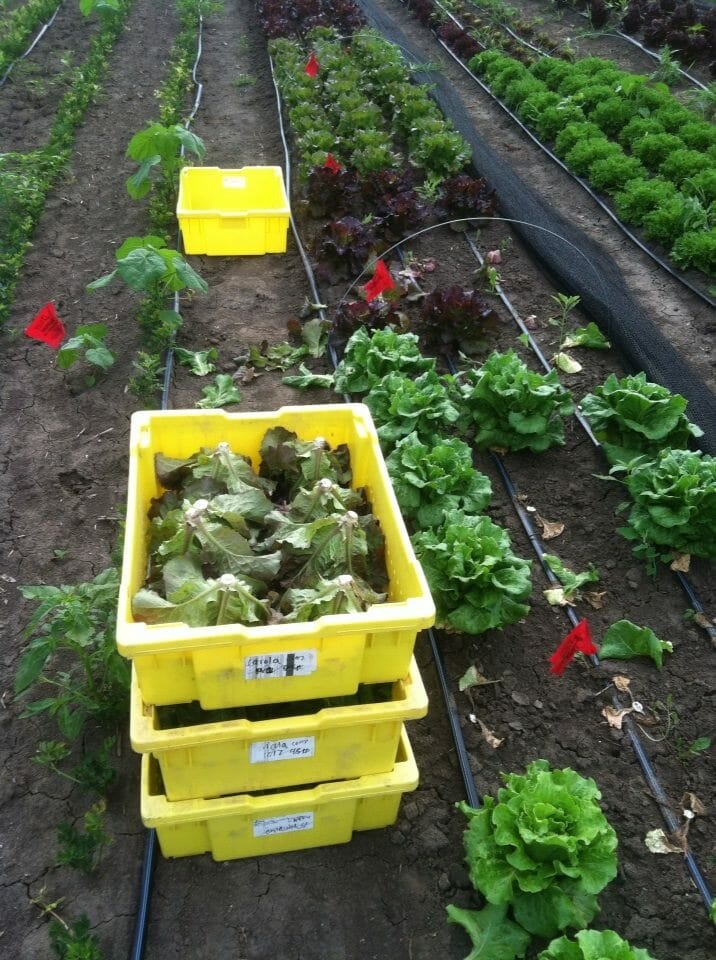
 Farmers harvested and field-cleaned lettuce heads, then recorded the weight and count of marketable lettuce heads harvested per plot. During each harvest date, farmers also scored varieties as acceptable (A) or unacceptable (U) for quality indicators including bolting, tip burn, bottom rot and flavor. These scores were then averaged across harvest dates to provide a score from 0 to 100% indicating the percent of harvest events for which the variety received an “A” rating for the quality indicator (100% being all “A” ratings).
Data were analyzed using JMP Pro 13 (SAS Institute Inc., Cary, NC) statistical software. Means separation among varieties by succession at each farm was computed using Tukey’s least significant difference (LSD) to examine effects on lettuce yield. Statistical significance is reported at the 90% confidence level.
Farmers harvested and field-cleaned lettuce heads, then recorded the weight and count of marketable lettuce heads harvested per plot. During each harvest date, farmers also scored varieties as acceptable (A) or unacceptable (U) for quality indicators including bolting, tip burn, bottom rot and flavor. These scores were then averaged across harvest dates to provide a score from 0 to 100% indicating the percent of harvest events for which the variety received an “A” rating for the quality indicator (100% being all “A” ratings).
Data were analyzed using JMP Pro 13 (SAS Institute Inc., Cary, NC) statistical software. Means separation among varieties by succession at each farm was computed using Tukey’s least significant difference (LSD) to examine effects on lettuce yield. Statistical significance is reported at the 90% confidence level.
Results and Discussion
Yield across farms and successions
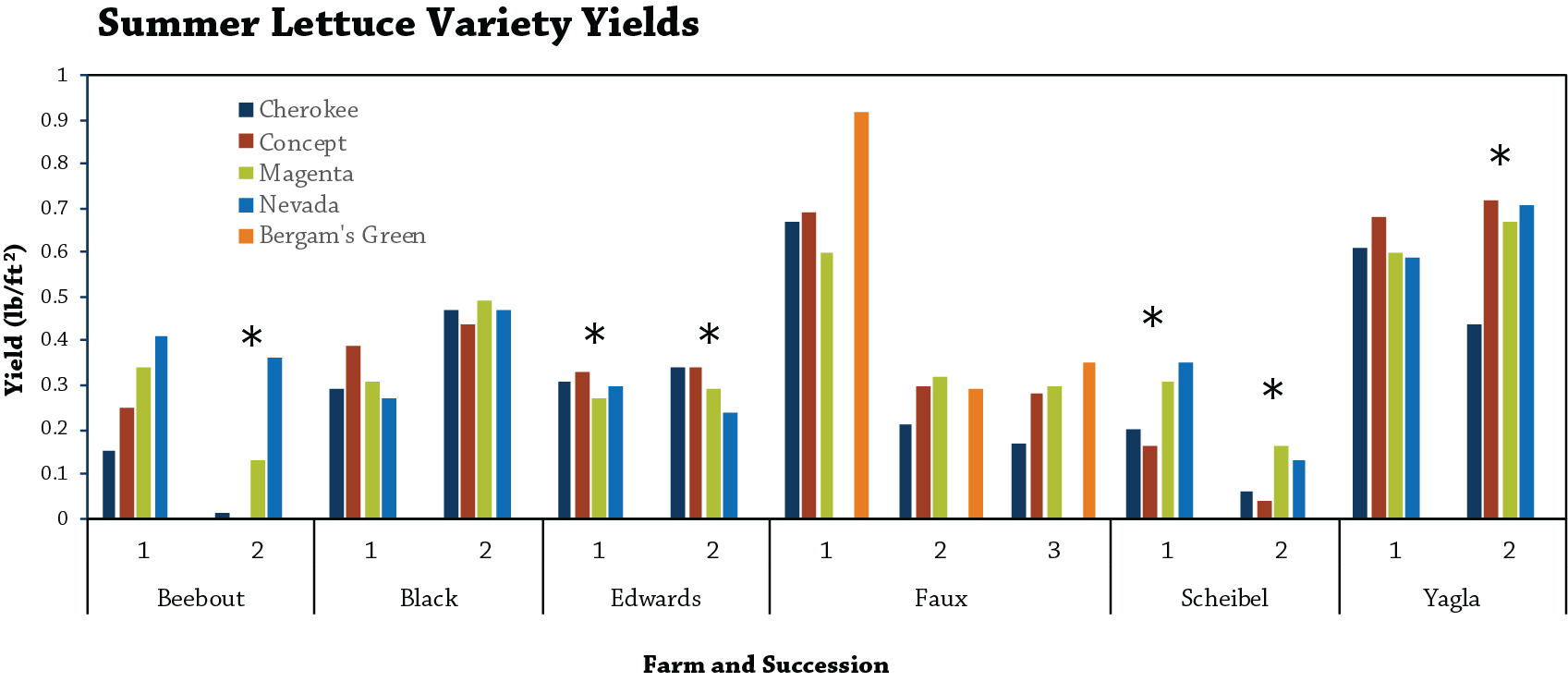
Mean yield by variety and succession on each farm are shown in Figure 1. Concept was the top-yielding variety (lb/ft2) in five of the 13 trials, though not always with statistical significance. In six different trials, differences in yield were statistically significant at 90% certainty. Among those six trials, the four main lettuce varieties – Cherokee, Concept, Magenta and Nevada – each achieved the highest yield during at least one trial.
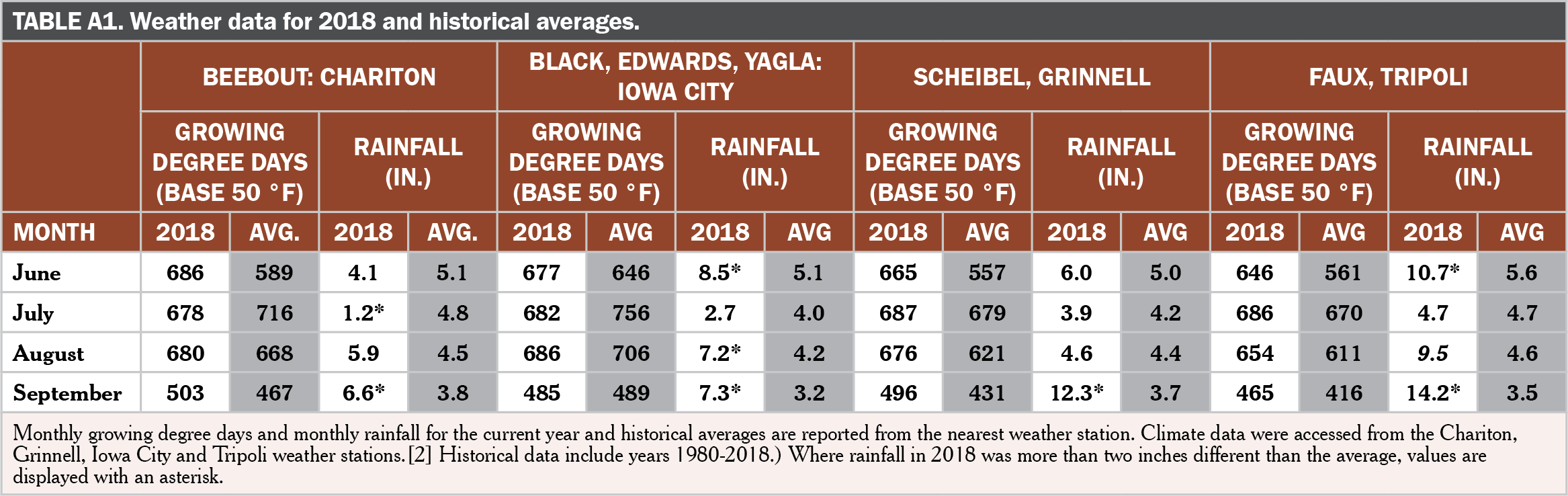
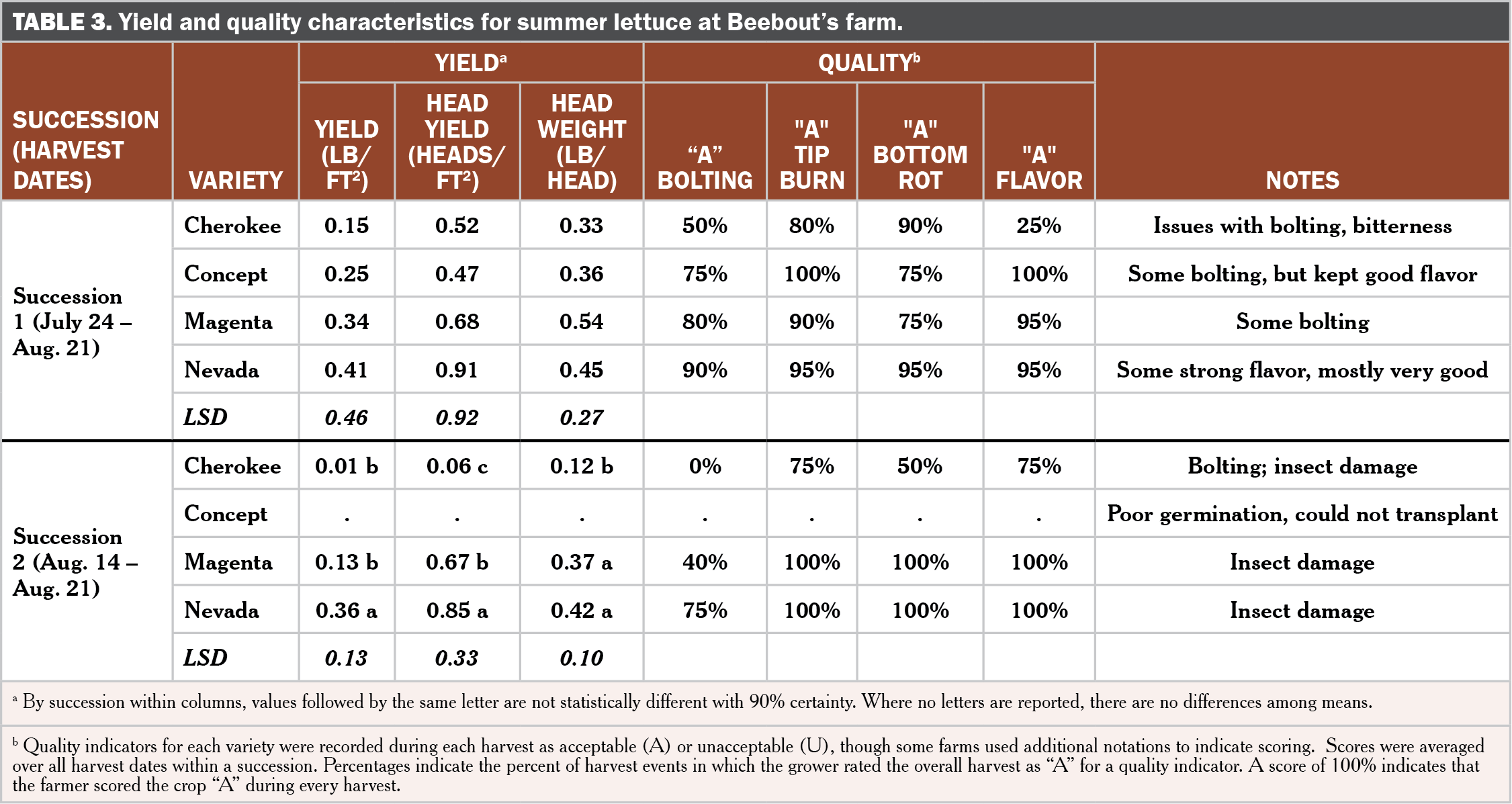 Beebout noted that Cherokee had the most trouble with bolting and bitterness. During succession 2 many of the plots had bolted plants and experienced insect damage from cucumber beetles and cabbage looper larvae. She also noted that weather was the most challenging part of the trial – July at her farm was very dry (Table A1).
Black, Solon
Black planted two successions of the summer lettuce trial, which were harvested July 2 and July 9 (Table 4). She was the only farmer to run the trial in a high tunnel, with the sides rolled up at all times. This was primarily to protect the lettuce from pounding rains and soil splash. Within succession 2, there were some statistically significant differences in head yield among the varieties. Concept (2.80 heads/ft2) and Cherokee (2.77 heads/ft2) had greater head yields than Nevada (2.54 heads/ft2), but were not significantly greater than Magenta (2.60 heads/ft2). The trend was the same for succession 1, with Concept having the most head yield (2.57 heads/ft2), followed by Cherokee, then Magenta and Nevada last; however, due to variation in yield within varieties, these differences were not statistically significant.
Beebout noted that Cherokee had the most trouble with bolting and bitterness. During succession 2 many of the plots had bolted plants and experienced insect damage from cucumber beetles and cabbage looper larvae. She also noted that weather was the most challenging part of the trial – July at her farm was very dry (Table A1).
Black, Solon
Black planted two successions of the summer lettuce trial, which were harvested July 2 and July 9 (Table 4). She was the only farmer to run the trial in a high tunnel, with the sides rolled up at all times. This was primarily to protect the lettuce from pounding rains and soil splash. Within succession 2, there were some statistically significant differences in head yield among the varieties. Concept (2.80 heads/ft2) and Cherokee (2.77 heads/ft2) had greater head yields than Nevada (2.54 heads/ft2), but were not significantly greater than Magenta (2.60 heads/ft2). The trend was the same for succession 1, with Concept having the most head yield (2.57 heads/ft2), followed by Cherokee, then Magenta and Nevada last; however, due to variation in yield within varieties, these differences were not statistically significant.
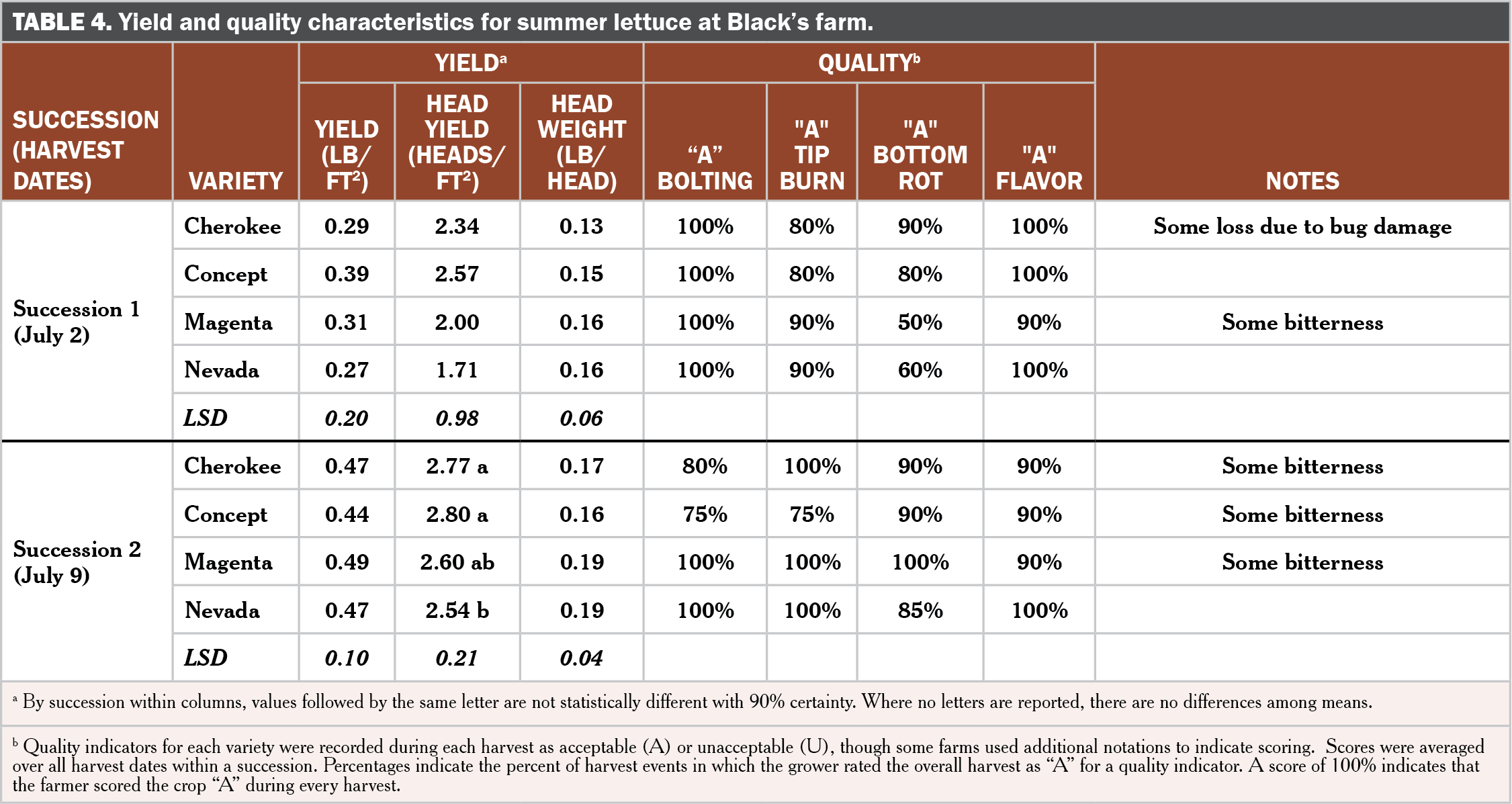 Black noted more bolting and bitterness in succession 2, particularly for Cherokee and Concept. Nevada had the best flavor in succession 2. Black reported that she harvested all plants in succession 1 as soon as the crew noticed some tip burn and bottom rot. This led to a slightly earlier harvest than preferred, but saved the crop before it became unmarketable.
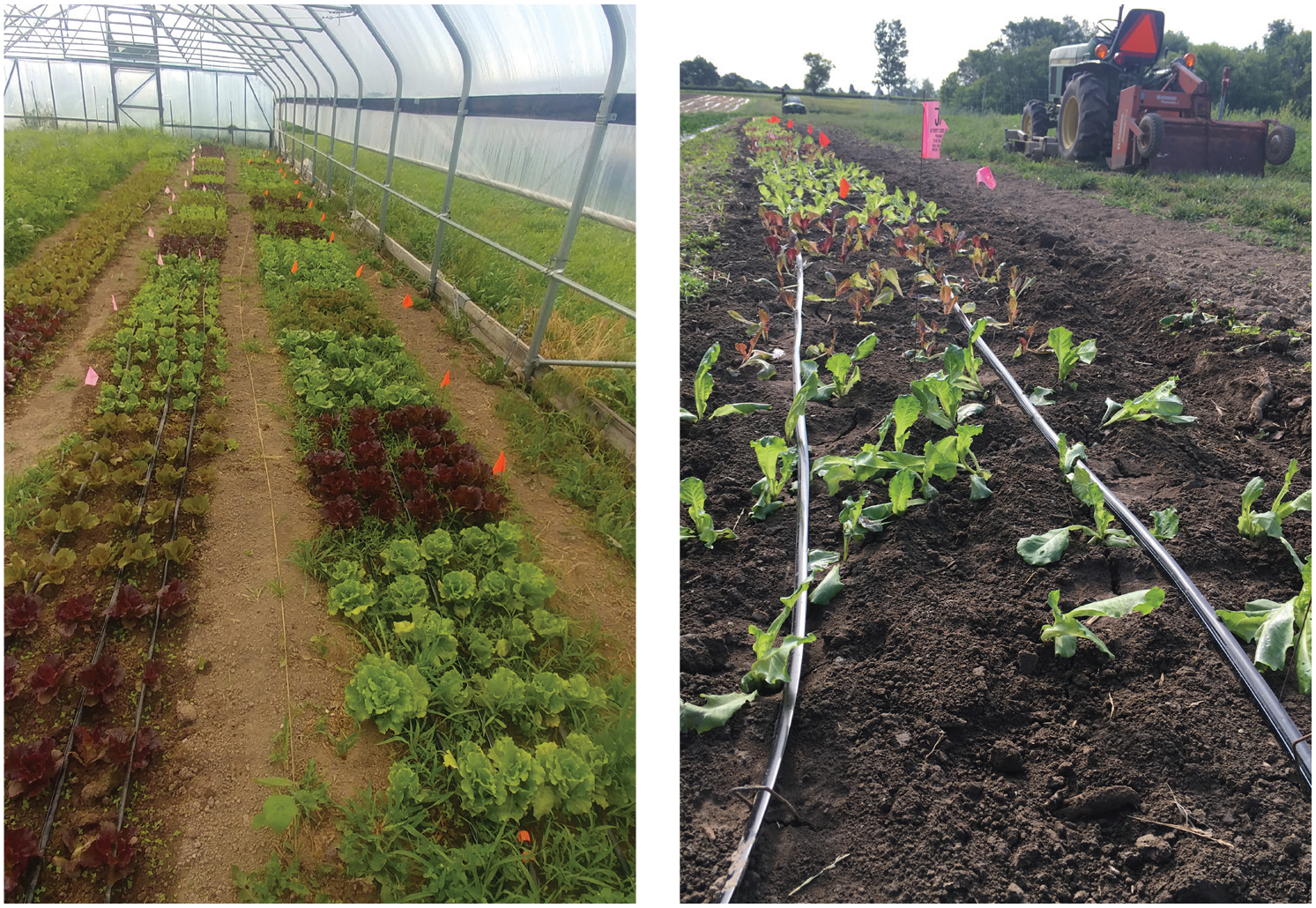
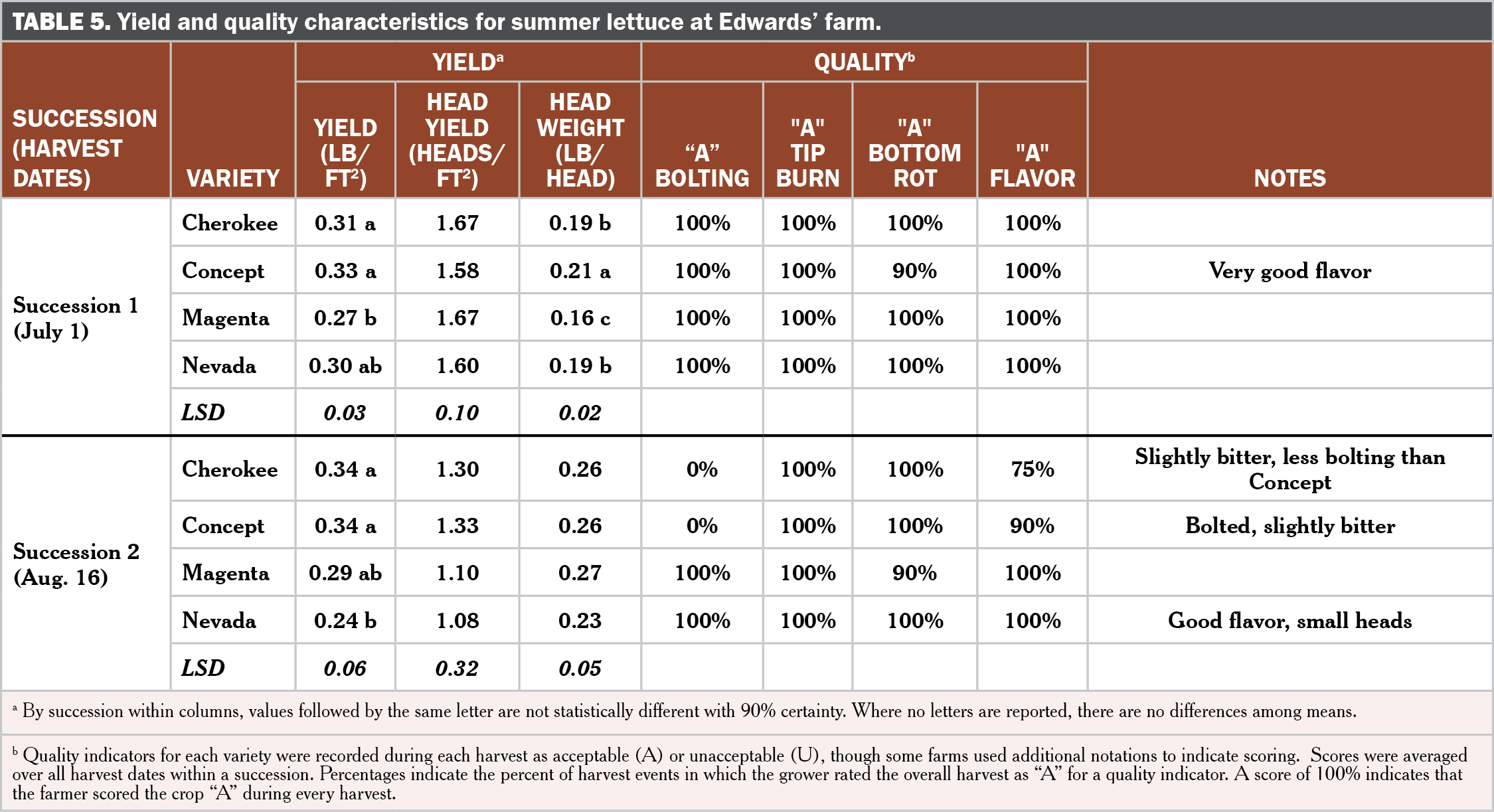 Edwards did not have any issues with bolting during succession 1 and noted that Concept had the best flavor. In succession 2, she noted that Cherokee and Concept were both slightly bitter and had issues with bolting. Still, bolting did not affect yield since she harvested before bolting was a problem. Edwards noted during succession 2 that Nevada had the best flavor but the smallest heads of the tested varieties.
Faux, Tripoli
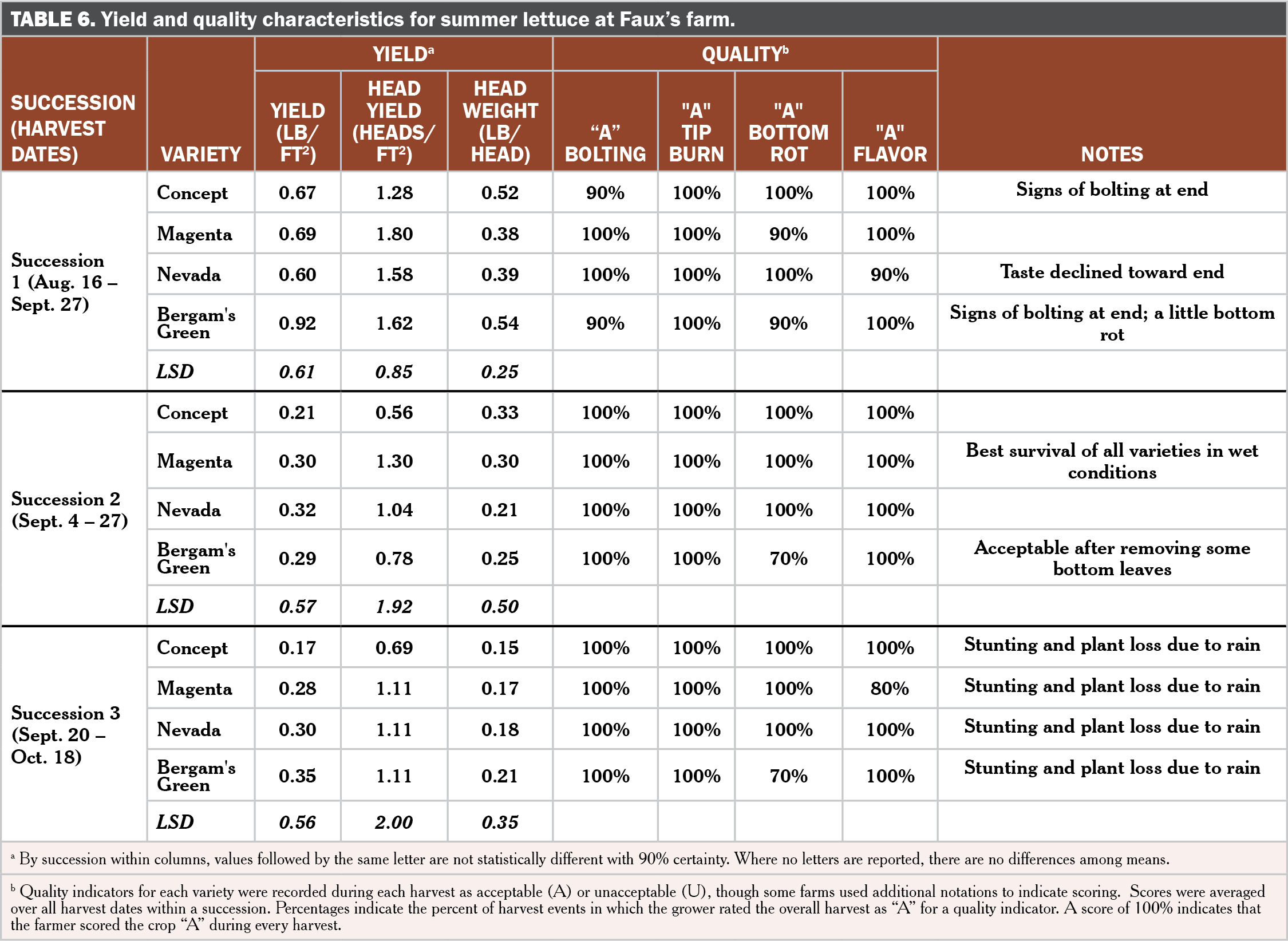
Faux’s variety trial setup was slightly different than the others – he replaced Cherokee with Bergam’s Green, ran three successions instead of two, and harvested later than any other farm (Table 6). This late harvest was due, in part, to rainy weather, as shown in Table A1. Faux recorded the overall highest yields of any farm – 0.92 lb/ft2 for Bergam’s Green during succession 1. Within each succession, there were no statistical differences in yield among varieties.
Edwards did not have any issues with bolting during succession 1 and noted that Concept had the best flavor. In succession 2, she noted that Cherokee and Concept were both slightly bitter and had issues with bolting. Still, bolting did not affect yield since she harvested before bolting was a problem. Edwards noted during succession 2 that Nevada had the best flavor but the smallest heads of the tested varieties.
Faux, Tripoli
Faux’s variety trial setup was slightly different than the others – he replaced Cherokee with Bergam’s Green, ran three successions instead of two, and harvested later than any other farm (Table 6). This late harvest was due, in part, to rainy weather, as shown in Table A1. Faux recorded the overall highest yields of any farm – 0.92 lb/ft2 for Bergam’s Green during succession 1. Within each succession, there were no statistical differences in yield among varieties.
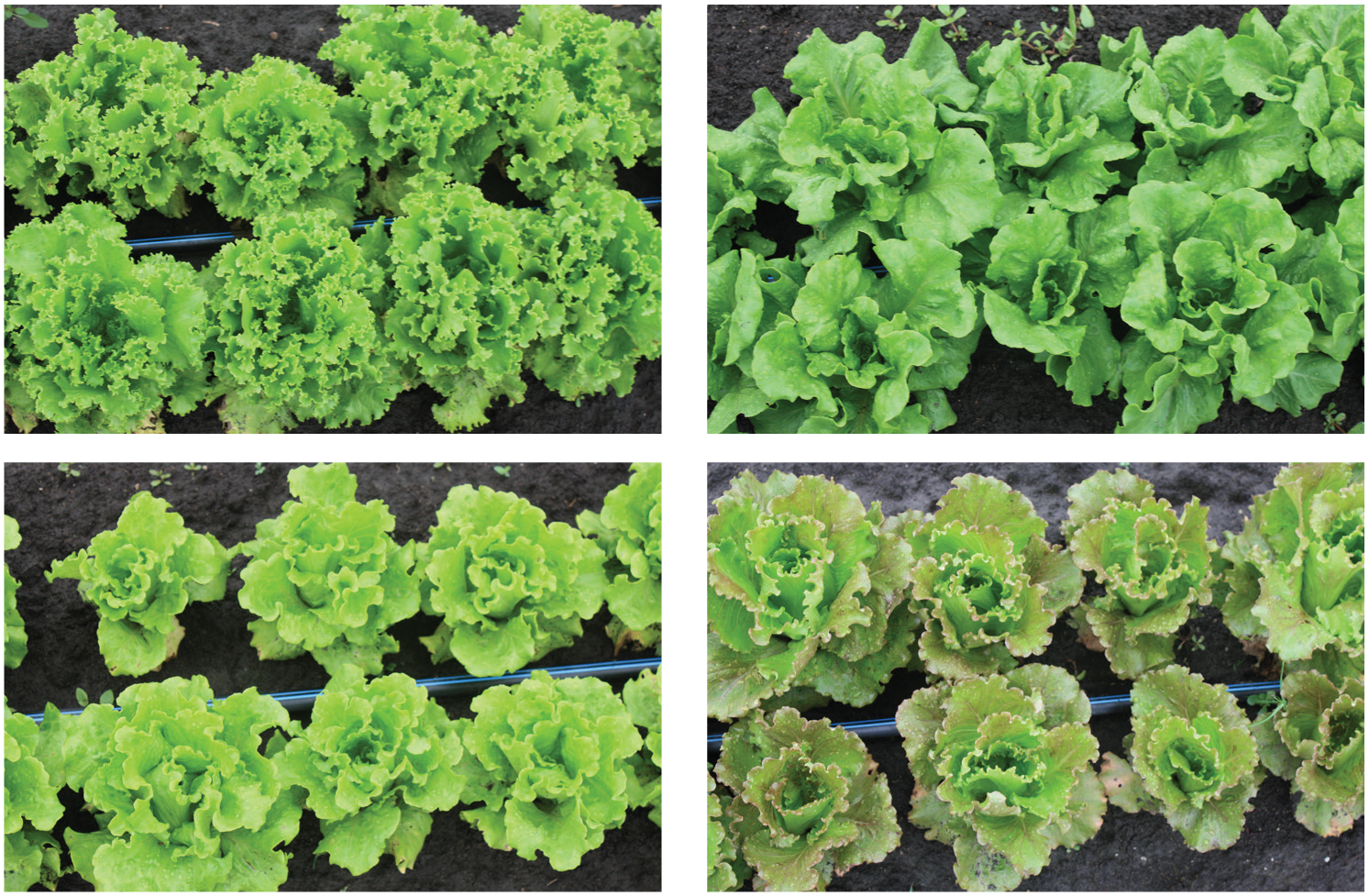
 Challenging weather conditions dictated much of the harvest at Faux. Heavy rainfall in late August and early September impacted the overall quality of the lettuce. With wet soil and some standing water, the plants reverted to root development from leaf development, and Faux delayed harvest as long as possible to allow the plants to size up. Only a portion of the succession 1 harvest was of the head size desired for market. Faux said, “Most of the lettuce held well-enough in the field; Nevada and Magenta held quality the longest, but did not bulk up too much more. Concept began to give out first, and then Bergam’s Green.”
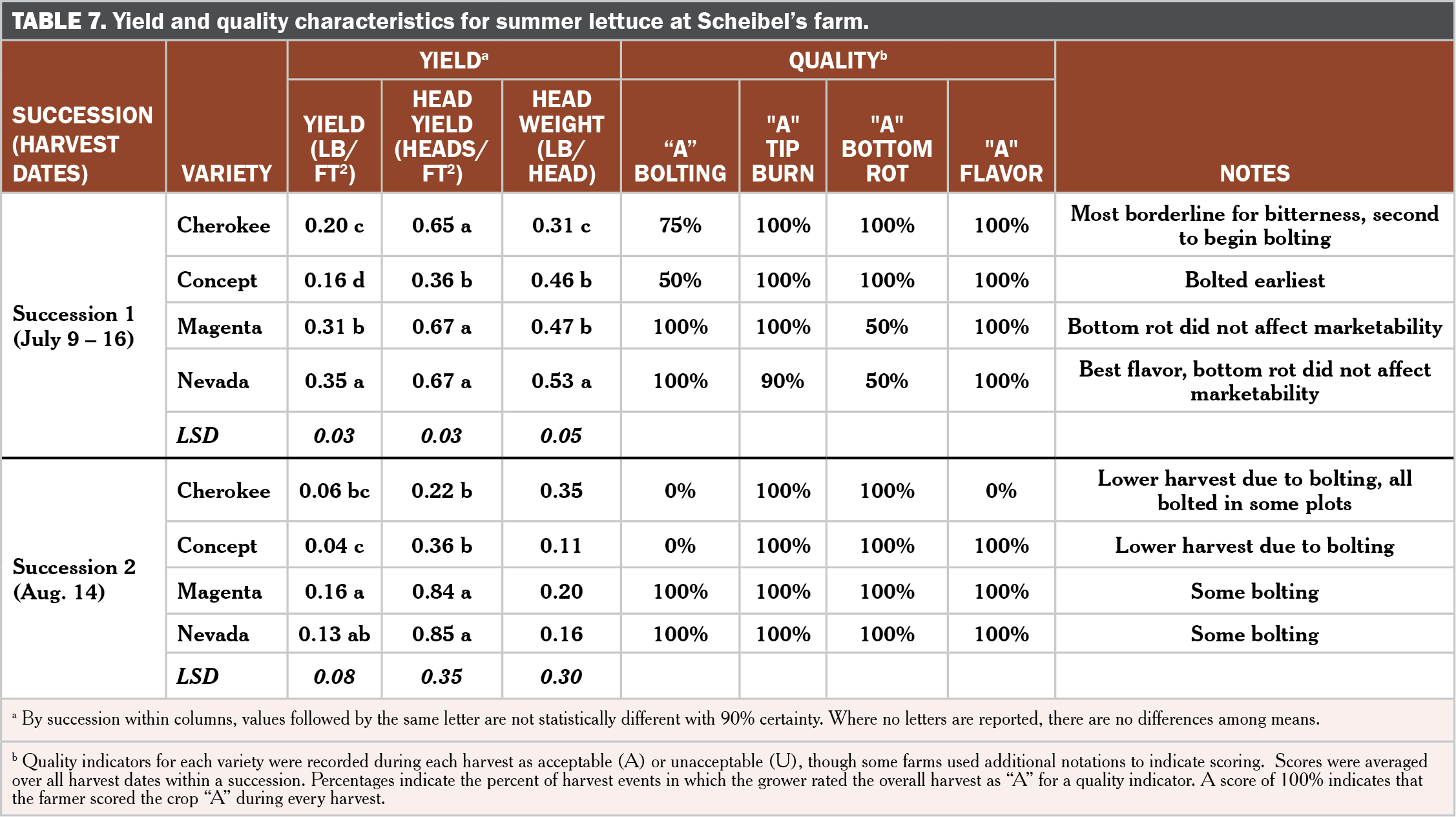 Within each succession, there were statistical differences in yield (lb/ft2) among varieties. During succession 1, each variety was statistically different from the others. Nevada had the greatest yield (0.35 lb/ft2) followed by Magenta (0.31 lb/ft2), Cherokee (0.20 lb/ft2) then Concept (0.16 lb/ft2). Cherokee produced the smallest head compared to the other three varieties during succession 1 (0.31 lb/head), and Nevada produced the largest heads (0.53 lb/head). The head weights of Concept and Magenta were not statistically different from one another (0.46 and 0.47 lb/head). Concept bolted earliest, and thus produced fewer marketable heads (0.36 heads/ft2), compared to the other three varieties (0.65–0.67 heads/ft2).
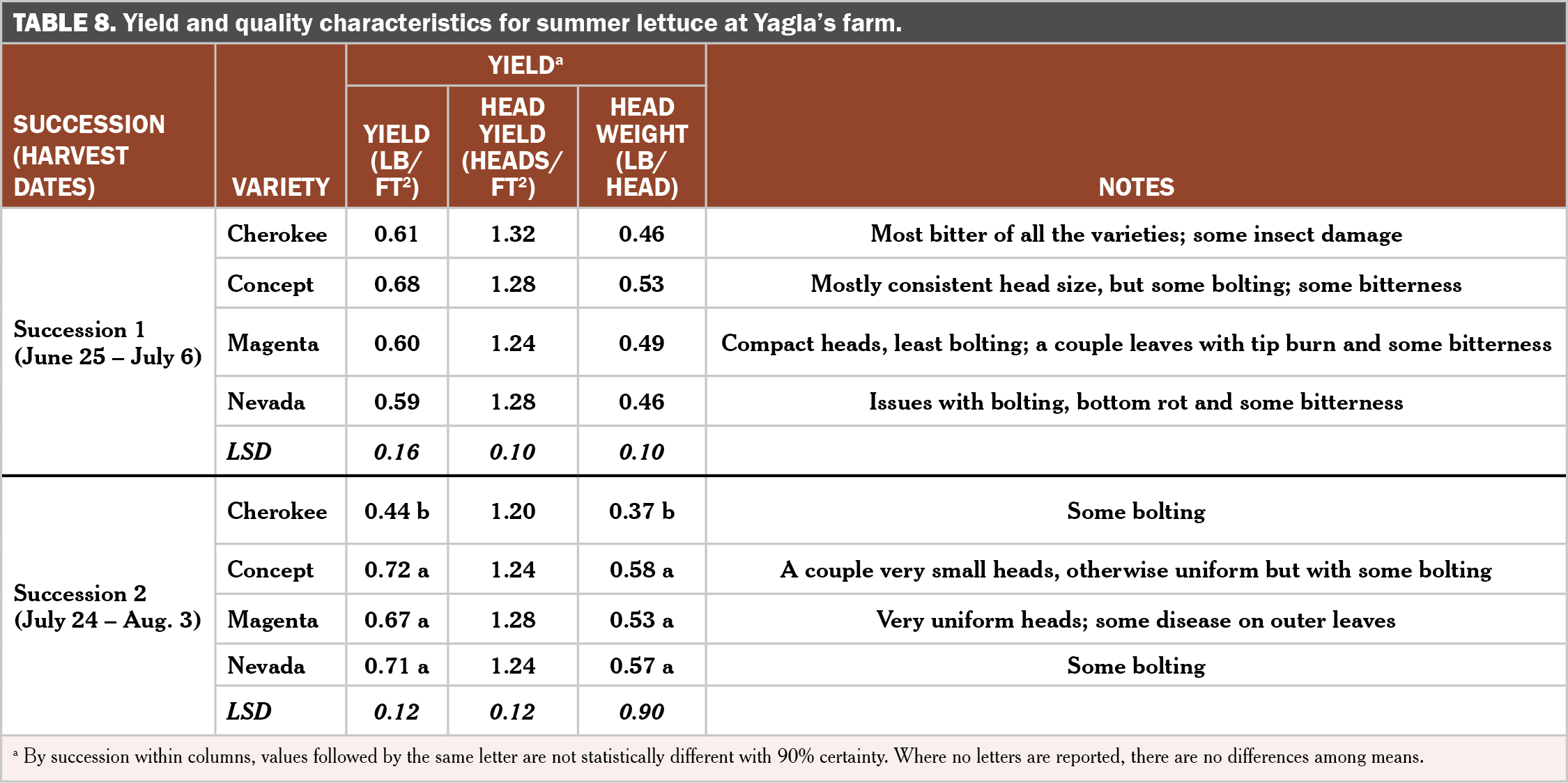 Yagla noted bitterness in all varieties in succession one and bolting in all varieties except Cherokee. He again noted some bitter flavor in succession 2. All lettuce heads harvested were of acceptable quality, though the bitterness of Cherokee in succession 1 was barely acceptable. His notes indicate Magenta had the most consistent and uniform heads and Concept was also a strong performer for quality.
Conclusions and Next Steps
Appendix - Weather Conditions
References
- Kolbe, L., C. Black, R. Faux, A. McGary, J. Scheibel and K. Edwards. 2017. Summer Lettuce Variety Trial. Practical Farmers of Iowa Cooperators’ Program. https://practicalfarmers.org/research/summer-lettuce-variety-trial/ (accessed April 2019).
- Iowa Environmental Mesonet. 2019. Iowa Environmental Mesonet. Iowa State University Department of Agronomy. http://mesonet.agron.iastate.edu/ (accessed March 2019).