Finding a Beneficial Rotation
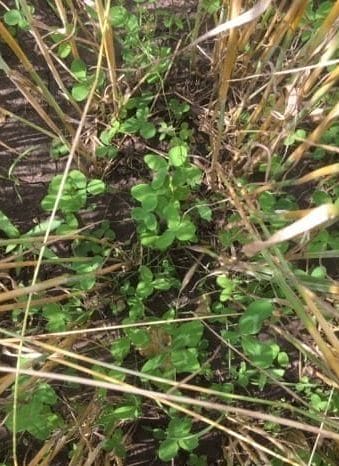
John admits that the farms' crop rotation is not set in stone, but rather one that balances the needs of each field. This includes everything from labor and machinery availability, weather, farming on contours and maintaining shallow tillage. John says, “There are certain tried and true crop sequences that we really like. For example, growing buckwheat into winter wheat and then frost-seeding clover followed by corn. It's a nice minimum tillage crop sequence and we're still able to grow three productive crops.” Right after corn, John seeds a succotash mix of oats and peas. “Last year, we did 40 acres of oats, barley, 40-10 peas and flax.” John follows this with a cover crop mix of legumes and brassicas. He prefers non-grass cover crops, that will winter kill, but leave a decent residue come spring. This green manure mix will allow nitrogen to be available in the soil when spring wheat is planted. Wheat is one of Meadowlark Farm's most versatile crops. “Wheat is a wonderful crop because it free threshes, and if you grind it, you can make a useful, universally applicable food product, so it's a great grain to value-add in your rotation,” says John. “It's also nice that you can spring seed it or use it as a winter annual, in the case of winter wheat.”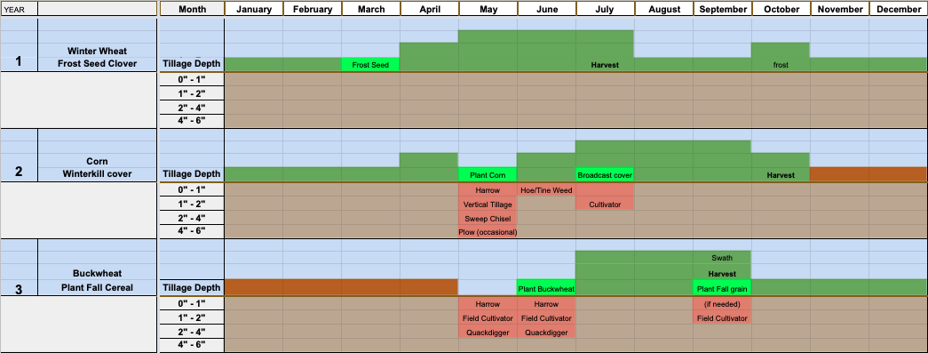
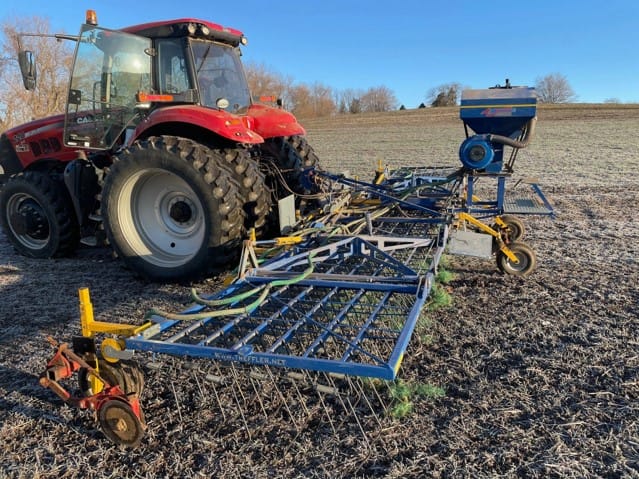
Frost-seeding clover and interseeding alfalfa with a modified tine weeder
To build nitrogen in the soil with small grain crops, the Meadowlark team frost-seeds red clover with their custom 30-ft Treffler tine weeder mounted with an air seeder. Frost-seeding begins in late winter or early spring and occurs in the early morning hours while the ground is firm. “We pretty much eyeball it with our frost-seeding, but compared to a four-wheeler with a spin seeder, we definitely get a more uniform seeding rate over those 30 feet.”