In a Nutshell:
- While maximizing the benefits of cover crops requires extending their growing period, prolonging growth and delaying termination beyond the date of soybean emergence is not allowed under federal crop insurance rules.
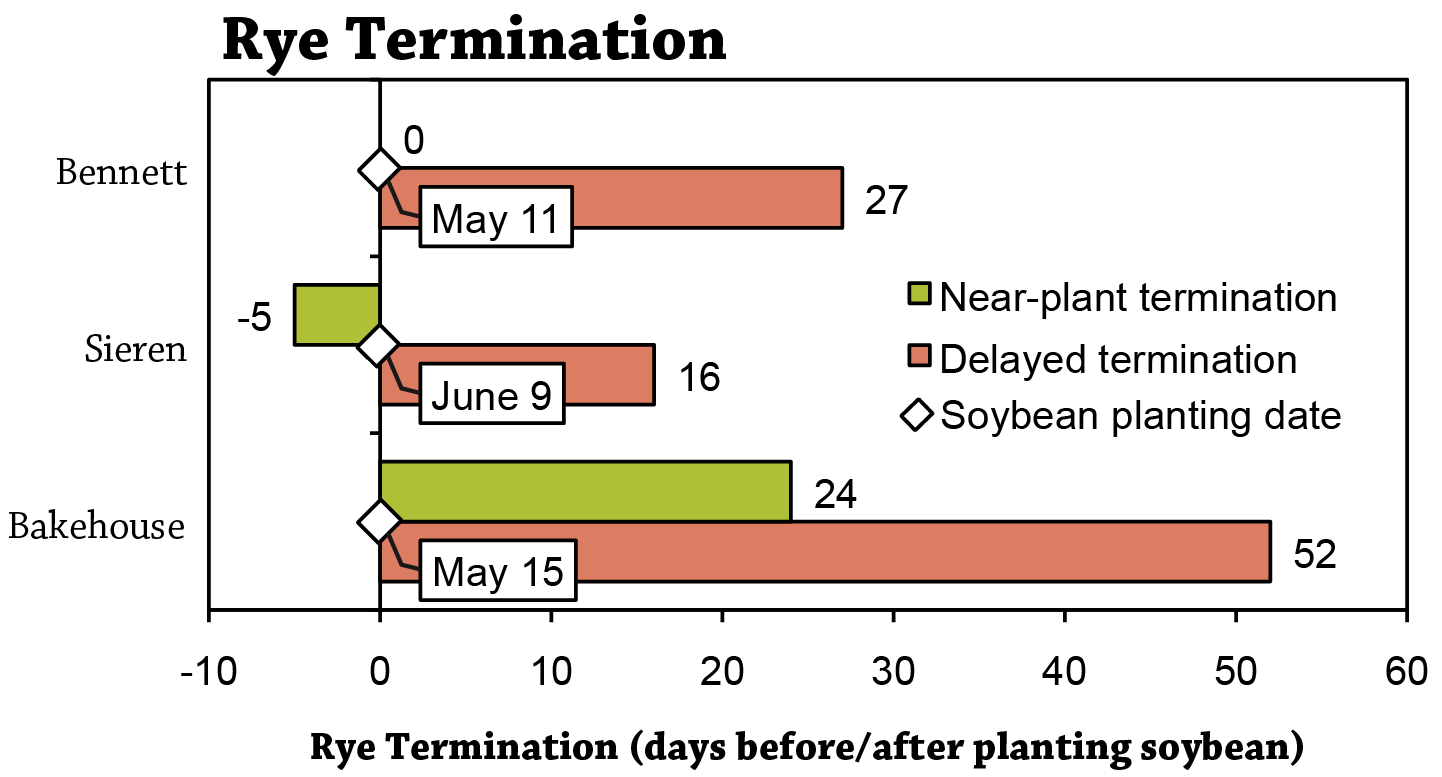
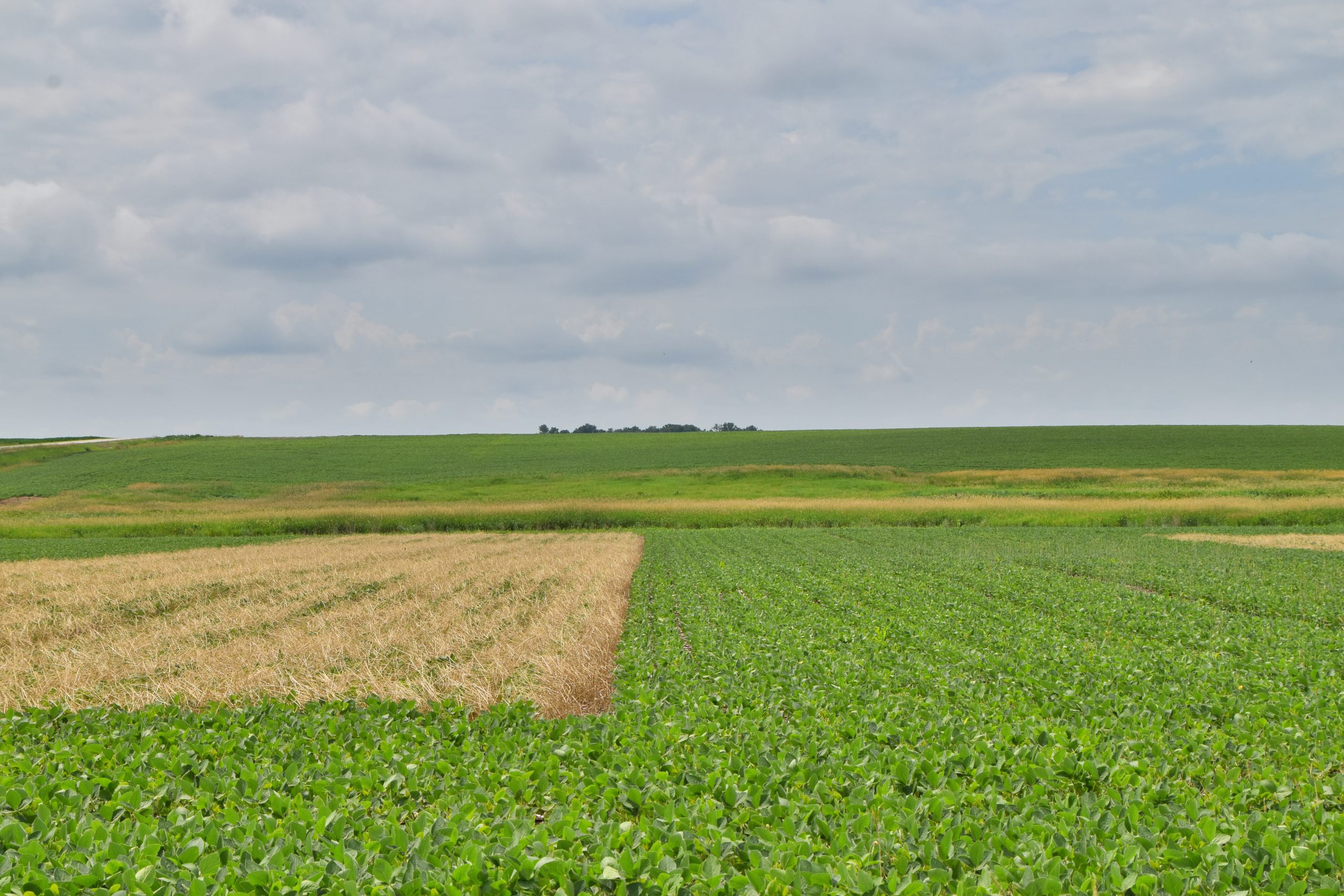
- Sam Bennett, Tim Sieren and Jon Bakehouse compared cereal rye biomass, soybean stand counts and soybean yield between strips in which a rye cover crop was terminated near the date of planting soybean (near-plant termination) and strips in which rye termination was delayed until 16 to 52 days after planting (delayed termination).
Key Findings:
- By delaying termination, Bennett was able to increase rye biomass on his field without reducing soybean yield. Sieren’s yields were also unaffected, but soybean stand counts were reduced and he was unable to increase rye biomass. Bakehouse increased rye biomass without reducing soybean stand count.
- As a result of this trial, Bennett and Sieren plan to continue the practice of delaying rye termination in soybeans. Bennett and Bakehouse plan to conduct a similar experiment in 2020 but will add a treatment in which the rye reseeds itself and grows without being terminated.
Background
Benefits of cover crops can include improved weed control, reduced herbicide inputs, increased water infiltration and improvement of soil health and water quality.[1–3] Adequate cover crop growth is needed to maximize these benefits, but the window of time for such growth is limited by federal crop insurance rules. When asked about his motivation to conduct this trial, Sam Bennett replied, “To contribute to a dataset that shows that planting soybeans into living rye and terminating that rye up to a month after planting will have no effect on soybean yield and will benefit weed control. I’d like to see RMA [USDA Risk Management Agency] remove the restrictions on cover crop termination dates as they apply to soybean crop insurance eligibility.”
Methods
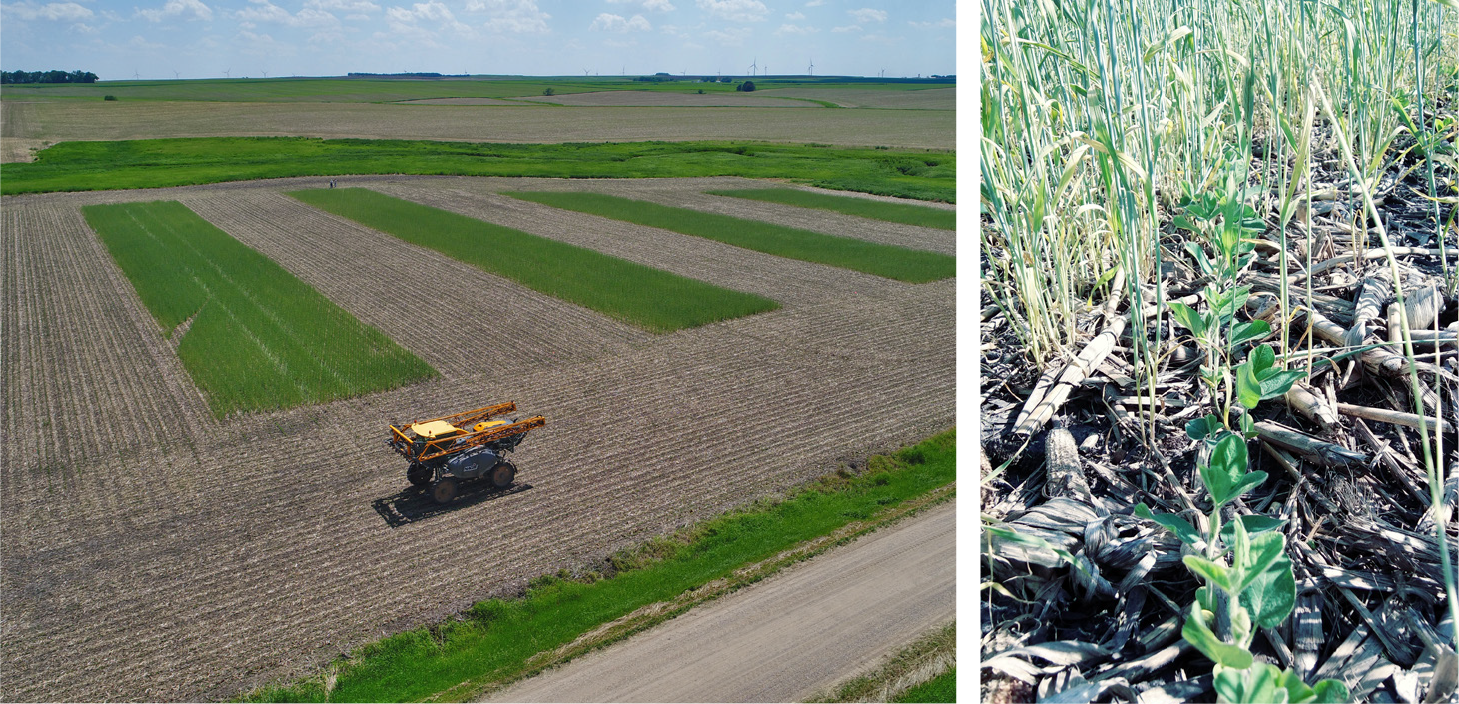
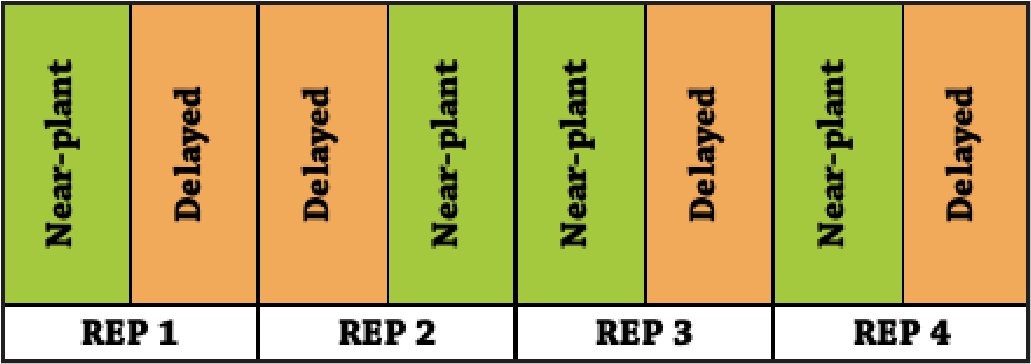
In the fall of 2018, Bennett, Sieren and Bakehouse drilled cereal rye (var. Elbon) after corn at a planting population of 1 million pure live seed per acre (PLS/ac). The subsequent spring, they planted soybeans and established treatment strips by terminating rye on two different dates at their site. Treatments were arranged in a randomized complete block design and randomly assigned to one strip per block (Figure A1). Blocks were replicated four times for a total of 8 strips at each farm.
Results and Discussion
Rye biomass
Rye biomass data at Bennett’s (Figure 2) represent the average amount of rye present at the time of termination in each treatment. At the time of termination, rye biomass in the delayed termination strips was statistically greater than the amount of rye biomass in the near-plant termination strips at Bennett’s. Rye biomass in the delayed termination strips averaged 4,970 lb/ac, and biomass in the near-plant termination strips averaged 540 lb/ac.
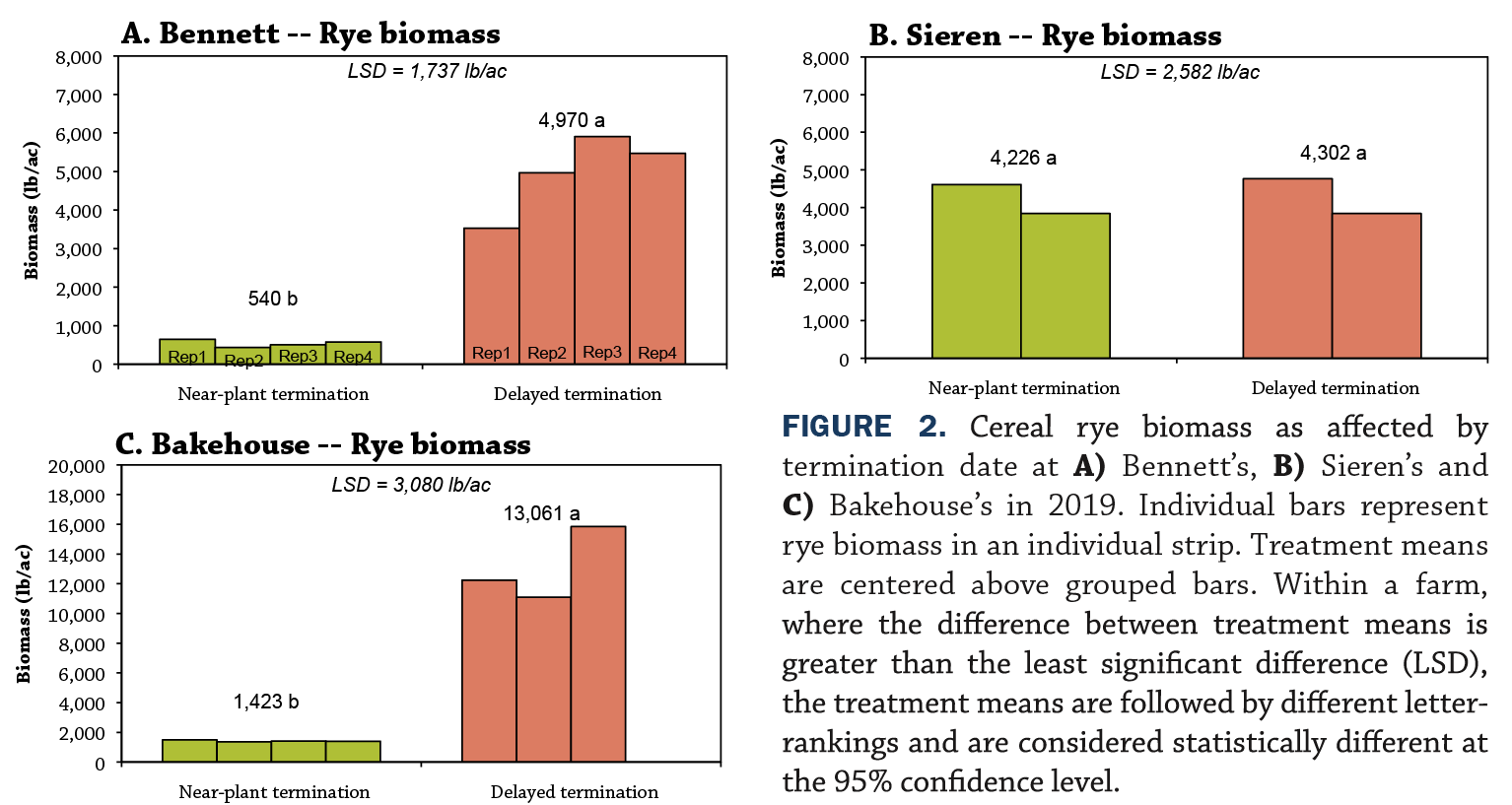 Rye biomass at Sieren’s was sampled in each treatment at incomparable stages of development – 16 days after termination in the near-plant termination strips and 5 days before termination in the delayed termination strips. Despite this, Sieren’s rye biomass data (Figure 2) can be considered a reasonably reliable representation of the amount of rye present at the time of termination in each treatment because biomass in the near-plant termination strips would not have increased during the 16-day period after terminating it and before sampling it. Similarly, because rye in the delayed termination strips was already half-dried down (nearly mature) at the time of sampling it, its biomass would also not likely have increased during the 5-day period after sampling it and before terminating it. Rye biomass at Sieren’s averaged 4,226 lb/ac in the near-plant termination strips and 4,302 lb/ac in the delayed termination strips. Biomass amounts for each treatment were statistically similar even though rye in the delayed termination treatment received 16 additional days of growth compared to rye in the near-plant termination treatment.
While Sieren’s data do not show a statistically significant difference in rye biomass, it is worth noting that biomass was numerically greater in his delayed termination strips. Analysis of Sieren’s biomass data required a more conservative approach than Bennett’s because information on the replicates from which samples were collected was not included with the samples. It is possible that including information on replicates could have resulted in a different conclusion for Sieren’s biomass data.
Bakehouse’s data show a statistically greater amount of rye biomass in the delayed termination strips compared to the near-plant termination strips (Figure 2). Similar to Sieren’s data, Bakehouse’s rye biomass data was collected at incomparable stages of the rye’s development in each treatment. Bakehouse sampled rye biomass 23 days before termination in the near-plant termination strips and 1 day before termination in the delayed termination strips. Had biomass in the near-plant termination strips been sampled 1 day rather than 23 days prior to the date of its termination, the data would have reflected an additional 22 days of growth and might have resulted in a smaller difference between treatments. Additionally, information on replicates was missing from Bakehouse’s data and required a more conservative statistical analysis as with Sieren’s biomass data, however, the conclusions drawn from Bakehouse’s data would be the same under both analyses.
Soybean stand counts
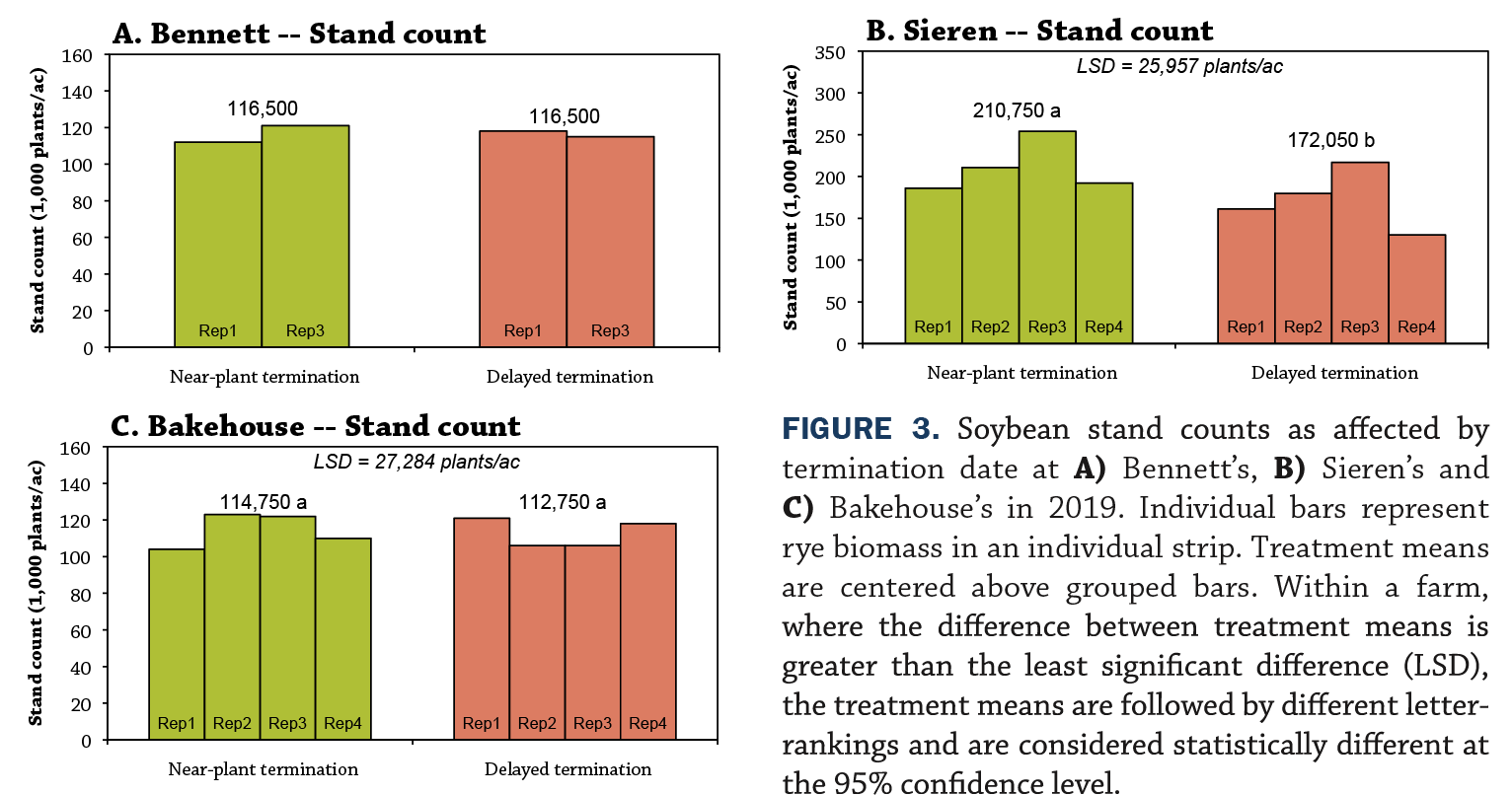
Delayed termination of rye reduced stand counts at Sieren’s (Figure 3). Average stand counts were 210,750 plants/ac and 172,050 plants/ac in his near-plant termination and delayed termination strips, respectively. Stand counts in each treatment at Bakehouse’s were statistically similar and averaged 114,750 plants/ac in his near-plant termination strips and 112,750 plants/ac in his delayed termination strips (Figure 3). Conclusions could not be drawn from Bennett’s data because it did not meet all the criteria necessary to conduct statistical analysis. The average stand count in each of Bennett’s termination-date treatments was 116,500 plants/ac (Figure 3).
Rye biomass at Sieren’s was sampled in each treatment at incomparable stages of development – 16 days after termination in the near-plant termination strips and 5 days before termination in the delayed termination strips. Despite this, Sieren’s rye biomass data (Figure 2) can be considered a reasonably reliable representation of the amount of rye present at the time of termination in each treatment because biomass in the near-plant termination strips would not have increased during the 16-day period after terminating it and before sampling it. Similarly, because rye in the delayed termination strips was already half-dried down (nearly mature) at the time of sampling it, its biomass would also not likely have increased during the 5-day period after sampling it and before terminating it. Rye biomass at Sieren’s averaged 4,226 lb/ac in the near-plant termination strips and 4,302 lb/ac in the delayed termination strips. Biomass amounts for each treatment were statistically similar even though rye in the delayed termination treatment received 16 additional days of growth compared to rye in the near-plant termination treatment.
While Sieren’s data do not show a statistically significant difference in rye biomass, it is worth noting that biomass was numerically greater in his delayed termination strips. Analysis of Sieren’s biomass data required a more conservative approach than Bennett’s because information on the replicates from which samples were collected was not included with the samples. It is possible that including information on replicates could have resulted in a different conclusion for Sieren’s biomass data.
Bakehouse’s data show a statistically greater amount of rye biomass in the delayed termination strips compared to the near-plant termination strips (Figure 2). Similar to Sieren’s data, Bakehouse’s rye biomass data was collected at incomparable stages of the rye’s development in each treatment. Bakehouse sampled rye biomass 23 days before termination in the near-plant termination strips and 1 day before termination in the delayed termination strips. Had biomass in the near-plant termination strips been sampled 1 day rather than 23 days prior to the date of its termination, the data would have reflected an additional 22 days of growth and might have resulted in a smaller difference between treatments. Additionally, information on replicates was missing from Bakehouse’s data and required a more conservative statistical analysis as with Sieren’s biomass data, however, the conclusions drawn from Bakehouse’s data would be the same under both analyses.
Soybean stand counts
Delayed termination of rye reduced stand counts at Sieren’s (Figure 3). Average stand counts were 210,750 plants/ac and 172,050 plants/ac in his near-plant termination and delayed termination strips, respectively. Stand counts in each treatment at Bakehouse’s were statistically similar and averaged 114,750 plants/ac in his near-plant termination strips and 112,750 plants/ac in his delayed termination strips (Figure 3). Conclusions could not be drawn from Bennett’s data because it did not meet all the criteria necessary to conduct statistical analysis. The average stand count in each of Bennett’s termination-date treatments was 116,500 plants/ac (Figure 3).
 Soybean yield
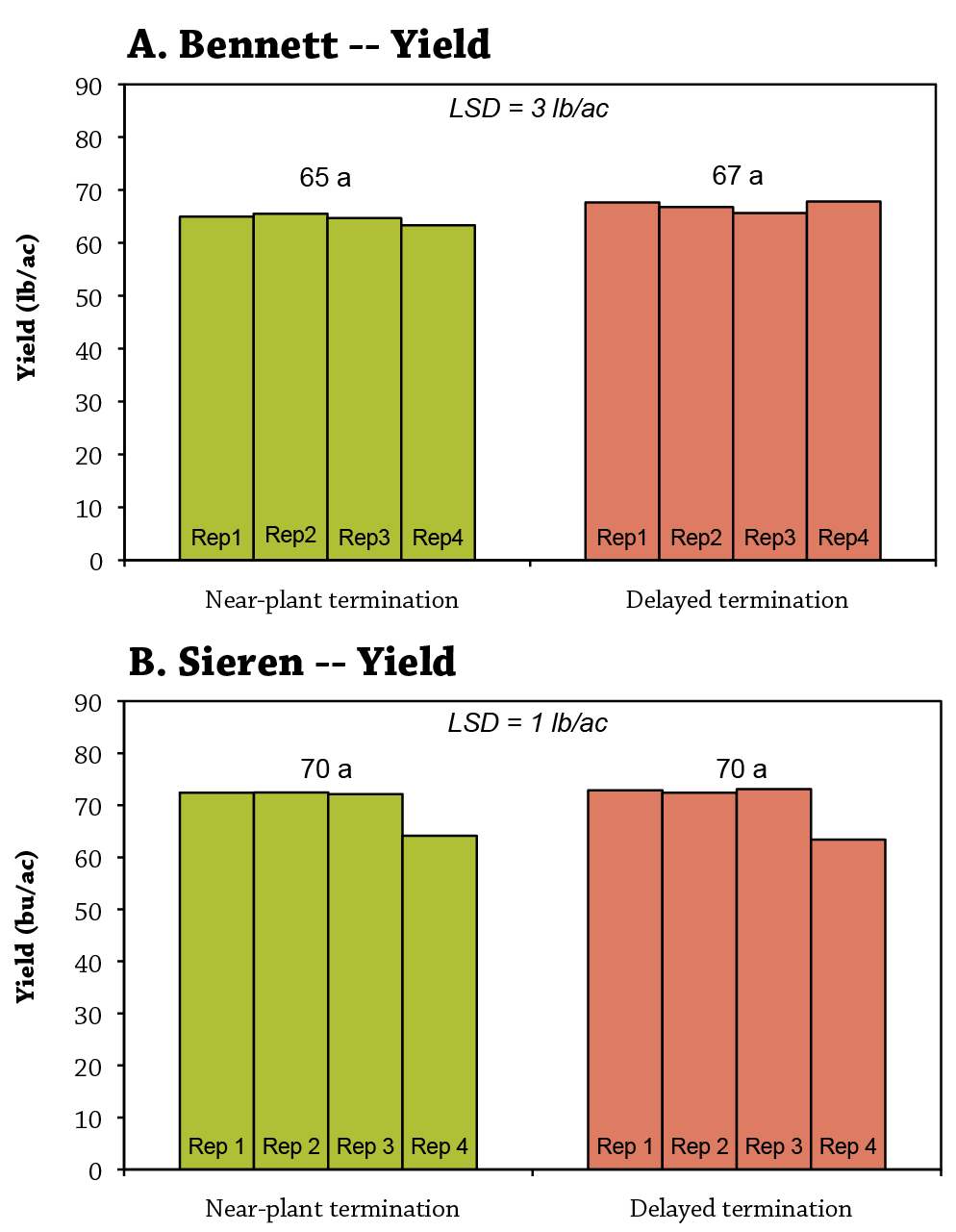
 at Bennett’s and Sieren’s was not reduced by delaying termination of rye (Figure 4). At Bennett’s, yields averaged 65 lb/ac and 67 lb/ac in the near-plant and delayed termination treatments, respectively. At Sieren’s, yields in the near-plant and delayed termination treatments each averaged 70 lb/ac. Despite the reduction in soybean stand counts at Sieren’s, his soybean yield remained unaffected by delaying termination.
Soybean yield
Soybean yield at Bennett’s and Sieren’s was not reduced by delaying termination of rye (Figure 4). At Bennett’s, yields averaged 65 lb/ac and 67 lb/ac in the near-plant and delayed termination treatments, respectively. At Sieren’s, yields in the near-plant and delayed termination treatments each averaged 70 lb/ac. Despite the reduction in soybean stand counts at Sieren’s, his soybean yield remained unaffected by delaying termination.
Conclusions and Next Steps
Appendix – Trial Design and Weather Conditions

References
- Gailans, S. and S. Bennett. 2019. Cereal Rye Cover Crop for Reducing Herbicides in Soybeans. Practical Farmers of Iowa Cooperators’ Program. https://practicalfarmers.org/research/cereal-rye-cover-crop-for-reducing-herbicides-in-soybeans-2019/ (accessed March 2020).
- Nelson, H. and S. Bennett. 2018. Cereal Rye Cover Crop for Reducing Herbicides in Soybeans. Practical Farmers of Iowa Cooperators’ Program. https://practicalfarmers.org/research/cereal-rye-cover-crop-for-reducing-herbicides-in-soybeans/ (accessed March 2020).
- Basche, A.D. and M.S. DeLonge. 2019. Comparing infiltration rates in soils managed with conventional and alternative farming methods: A meta-analysis. PLOS ONE. 14: http://dx.plos.org/10.1371/journal.pone.0215702 (accessed February 2020).
- USDA Natural Resource Conservation Service. 2019. NRCS Cover Crop Termination Guidelines. Version 4. https://www.rma.usda.gov/en/Topics/Cover-Crops (accessed March 2020).
- Gailans, S., J. Boyer and T. Sieren. 2018. Terminating Cereal Rye Cover Crops After Planting Soybeans. Practical Farmers of Iowa Cooperators’ Program. https://practicalfarmers.org/research/terminating-cereal-rye-cover-crops-after-planting-soybeans/ (accessed April 2020).
- Iowa Environmental Mesonet. 2020. IEM “Climodat” Reports. Iowa State University Department of Agronomy. http://mesonet.agron.iastate.edu/climodat/ (accessed March 2020).