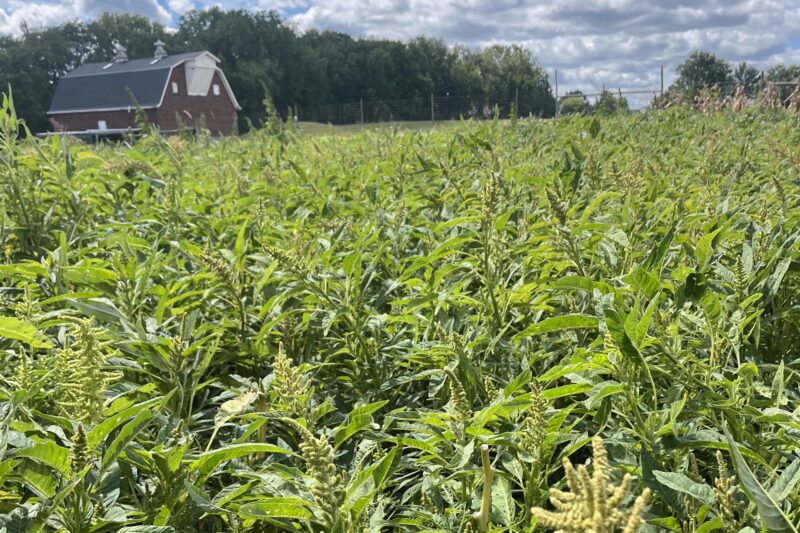
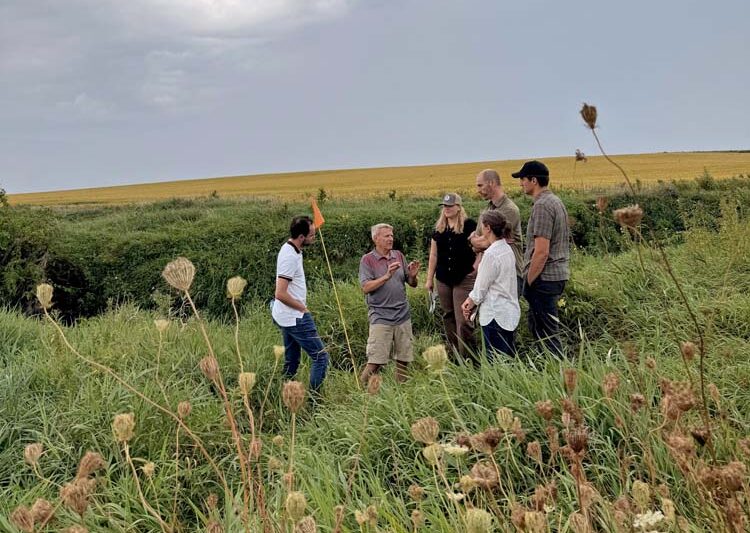
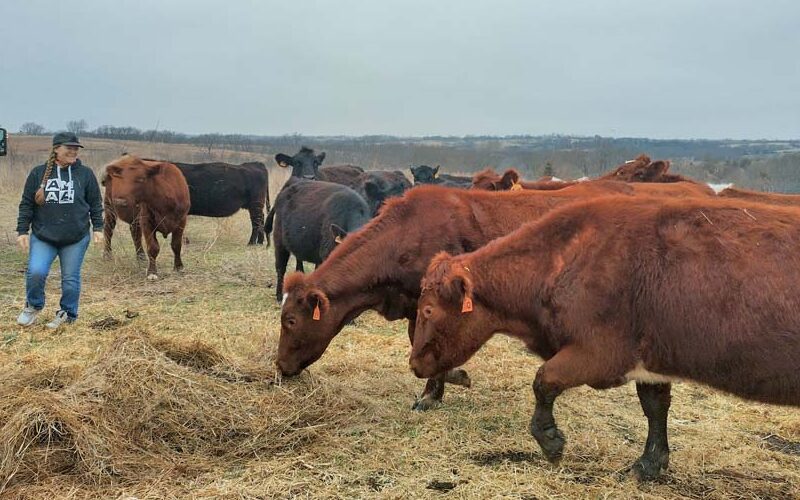
The Ackleys have been members of PFI for more than 15 years – but they have served as sustainable agriculture leaders for decades, modeling thoughtful soil stewardship and regenerative farming practices, and serving as inspiration and mentors to countless farmers over the years. In addition to using cover crops on all their crop acres, they have been completely no-till for 30 years and practice rotational grazing to help nurture soil health. They have also installed terraces, wetlands, grassed waterways and riparian buffers to minimize erosion and provide wildlife habitat.
“Paul was a long-time soil health and regenerative agriculture advocate well before it was a hot topic,” says Colten Catterton of Green Cover Seed, who presented the award to Paul during the virtual award ceremony. “He's a modest man that never boasts and doesn't claim to know everything, but rather has an insatiable thirst for knowledge that is contagious.”
The Ackleys have been members of PFI for more than 15 years – but they have served as sustainable agriculture leaders for decades, modeling thoughtful soil stewardship and regenerative farming practices, and serving as inspiration and mentors to countless farmers over the years. In addition to using cover crops on all their crop acres, they have been completely no-till for 30 years and practice rotational grazing to help nurture soil health. They have also installed terraces, wetlands, grassed waterways and riparian buffers to minimize erosion and provide wildlife habitat.
“Paul was a long-time soil health and regenerative agriculture advocate well before it was a hot topic,” says Colten Catterton of Green Cover Seed, who presented the award to Paul during the virtual award ceremony. “He's a modest man that never boasts and doesn't claim to know everything, but rather has an insatiable thirst for knowledge that is contagious.”
A Lifelong Focus on Soil Health
While Paul's farming practices and philosophies have evolved over time, his concern for soil health is deeply rooted – and has always been a key barometer driving change on the farm. As an only child growing up, he recalls his parents sharing their memories of the devastating effects of the Dust Bowl, and their awareness of the perils to the soil of focusing too heavily on one crop. “My mother would talk about the sky being red with dust, and Dad kept as much ground seeded as possible, because he was very aware of what rainfall could do,” says Paul, who also serves as soil commissioner for the Taylor County Soil and Water Conservation District.“I don't think just stopping erosion is enough. We need more life in the soil . . . . We need to re-store some of the wealth, the organic matter we've pulled out.” – Paul AckleyThree months after graduating from Iowa State University in 1967 with a degree in farm operations, he was drafted into the Army, married Nancy and relocated to Kentucky for six months while in the service. But he always knew he wanted to farm, and in 1969, he and Nancy returned home to Bedford. Having grown up on a diversified farm that included small grains and hay, Paul says he and Nancy felt they needed a crop rotation with perennials in it. But he also came of age at a time in the 1950s and ‘60s when many farmers in his community were getting out of farming. The stream of farm sales over the years left an imprint, pitting financial survival against Paul's instincts to let the condition of his soil guide his actions. “I remember seeing so many closing-out farm sales during the winter in our local paper from the mid-1950s, when I started reading it, until 1963 when I graduated from high school,” Paul says. “I wanted to be a ‘stayer,' and so profit and financial survival rose to the top instead of being equal to the other two pillars of farming – that it does no harm to our neighbors, and restores and regenerates our soil resource.” This initial concern of getting started in farming – and, most importantly, surviving as a farmer for the long-term – led Paul and Nancy to drop perennials from their crop rotation, experiment with continuous corn and start using herbicides and insecticides. But the health of the soil was never far from Paul's mind, and he carefully observed how the soil responded to the profit-centered changes introduced on the farm. “When we started to drop perennials, I wondered how it was going to work,” Paul says. “It worked all right for a while, and then the soil lost its structure and ability to take rainfall rather quickly. It just didn't have any life in it.” These observations would start the process of leading Paul back to the path of holistic soil stewardship – and to a realization that healthy soil was as important to being a “stayer” as making a profit.