In a Nutshell:
- Many berry farmers package their berries in vented clamshell containers, but consumer advice suggests that sealed containers may better preserve berry quality.
- Kim Andersen and Aaron Wills conducted trials assessing strawberry shelf life in four different packaging types: vented containers, unvented plastic clamshells, mason jars and vacuum-sealed mason jars.
Key Findings:
- Both Andersen and Wills found that strawberry shelf life was enhanced by storage in unvented containers compared to vented clamshells. They reported strawberries remained salable for 2-5 days longer in unvented containers, with variation by container type, berry variety and berry quality.
- Condensation affected storage quality of all three unvented options. Both farmers reported a need to cool berries down before packaging in unvented containers to minimize condensation.
Background
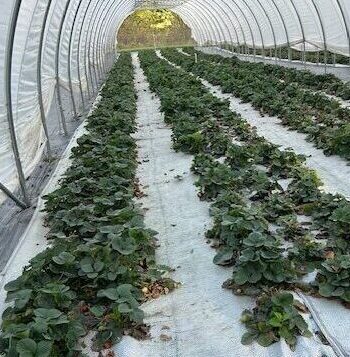
Produce going bad before you get it to market is a costly problem for farmers of fragile, high-value crops like strawberries. After hearing consumer advice about storing berries in vacuum-sealed jars for improved shelf life, Kim Andersen wondered whether switching from traditional vented clamshells to sealed packaging could be useful for extending strawberry shelf life on her farm. Andersen talked to fellow strawberry farmer Aaron Wills and they decided that a research trial would be a good way to investigate whether sealed containers could preserve berries for longer than vented clamshells.
Methods
Design
Andersen and Wills packed four replicates of four different one-quart strawberry packaging types and observed berry visual quality and taste daily until they were on the cusp of being too far deteriorated to process. Both farmers used one-quart vented plastic clamshells as their control treatment. Though Wills typically packs strawberries in open pulp containers for immediate sale, he chose not to include this packaging type in his study because he already knew that shelf life in the pulp containers is poor. Both farmers then tested three one-quart unvented packaging methods: unvented plastic clamshells, mason jars and vacuum sealed mason jars. They repeated the trial on two dates (one in August and one in September) to see if results were consistent across their harvest season. Andersen notes that while she filled containers full in the August iteration of the trial, this took a lot of berries, so she only filled containers halfway in the September iteration.
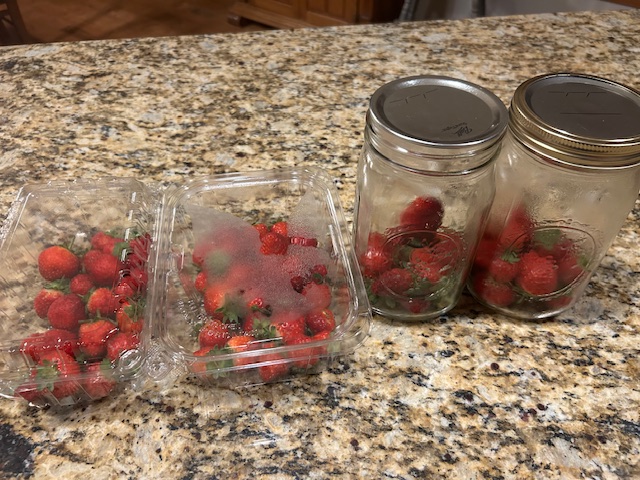
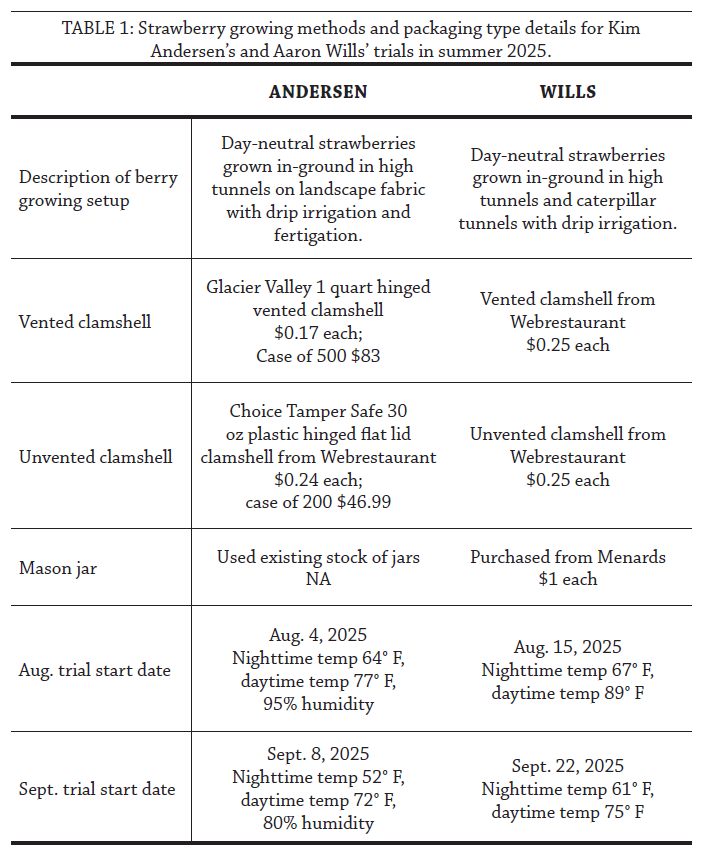
Growing details and packaging prices are included in Table 1. Jars were vacuum sealed using a household electric vacuum jar sealer that cost $30 on Amazon.
Results and Discussion
Generally, vented clamshells performed worse than all three unvented containers in terms of salable shelf life and processible shelf life (Figure 1). One exception, however, is that in her September trial Andersen found that both mason jar treatments performed just as poorly as vented clamshells, likely due to condensation in jars. Otherwise, neither Andersen nor Wills observed differences in packaging method efficacy between their August and September trials.

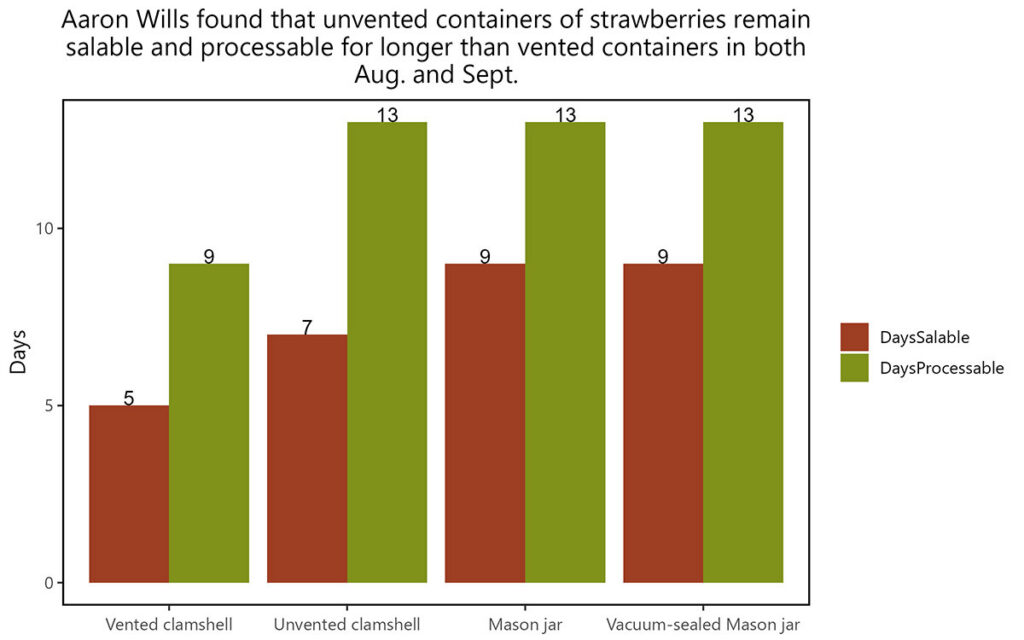
There was not a clear winner in the unvented packaging category across farms and trial dates. Mason jars were at least four times as expensive as the unvented plastic containers. Wills noted that the berries in the mason jar and vacuum-sealed mason jar continued to look nice for many days longer than the berries in the unvented clamshell, but the flavor deteriorated at a similar schedule. So, the nice-looking berries were nevertheless only salable for two additional days and had the same processable shelf life as the less expensive unvented plastic clamshells. Andersen saw similar results in her August trial, with berries in mason jars lasting days longer in top condition than those in unvented clamshells. However, in September she had more issues with condensation in her berries in mason jars, and those berries were only salable for 3 days compared to 7 days in an unvented clamshell.
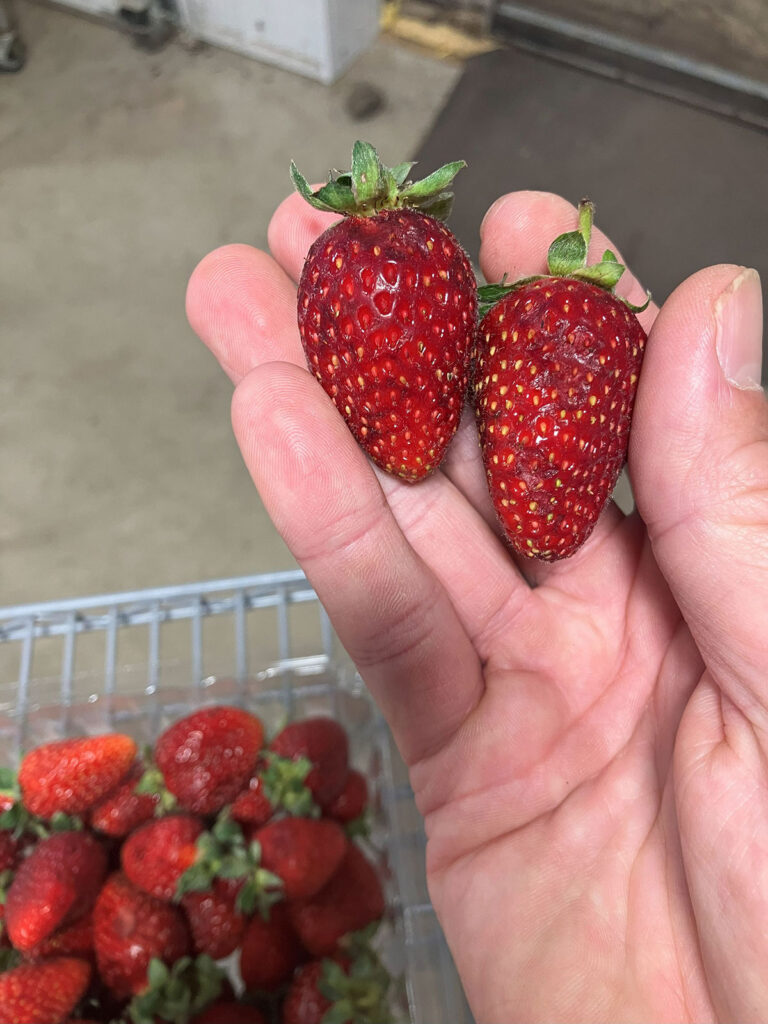

As is often the case during cooperators’ trials, farmers reported that they learned about more than packaging, the studied outcome, during the course of the trial. “Although this trial was not about variety of strawberry, we noted that Monterey held up best after packaging and Evie II was the first to start to ferment,” Andersen said. She also said that during the course of the trial, she learned just how important it is to cool down her berries before packaging to prevent condensation and further shelf life. She does this by spreading them out on cookie sheets in a cool basement. Wills echoes the importance of cooling down berries and says that he does so in vented hexagon pails in the cooler before packaging.
Conclusions and Next Steps
After seeing trial results, Andersen will now “change to unvented containers to extend shelf life for selling fresh strawberries.” While she was previously able to freeze or process berries into value-added products before they went bad, she would rather sell fresh fruit as it reduces her labor costs. Similarly, Wills says that “I had a sense that the vented pulp containers we use aren't the best for the longevity of our berries. This trial helped us quantify how much improvement in quality we could see by switching to different containers.” While he does not plan to switch packaging methods now, he may do so when he scales up his strawberry production in the future. He reports that support from PFI and collaboration with Andersen were the most valuable aspects of the trial.