Funding provided by the Walton Family Foundation.
In a Nutshell:
- Many vegetable seed companies offer horticulture farms small contracts to grow vegetable seeds for them. Many farmers see seed contracts as a good way to diversify their farm enterprises, learn a new skill, and/or just try something different.
- For those who have not grown seed for a particular vegetable before, it can be hard to tell if the contracted payment is worth the space and labor required for growing, harvesting and processing vegetable seeds.
- After finding in 2024 that growing tomato seed for contract was less profitable than growing tomatoes for sale, Hannah Breckbill repeated her enterprise budget trial in 2025 growing cucumbers for seed contract vs. for sale.
- Carly and Ethan Zierke joined the project and conducted an enterprise budget trial growing tomatoes for seed vs. for sale.
Key Findings:
- Both Breckbill and the Zierkes found that growing seed for their respective contracts was profitable after accounting for all costs, but less profitable than growing for direct market sales.
- Breckbill made $0.38/row ft on cucumber seed compared to $0.70/row ft on direct-to-consumer sales. She plans to grow cucumber seed for contract again in the future, though not as much as in 2025.
- The Zierkes made $0.56/ft2 growing tomato seed and $2.37/ft2 on direct-to-consumer sales. They would consider growing tomatoes for seed again if the contract price was a bit higher or the tomato variety available produced more seed per pound of fruit.
Background
Many seed companies contract horticulture farmers to grow open-pollinated vegetable seed. Farmers sign a contract with the company to produce a goal weight of seed, and companies agree to purchase the seed for a set rate after cleaning and germination rate testing.
For most types of vegetables, farmers must carefully follow the company’s distancing requirements to ensure that their plants grown for seed do not cross-pollinate with another variety of the same crop. Though companies sometimes include recommendations for how much seed will be produced per plant, it is up to the farmer to determine how many plants they need to fill their contract and what growing, seed collecting and processing methods to use. They also must determine whether the fixed price received from the seed company is enough to make the enterprise economically viable [1].
In 2024, Hannah Breckbill and Emily Fagan conducted an enterprise budget trial to evaluate the economics of growing tomatoes for a seed contract vs. for sale to consumers. They found that after accounting for all supplies, labor and infrastructure use, tomatoes for sale had a net income of $1,263 while tomatoes for seed had a net income of -$59 [2]. Though these results were disappointing, they were not deterred from the whole idea of growing seeds for contract, and in 2025 decided to repeat their trial and grow for a cucumber seed contract. Breckbill hoped that “this trial will give us more information about the financial viability of our seed production enterprises, which will help us decide whether to take on future seed contracts and for what crops.”
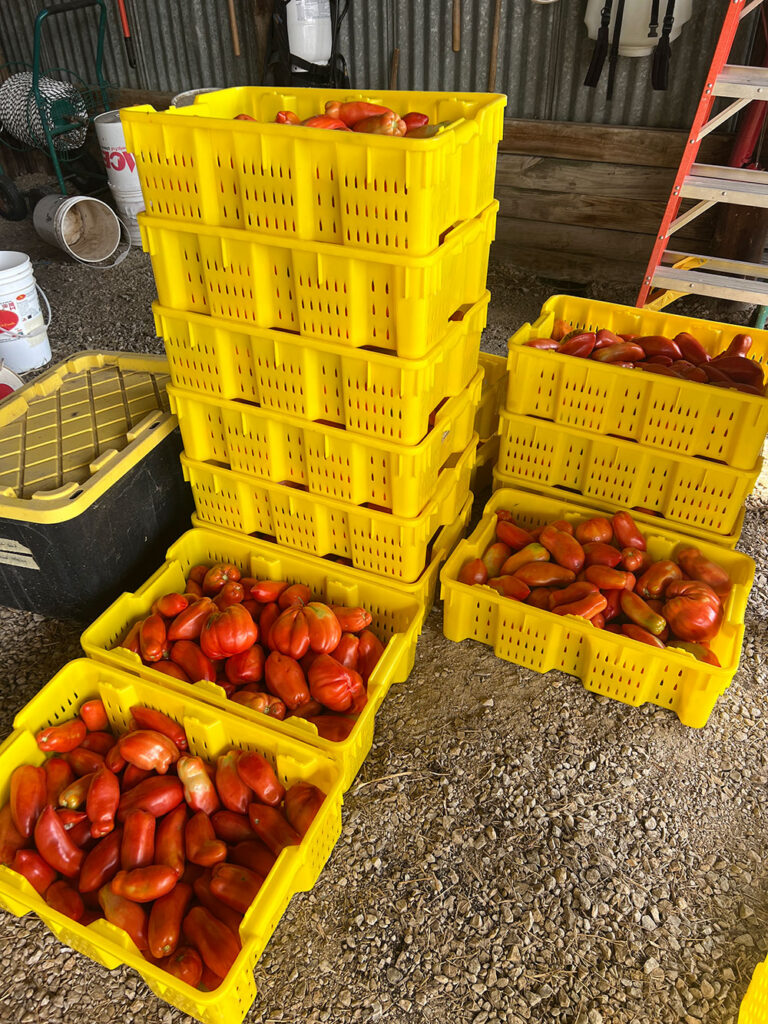
Carly and Ethan Zierke also decided to conduct a trial in 2025, growing seed for a paste tomato variety for contract. Carly reported that “having contracted income, like with seed work, is really helpful to our farm because we're in a rural environment with limited access to fresh markets. The results of this trial will help us know whether our seed enterprise is working for our farm.”
Methods
Design
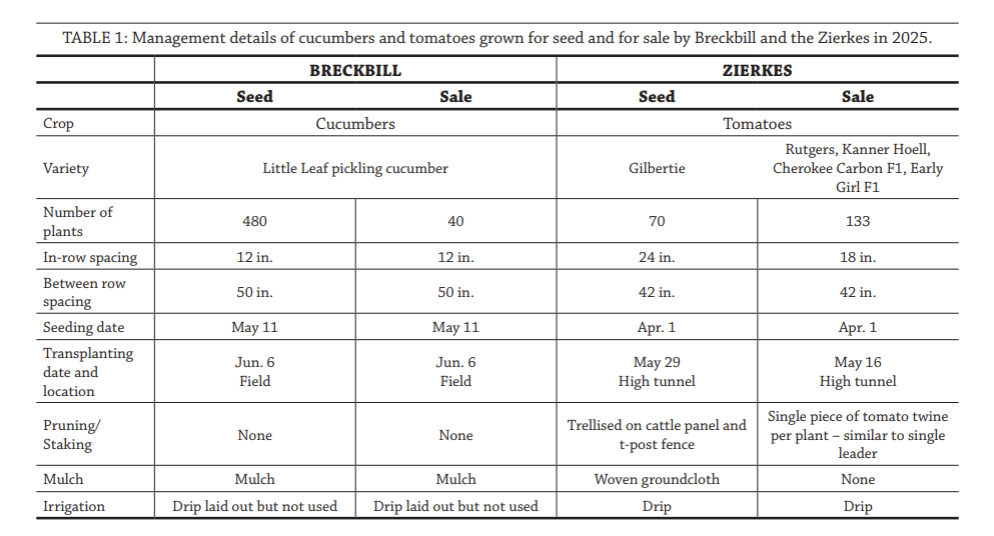
For this enterprise budget, Breckbill and the Zierkes did not replicate their treatments. Breckbill grew the same variety of cucumber for seed and for sale and simply split the bed into sections for the two separate enterprises. The Zierkes grew different varieties and numbers of tomatoes for seed vs. for sale and used slightly different spacing and trellising methods but grew both types of tomatoes in a high tunnel to maximize production in a limited space. Management details including number of plants grown in each treatment is shown in Table 1.
Measurements
Breckbill and the Zierkes tracked all costs and labor time related to seeding, bed preparation, transplanting, plant care, harvest and post-processing for seed or time spent on sale of cucumbers and tomatoes. The farmers both included the cost of their own labor and any hired labor at $15/hour.
Results and Discussion
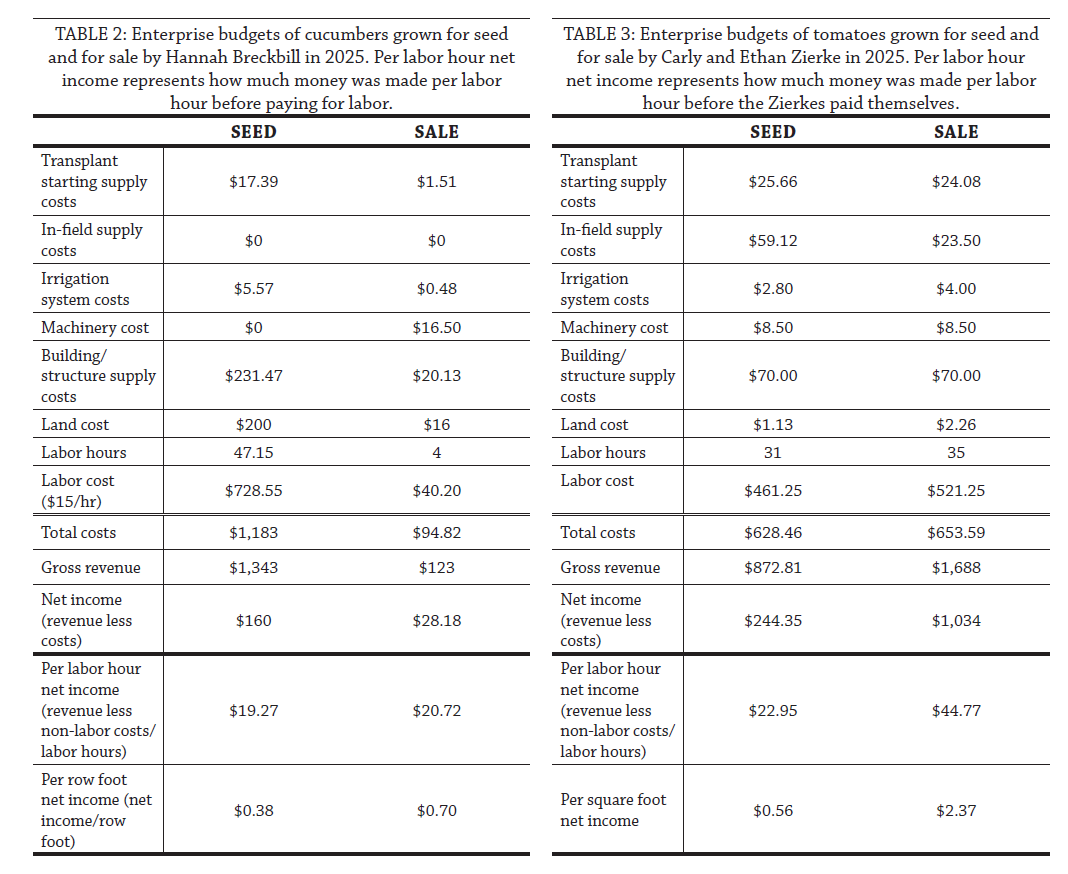
Breckbill was able to produce 23.5 lb of quality cucumber seed worth $1,343 from about 480 row ft of cucumber and also harvested cucumbers from 40 row ft that they sold for $123. They “learned that both marketing cucumbers for seed and marketing them for fresh eating were profitable, and that marketing them for seed was less profitable on a per row foot basis ($0.38/row ft) than direct to consumer ($0.70/row ft)” (Table 2). However, income made per labor hour before paying for labor was similar between the seed ($19.72/hour) and direct to consumer ($20.72/hour) enterprises.
Breckbill notes that these conclusions were not surprising to them, but that they are glad to have data from the trial to back up their assumptions. “We're trying to refine our seed production techniques, and it feels worthwhile to have some solid enterprise budget data to know where we can tweak our system to get the best bang for our buck.” They also think that processing cucumber seeds will be faster in the future now that they have had some practice. While Breckbill enjoyed processing the seed, some employees did not, so she warns others that cucumber seed contracts might not be for everyone.
The Zierkes similarly found that both their seed and direct-to-consumer tomato enterprises were profitable in 2025. They harvested and processed 1,505 lb of tomatoes for seed, producing 1.75 lb of seed sold which they sold for $875. They also harvested 713 lb. of tomatoes for sale and made $1,688 selling to consumers. After accounting for supply, machinery, building, land, and labor expenses, they made $244 on their seed enterprise and $1,034 on their direct-to-consumer sale enterprise. This worked out to $0.56 of profit per square foot of growing space in the seed enterprise and $2.37 of profit per square foot of growing space in the sale enterprise (Table 3). Their per labor hour profit was also much higher in the sale ($44.77/hour) compared to seed ($22.95/hour) enterprises.
Carly Zierke concluded that while conducting the enterprise budget trial was a challenge, the results were even more useful than she expected. The trial helped them identify places where they want to improve in both tomato enterprises: avoiding shrink with direct-to-consumer sales and choosing tomato varieties with higher seed yields and taking a closer look at the per pound contracted rate for seed production. Finally, Carly notes that seeing the profitability of both tomato enterprises was a confidence boost. “Tomatoes don't always feel like a big winner on our farm, even though they're my favorite to grow, so it's good to see in black and white that it is working!”
Conclusions and Next Steps
Both farms were pleased to learn that they could make money growing seed for contract, but not as much as with direct-to-consumer vegetable sales.
Breckbill expects that they will continue to grow cucumber seed for contract, though likely not as much as in 2025, and potentially try other vegetable crops as well.
The Zierkes repored that they would consider another tomato seed contract in the future, especially one offering a higher price per pound of seed, but that the trial “helped us learn that our fresh eating tomatoes are likely the better focus for our farm, so long as we are direct marketing food.”
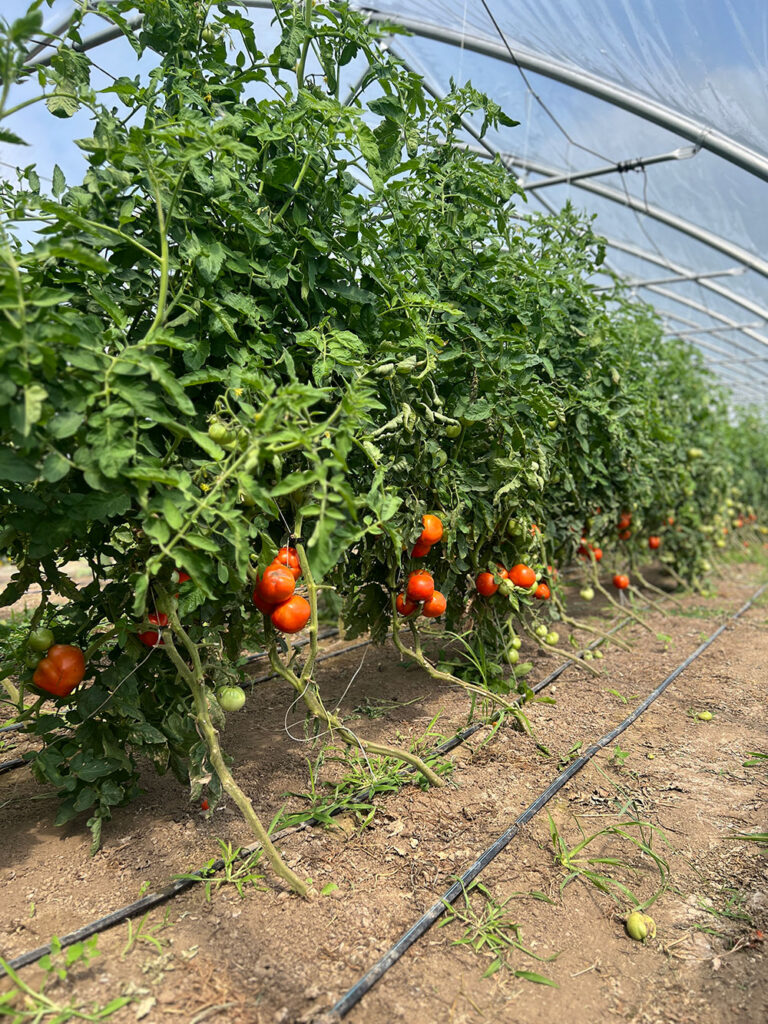
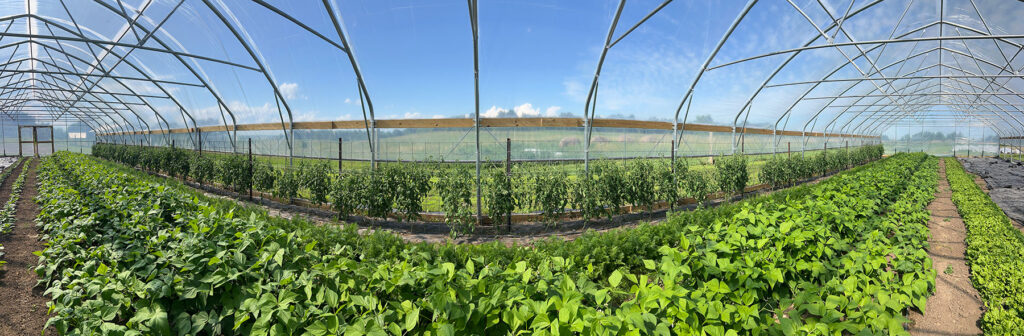
a high tunnel to increase plant productivity and reduce the total amount of growing
space required.
Appendix - Weather Conditions
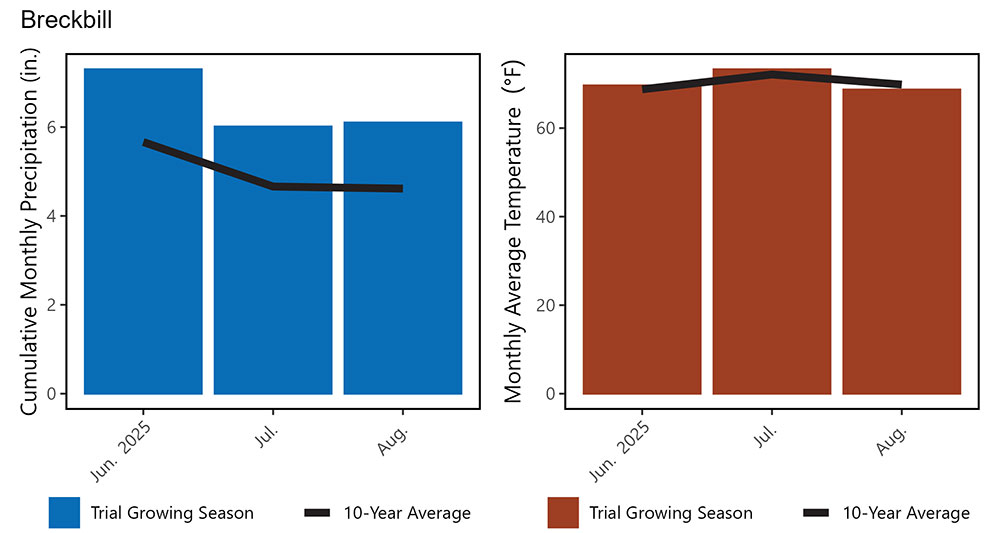
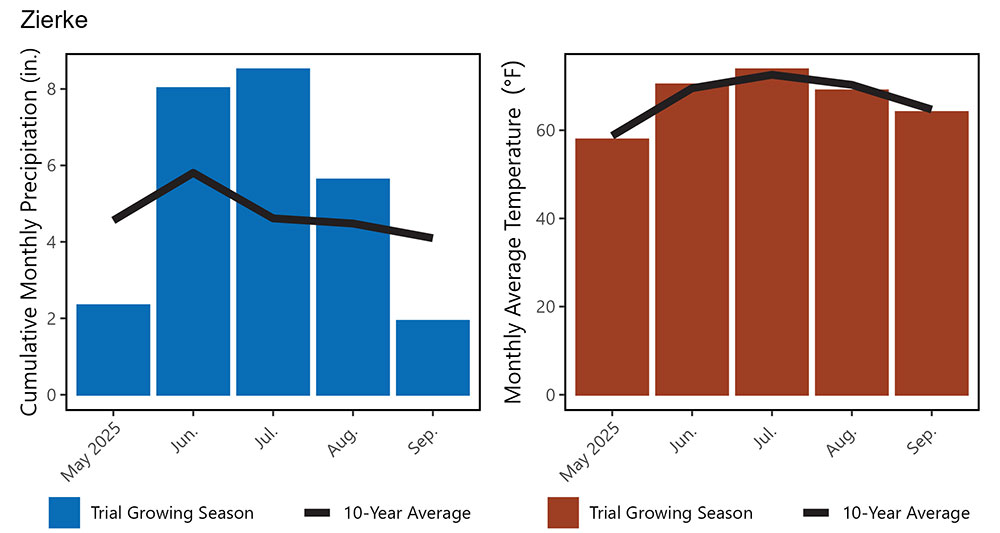
Calmar (Zierkes) [3], [4]. Click to enlarge.
References
- “Contracting in Agriculture: Making the Right Decision. Information For Farmers from USDA.” 2016. [Online]. Available: https://www.fsa.usda.gov/sites/default/files/documents/2016%20Drake%20FSA%20NSAC%20Production%20Contracts%20Guide.pdf
- H. Breckbill, E. Fagan, and E. Link, “Growing tomatoes for sale vs. seed,” Practical Farmers of Iowa, 2024.
- A. H. Sparks, “nasapower: A NASA POWER Global Meteorology, Surface Solar Energy and Climatology Data Client for R,” J. Open Source Softw., vol. 3, no. 30, p. 1035, Oct. 2018, doi: 10.21105/joss.01035.
- A. H. Sparks et al., nasapower: NASA POWER API Client. (May 18, 2024). Accessed: Sep. 11, 2024. [Online]. Available: https://cran.r-project.org/web/packages/nasapower/index.html