
Program Overview
Extended crop rotations enhance soil quality and provide a pathway to reduce reliance on synthetic inputs. Practical Farmers of Iowa supports farmers using extended crop rotations by providing cost-share for the following extended rotation practices:
Receive $20 per acre per cost-share option. You may participate in one or both of the following scenarios:
1. Small grains cost-share
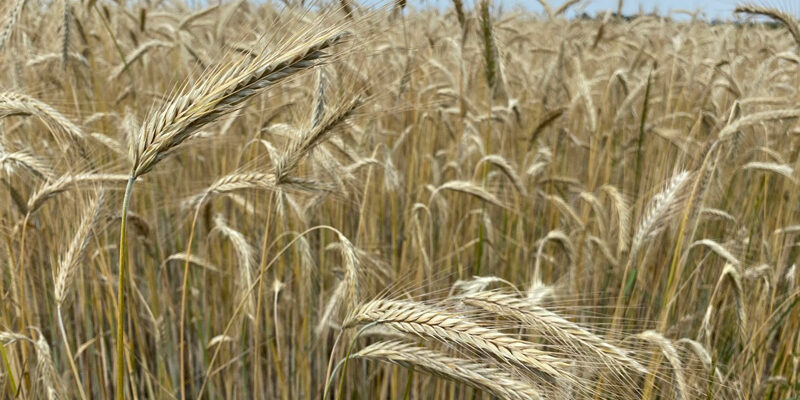
- Raise a small grain (oats, cereal rye, barley, wheat, triticale) that will be harvested as grain or forage in 2027, and follow it with a frost-seeded or summer-planted cover crop that contains at least one legume species.
- Note: Double-cropping soybeans and relay-cropping soybeans are not eligible for this cost-share. Hay and other forages are eligible if they contain a small grain and a legume.
2. Reduction of applied nitrogen on corn cost-share
- On 2027 corn following a small grain plus cover crop or leguminous hay crop in your rotation, reduce your applied nitrogen rate to corn by 40 pounds of nitrogen per acre compared to your typical nitrogen rate in a corn-soy rotation OR apply no more than 100 pounds of nitrogen per acre to corn harvested in 2027 that followed a small grain plus cover crop or leguminous hay crop in your rotation.
Frequently Asked Questions
Any legume species qualify—including if the legume constitutes just a part of a mix. Commonly used legume cover crop species include clover, alfalfa, vetch, peas or sunn hemp. If you’d like to discuss what species might be a good option to meet your goals, sign up for a phone call consultation.
Any nitrogen applied via synthetic fertilizer sources or through manure is counted in your application rates. If you do not have a manure analysis, we will use book values from Iowa State University and the University of Minnesota to estimate your applied nitrogen. Biological products or legume credits are not calculated into your typical applied nitrogen rate.
Privately funded cost-share payments and carbon outcomes program payments are NOT stackable on acres enrolled in PFI’s extended rotations cost-share. Acres enrolled in PFI’s fall cover crop cost-share are also NOT stackable.
Acres enrolled in carbon programs or privately funded cost-share programs are not eligible for PFI cost-share on the same acres, even if the program is paying for different practices. For most programs, you can be enrolled in both programs, just not paid on the same acres.
It is okay with PFI if you enroll in both PFI’s cost-share and a different privately-funded outcomes program, so long as the same fields are not enrolled in both programs. If you are unsure if programs are stackable, please reach out!
Federal or state cost-share program payments, such as EQIP or CSP, are stackable on PFI’s extended rotations cost-share. Stacking PFI cost-share on public programs is encouraged!
No, you’re encouraged to apply as soon as you can. You will confirm the final number of acres eligible for either cost-share practice in the wrap-up survey in August or September.
The program funders do not buy organic corn or soybeans in the region, so to be eligible, only non-organic land is eligible. Acres transitioning to organic are eligible.