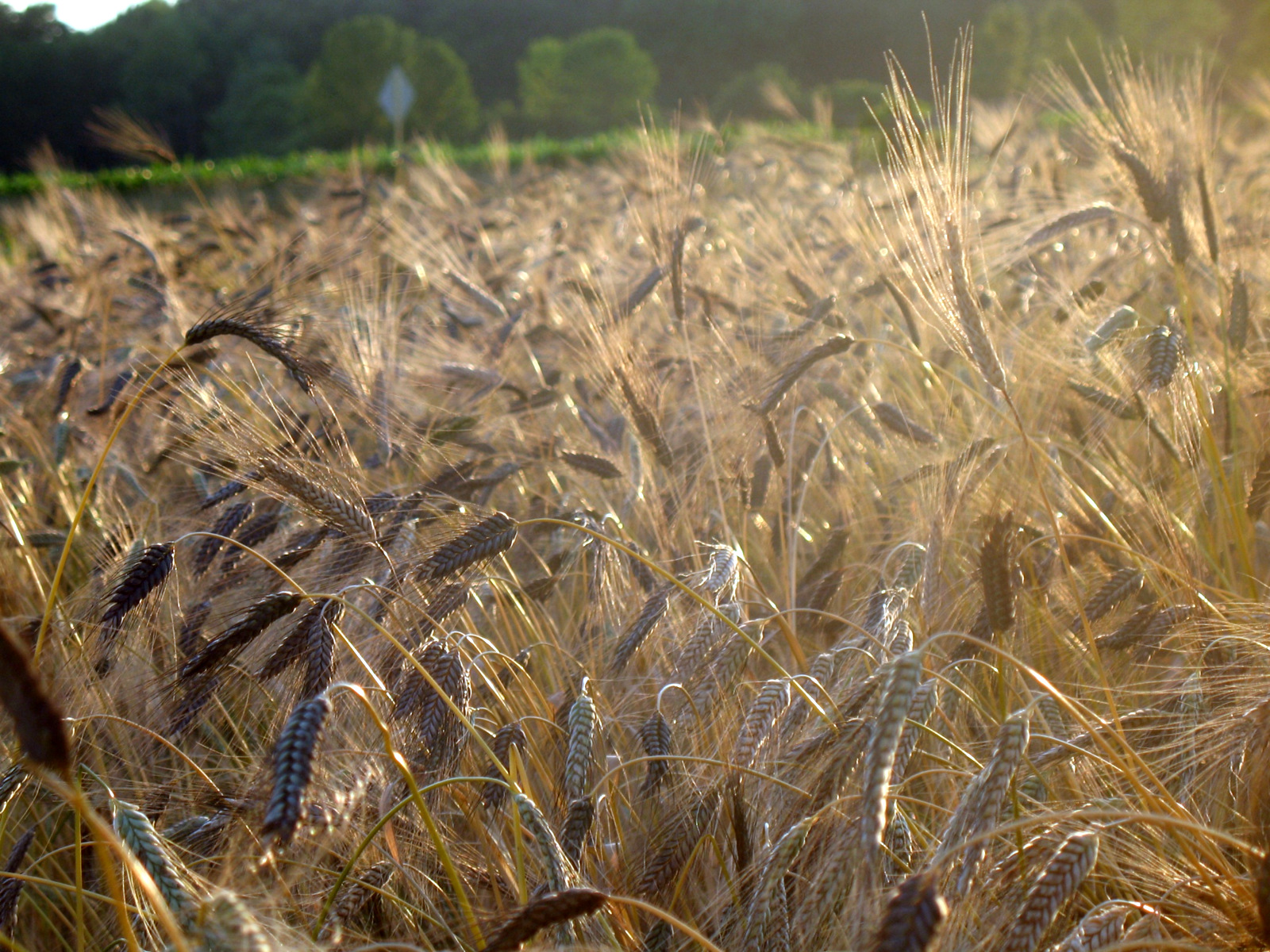
 In the U.S., several classes of wheat are available, including: hard red, winter hard, hard red spring, soft red winter, hard white, soft white and durum. In the Corn Belt, hard red winter wheat and soft red winter wheat are best suited for both grain production and livestock feed purposes.
Nutritional Quality and Health Benefits
Compared to corn, wheat has a lower energy content. Both soft and hard red winter wheat contain more crude protein, lysine and phosphorus, and the latter is also more bioavailable to pigs than corn.| Nutrient analysis comparing corn and wheat (as-fed basis) | |||
| Corn | Hard Red Winter Wheat | Soft Red Winter Wheat | |
| Crude Protein (%) | 8.3 | 13.5 | 11.5 |
| Energy (ME, kcal/kg) | 3,420 | 3,210 | 3,305 |
| Lysine (%) | 0.26 | 0.34 | 0.38 |
| NDF (%) | 9.6 | 13.5 | - |
| ADF (%) | 2.8 | 4.0 | 0.04 |
| Calcium (%) | 0.03 | 0.06 | 0.39 |
| Phosphorus (%) | 0.28 | 0.37 | 0.39 |
| Bioavailability of Phosphorus (%) | 14.0 | 50.0 | 50.0 |
Feeding Wheat in Different Production Phases
Wheat can replace corn entirely in pig rations across all production phases – keeping in mind to balance for lysine and protein. Experts recommend that wheat occupy no more than 90 percent of gestating sow rations and no more than 95 percent for grow-finish rations “Smithfield is not afraid to use it in any stage of production,” Terry says, “Be cautious about feeding lactating sows, to make sure they do not get off feed due to a new ingredient.” He says that with gestating sows, it is important to remember that adding even 20 percent wheat to the ration can change the bulk density of the sow's diet. “It would be primary to use wheat in the grow-finishing phase more than other phases of production,” he says.| Grain | Starters (less than 60 lbs.) | Grow-Finish (125 - 250+ lbs.) | Gestating Sows | Lactating Sows |
| Wheat | <45% | <95% | <90% | <40% |
How Much Should You Pay for Wheat?
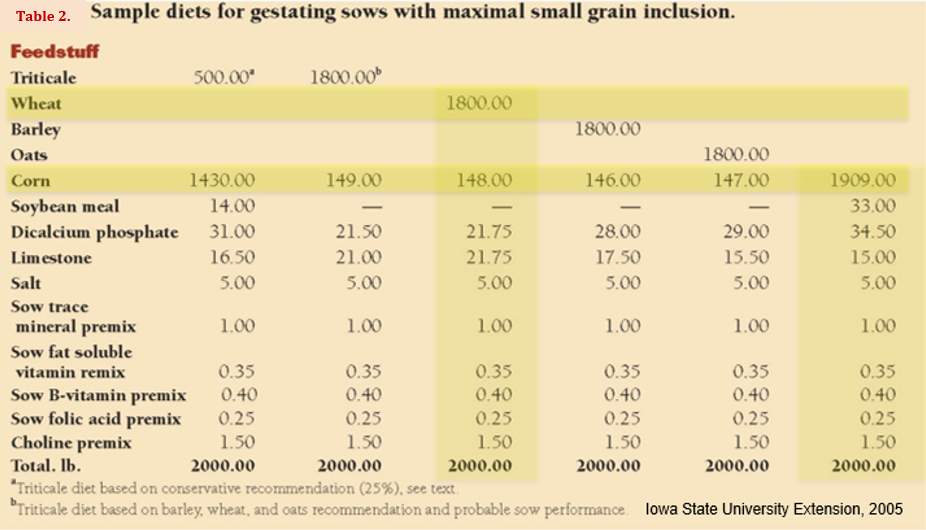
The value of any small grains species should be based on the nutrients it contributes to the ration – especially digestibility – minus the purchase cost. As of January, corn was priced at $3.83 per bushel and wheat at $5.16 per bushel. From January to October 2018, hard red winter wheat cost an average of $1.39 per bushel more than corn, while soft red winter wheat cost an average of $1.43 per bushel more than corn.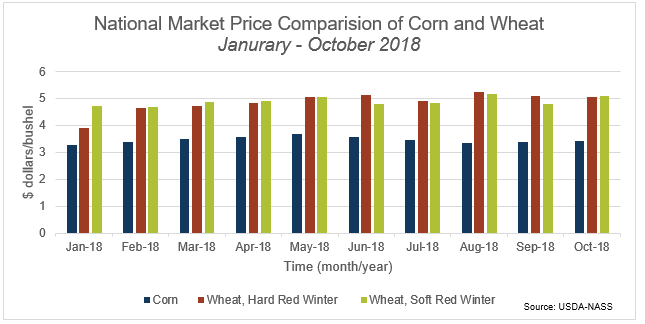 When you look at the tables 1 and 2, you'll see that rations with wheat are more expensive than rations without. However, when planted in rotation with corn and soybean, wheat keeps a living cover to help protect soil and water quality. Along with these environmental benefits, growing wheat in corn-soybean rotations can reduce other costs, such as input costs, and improve yields of the cash crops.
Feeding wheat in rations entirely or with moderate inclusions can also lower feed costs. Terry notes that including 10 percent wheat in your ration means less lysine and phosphorus is needed. “These lower amounts of ingredients contribute to the math that can save you money,” he says. “If you can grow your feed economically, wheat planted right after corn gives you a positive feed value by rotating crops on the land. Once the math of crop production works, then the feeding part is easy – wheat makes an excellent feed for pigs.”
Using the Wheat Price Estimator, developed by Beob Kim and Hans Stein at the University of Illinois Urbana- Champaign, is another way to assess and calculate the cost of replacing corn with wheat in swine diets.
When you look at the tables 1 and 2, you'll see that rations with wheat are more expensive than rations without. However, when planted in rotation with corn and soybean, wheat keeps a living cover to help protect soil and water quality. Along with these environmental benefits, growing wheat in corn-soybean rotations can reduce other costs, such as input costs, and improve yields of the cash crops.
Feeding wheat in rations entirely or with moderate inclusions can also lower feed costs. Terry notes that including 10 percent wheat in your ration means less lysine and phosphorus is needed. “These lower amounts of ingredients contribute to the math that can save you money,” he says. “If you can grow your feed economically, wheat planted right after corn gives you a positive feed value by rotating crops on the land. Once the math of crop production works, then the feeding part is easy – wheat makes an excellent feed for pigs.”
Using the Wheat Price Estimator, developed by Beob Kim and Hans Stein at the University of Illinois Urbana- Champaign, is another way to assess and calculate the cost of replacing corn with wheat in swine diets.

| Finishing Pigs | High | Low |
| Wheat | $152.13 | $43.00 |
| Corn | $13.33 | $83.09 |
| Total | $165.46 | $126.09 |
| Inclusion Rates of Wheat: High level, 88% and low level, 25% | ||
| Gestating Sows | Corn | Wheat and Corn |
| Total | $130.56 | $164.92 |
|
Inclusion Rates of Wheat: 90% |
||
Other blogs in our feeding small grains to pigs series: feeding Barley to pigs Feeding Oats to Pigs Feeding Rye to Pigs feeding Triticale to pigs Feeding Small Grains to Pigs