In a Nutshell:
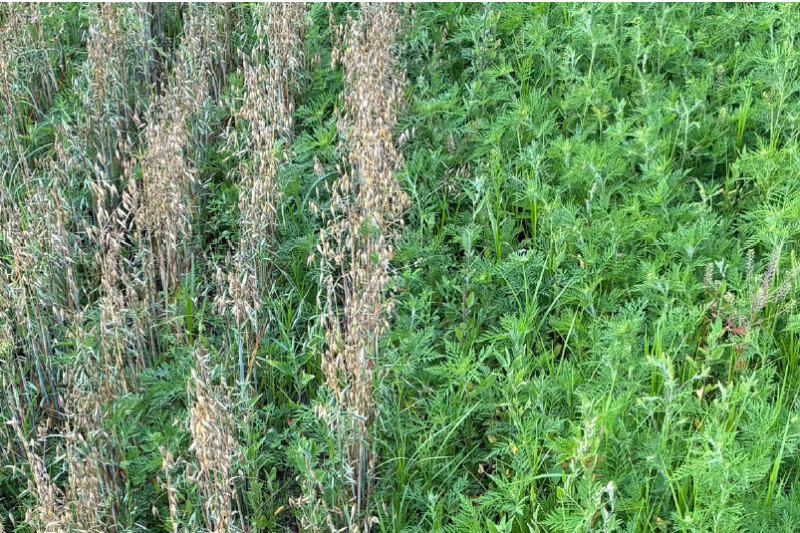
- In recent years, several farmers have wondered about using clover as a companion cover crop or “living mulch” with corn. Such a strategy would increase the amount of time a legume cover crop is present in a crop rotation and possibly reduce the need to re-seed a cover crop each year.
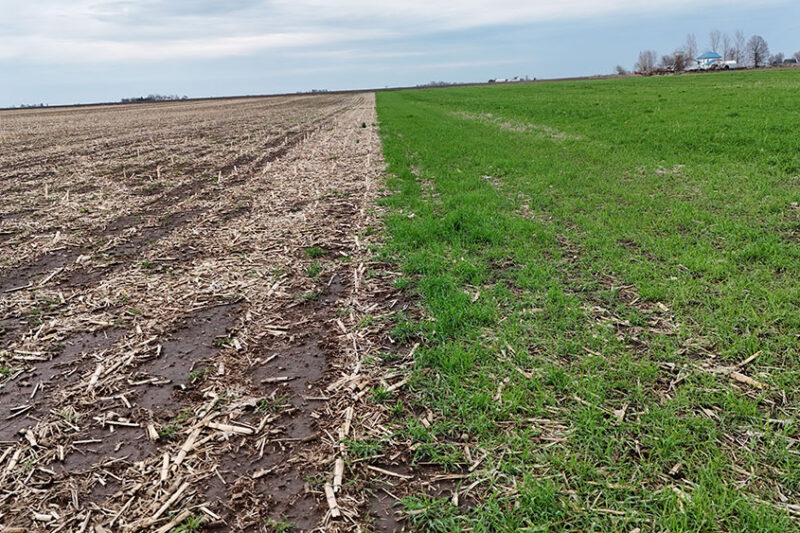
- Jack Boyer and Dick Sloan planted corn into a living clover cover crop and then chemically suppressed the clover to limit competition with the corn and with the intention for the clover to regrow later in the season. The clovers at both farms were eventually terminated, though, because of weed pressure.
- Boyer and Sloan hypothesized that suppressing (and then eventually terminating) the clover cover crop would not harm corn yields compared to terminating the cover crop at corn planting.
Key Findings:
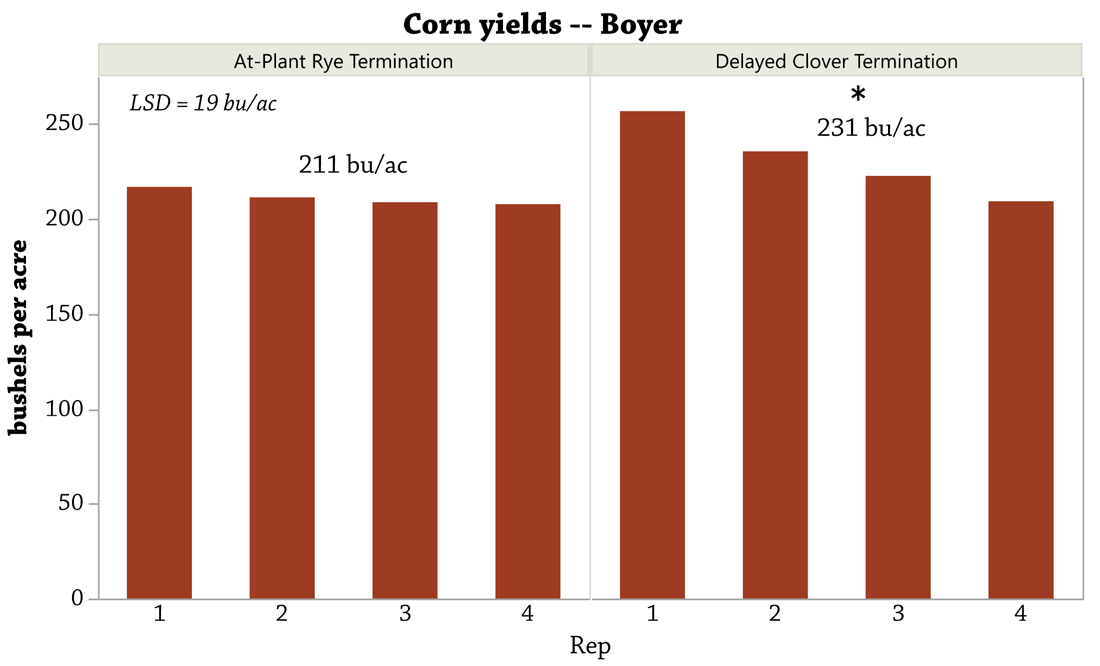
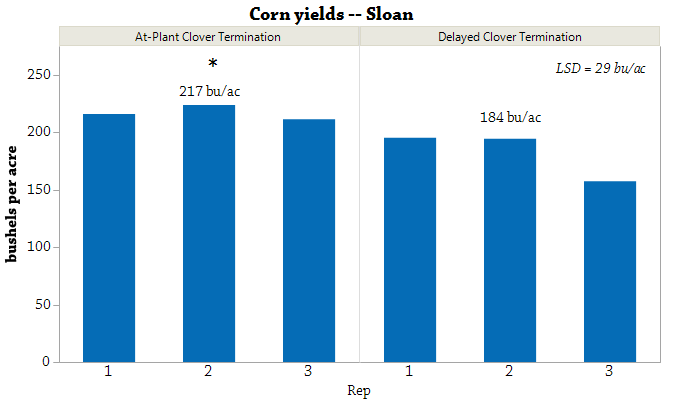
- Results were mixed between the farms and this could be indicative of the slightly different experimental designs. Boyer saw better corn yields where he delayed clover termination compared to where he terminated a rye cover crop just prior to corn planting. Sloan, on the other hand, used only clover cover crops – he scored better corn yields where he terminated at corn planting compared to where he delayed clover termination.
Background
Cover cropping typically involves growing vegetation between the harvest and planting of cash crops. Companion cropping or living mulch strategies, on the other hand, involve growing cash crops alongside cover crops (e.g., the cover crop is not terminated). Research in the Midwest over the past 20 years has uncovered both the challenges and opportunities with this approach.[1] Challenges include competition for nutrients and moisture between the cash crop and companion, which can severely reduce cash crop yield.[2–5] In other words, the companion behaves like a weed. This challenge can be partially overcome by careful variety and species selection as well as suppression of the companion.[1,6] The opportunities and benefits of living mulch systems mirror those commonly associated with perennial groundcover: reduced soil erosion; improved soil fertility; improved soil water and temperature dynamics; forage for grazing livestock.
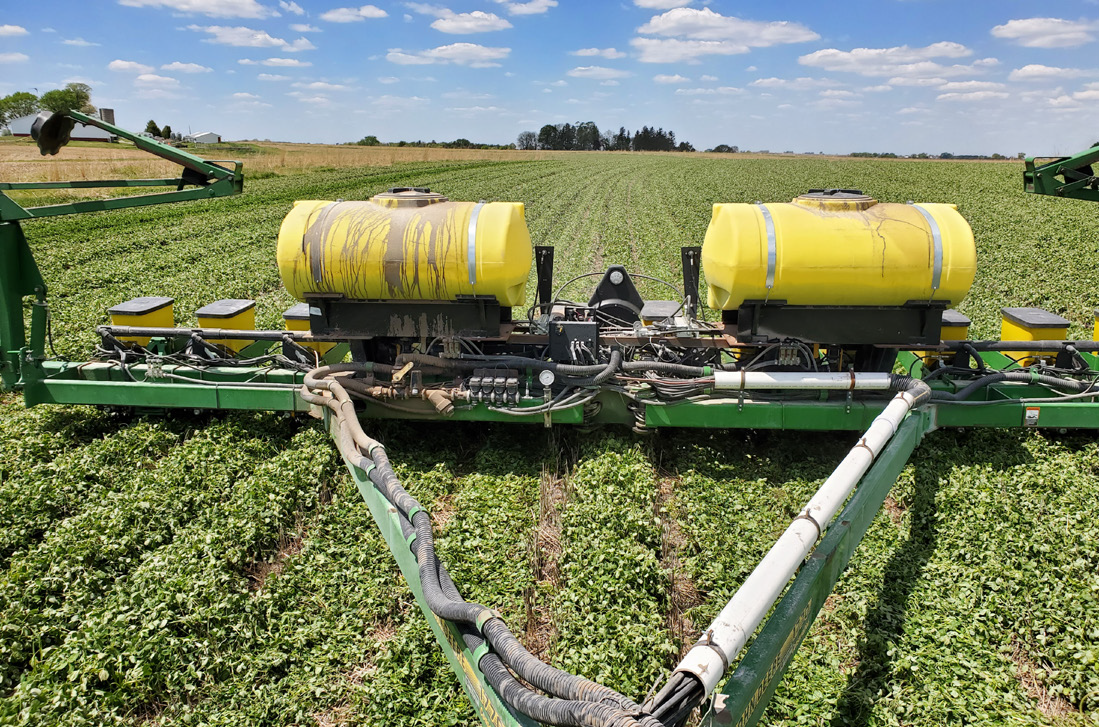
Jack Boyer and Dick Sloan have incorporated small-grains crops into their rotations in recent years, which affords them the opportunity to use legume cover crops like red clover. Typically, the clover cover crop is terminated prior to planting corn and research suggests between 50 and 150 units of N fertilizer can be replaced with this practice.[7–9] In this project, Boyer and Sloan wanted to compare clover as a living mulch in their corn with the typical practice of terminating the cover crop. Weed pressure on both farms necessitated a herbicide pass in June that terminate the clovers; the resulting experiments effectively compared termination dates: at-plant vs. delayed.
Methods
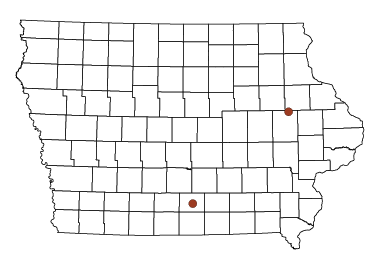
DesignBoyer and Sloan conducted similar, but slightly different, experiments. Both raised a winter small grain in 2020 in order to establish the clover cover crop. Boyer seeded four strips of red clover and compared the following two treatments:
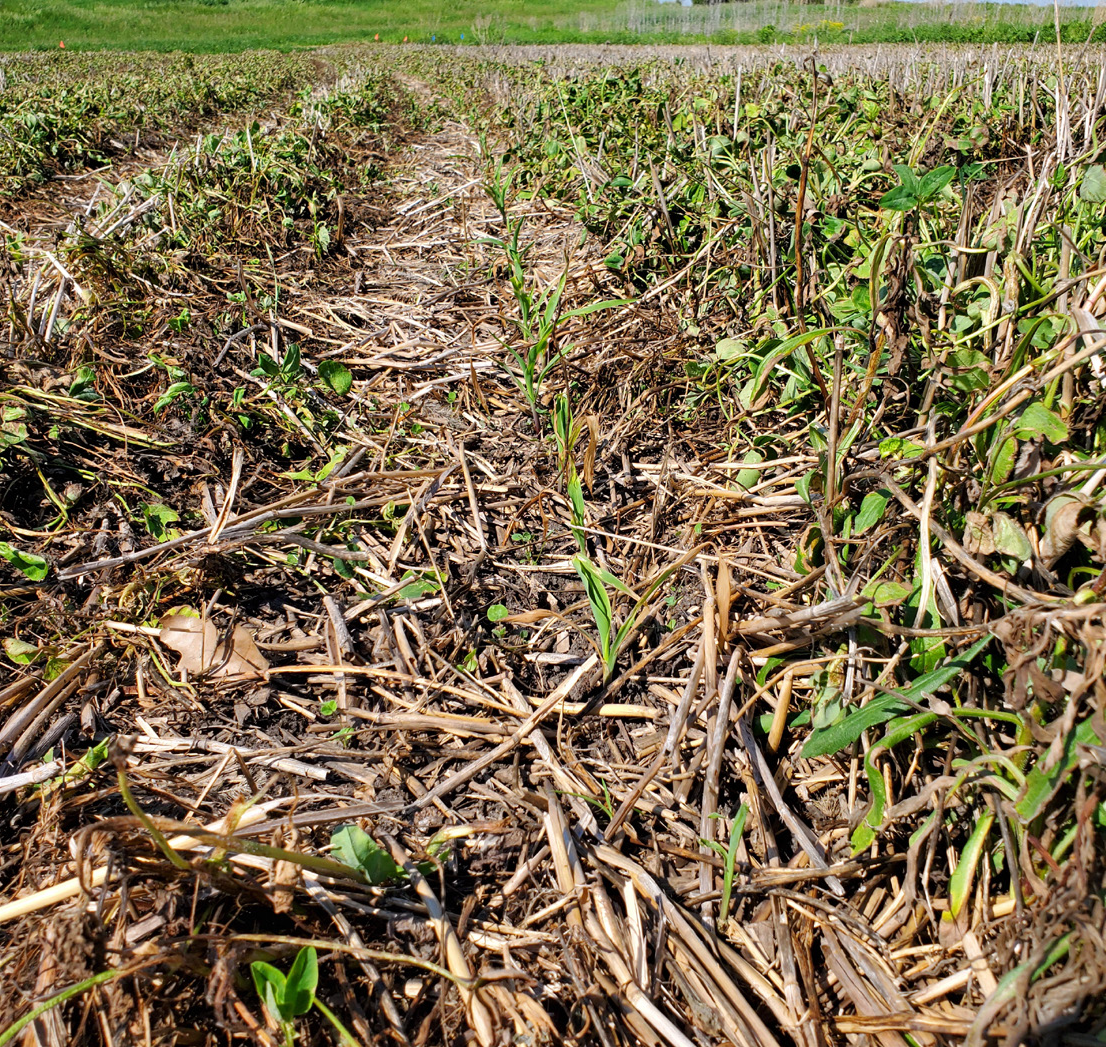
- Delayed Clover Termination – Chemically suppress red clover at corn planting; terminate clover in June after corn emergence. Clover was interseeded to cereal rye seed crop in spring 2020.
- At-Plant Rye Termination -- Terminate cereal rye
Sloan seeded his entire experiment to a blend of red clover and alsike clover and compared the following two treatments:
- Delayed Clover Termination -- Chemically suppress clover cover crop at corn planting; terminate clover in June after corn emergence Clover was interseeded to triticale grain crop in spring 2020.
- At-Plant Clover Termination -- Terminate clover cover crop at corn planting. Clover cover crop was interseeded to triticale grain crop in spring 2020.
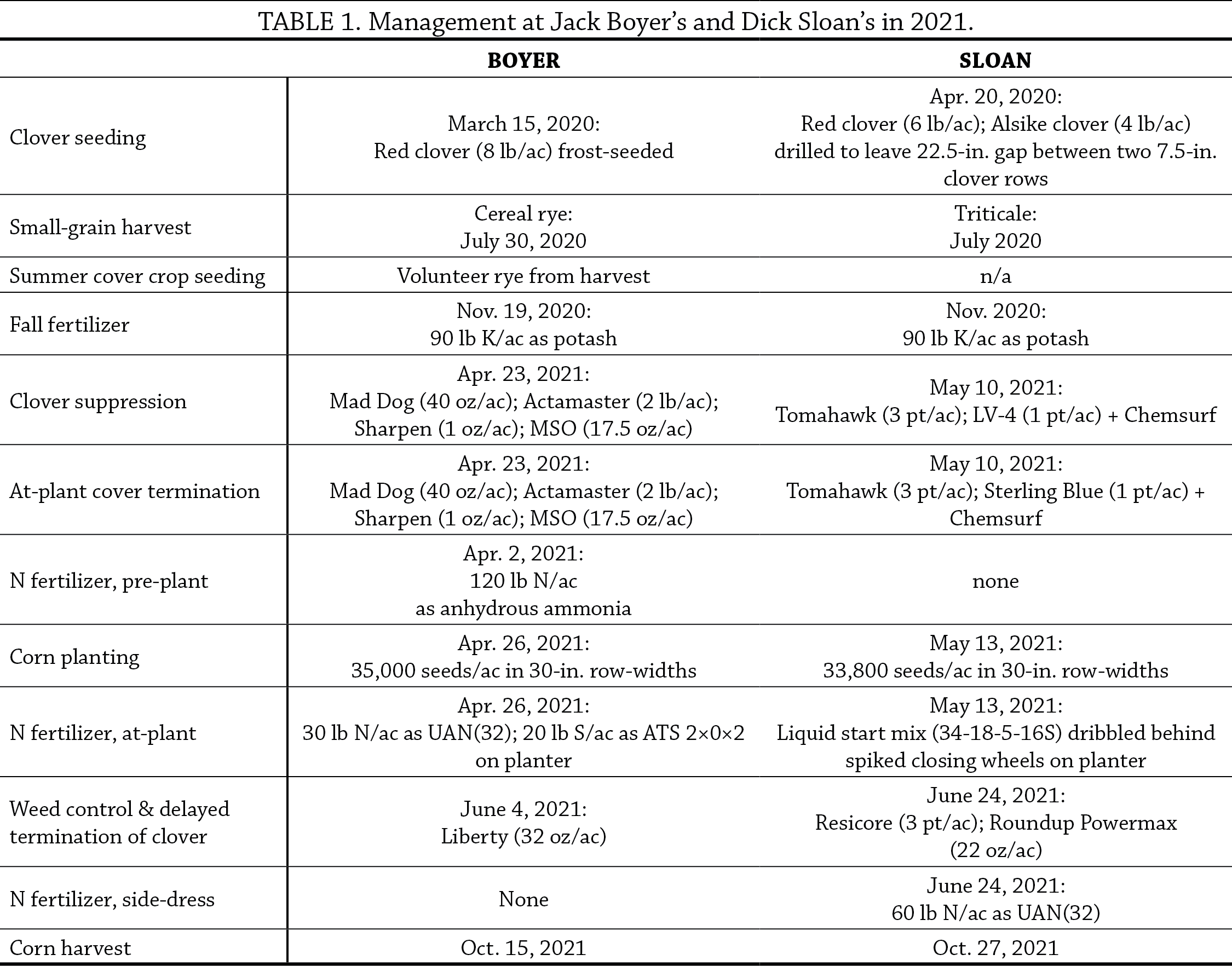
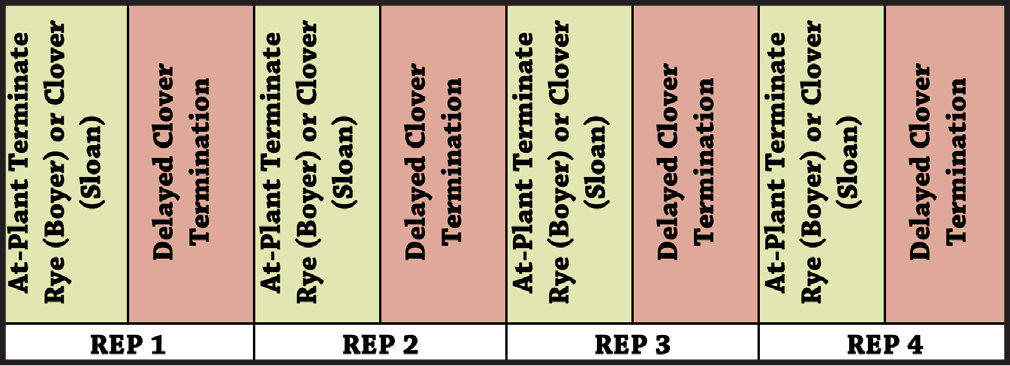
Boyer implemented four replications of the two treatments (Figure A1) in strips measuring 15 ft wide by 2,100 ft long. Sloan implemented three replications of his two treatments (Figure A1) in strips measuring 30 ft wide by 1,620 ft long. Field management at both farms is presented in Table 1.
Results and Discussions
Clover biomass
From samples he collected about one week after planting corn, Sloan determined that he planted corn into a clover stand of 4,118 lb/ac of biomass. In his Delayed Clover Termination strips, the clover was allowed to grow for an additional month before Sloan terminated on June 24 (Table 1).
Cornstalk nitrate & plant population
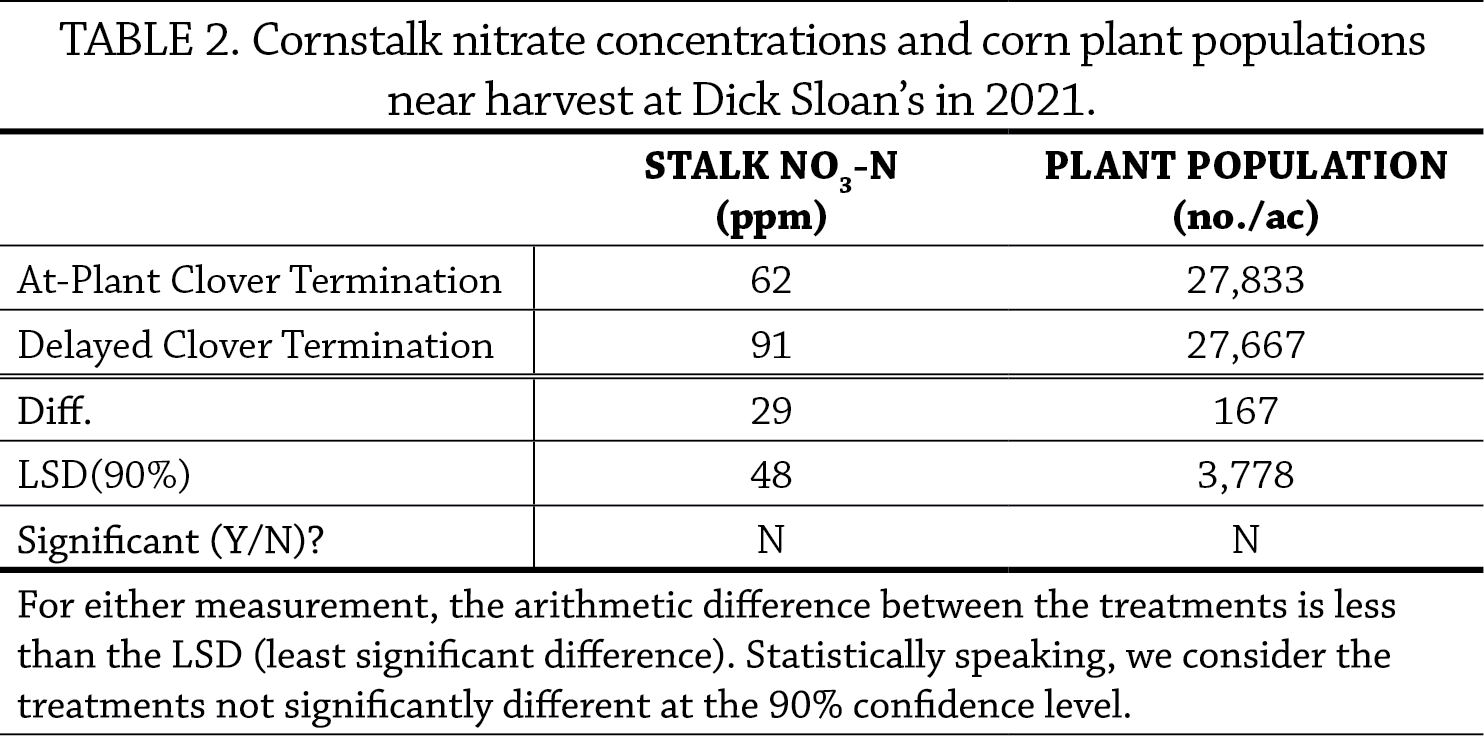
At Sloan’s, neither cornstalk nitrate concentrations nor plant populations just prior to harvest were affected by the clover termination date treatments (Table 2). For both treatments, stalk nitrate concentrations fell in the low category (<250 ppm), but this does not necessarily indicate nitrogen deficiency, according to Iowa State University Extension and Outreach.[10] Rather, it could be an indication of the corn having just enough nitrogen through the season.
Conclusions and Next Steps
From their results, both Boyer and Sloan expressed some hesitancy about adopting the practice of suppressing or delaying termination of a clover cover crop in corn. Boyer did see some promise to the practice, but came away from the experience wondering if it would be consistently feasible. Attempting to stunt the clover and create conditions where it would not interfere with the corn proved challenging. “I saw some opportunity for clover producing nitrogen, however, weed control became an issue,” he said. “The concept was good, but in practice, it was more difficult to implement successfully.” Sloan echoed Boyer’s concerns about weed pressure when intending to let clover grow beneath the corn canopy. “A suppressed clover crop can compete with a newly planted corn crop. If weed control becomes critical to save the corn, I won't gain any benefits later in the season and could further damage the corn in a dry year.” Instead, Sloan intends to keep using clover cover crops in his cropping system but will terminate it before planting corn because “clover after winter small grains improves my soil health and subsequent corn crops.” In a future trial, Sloan will compare a fall clover termination date with a spring termination date.
Appendix - Trial Design and Weather Conditions
References
- Moore, K.J., R.P. Anex, A.E. Elobeid, S. Fei, C.B. Flora, A.S. Goggi, K.L. Jacobs, P. Jha, A.L. Kaleita, D.L. Karlen, D.A. Laird, A.W. Lenssen, T. Lübberstedt, M.D. McDaniel, D.R. Raman and S.L. Weyers. 2019. Regenerating agricultural landscapes with perennial groundcover for intensive crop production. Agronomy. 9: https://www.mdpi.com/2073-4395/9/8/458 (accessed November 2021).
- Sawyer, J.E., P. Pedersen, D.W. Barker, D.A. Ruiz Diaz and K. Albrecht. 2010. Intercropping corn and kura clover: Response to nitrogen fertilization. Agronomy Journal. 102:568–574. https://dl.sciencesocieties.org/publications/aj/abstracts/102/2/568 (accessed November 2021).
- Flynn, E.S., K.J. Moore, J.W. Singer and K.R. Lamkey. 2013. Evaluation of grass and legume species as perennial ground covers in corn production. Crop Science. 53:611–620. https://lib.dr.iastate.edu/cgi/viewcontent.cgi?article=1220&context=agron_pubs (accessed November 2021).
- Bartel, C.A., C. Banik, A.W. Lenssen, K.J. Moore, D.A. Laird, S. V. Archontoulis and K.R. Lamkey. 2017. Establishment of perennial groundcovers for maize-based bioenergy production systems. Agronomy Journal. 109:822–835. https://acsess.onlinelibrary.wiley.com/doi/full/10.2134/agronj2016.11.0656 (accessed November 2021).
- Ochsner, T.E., T.W. Schumacher, R.T. Venterea, G.W. Feyereisen and J.M. Baker. 2018. Soil Water Dynamics and Nitrate Leaching Under Corn–Soybean Rotation, Continuous Corn, and Kura Clover. Vadose Zone Journal. 17:1–11. https://acsess.onlinelibrary.wiley.com/doi/full/10.2136/vzj2017.01.0028 (accessed November 2021).
- Ziyomo, C., K.A. Albrecht, J.M. Baker and R. Bernardo. 2013. Corn performance under managed drought stress and in a Kura clover living mulch intercropping system. Agronomy Journal. 105:579–586. https://acsess.onlinelibrary.wiley.com/doi/full/10.2134/agronj2012.0427 (accessed November 2021).
- Liebman, M., R.L. Graef, D. Nettleton and C.A. Cambardella. 2012. Use of legume green manures as nitrogen sources for corn production. Renewable Agriculture and Food Systems. 27:180–191. https://lib.dr.iastate.edu/cgi/viewcontent.cgi?article=1202&context=stat_las_pubs (accessed November 2021).
- Gaudin, A., S. Westra, C. Loucks, K. Janovicek, R. Martin and W. Deen. 2013. Improving Resilience of Northern Field Crop Systems Using Inter-Seeded Red Clover: A Review. Agronomy. 3:148–180. https://www.mdpi.com/2073-4395/3/1/148 (accessed November 2021).
- Gailans, S. and T. Sieren. 2014. Nitrogen Replacement Value of Red Clover. Practical Farmers of Iowa Cooperators’ Program. https://practicalfarmers.org/research/nitrogen-replacement-value-of-red-clover/ (accessed November 2021).
- Sawyer, J. and A.P. Mallarino. 2018. Cornstalk Testing to Evaluate Nitrogen Management. PM 1584. Iowa State University Extension and Outreach. https://store.extension.iastate.edu/product/Use-of-the-End-of-Season-Corn-Stalk-Nitrate-Test-in-Iowa-Corn-Production (accessed November 2021).
- Vyn, T.J., J.G. Faber, K.J. Janovicek and E.G. Beauchamp. 2000. Cover Crop Effects on Nitrogen Availability to Corn following Wheat. Agronomy Journal. 915–924. https://doi.org/10.2134/agronj2000.925915x (accessed November 2021).
- Gailans, S.R. 2017. Evaluating alternative , diverse cropping systems that include canola , wheat , and red clover in Iowa. Thesis. Iowa State University. https://lib.dr.iastate.edu/cgi/viewcontent.cgi?article=7139&context=etd.
- US Department of Agriculture-National Agricultural Statistics Service. Quick stats. USDA-National Agricultural Statistics Service. https://quickstats.nass.usda.gov/ (accessed November 2021).
- Plastina, A. 2021. 2021 Iowa Farm Custom Rate Survey. Iowa State University Extension and Outreach. https://www.extension.iastate.edu/agdm/crops/pdf/a3-10.pdf (accessed November 2021).
- Iowa Environmental Mesonet. 2021. Climodat Reports. Iowa State University. http://mesonet.agron.iastate.edu/climodat/ (accessed November 2021).