In a Nutshell:
- Jack Boyer, Eric Fynaardt, Kevin Holl and Rob Stout conducted strip trials for a second year to test the effect of cereal rye cover crop termination date on corn disease pressure and corn yield. They each compared terminating the cover crop before planting corn to terminating the cover crop after planting corn.
Key Findings:
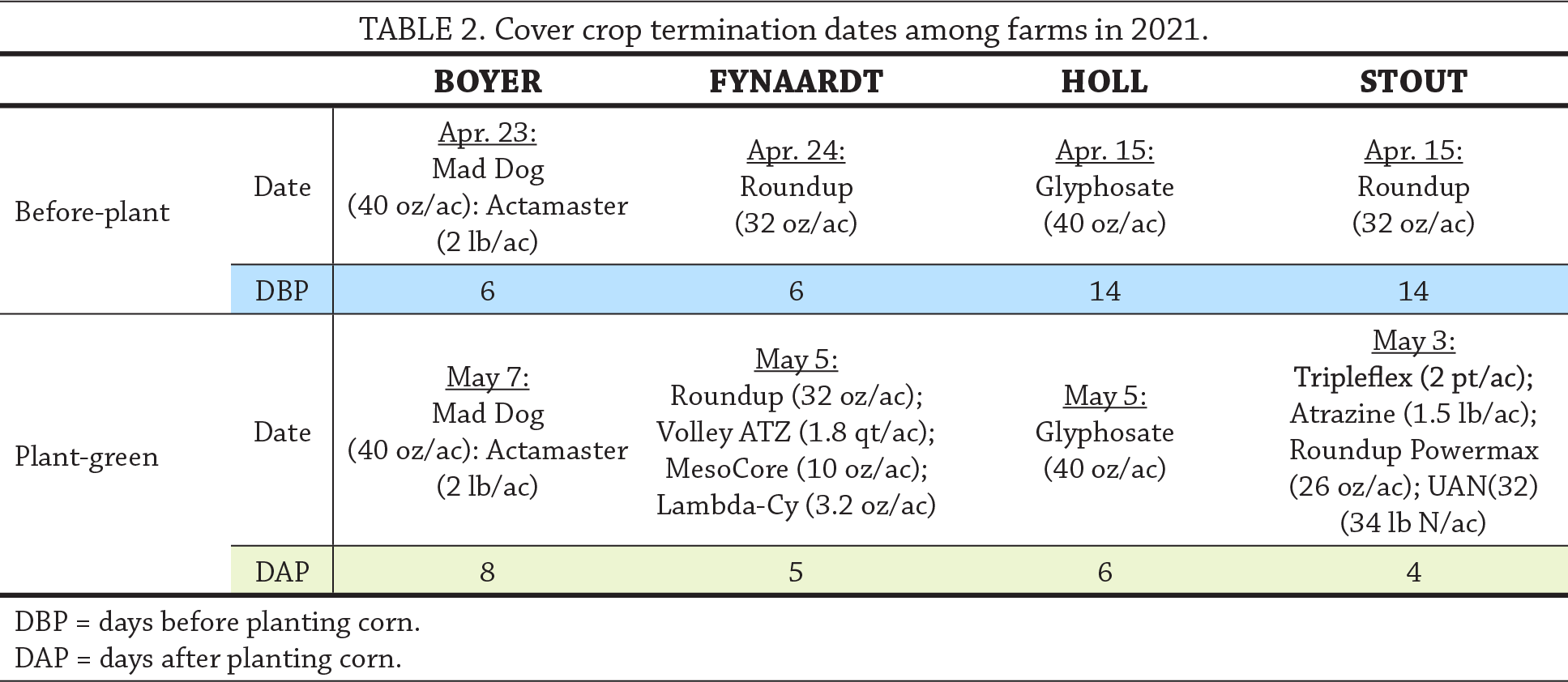
- Across the four farms, cover crop termination dates ranged from 6 to 14 days before planting corn (before-plant) to 4 to 8 days after planting corn (plant-green).
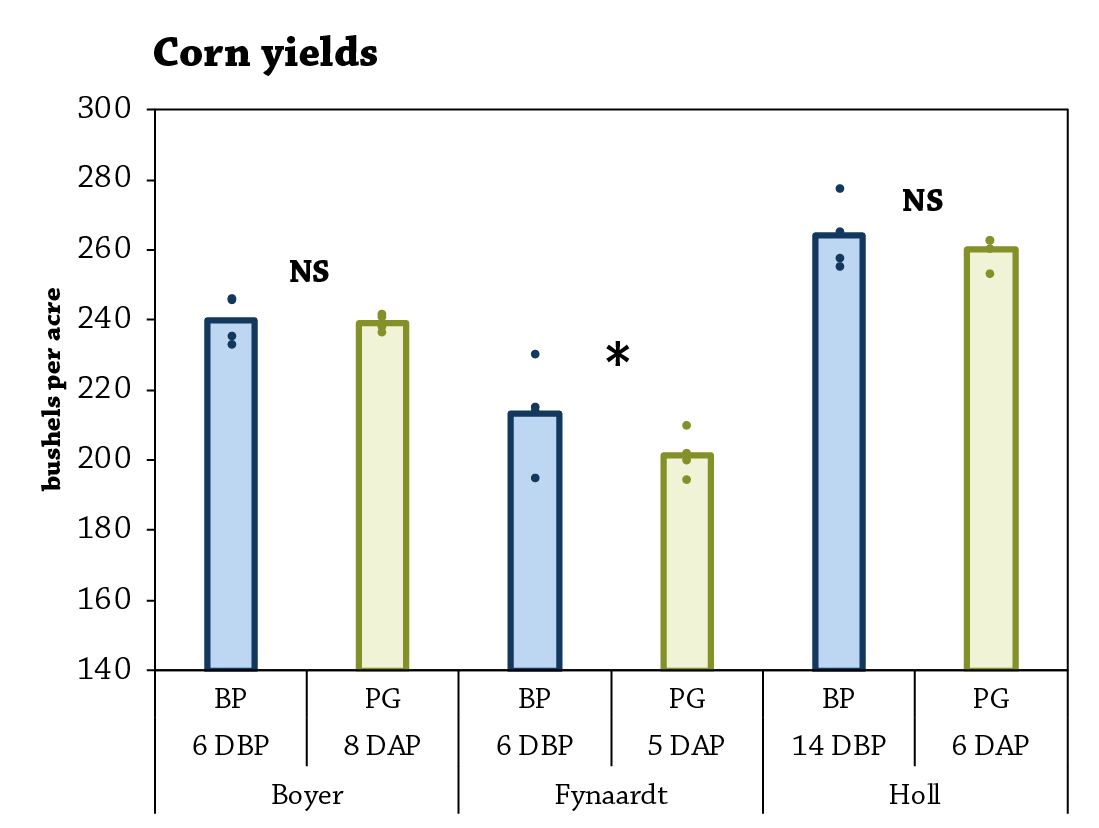
- At only one farm (Fynaardt’s) did we observe a negative effect on corn yield from planting green.
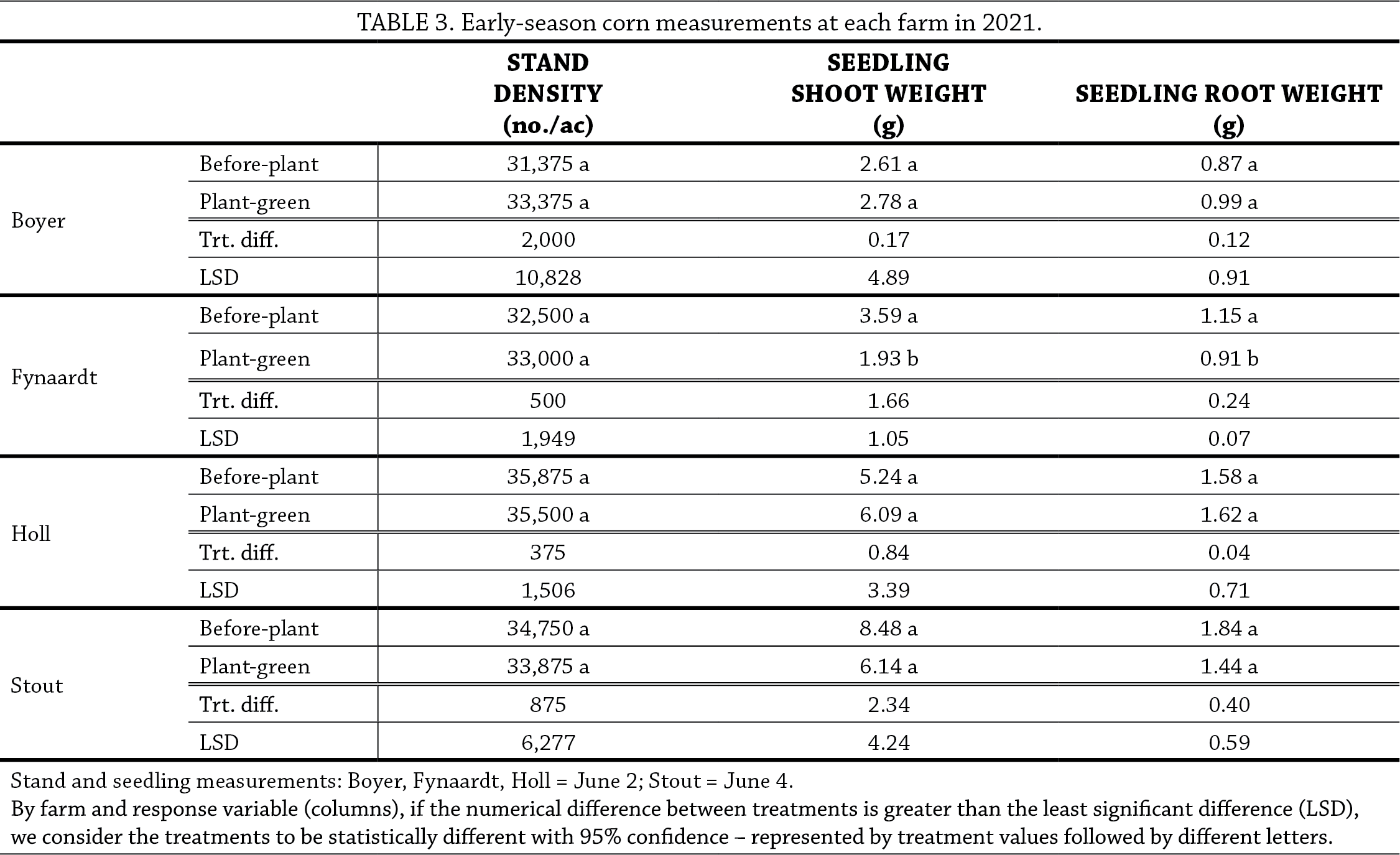
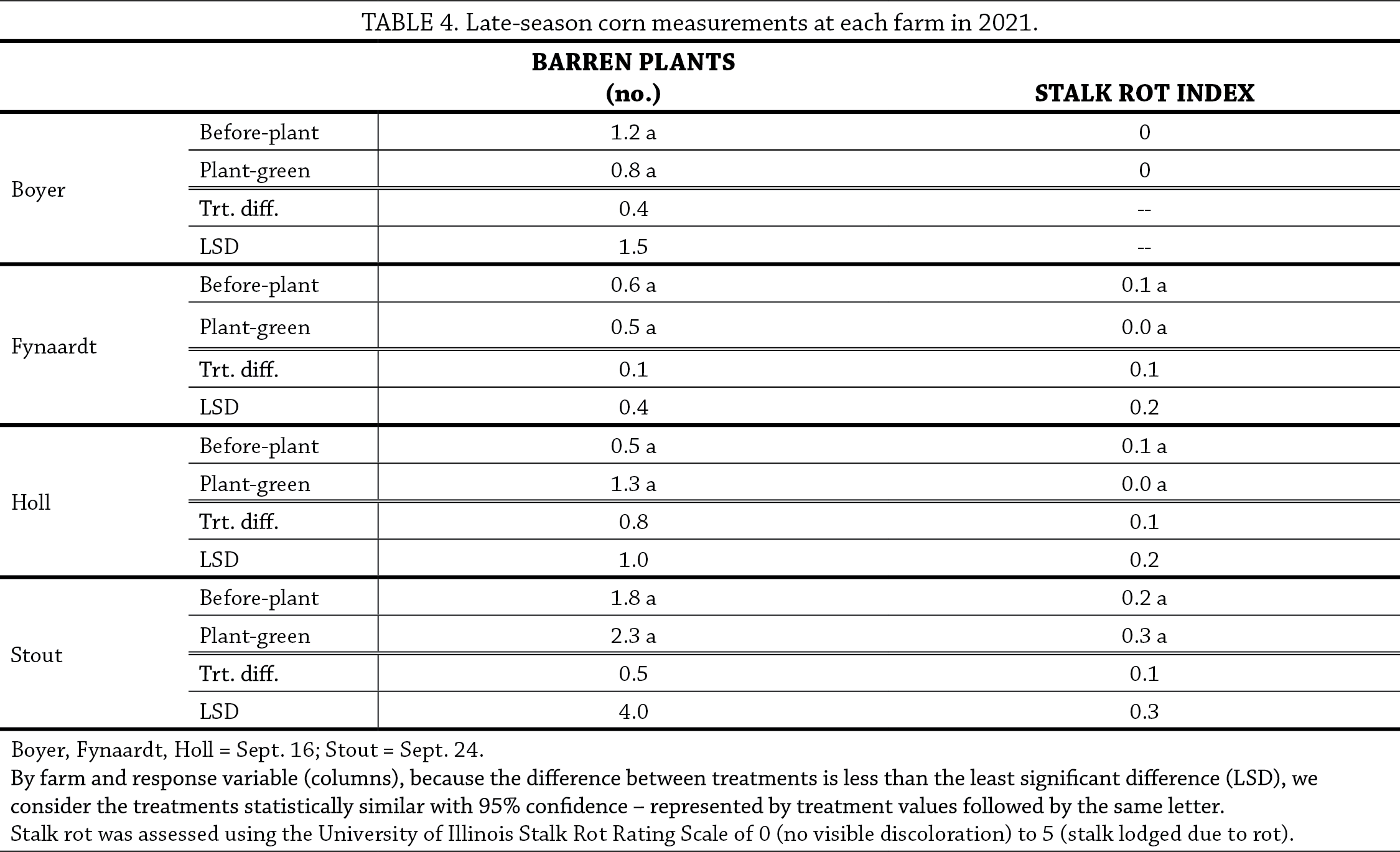
- Dr. Alison Robertson’s lab team from ISU Plant Pathology and Microbiology observed no effects of cover crop termination date on corn stands, number of barren plants and stalk rot at any of the farms. At Fynaardt’s only, they detected reduced seedling shoot and root weights in the plant-green treatment.
- After two years of study, yield drag occurred in only two of seven instances – both occurred at Fynaardt’s and translated to a 5–6% reduction in yield compared to terminating the cover crop at least 6 days before planting corn.
Background
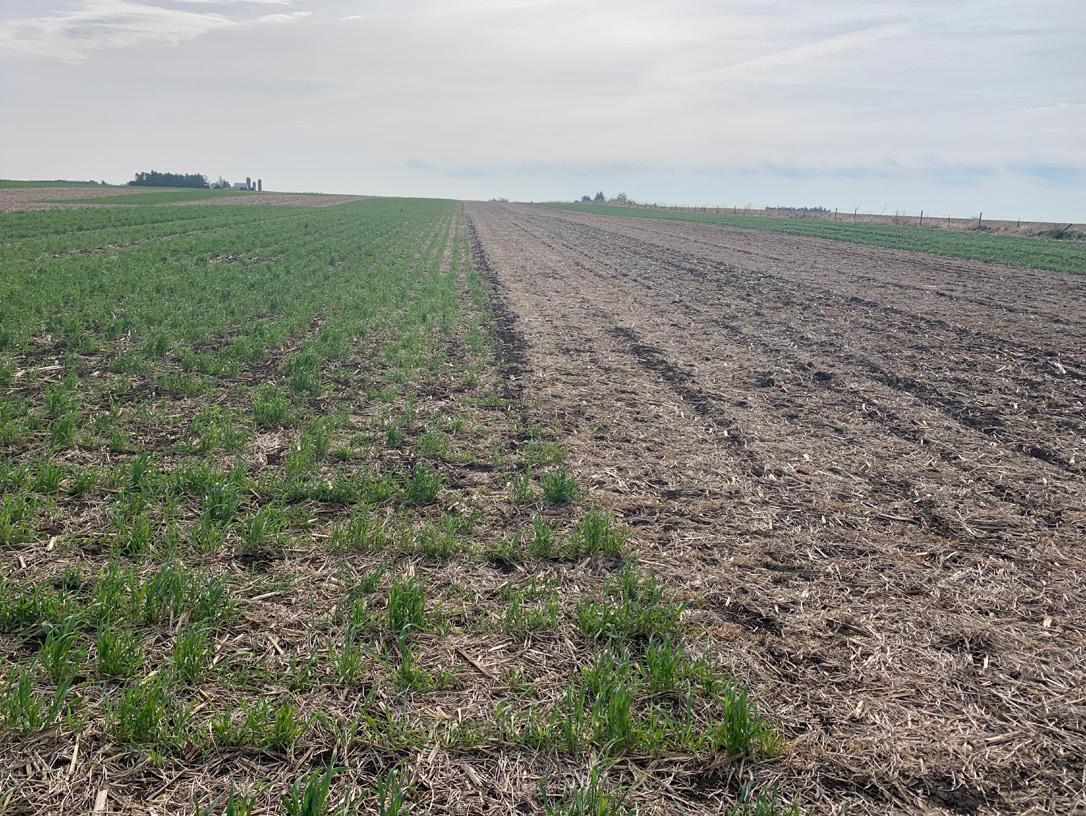
Most recommendations suggest terminating a cover crop at least 10 days before planting corn to avoid early-season deficiencies of soil moisture and soil N. On-farm strip trials by PFI cooperators between 2016 and 2018 backed up those recommendations. In those trials, cooperators reported significant corn yield reductions (2 to 14%) when cover crops were terminated within two days of planting corn.[1–3] Recent scientific evidence points to corn seedling disease as the culprit for yield dag when planting corn soon before or soon after terminating a cover crop.[4] Contrary to these research findings, some farmers report no problems when planting corn before terminating a cover crop. (Otherwise known as planting green.) In these cases, the cover crops were typically only a few inches tall at the time of corn planting. Many farmers experienced with using cover crops stress the importance of applying N fertilizer with the corn planter for alleviating the potential for yield drag when planting green. The appeal to planting green is that the practice allows the cover crop to grow longer into the spring and thus enhancing the soil and water conservation benefits a cover crop provides.
Methods
Design
Each cooperator seeded a cereal rye cover crop shortly after soybean harvest in Fall 2020. Boyer, drilled at 65 lb/ac on Nov. 4; Fynaardt, airseeder + Phoenix till lite at 56 lb/ac on Nov. 11; Holl, drilled at 90 lb/ac on Nov. 17; Stout, drilled at 56 lb/ac on Oct. 6. Each cooperator planted corn in 2021 and field management at all farms is provided in Table 1.
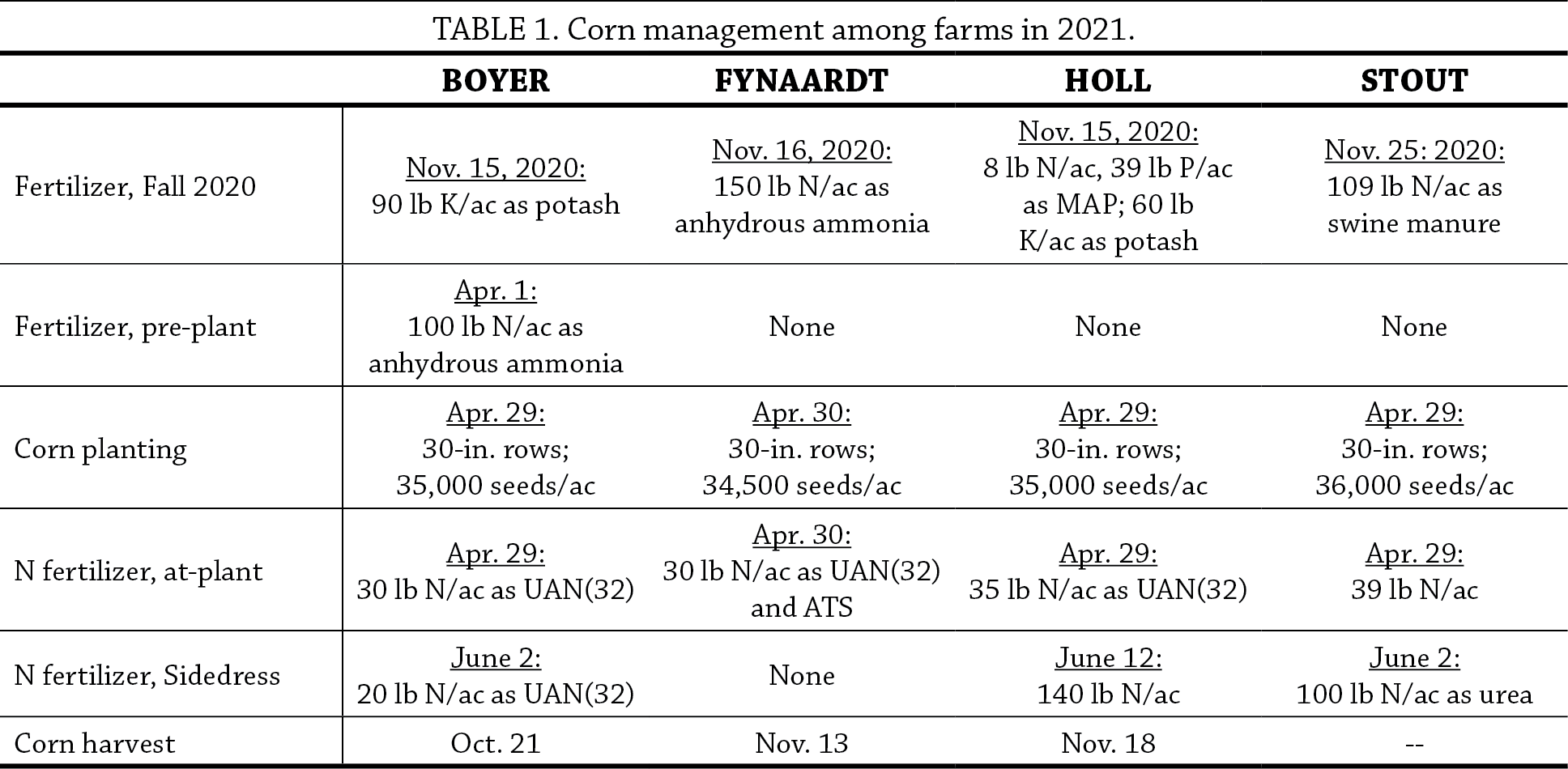 To test the effect of cover crop termination date on corn, each cooperator compared two treatments:
- Before-plant. Target: terminate cover crop ~18 days before planting corn
- Plant-green. Target: terminate cover crop ~6 days after planting corn.
Actual cover crop termination dates at each farm is provided in Table 2.
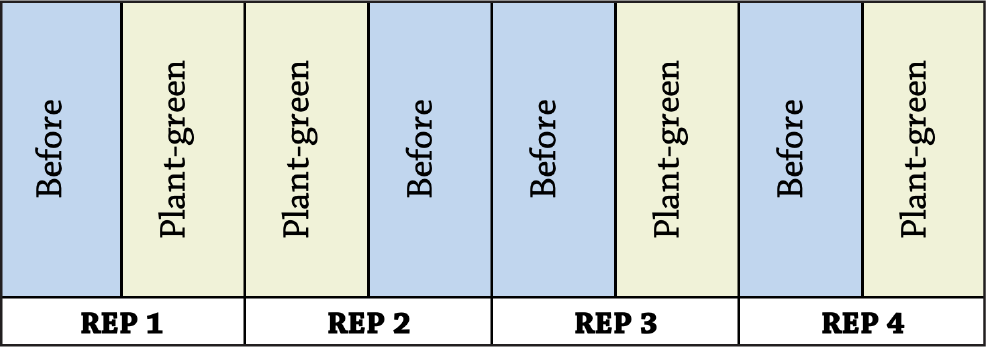
 Each cooperator implemented at least four replications of the two treatments in randomized strips (Figure A1). Strips at each farm were as wide as at least one combine pass and ran the length of the field.
Measurements
Cooperators measured cover crop height and groundcover at both termination dates. To determine groundcover, cooperators took photographs from three to four locations in each strip and then we analyzed them using Foliage, an open-source web-based application.[6]
Dr. Alison Robertson’s lab group travelled to Boyer’s, Fynaardt’s, and Holl’s farms on June 2 and to Stout’s farm on June 4 to determine corn stand densities, corn seedling shoot weights and corn seedling root weights. The lab group assessed barren plants and stalk rot incidence at Boyer’s, Fynaardt’s, and Holl’s on Sept. 16 and at Stout’s on Sept. 24.
All cooperators harvested corn from each individual strip, except for Stout because a high-wind incident in August made it impossible to detect individual cornrows and strips. Grain yields from Boyer’s, Fynaardt’s and Holl’s were corrected to 15.5% moisture.
Data analysis
To evaluate any effects of cover crop termination date, we calculated the least significant difference (LSD) at the 95% confidence level using a t-test for each measurement: cover crop height, cover crop groundcover, corn yield, corn stand density, corn seedling shoot weight, corn seedling root weight, barren plants and stalk rot. For each measurement, if the numeric difference resulting from the two termination dates was greater than the LSD, we would expect such a difference to occur 95 times out of 100 under the same conditions – we refer to this as a statistically significant effect. On the other hand, if the numeric difference resulting from the two termination dates was less than the LSD, we considered the results statistically similar. We could make these statistical calculations because the cooperators’ experimental designs involved replication of the two cover crop termination dates (Figure A1).
Each cooperator implemented at least four replications of the two treatments in randomized strips (Figure A1). Strips at each farm were as wide as at least one combine pass and ran the length of the field.
Measurements
Cooperators measured cover crop height and groundcover at both termination dates. To determine groundcover, cooperators took photographs from three to four locations in each strip and then we analyzed them using Foliage, an open-source web-based application.[6]
Dr. Alison Robertson’s lab group travelled to Boyer’s, Fynaardt’s, and Holl’s farms on June 2 and to Stout’s farm on June 4 to determine corn stand densities, corn seedling shoot weights and corn seedling root weights. The lab group assessed barren plants and stalk rot incidence at Boyer’s, Fynaardt’s, and Holl’s on Sept. 16 and at Stout’s on Sept. 24.
All cooperators harvested corn from each individual strip, except for Stout because a high-wind incident in August made it impossible to detect individual cornrows and strips. Grain yields from Boyer’s, Fynaardt’s and Holl’s were corrected to 15.5% moisture.
Data analysis
To evaluate any effects of cover crop termination date, we calculated the least significant difference (LSD) at the 95% confidence level using a t-test for each measurement: cover crop height, cover crop groundcover, corn yield, corn stand density, corn seedling shoot weight, corn seedling root weight, barren plants and stalk rot. For each measurement, if the numeric difference resulting from the two termination dates was greater than the LSD, we would expect such a difference to occur 95 times out of 100 under the same conditions – we refer to this as a statistically significant effect. On the other hand, if the numeric difference resulting from the two termination dates was less than the LSD, we considered the results statistically similar. We could make these statistical calculations because the cooperators’ experimental designs involved replication of the two cover crop termination dates (Figure A1).
Results and Discussion
Cover crop height and groundcover
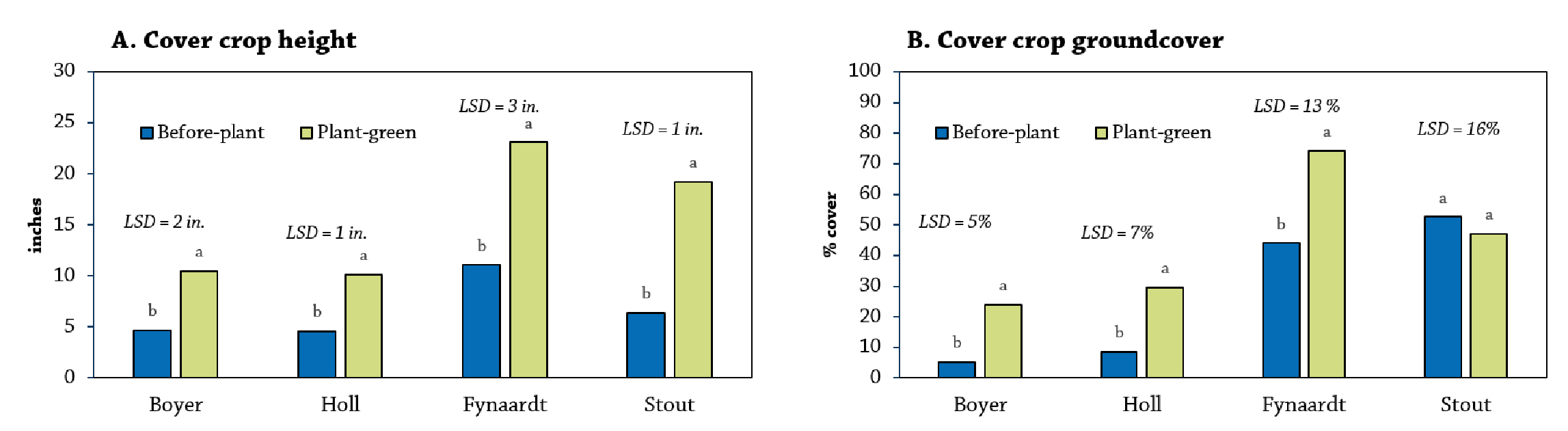
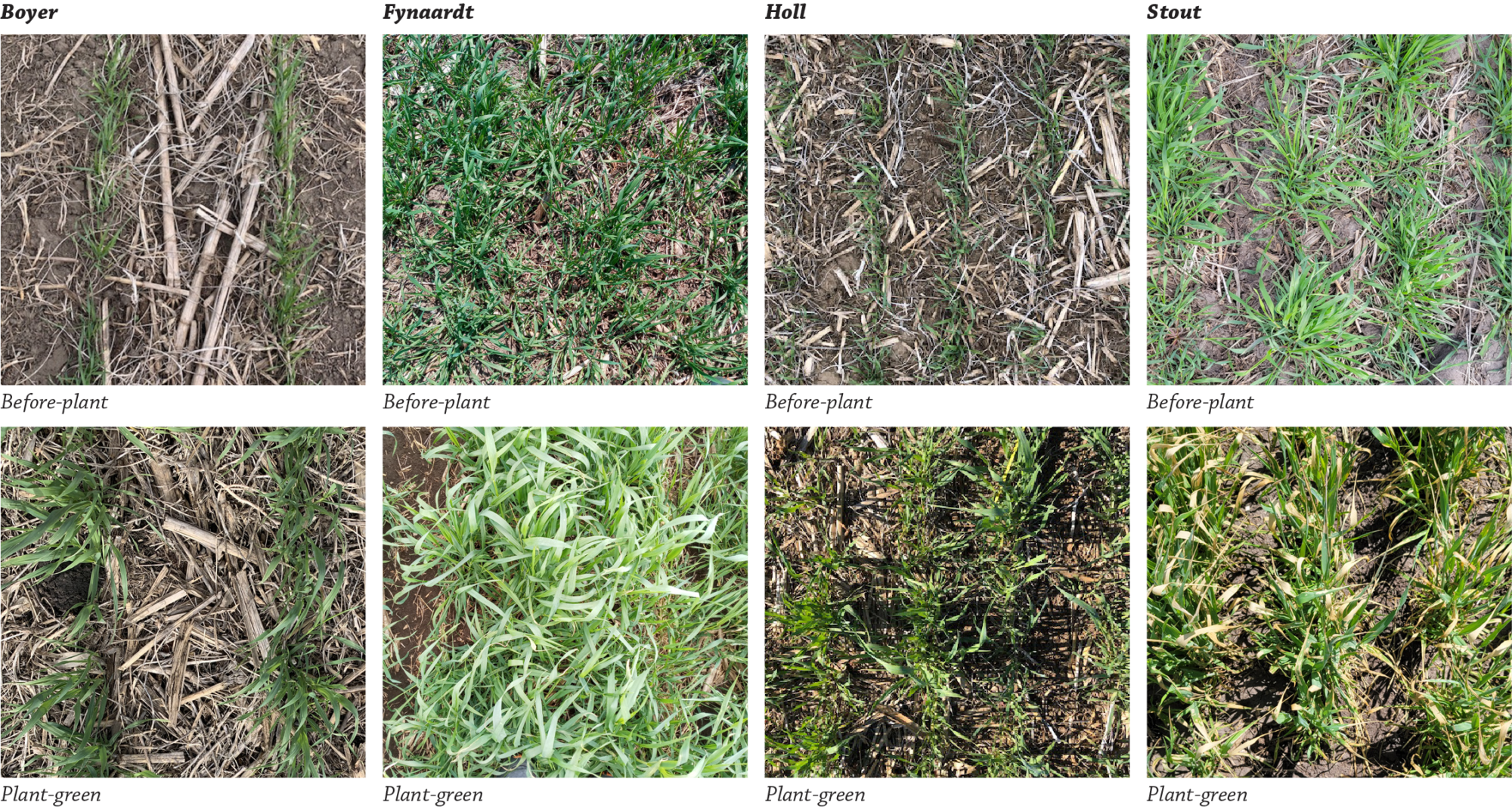
At Boyer’s, Holl’s and Fynaardt’s, terminating the cover crop after corn planting (plant-green) resulted in a cover crop that was roughly twice as tall as the cover crop terminated before corn planting (Figure 1A). At Stout’s, the later terminated cover crop was three times as tall as the cover crop terminated before corn planting. At all sites but Stout’s, the cover crop in the plant-green treatment provided 60% more groundcover on average than the cover crop terminated before corn planting (Figure 1B). We did not see this same response at Stout’s despite the cover crop in the plant-green treatment being three times as tall. This was probably because the cover crop in the plant-green treatment was terminated (May 3) four days prior to when he took photos to assess groundcover (May 7). The Foliage web application measures groundcover by detecting greenness from photographs. When Stout took photos on May 7, the cover crop in the plant-green treatment had already begun to senesce (brown) and this may have resulted in the Foliage application detecting less groundcover than was actually present. In general, and not surprisingly, the cooperators observed far more cover crop growth in the plant-green treatment as judged by height and groundcover. This was because the cooperators terminated the cover crop in the plant-green treatment, on average, 16 days after they terminated in the before-plant treatment.
 Ear and stalk measurements
In mid-September, Dr. Robertson’s lab group returned to the farms to determine the number of barren plants and assess the amount of stalk rot in each strip. At none of the farms did they detect an effect of cover crop termination date on these late-season measurements.
Ear and stalk measurements
In mid-September, Dr. Robertson’s lab group returned to the farms to determine the number of barren plants and assess the amount of stalk rot in each strip. At none of the farms did they detect an effect of cover crop termination date on these late-season measurements.
 Previous research in Iowa by Dr. Robertson’s lab linked planting green to reduced corn stands, increased number of barren plants and reduced corn yields.[4] They attributed these findings to increased levels of seedling disease compared to where the cover crop was terminated at least 10 to 14 days prior to planting corn. Yearly and seasonal variation as well as crop management can influence the prevalence of crop pathogens (such as Pythium and Fusarium species that cause seedling disease in corn). In this year’s study, conditions at Boyer’s, Holl’s and Stout’s farms may not have been suitable for corn seedling disease pathogens regardless of cover crop termination date.
Conclusions and Next Steps
After two years of study, planting green did not reduce yields in five of seven instances. In the remaining two instances, both of which occurred at Fynaardt’s, planting green statistically reduced corn yields by 5–6%. From samples collected at all farms over the two years, Dr. Robertson’s lab detected evidence of corn seedling disease only once: at Fynaardt’s in June 2021 from the plant-green treatment. In both years, it appeared that corn at Fynaardt’s emerged through much more cover crop in the plant-green treatment compared to the other farms. The reduced corn yields he observed may have been due to early-season competition for resources between the cover crop and the corn, seedling disease pressure or both. Boyer, Holl and Stout learned that planting green may in fact be a viable practice for their farms going forward. Each of them is keen to allow a cover crop to grow as long as possible in the spring (up until corn planting) in order to maximize soil health benefits. From their results, the sweet spot for success might involve a cover crop that is no more than a foot tall as well as the ability to apply at least 30 units of N/ac with the planter.
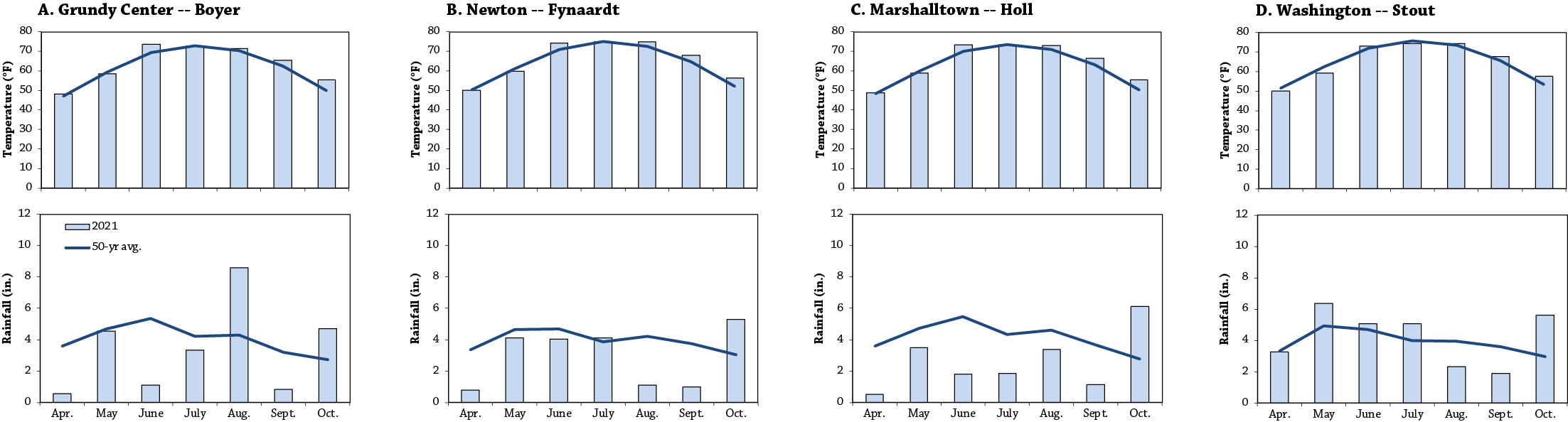
Appendix - Trial Design and Weather Conditions
Funding Acknowledgement
This material is based upon work supported by the Agriculture and Food Research Initiative of the National Institute of Food and Agriculture, U.S. Department of Agriculture, under 2019-68008-29909 subaward number 021155. Any opinions, findings, conclusions, or recommendations expressed in this publication are those of the author(s) and do not necessarily reflect the views of the U.S. Department of Agriculture.
References
- Gailans, S. and D. Sloan. 2016. Cover Crop Termination Date Ahead of Corn. Practical Farmers of Iowa Cooperators’ Program. https://practicalfarmers.org/wpcontent/uploads/2018/10/16.FC_.CC.Cover_Crop_Termination_Date_Corn.pdf (accessed December 2021).
- Gailans, S., D. Sloan and T. Sieren. 2017. N Fertilizer Strategies for Corn Following Cover Crop. Practical Farmers of Iowa Cooperators’ Program. https://practicalfarmers.org/wp-content/uploads/2018/10/17.FC_.CC.N-fert-strategies-for-corn-after-cover.compressed.pdf (accessed December 2021).
- Gailans, S. and A. Kauffman. 2018. Cereal Rye Cover Crop Termination Date Before Corn. Practical Farmers of Iowa Cooperators’ Program. https://practicalfarmers.org/research/cereal-rye-cover-crop-termination-date-before-corn/ (accessed December 2021).
- Acharya, J., M.G. Bakker, T.B. Moorman, T.C. Kaspar, A.W. Lenssen and A.E. Robertson. 2016. Time Interval Between Cover Crop Termination and Planting Influences Corn Seedling Disease, Plant Growth, and Yield. Plant Disease. 101:591–600. https://apsjournals.apsnet.org/doi/pdfplus/10.1094/PDIS-07-16-0975-RE (accessed December 2021).
- Gailans, S., J. Boyer, E. Fynaardt, K. Holl and R. Stout. 2020. Effect of Planting Green on Corn Seedling Disease, Stalk Rot and Yield. Practical Farmers of Iowa Cooperators’ Program. https://practicalfarmers.org/research/effect-of-planting-green-on-corn-seedling-disease-stalk-rot-and-yield/ (accessed December 2021).
- Patrignani, A. 2020. Foliage (Version v1.). Zenodo. https://andres-patrignani.github.io/foliage/ (accessed December 2021).
- Iowa Environmental Mesonet. 2021. Climodat Reports. Iowa State University. http://mesonet.agron.iastate.edu/climodat/ (accessed November 2021).