In a Nutshell:
- Kate Edwards, Carmen & Maja Black and Helaina Thompson, Jon Yagla and Roxane Mitten wanted to find a cauliflower cultivar which can consistently produce a fall crop.
- They trialed five cauliflower varieties and hypothesized that the cultivar with the shortest days to maturity (Snow Crown, 50 days) would be the most successful.
Key Findings:
- Snow Crown outperformed the other cultivars on all cooperator farms except at Yagla’s.
- At Edwards’ farm, the earlier succession of cauliflower planting yielded higher than the second succession.
Background
- Snow Crown (50 days to maturity)
- Cheddar (58 days to maturity)
- Flame Star (62 days to maturity)
- Amazing (68 days to maturity)
- Lavender (70 days to maturity)
They hypothesized cauliflower with the fewest number of days to maturity would yield greatest. Fewer days to maturity means a shorter growing period, which could minimize opportunity for the black rot pathogen to infect and cause disease as well as decrease the odds of a fall frost striking before cauliflower fully mature. The growers also planted cauliflower in two different successions to shed light on whether or not they should consider adjusting their planting dates.
This research includes two varieties that were tested by Mark Quee (Scattergood Farm) and Shanti Sellz (Muddy Miss Farm) in a 2019 variety trial – Snow Crown and Amazing.[3] At Sellz’s, Snow Crown was the only variety out of four to generate any yield, but only in the second of her two succession plantings. Quee fared better. Amazing was competitive but not the leader in his first succession, and no varieties stood out as better or worse in his second succession.
Methods
Design
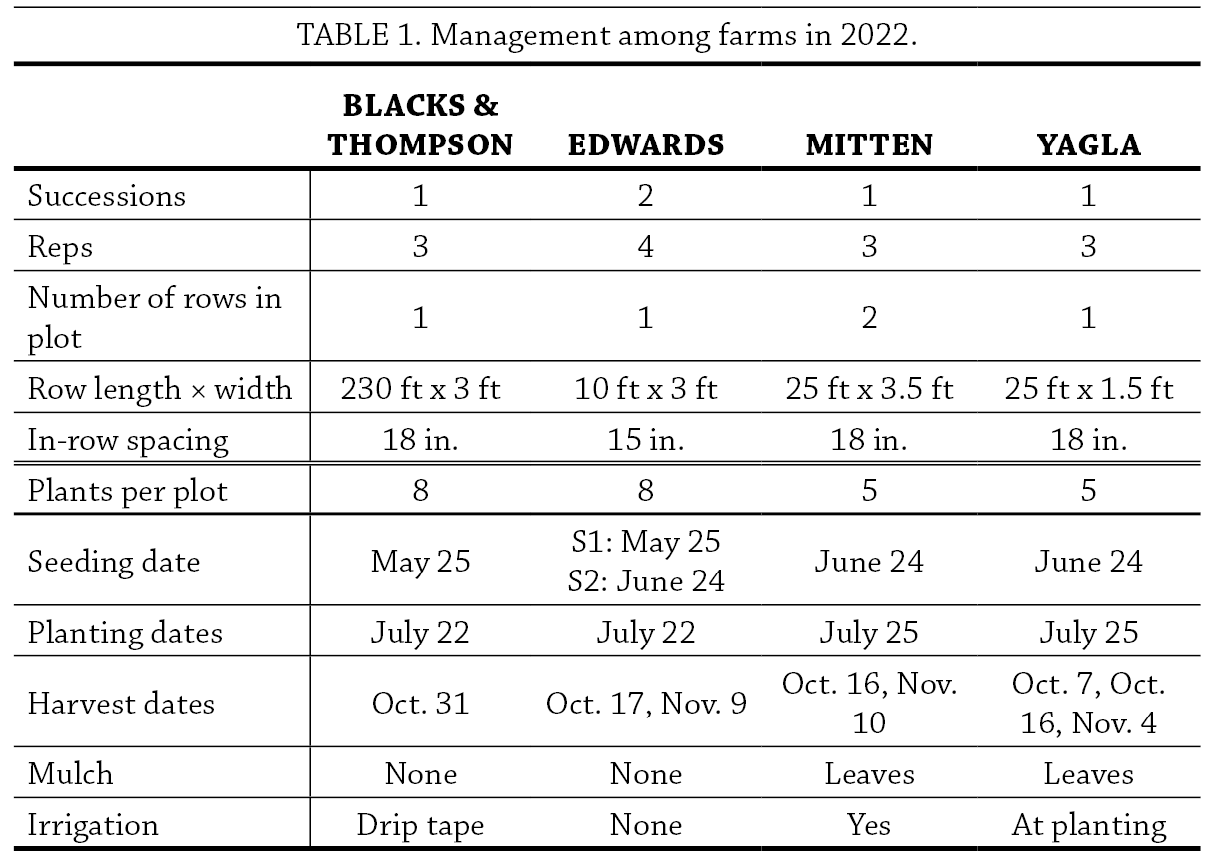
Two of the cooperators, Mitten and Yagla, compared two cauliflower cultivars, Snow Crown and Cheddar, in a randomized complete block design with three replications. The other two cooperators, Blacks & Thompson and Edwards, compared five cauliflower cultivars (Amazing, Cheddar, Flame Star, Lavender and Snow Crown) in a randomized complete block design with four replications. Edwards also compared the five cultivars in two successional plantings (4 cultivars x 4 replications x 2 successions= 32 plots). Management details are presented in Table 1.
 Measurements
At each harvest the cooperators recorded the number and weight of marketable cauliflower heads from each cultivar. Incidence of black rot in cauliflower heads was noted. Yagla and Mitten also recorded the date of first head formation of the two cultivars compared on their farms.
Data analysis
To determine the difference in cauliflower yield between cultivars at Blacks & Thompson’s, Mitten’s and Yagla’s, we analyzed the number and weight of marketable heads using the least significant difference (LSD) generated from a t-test. At Edwards’, we used Tukey’s LSD in order to make comparisons among the five cultivars trialed. With either analysis (t-test or Tukey’s), if the difference in cauliflower yield between any two cultivars was greater than or equal to the LSD, the cultivars are considered to be significantly different. Using a 90% confidence level, growers could expect this outcome 9 out of 10 times under the same conditions. The statistical calculations could be made because all growers used randomization and replication of their treatments in their experimental designs (Figure A1).
Measurements
At each harvest the cooperators recorded the number and weight of marketable cauliflower heads from each cultivar. Incidence of black rot in cauliflower heads was noted. Yagla and Mitten also recorded the date of first head formation of the two cultivars compared on their farms.
Data analysis
To determine the difference in cauliflower yield between cultivars at Blacks & Thompson’s, Mitten’s and Yagla’s, we analyzed the number and weight of marketable heads using the least significant difference (LSD) generated from a t-test. At Edwards’, we used Tukey’s LSD in order to make comparisons among the five cultivars trialed. With either analysis (t-test or Tukey’s), if the difference in cauliflower yield between any two cultivars was greater than or equal to the LSD, the cultivars are considered to be significantly different. Using a 90% confidence level, growers could expect this outcome 9 out of 10 times under the same conditions. The statistical calculations could be made because all growers used randomization and replication of their treatments in their experimental designs (Figure A1).
Results and Discussion
Yield
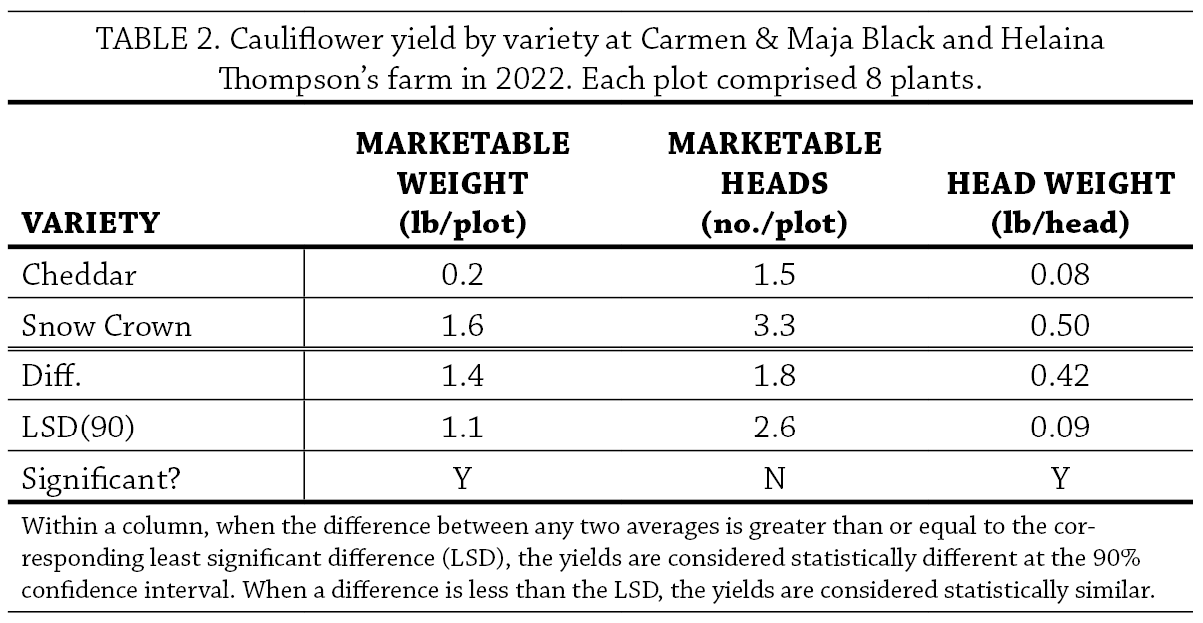
At the Blacks & Thompson’s, only Snow Crown and Cheddar produced marketable heads. The remaining three cultivars (Amazing, Flame Star and Lavender) did not produce any marketable heads and, therefore, do not have results to present. Snow Crown yielded a significantly higher weight of marketable heads per plot than Cheddar (Table 2). The two cultivars produced a similar number of marketable heads. Snow Crown produced larger marketable heads on average, contributing to the overall higher weight per plot.
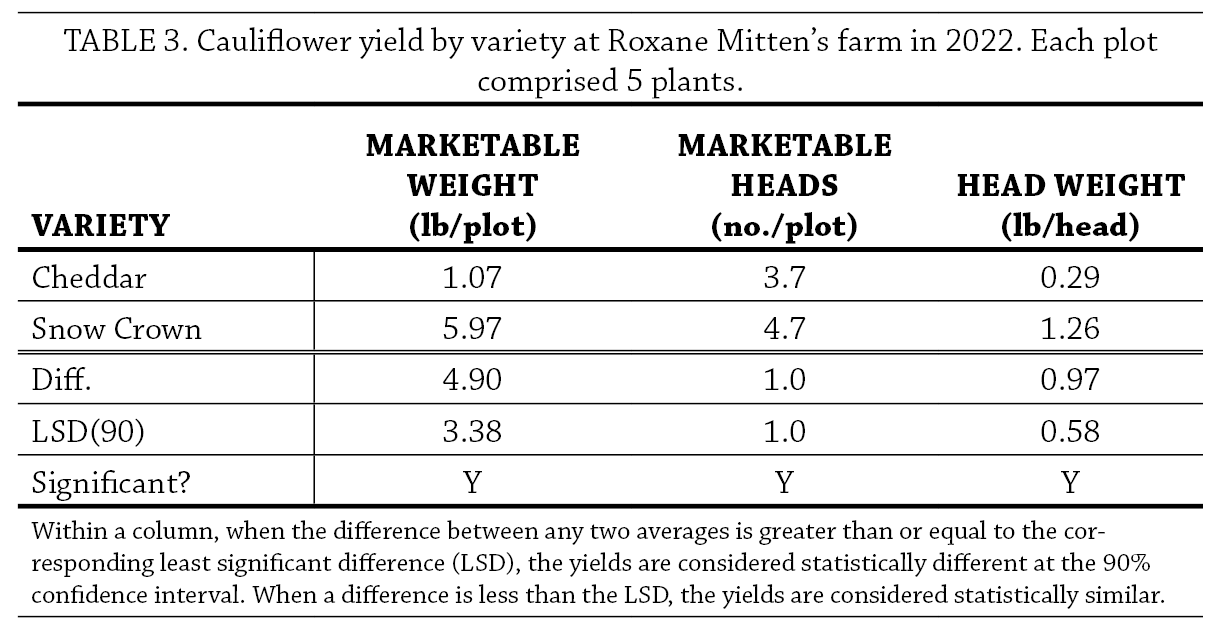
 At Mitten’s, Snow Crown produced a significantly higher number and weight of marketable heads per plot (Table 3). Snow Crown also produced a significantly larger average head weight.
No significant differences were found in the number and weight of marketable heads between Snow Crown and Cheddar at Yagla’s (Table 4). The two cultivars also produced similar average head weights.
At Mitten’s, Snow Crown produced a significantly higher number and weight of marketable heads per plot (Table 3). Snow Crown also produced a significantly larger average head weight.
No significant differences were found in the number and weight of marketable heads between Snow Crown and Cheddar at Yagla’s (Table 4). The two cultivars also produced similar average head weights.
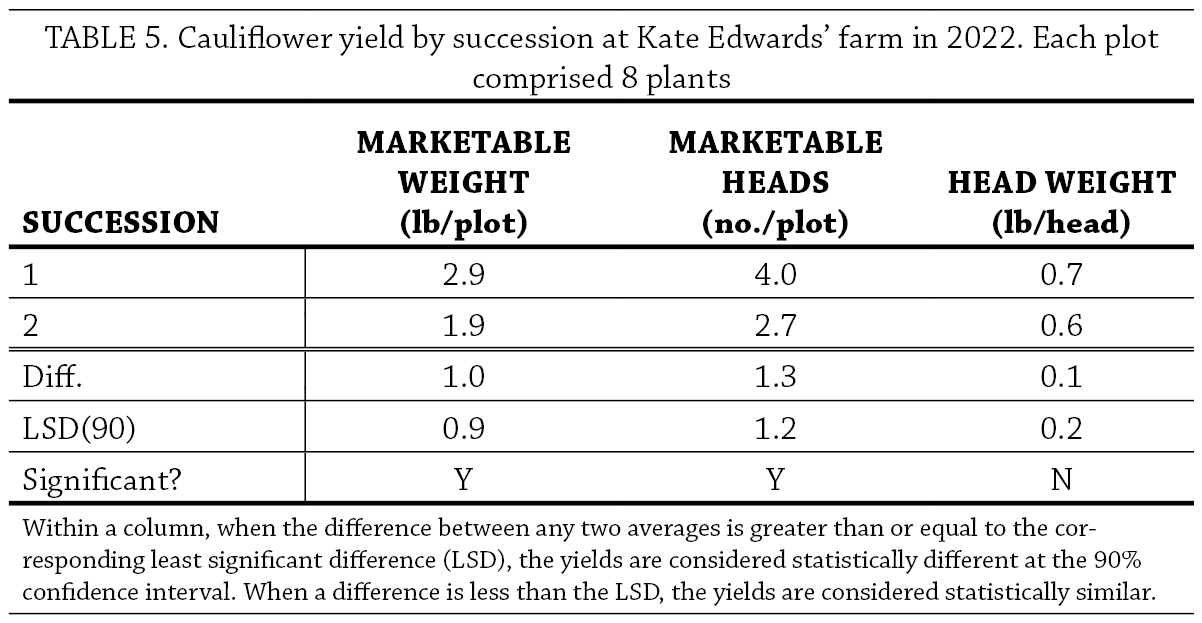
 Edwards trialed all five varieties in two successions. Regardless of variety, the first succession produced significantly more weight per plot and more marketable heads than the second succession (Table 5). The average head weight in both successions, however, was not different.
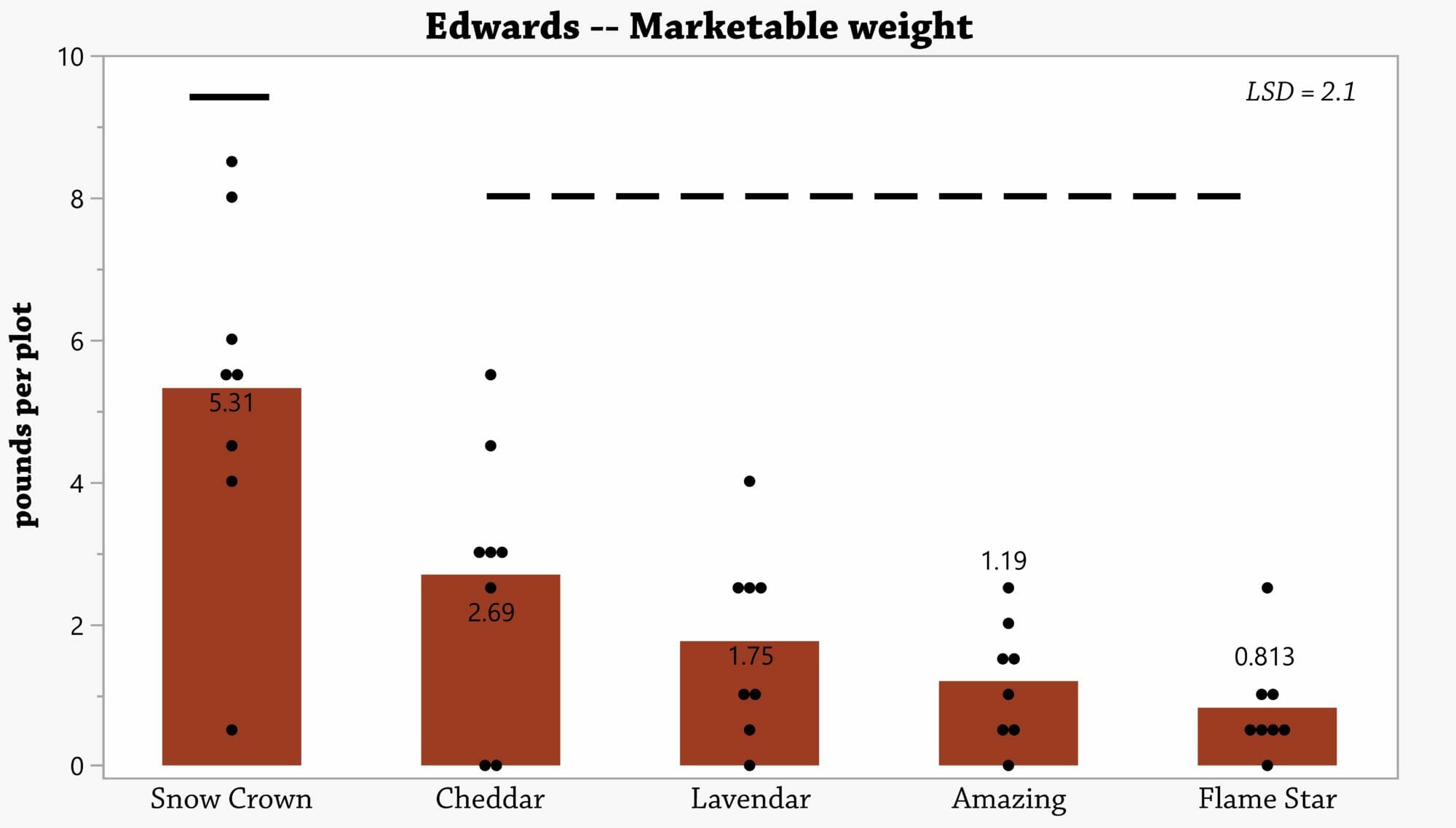
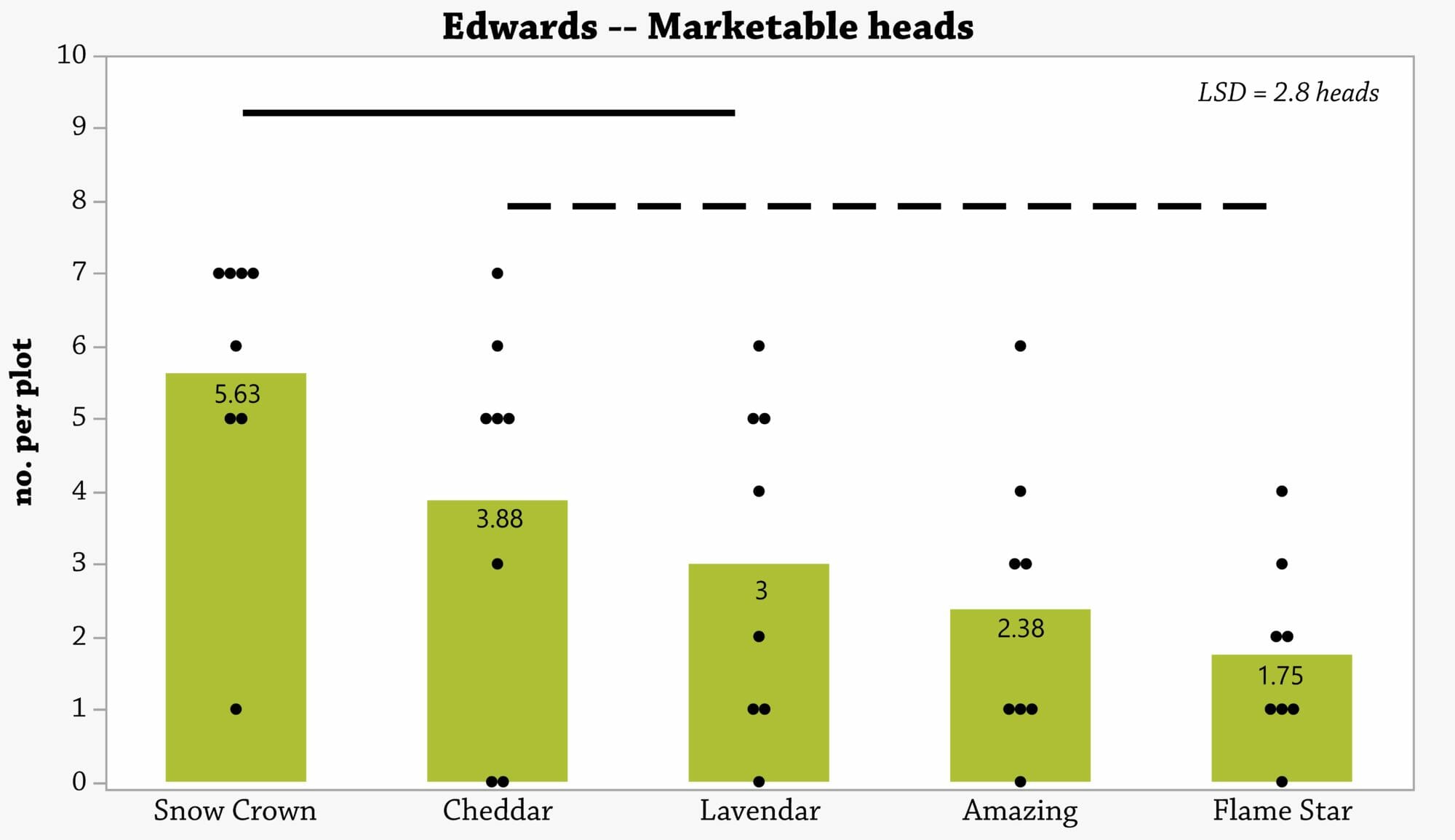
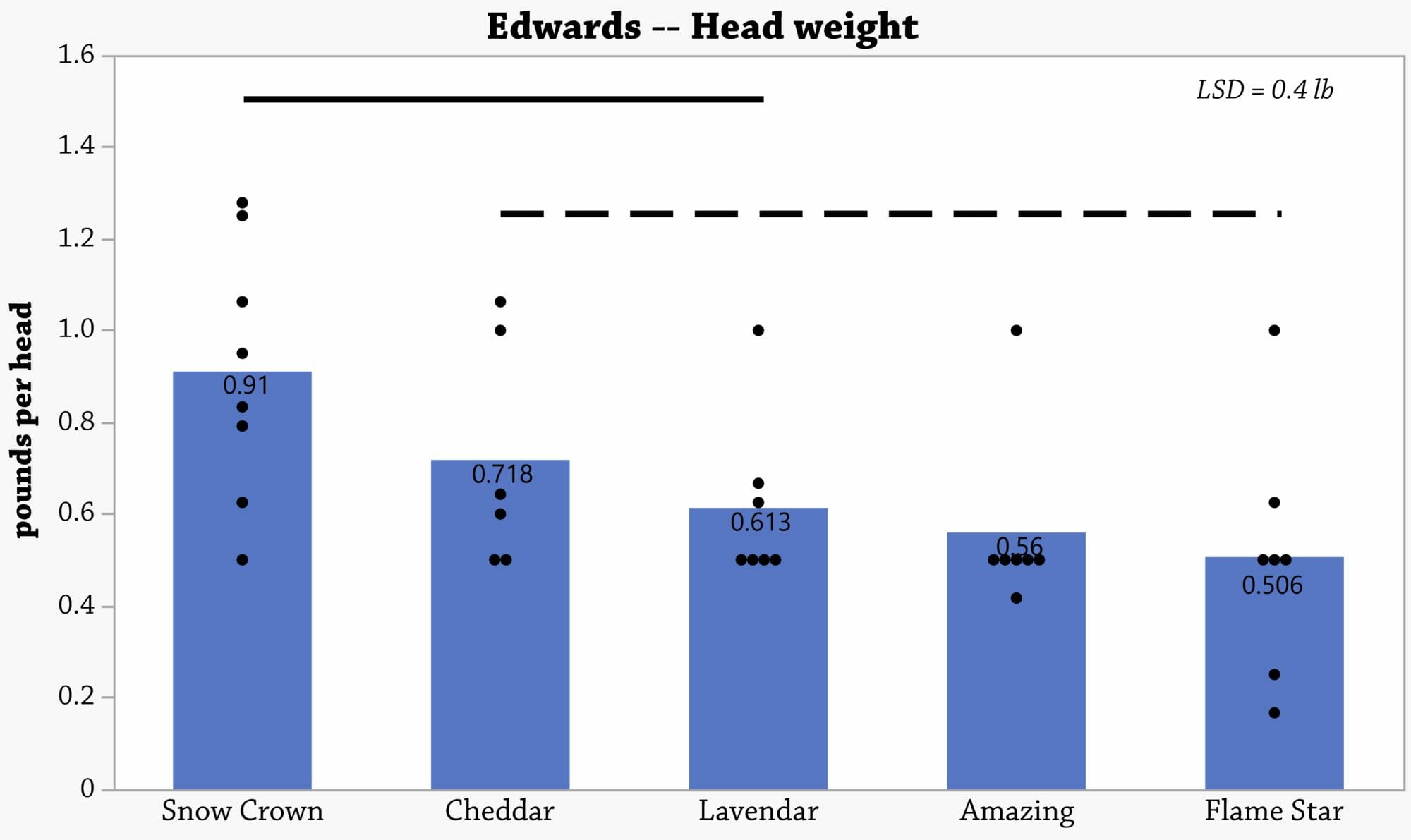
 When considering the effects of variety at Edwards’, similar patterns emerged in both successions so results from both successions were combined. Snow Crown was generally the top producer among the five cultivars while Amazing and Flame Star were generally the least productive. Cheddar and Lavender were somewhat intermediate in terms of the number of marketable heads and head weight.
Figure 1 illustrates that Snow Crown produced three times more marketable weight per plot than the four other varieties. The other four varieties (Cheddar, Lavender, Amazing and Flame Star) were statistically similar in terms of marketable weight per plot; on average they each produced 1.6 lb/plot while Snow Crown produced 5.3 lb/plot.
When considering the effects of variety at Edwards’, similar patterns emerged in both successions so results from both successions were combined. Snow Crown was generally the top producer among the five cultivars while Amazing and Flame Star were generally the least productive. Cheddar and Lavender were somewhat intermediate in terms of the number of marketable heads and head weight.
Figure 1 illustrates that Snow Crown produced three times more marketable weight per plot than the four other varieties. The other four varieties (Cheddar, Lavender, Amazing and Flame Star) were statistically similar in terms of marketable weight per plot; on average they each produced 1.6 lb/plot while Snow Crown produced 5.3 lb/plot.

- 2022: 2,642
- 50-yr: 2,722
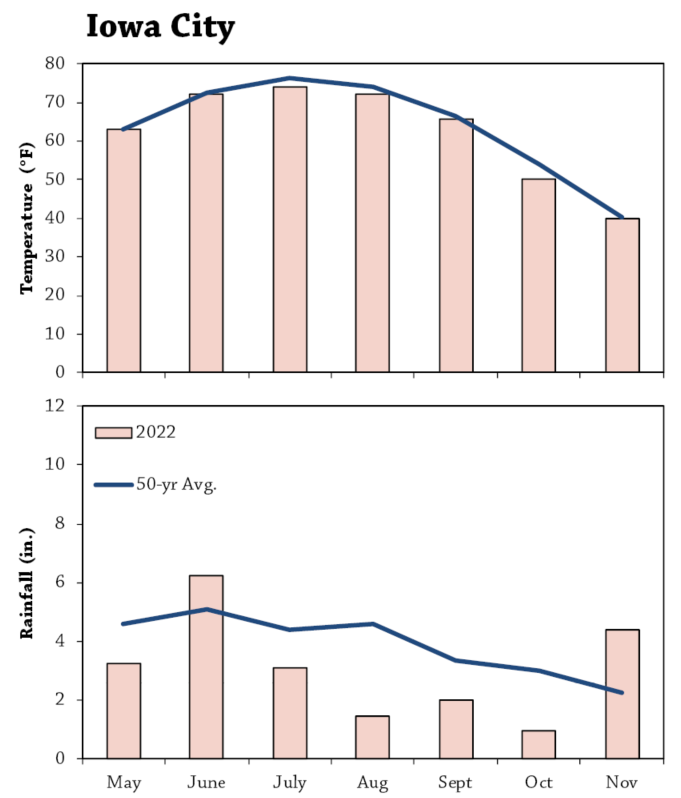
The growing period experienced 80 less growing-degree days in 2022 than the long-term average. Had the farms experienced more normal summer–fall temperatures or if the farmers planted cauliflower a couple of weeks earlier, they may have observed better performance from some of the later maturing cauliflower varieties trialed..
Conclusions and Next Steps
Of the cultivars evaluated, Snow Crown seems to be the variety best suited to fall cauliflower production in Iowa, producing larger heads and higher marketable weights among most cooperator farms. Carmen Black said, “we will definitely be planting Snow Crown again” as “it will yield heads when planted late and in a drought.” Black and Edwards found satisfaction in the trial and plan to implement changes on their farms, hopefully better able to maximize row footage by only growing cauliflower which can be harvested and sold. Edwards added, “I need to plant the other varieties much earlier to be successful with them.” Snow Crown has the shortest days to maturity of the cultivars evaluated, allowing it to produce marketable heads before consistent hard frost. Edwards was also surprised by the hardiness of Snow Crown, surviving “a few nights of 22 degrees F weather” in October. Mitten also experienced frost hardiness of Snow Crown and Cheddar and attributes higher yield due to the additional 3 weeks of extended fall after a period of hard frosts in October. She suggests that a minor intervention such as a row cover could help production through a frost period in fall to gain a harvest that might otherwise be lost. All cooperators were interested in working together to better understand the potential for cauliflower in Iowa, often not given much attention but with appeal to consumers in the late season. Edwards explained that “the trial confirmed that it is a tricky crop and gave us a direction to go in for the future.” Edwards hopes to repeat the trial with earlier planting dates adding that she was “intrigued by how beautiful the orange and purple varieties were and how they didn’t show much disease. I am curious if that will hold true if they are started earlier in the summer.”
Acknowledgements
We wish to extend our gratitude to Johnny’s Selected Seed (Winslow, ME) for donating seed for all varieties trialed in this on-farm research project.
Appendix - Trial Design and Weather Conditions

References
1. Hoidal, N. 2022. Black rot of Brassica crops. University of Minnesota Extension. https://extension.umn.edu/disease-management/organic-management-black-rot (accessed December 2022). 2. Cebula, S., A. Kalisz and E. Kunicki. 2005. The course of growth and yielding of white and green cauliflower cultivated in two terms for autumn production. Folia Horticulturae. 17:23–35. https://www.researchgate.net/publication/259975205 (accessed December 2022). 3. Kolbe, L., M. Quee and S. Sellz. 2020. Cauliflower Variety Trial. Practical Farmers of Iowa Cooperators’ Program. https://practicalfarmers.org/research/cauliflower-variety-trial/ (accessed December 2022). 4. Iowa Environmental Mesonet. 2022. IEM “Climodat” Reports. Iowa State University Department of Agronomy. https://mesonet.agron.iastate.edu/climodat/ (accessed December 2022).