This research was funded by Builders Vision Philanthropy.
In a Nutshell:
- While there are many biological products on the market, few are organic certified.
- BioGuard is an OMRI-listed biological that is advertised to reduce insect feeding and fungal disease damage and improve emergence, plant stand uniformity, and plant nutrient uptake.
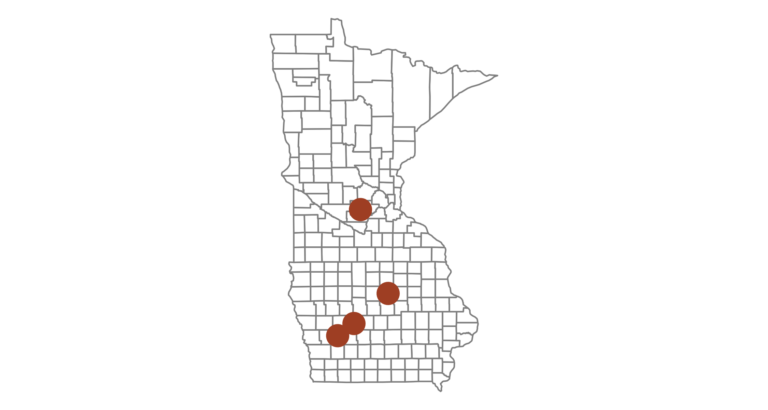
- Organic farmers Doug Alert & Margaret Smith, Matthew Fitzgerald, Eric Madsen and Scott Shriver decided to trial BioGuard on their farms and determine whether it had any effect on corn population or yield.
Key Findings:
- Neither Alert & Smith nor Shriver found any differences in corn population or corn yield with BioGuard, even in a very wet year.
- Fitzgerald’s and Madsen’s replicated trials were both flooded and abandoned. However, they replanted single-strip observation trials where they observed no differences in corn growth or yield.
- All farmers concluded that they will not continue to use BioGuard.
Background
Organic row crop farmers have few product options for pest and disease management. BioGuard is a relatively new biological seed coating that is OMRI-listed and advertised as reducing insect feeding and fungal disease damage as well as supporting plant growth throughout the corn life cycle. Intrigued by these promises but also leery of the product’s price tag, PFI farmers Doug Alert & Margaret Smith, Matthew Fitzgerald, Eric Madsen and Scott Shriver decided to test BioGuard’s effects on corn planting population, yield and return-in-investment through rigorous research trials on their farms. At the outset, Shriver said that “This trial will help me decide if using the BioGuard seed treatment will be something I want to use (or not use) in future.”
It is important to note that while BioGuard is OMRI-listed, the farmers had to get permission from their organic certifier before using the product.
Methods
Design
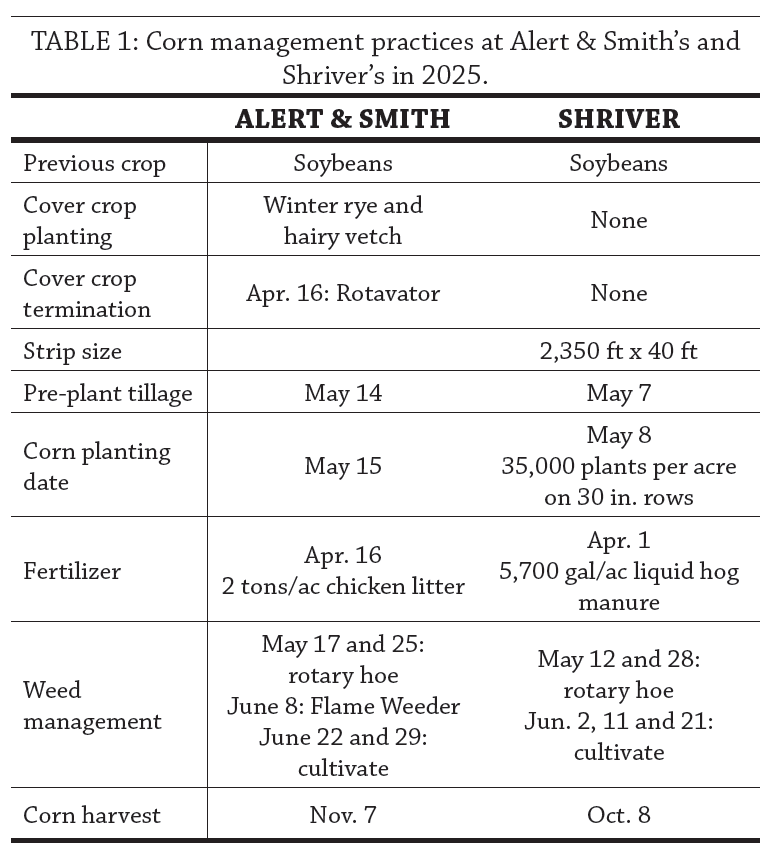
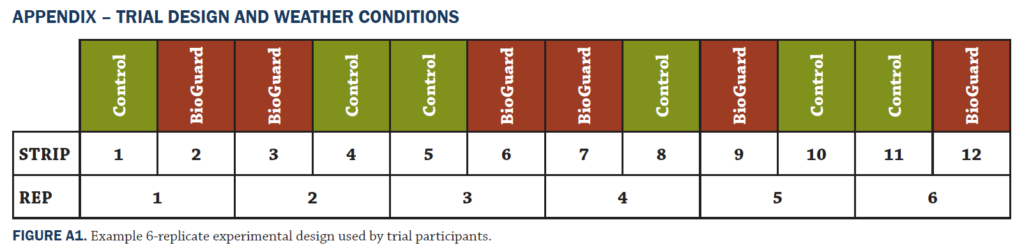
Fitzgerald and Madsen were unable to plant replicated trials due to seed availability and time constraints while planting/replanting in a very wet season. Alert & Smith and Shriver each planted corn in two treatments, BioGuard (applied as seed coating with 1r) and control (only 1r), in spring of 2025. 1r is also a biologically-derived seed coating that is advertised as protecting seeds from pathogens and improve nutrient uptake. Seed treated only with BioGuard was not available. Planting and management details on each farm are presented in Table 1. Seed came pre-treated to the manufacturer’s specifications. Cooperators established treatments in randomized, paired strips: 2 treatments × 6 replications = 12 strips total (Figure A1).
Measurements
To measure plant population, farmers counted number of plants in two, 17-foot and 5-inch row sections in each replicate. At harvest, farmers recorded grain yield and moisture using a yield monitor or weigh wagon. Reported corn yields are corrected to 15.5% moisture. Farmers also documented costs of equipment passes and applied products.
Data Analysis
We used an ANOVA (Analysis of Variance) at a 95% confidence level to determine if there were significant differences in plant population and yield between BioGuard and control treatments. This means that any treatments we declare statistically different would be expected to occur 95 times out of 100 under the same conditions. We can perform this analysis because the cooperators had completely randomized and replicated experimental designs (Figure A1).
Results and Discussion
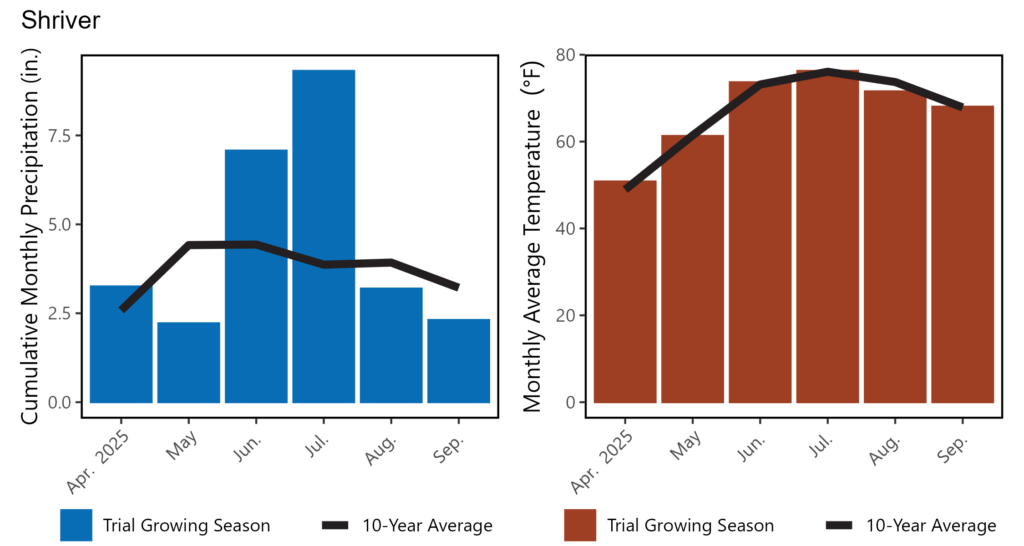
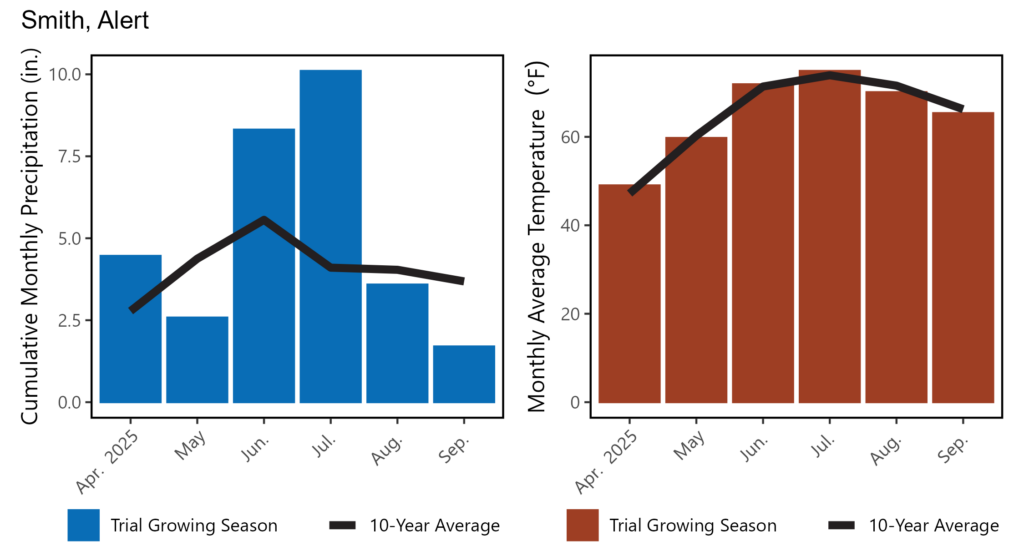
Neither Alert & Smith nor Shriver saw any differences in plant population or corn yield between BioGuard and control treatments (Table 2). BioGuard seed treatment cost $17.50/ac in 2025, meaning that there was a relative net loss of $17.50/ac from the treatment. Anecdotally, Fitzgerald and Madsen also did not observe any differences in corn growth or yield between BioGuard and the control in their unreplicted check strips on the product, which were replanted after their full trials flooded.

Farmers were unsurprised to find no difference in yield between the two treatments, though they were somewhat surprised that there were no differences in plant population in any of the trials. Fitzgerald summed up the conclusions of the group succinctly. “There was no impact observed from seed treatment. We’re unlikely to change our management practices (i.e.. adopt BioGuard broadly).”
Conclusions and Next Steps
BioGuard did not provide any plant population increase or yield increase, and reduced financial returns at both Alert & Smith or Shriver’s. Past PFI research on other biological and biostimulant products in organic and conventional corn and soybean production have generally reached similar conclusions [1], [2], [3]. Participating farmers report that they will not continue to use BioGuard in the future. PFI will continue to support farmers in testing the effects of biological and biostimulant treatments as new products come on the market.
Appendix
References
- Holganix, “Holganix Bio 800+ Compotnents.” Nov. 29, 2021. Accessed: Jul. 24, 2023. [Online]. Available: https://f.hubspotusercontent30.net/hubfs/18130/Holganix%20Bio%20800%20Ingredient%20List%2011.29.21%20(1).pdf
- Corteva, “Utrisha N Nutrient Efficiency Optimizer Application in Corn.” Corteva Agriscience. Accessed: Jan. 02, 2024. [Online]. Available: https://www.corteva.us/content/dam/dpagco/corteva/na/us/en/files/product-page-resources/utrisha-n/DOC-Utrisha-N-Fact-Sheet-Corn.pdf
- J. Olson, “Biologicals and Unconventional Products,” 1994. Available in PFI research report archive.
- A. H. Sparks, “nasapower: A NASA POWER Global Meteorology, Surface Solar Energy and Climatology Data Client for R,” J. Open Source Softw., vol. 3, no. 30, p. 1035, Oct. 2018, doi: 10.21105/joss.01035.
- A. H. Sparks et al., nasapower: NASA POWER API Client. (May 18, 2024). Accessed: Sep. 11, 2024. [Online]. Available: https://cran.r-project.org/web/packages/nasapower/index.html