In a Nutshell:
- Ben Albright, an integrated beef and crop farmer, grazed cover crops with finishing steers in the fall, winter and early spring. In order to determine the economic and soil health impact of grazing cover crops, he kept cover crop and grazing records and had his soil sampled in 2019, 2020 and 2021.
Key Findings:
- Albright profited from grazing cover crops each year. His profits averaged $45.56/acre or $16.08/head.
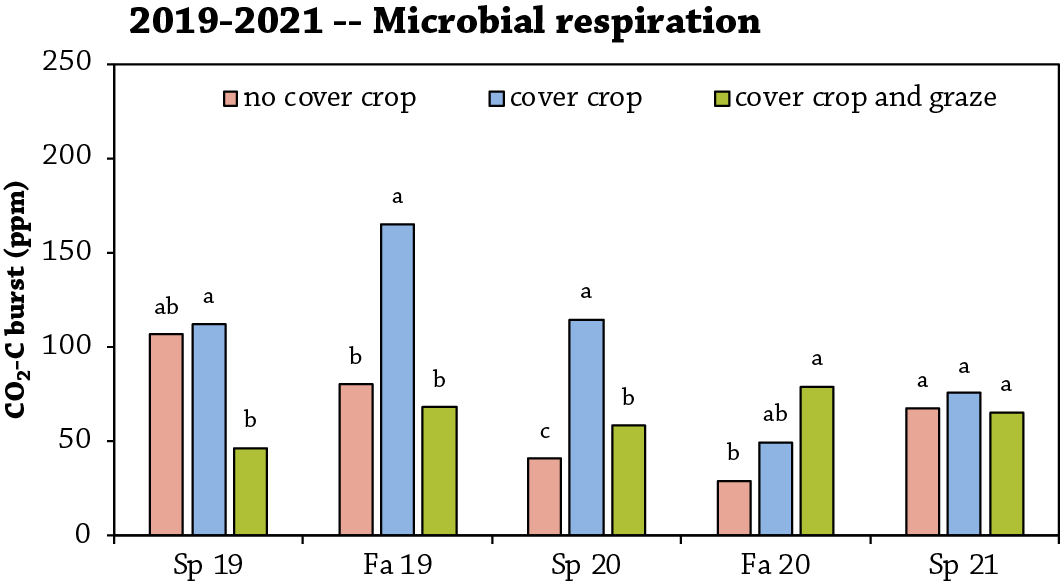
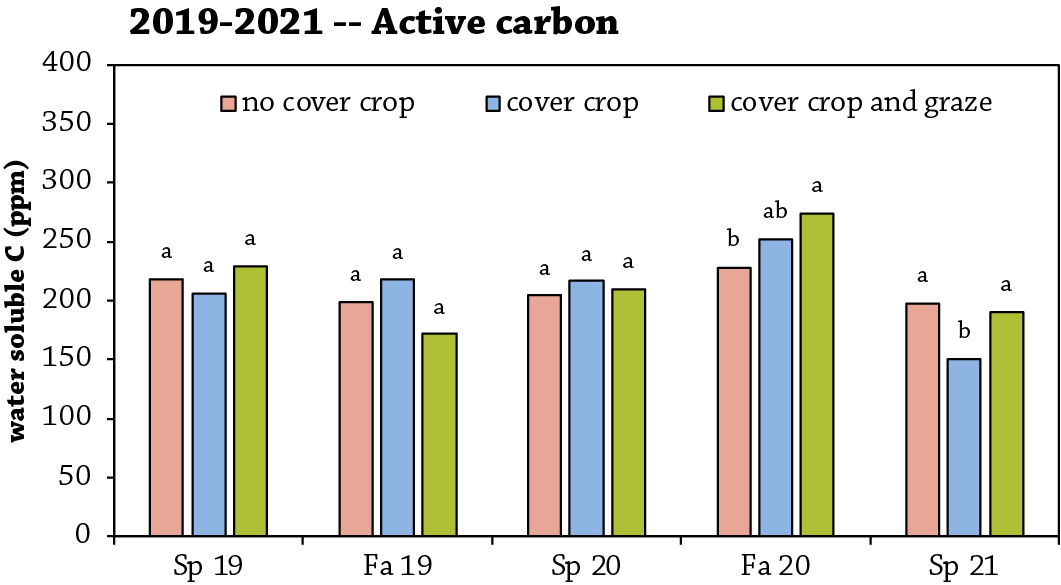
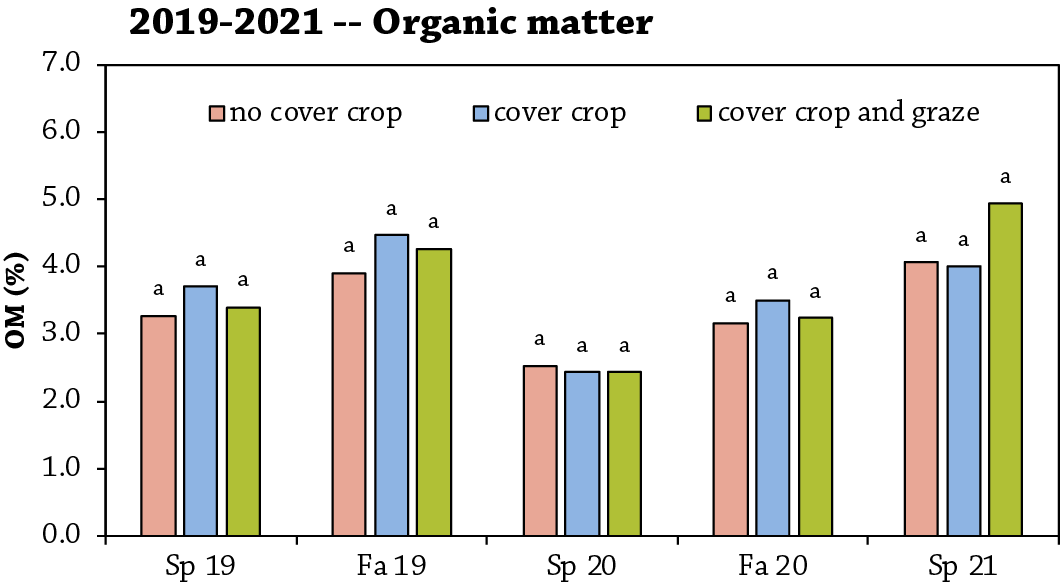
- Soil samples from May 2019 through April 2021 show very few detectable trends in soil health.
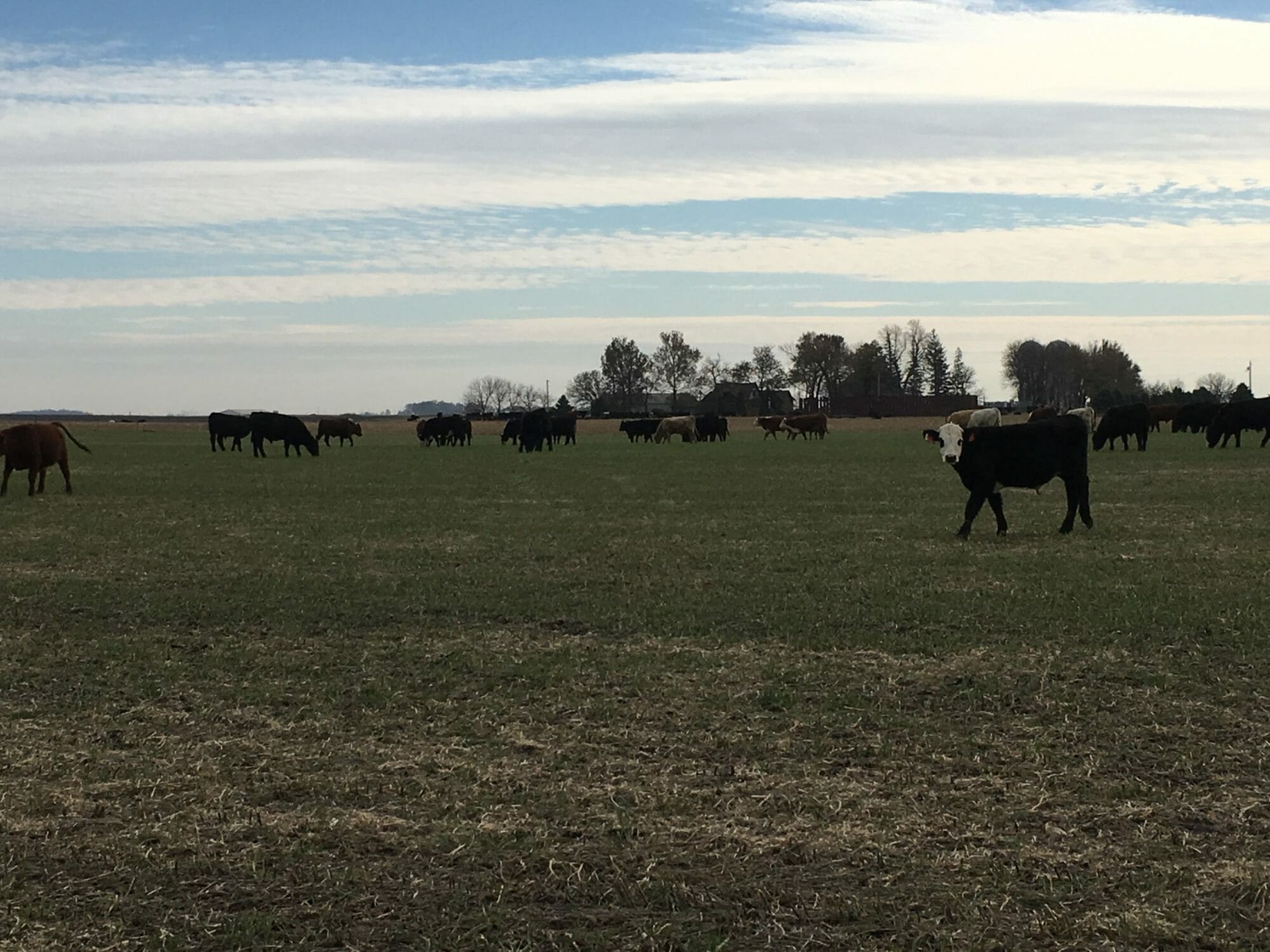
- Grazing cover crops is becoming standard practice for cow-calf producers, but less so for feedlot producers. Albright proved how a cover crop field adjacent to his feedlot could provide supplemental forage through simply allowing finishing cattle to graze them, which saved him thousands of dollars in feed costs each year.
Background

Methods
DesignIn September of 2018, 2019 and 2020, Albright seeded cereal rye and oats in a 79-acre field adjacent to his feedlot with the intention of grazing the forage produced. Cover crops were seeded in fields rotated with corn and soybeans. Cattle in the lot were given access to the cover crop field from fall to late winter/early spring (Table 1). For soil sampling, Albright established three treatment fields:
- No cover crops with no grazing (no cover crop)
- Cover crops with no grazing (cover crop)
- Grazed cover crops (cover crop and graze)
 Feed economics
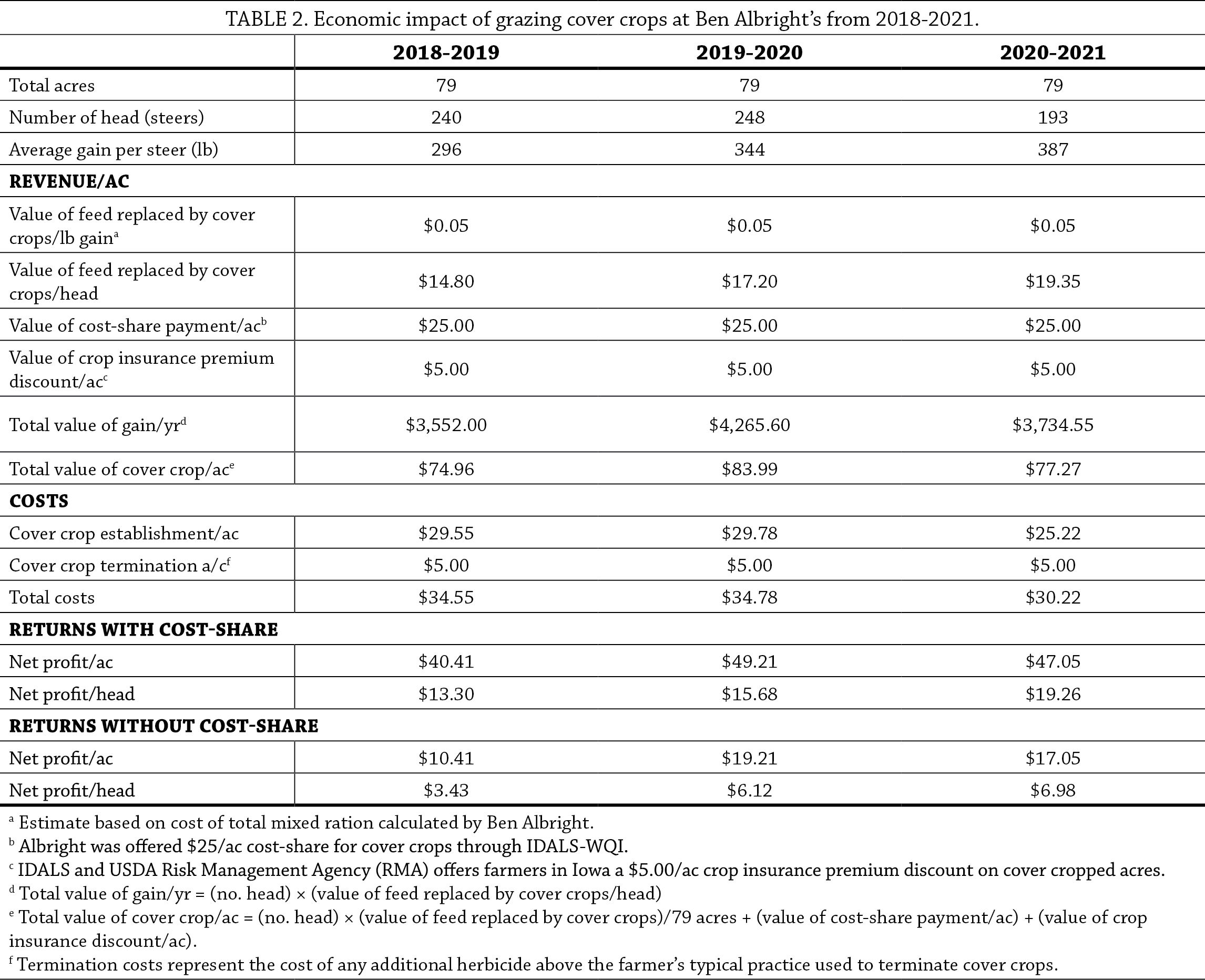
Albright recorded cover crop expenses, cover crop grazing data and tons of TMR amounts offered to cattle. Based on comparing tons of TMR offered to two different pens of cattle, one of which had access to cover crops as supplemental feed, Albright estimated cover crop forage to be valued at $0.05 per pound of gain. In order to estimate the value of cover crops in Albright’s system, the revenue and costs associated with cover crop grazing were taken into account. Revenue includes the value of feed replaced by grazing, cost-share payments received and crop insurance discounts. Expenses include costs for establishing cover crops and additional herbicide needed for cover crop termination. Cattle were weighed when they arrived and departed from the feedlot in order to calculate average weight gain per animal, which then was multiplied by $0.05/lb gain, representing the value of the cover crop forage. Net profit is reported on a per acre and a per head basis. Net profit was calculated two ways: 1) including cost-share and crop insurance discounts; and 2) without including cost-share or crop insurance discounts. This economic analysis did not take into account effects on cash crop yield, soil retention value, nutrient retention value, soil health value or nutritional value of forage. Soil health Soil samples were collected in spring 2019, 2020 and 2021 and in fall 2019 and 2020 in all three treatment fields to a depth of 6 in. Soil sample locations were marked by GPS and taken within the same soil type. Samples were sent to AgSource Laboratories (Ellsworth, IA) and analyzed for microbial respiration by determining the burst of CO2-C following rewetting of dried soil using an infrared gas analyzer. Other soil indicators measured included water soluble carbon (active C) and organic matter (OM). Soil data were analyzed using JMP Pro 15 (SAS Institute Inc., Cary, NC) statistical software. Means separations are reported using Tukey’s least significant difference (LSD). Statistical significance was determined at the 90% confidence level.
Results and Discussion
Economic impact
Results from Albright’s farms are presented in Table 2. Three years of data are included, each year representing a full cover crop season spanning autumn to the following spring. On average, cover crop establishment cost $28.18/ac. Net profits from grazing averaged $45.56/ac or $16.08/head. Without the assistance of cost-share and crop insurance discounts, net profits averaged $15.56/ac or $5.51/head. Regardless of financial assistance, Albright scored positive profits from grazing cover crops within the same year of planting cover crops.
Across the three years, Albright saved an average of $3,851 in TMR per year. This is an important finding considering winter feed costs represent the single largest cost in cattle operations.[3] Grazing cover crops reduces winter feed costs. “I think grazing covers in a no brainer for cattle producers, as the numbers show,” stated Albright.
Conclusions and Next Steps
The economic results from this project add to a growing body of work by PFI cooperators showing that grazing cover crops provides short-term economic benefits and pay off in one year. Grazing cover crops is becoming standard practice for cow-calf producers, but less so for feedlot producers. In this case, Albright proved how a cover crop field adjacent to his feedlot could provide supplemental forage through simply allowing finishing cattle to graze them. This saved him thousands of dollars in feed costs each year. Albright proclaimed, “I will definitely continue to plant cover crops on all the fields we graze.” Soil health results indicate the soil health impact of grazing cover crops may take more time to realize and research efforts may be better spent focusing on economics, ecological benefits and field fitness.
Funding Acknowledgement


References
- Myers, R., Weber, A., S. Tellatin. 2019. Cover Crop Economics. SARE Technical Bulletin. https://www.sare.org/Learning-Center/Bulletins/Cover-Crop-Economics (accessed August 2021).
- Filbert, M. 2017. Livestock Economic Impact of Grazing Cover Crops in Cow-Calf Operations. Practical Farmers of Iowa Cooperators' Program. https://practicalfarmers.org/research/economic-impact-of-grazing-cover-crops-in-cow-calf-operations/ (accessed August 2021).
- Boetel, B. 2017. In The Cattle Markets: Cost of Wintering Cattle. Drovers. https://www.drovers.com/article/cattle-markets-cost-wintering-cattle (accessed August 2021).
- Franzluebbers, A.J. and J.A. Stuedemann. 2015. Does grazing of cover crops impact biologically active soil carbon and nitrogen fractions under inversion or no tillage management? Journal of Soil and Water Conservation. 70(6):365–373. https://www.jswconline.org/content/70/6/365 (accessed August 2021).