
Answering a Call to Conservation
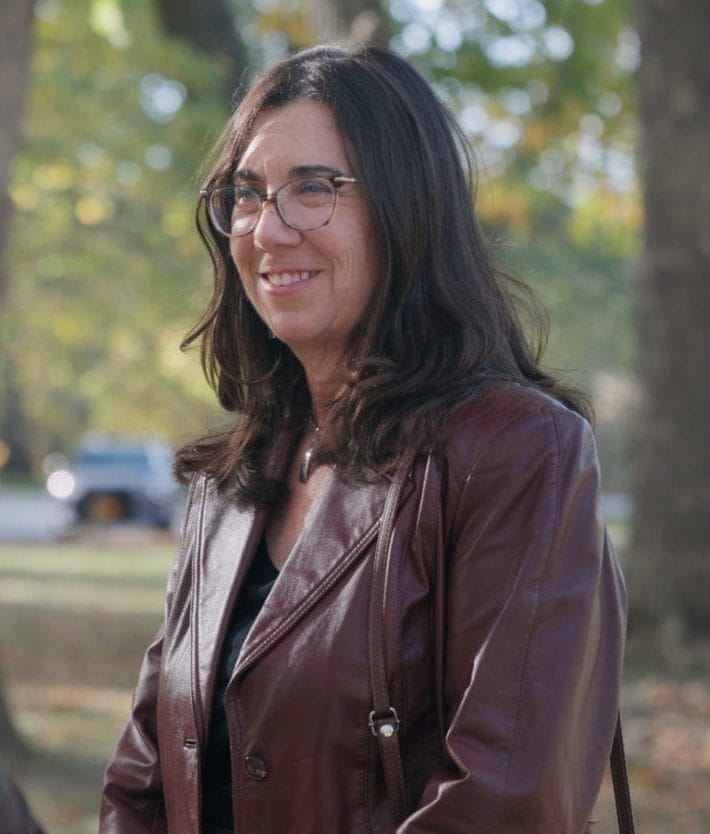 For Ruth Rabinowitz, caring for her family’s farmland is an act of meditation, art and tribute to her father’s legacy.
When Ruth Rabinowitz inherited farmland, she could have sold it to the highest bidder. She could have hired tenants to produce the greatest yield. She could have functioned as a distant landowner, detached from the challenges faced by Midwestern farmers.
Instead, she did the opposite: She went to work.
“I’m not a person that would just take money and lay on the beach somewhere,” Ruth says. “That’s just not who I am.”
Ruth inherited not only farmland but also a commitment to doing the right thing because she is her father’s daughter.
Daughter
Ruth’s father is the late Dr. David Charles Rabinowitz, whom she considers a visionary. Her father was born a child of the Great Depression and grew up hardscrabble in Camden, New Jersey. Equipped with a work ethic and intellect, he put himself through university and medical school. David moved his family – including young Ruth – from Michigan, where Ruth was born, to Arizona where his medical practice thrived. He enjoyed helping people. As a reader and thinker, he also pursued his interests in agriculture. He gardened the family’s arid urban acre.
“He was such an astute learner,” says Ruth, recounting his varied interests such as Shakespeare, world hunger and the types of soils. He studied climate change before it became part of our cultural lexicon.
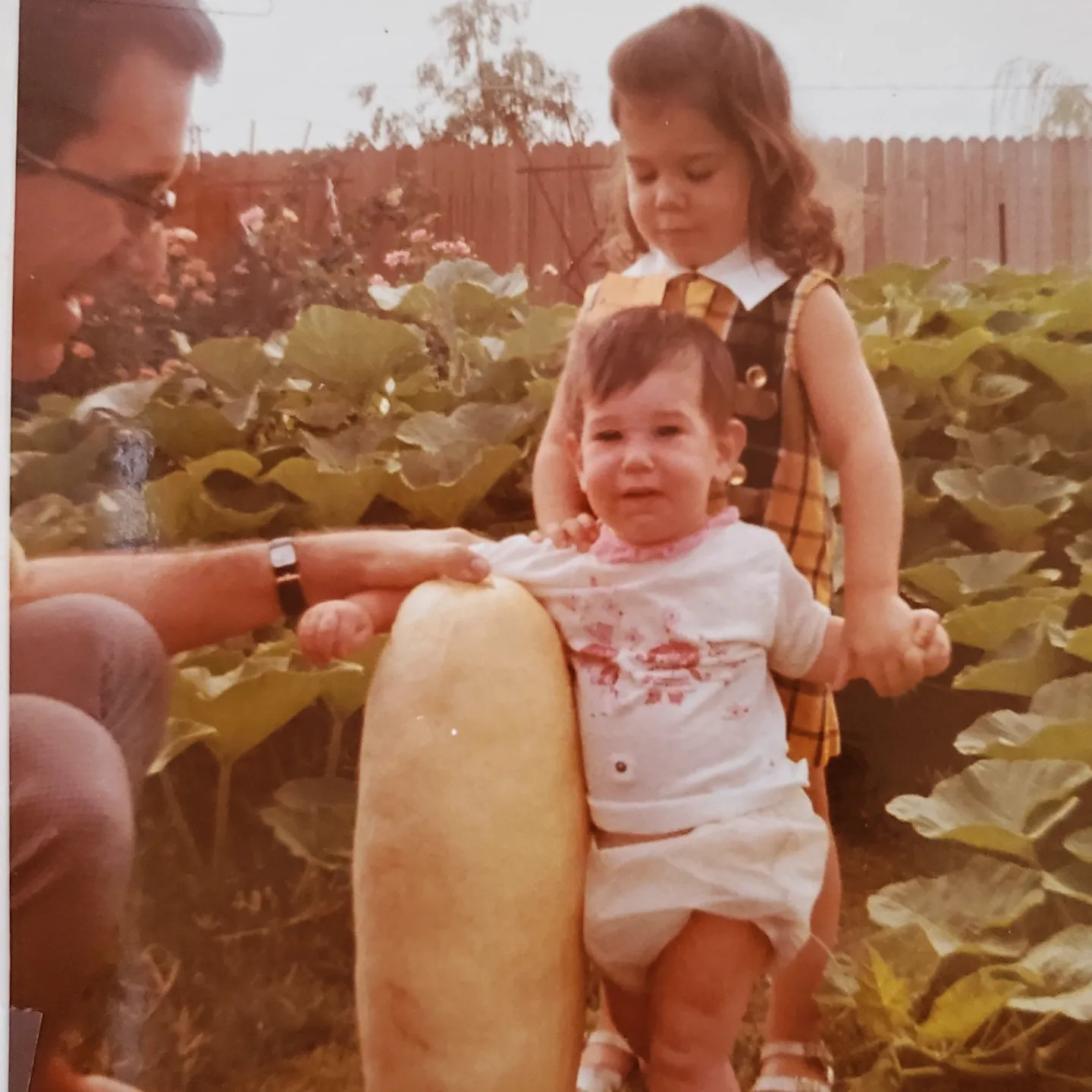
From left: Ruth’s father, the late Dr. David Rabinowitz, Ruth (taller child) and her sister Shaunna.
Knowing that Midwestern soils were premium, through the years Ruth’s father bought tracts of farmland in Iowa and South Dakota. To make these purchases possible, he pieced together resources – such as mortgages on the family house, lines of credit and payment plans. He invested in land partly to create security for his children, yet he also believed Ruth and her younger sister needed to support themselves.
“Dad did not spoil his kids,” Ruth says. “He expected us to work jobs at a young age for any spending money we wanted. I worked as early as 13 years old and never stopped.”
Infused with her father’s influence, as an adult Ruth moved to California to pursue art.
Artist
Ruth holds a bachelor’s degree in art from University of California Santa Cruz and a degree in early childhood education with a site supervisor focus. She ran her own photography business for 20 years and worked in portraiture, floral arranging, ceramics and education.
When her father fell ill in 2013, Ruth shifted her work to providing care and handling the family farms, totaling 1,650 acres. At the time, she was inexperienced with land management. The more she learned, the more she understood the urgency at hand. She discovered erosion, poor soil, ploughed-in waterways, low returns, delayed maintenance and debt.
Could the family keep the farms and pay for David’s mounting medical needs? Ruth had decisions to make. “It was really like five-alarm bells. If I don’t save this, it’s going to be lost,” Ruth says. “And I didn’t want it to go away. I wanted what my dad had done to really stand. My father had spent his whole life working to purchase these farms.”
Her artistic brain hatched a plan. She would approach her problems like a puzzle – trying, fitting and piecing answers one by one. Just as her dad had patched together funds for farm purchases, Ruth would cobble up resources for farm resilience. The self-described “land healer, Earth warrior-artist, prairie tender, rewilding and sanctuary designer” committed herself to the task. Meanwhile, she cared for her father, her best friend, for five years until he died in 2017. Ruth would later build a little house on the Iowa prairie and shift her purpose to full-time farming.
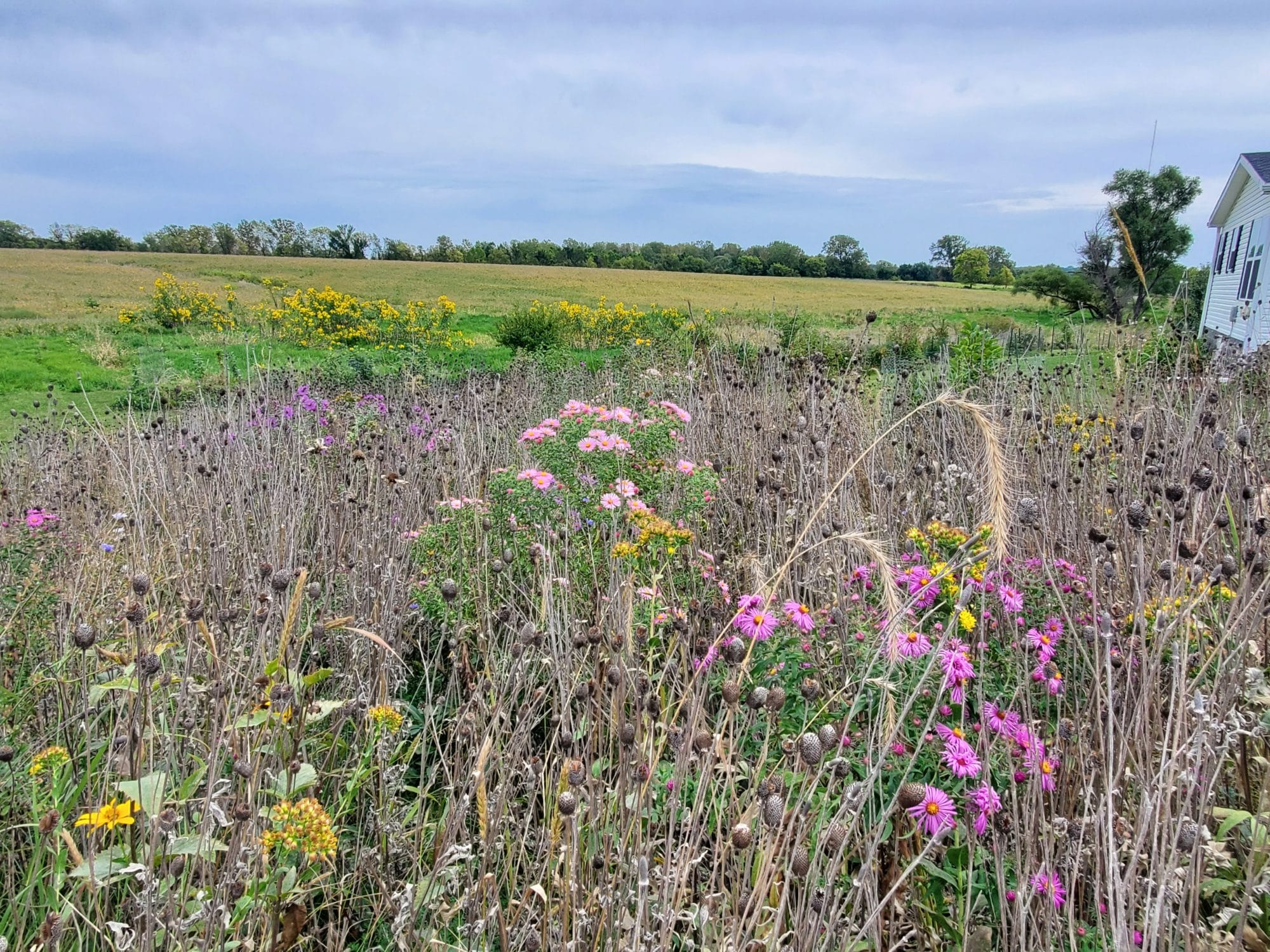
Asters on Ruth’s reconstructed prairie.
Farmer
As she embraced the task, Ruth got to work researching agriculture.
She read books, watched videos and signed up for webinars. She joined Practical Farmers of Iowa and networked with experienced farmers. She earned her Permaculture Design Certificate. She partnered with organizations such as Ducks Unlimited, Iowa Farmers Union, Environmental Defense Fund, Pheasants Forever, Xerces Society and Women, Food and Agriculture Network.
Ruth also got to work doing agriculture.
She walked the land, paid debts and replaced farmer tenants with ones who shared her values. She incorporated cover crops and no-till. She limited chemicals and expanded buffers. She established ponds, orchards and pollinator habitats. She planted 300 native trees and shrubs. She weeded and seeded prairie by hand. She installed wildlife corridors and restored oxbows. She devoted sweat equity.

In this image, land Ruth Rabinowitz enrolled in the Conservation Reserve Program is visible in the foreground while a no-till crop field and oxbow lake surrounded by walnut trees are in the background.
“I think with boots on the ground, the skin in the game, that’s when you get credibility,” says Ruth.
Presently, Ruth owns and farms a total of 800 acres, with 300 acres in conservation. Farming enterprises include alfalfa, corn and soybeans. Her land thrives with native flora and fauna. The soil is rich and gives back. She builds intentional, trusting relationships with her tenants and neighbors.
Still, she wants more. Ruth seeks healing.
Healer
Before David died, he implored Ruth and her sister not to sell the farms. He may have known the worries of transitioning farmland when personal values do not align. But Ruth’s values aligned.
“I wanted to do more than just ‘don’t sell the farm.’ I wanted to heal and take care of and enhance the farm,” Ruth says.
“I did really feel for the land right away. I saw it as a living organism, the soil as a living being and that it needed me to take care of it because everyone else was extracting from it – extracting money, extracting topsoil, extracting crop.”
Ruth feels outreach and education are important. She communicates tips and tricks on her social media platform – Oxbow Farms Iowa – infused with her photography and reflections. She shares her knowledge, such as how to write one’s own farming and hunting leases. She presents at PFI events and is a stewardship ambassador for WFAN. Additionally, she has made her own farm succession plans with conservation as the primary goal.
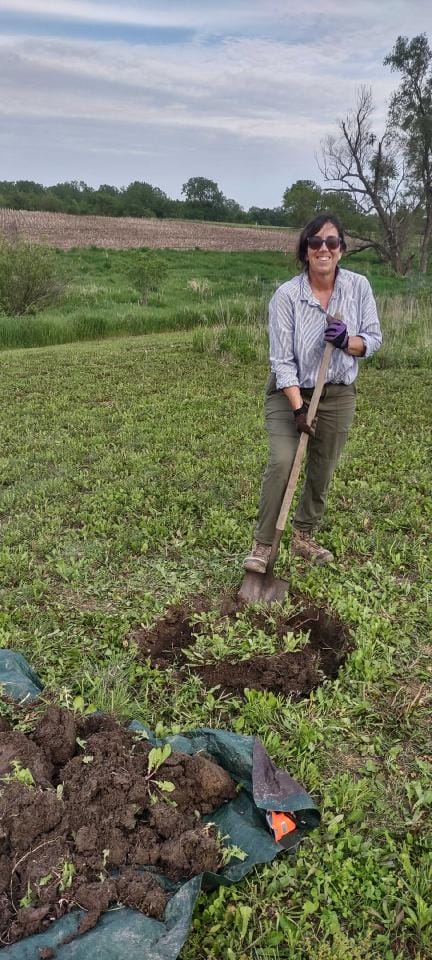
Ruth planted and nurtured 300 native trees and bushes by hand.
Ruth Rabinowitz had choices when she inherited land. Her actions to prioritize conservation led the PFI board of directors to select Ruth as the 2025 Farmland Owner Legacy Award recipient. The award ceremony was held Oct. 23 in Madison County, Iowa, where some of Ruth’s Iowa farmland parcels are located. With this award, Practical Farmers calls attention to the important role non-operator farmland owners can play in the future success of sustainable agriculture.
“Without intention, non-operators can perpetuate ag trends that result in environmental, community and economic degradation. But with intent, they can do a lot of good,” says Sally Worley, PFI’s executive director. “Ruth is a shining example of the impact a landowner can have.”
Ruth answered the call to conservation by integrating her roles of daughter, artist, farmer and healer to do what she believes are the right things: steward the land, honor her father, live her joy.
Ruth says, “I’m very grateful to my dad for that incredible gift of a vocation and an avocation simultaneously.”
Learn More
Watch Ruth’s acceptance speech from the award ceremony.
Read more about Ruth’s work to plant trees on her land in “Wonders of Windbreaks” from our Spring 2024 magazine.