Funded by Builders Vision Philanthropy.
In a Nutshell:
- Anna & Shae Pesek and Ashley & Zach Wenke raise chickens on pasture. Like many farmers, they raise Cornish Crosses, a modern, fast-growing breed.
- The Peseks have observed high rates of Deep Pectoral Myopathy (DPM, also known as “green wing”) in their Cornish Crosses. This disease is caused by ligament injury due to excessive wing flapping and leads to valuable cuts of meat being unmarketable. They decided to conduct a trial comparing green wing incidence in Cornish Crosses and White Rangers, a new breed that is related to the Cornish Cross but heartier.
- The Wenkes have observed differences in bird performance when raising Cornish Crosses from different hatcheries. They decided to test whether Cornish Crosses from Metzer and Welp hatcheries performed differently in terms of average daily gain and green wing incidence.
Key Findings:
- The Peseks found that White Ranger chickens had significantly lower rates of DPM (16%) than their Cornish Crosses (24%).
- The Wenkes found that Cornish Rocks from Welp hatchery did not size up as quickly as the Cornish Crosses from Metzer hatchery. There were also significantly more Welp birds rejected by the processor.
- Both farms faced challenges with experimental design during this trial. The Peseks were unable to raise different birds breeds simultaneously, and neither farmer was able to get individual bird weights from their processors. Future poultry trial plans will have to address these challenges.
Background
Fast-growing broiler chicken breeds are essential for the economic viability of many chicken farms. One of the most common and efficient meat birds used across production settings is the Cornish Cross, which reaches processing weight in 7-8 weeks. Rather than being a breed in the strict sense, Cornish Crosses are available from multiple hatcheries under slightly different names (ex. Cornish Rock and Cornish X) and have different, proprietary genetics, though all are originally derived from a cross of the Cornish and White Plymouth Rock chickens.
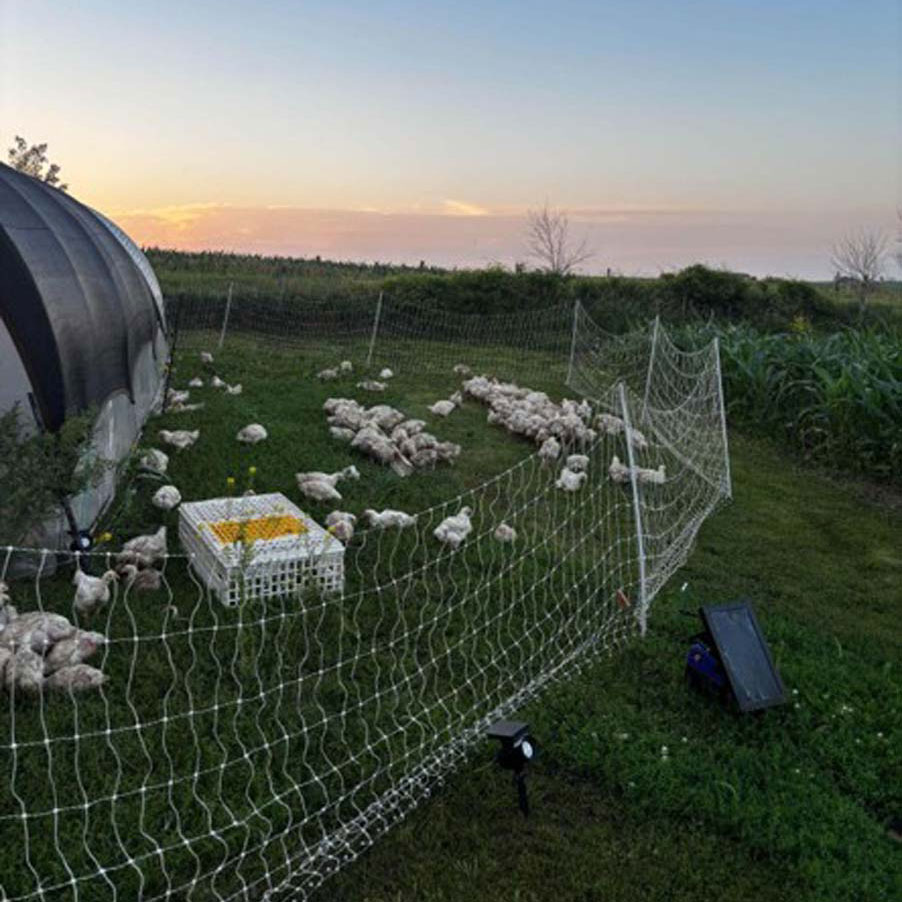
While the Cornish Cross was bred for barn production, many farmers including Anna & Shae Pesek and Ashley & Zach Wenke commonly use them for pasture production. However, the Cornish Cross is considered to be poorly suited for pasture. The birds do not exhibit much foraging behavior, can get too hot and do not move around much, especially when they are nearing processing weight. Farmers also commonly report significant differences in Cornish Cross performance across hatcheries, which can be frustrating.
In 2025, both the Peseks and the Wenkes were interested in trialing genetically different broiler chickens to see which performed best in their pastured poultry setups. In Anna Pesek’s words, both farms were motivated by their desire to have “data to make decisions about production while maintaining our bottom line.” They each conducted different trials based on their own research questions and the changes they were interested in making to their practices.
The Peseks decided to compare performance of Cornish Crosses with White Rangers. White Ranger is a newly available breed that is closely related to the Cornish Cross but is supposed to be hardier. In addition to observing differences in growth rate and habits between the two breeds, the Peseks were particularly interested in tracking rates of deep pectoral myopathy (DPM) between the two breeds. This condition is necrosis of the deep pectoral muscle that is thought to be caused by wing flapping restricting the blood supply to the muscle [1]. DPM is not visible until the chicken is deboned, and it makes the breasts and tenders unsellable. DPM historically has significantly affected the economics of the Peseks’ operation; in 2024, the Peseks saw DPM in about 15% of one batch of chickens processed in late fall.
The Wenkes were initially interested in also experimenting with the White Rangers, but hatchery closures during the 2025 avian flu outbreak made it impossible to get the chicks. Instead, they decided to dig into question they have had for a while: do Cornish Crosses from different hatcheries perform differently? They ordered Cornish Crosses from Metzer hatchery and Cornish Rocks from Welp hatchery and tracked bird weights and green wing incidence across the two groups.
Methods
Design
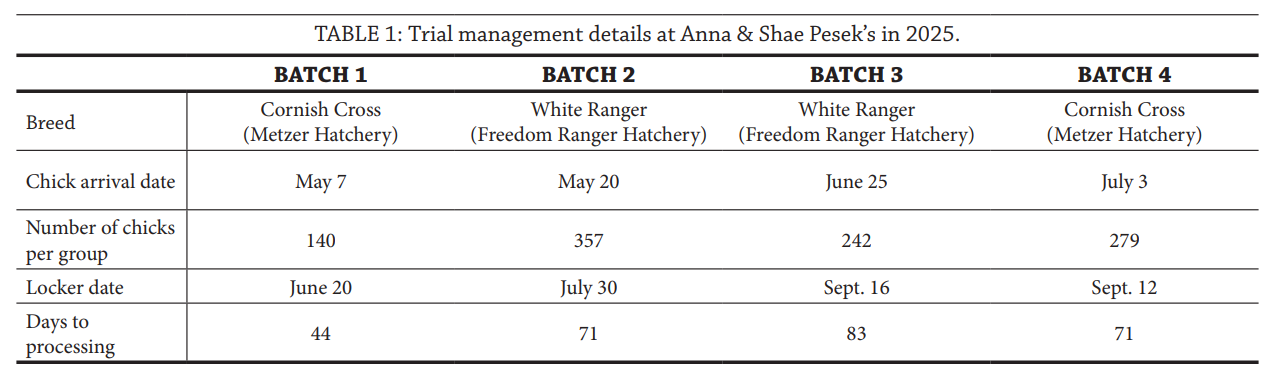
The Peseks’ processor could not separate different varieties of chicken at processing time, so they had to raise the different birds in different batches. They raised four different groups of birds over the course of the summer; two of White Ranger and two of Cornish Cross. They tracked the number of birds affected by DPM in each group. Group management dates are shown in Table 1.
The Wenkes raised their chickens in two groups simultaneously. They raised the birds in separate tractors. Their processor was able to separate the two varieties and report weight data on each group individually. Group sizes and management details are shown in Table 2.
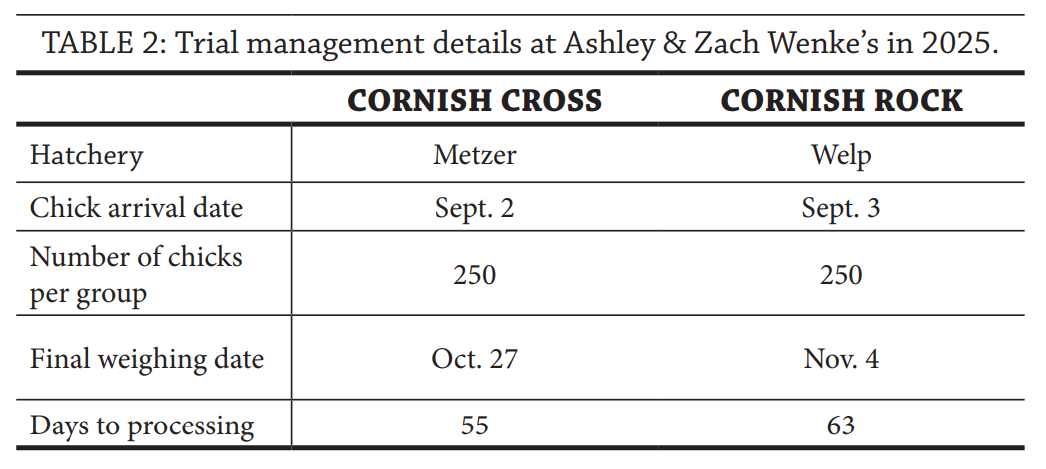
Neither processor was able to provide individual bird weights to the farmers. This means that we could not say whether birds from one treatment weighed statistically more than the other. Getting individual chicken weight data is important for statistically rigorous experimental design, but most processors run chickens over a scale that tracks cumulative weight of the group. This is a significant hurdle for farmers who do not do their own processing and want to trial poultry production methods.
Data Analysis
We used a proportion test at a 90% confidence level to determine if there were significant differences in DPM rate or bird survival rate between chicken breeds (Pesek) and hatchery sources (Wenke) [2]. If the proportion test determines that one group outperformed the other, the farmer can expect the same results to occur 90 out of 100 times under the same conditions. We could perform this type of analysis because the Peseks and the Wenkes kept everything except for chicken breed the same when raising the two groups of birds.
Results and Discussion
The Peseks found that their White Ranger chickens had significantly lower rates of DPM than their Cornish Crosses. Across both groups of birds raised at different times, the White Rangers has a DPM rate of 16% while the Cornish Crosses had a DPM rate of 24%. Complicating matters is the fact that most of the differences between the DPM rates was driven by a 10% rate of DPM in the second batch of White Rangers, processed Sept. 16, while the batch processed in the heat of summer had a rate of 20% (Figure 1). Interestingly, the Peseks noticed that the meat proportions were quite different than they are used to on the White Rangers, with “significantly smaller breasts than the Cornish Crosses, but much nicer leg quarters!”
The Peseks noted that the White Rangers were clearly slower growing, but that is not necessarily a deal-breaker for them. “We started the trial ’slow growth curious’ with the White Ranger and continue to feel that way.” However, they are going to need to do more research before they decide whether to change breeds. This trial did not include an in-depth analysis of feed consumption or feed conversion ratios. “Conducting this trial and looking at the results has certainly increased our desire to continue looking into our chicken breed decision making. A financial analysis will be important for us to look into, in addition to the data shared here."
The Wenkes found that significantly more of the Welp Cornish Rocks died or were otherwise unable to be processed (13 birds) compared to the Metzer Cornish Crosses (0 birds). Ashley Wenke also reported that from the time the birds were moved outside, the Metzer birds appeared more uniform in size than the Welp birds. The Welp birds were not all uniformly to size on the chosen processing day, so the Wenkes kept them for longer than the Metzer birds. After an additional 8 days, the Welp birds weighed the same on average as the Metzer birds (6.03 and 6.04 lb, respectively). They conclude that they “will continue to use Metzer and the Cornish Cross birds over other genetics of meat birds.”
Both farms reflected that the support of a PFI trial was instrumental in allowing them to experiment with their meat chicken enterprises. Anna Pesek wrote “while we have been curious about White Ranger chickens, without the structure and support of PFI's Cooperators’ Program, we aren't sure if we would have decided to try them. Trying a need breed takes on risk, financially and otherwise! We appreciated having an opportunity to try these birds out, mitigate some of the risk, and have real data to compare.” Ashley Wenke similarly writes that the trial gave them a framework for testing their suspicions about the quality of different Cornish crosses. “It can always be blamed on weather since meat birds are so fickle but since we had the batches at the exact same time it is a for sure thing that the Metzer Cornish Cross are healthier and produce a better weight in the timeframe.”
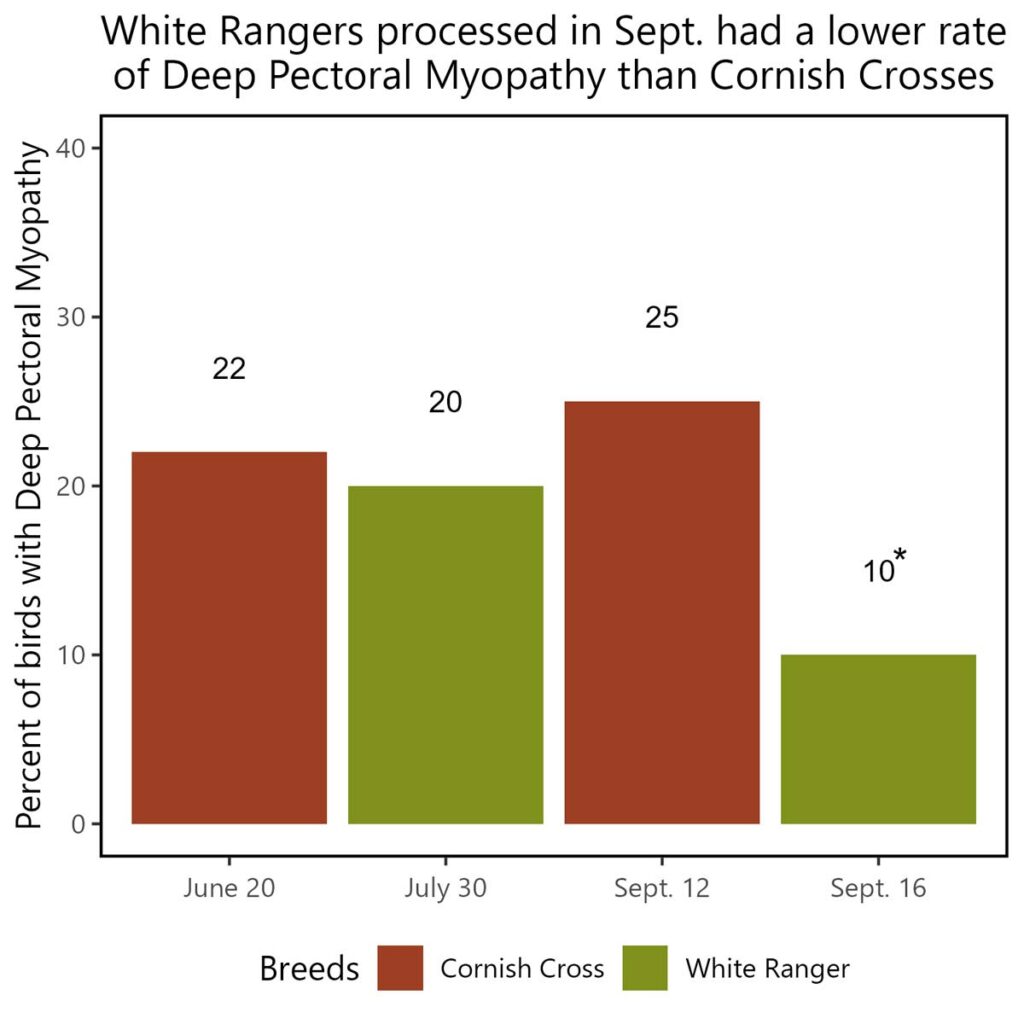
group in 2025. Columns represent the rate of DPM for each group. Asterisk (*) indicates that the White Ranger group processed on Sept. 16 had a significantly lower rate of DPM than the other three groups of chickens at the 90% confidence level. Click to enlarge.
Conclusions and Next Steps
While the Wenkes continue to be happy using the Cornish Crosses, other PFI farmers including the Peseks will continue looking into alternative breeds to raise on pasture. In 2026, five farmers will conduct trials comparing Cornish Crosses to White or Red Rangers. This time, they are focused on feed conversion ratios and economics of growing the different breeds.
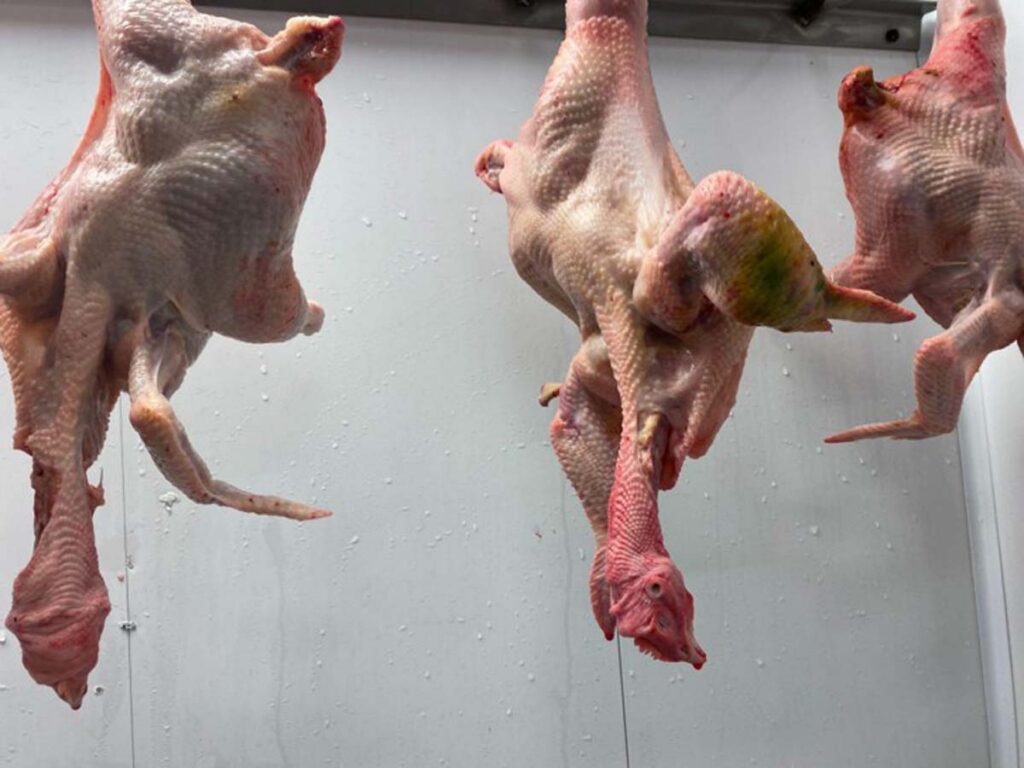
both Cornish Crosses and White Rangers that were processed during the heat of late summer.
Appendix - Weather Conditions
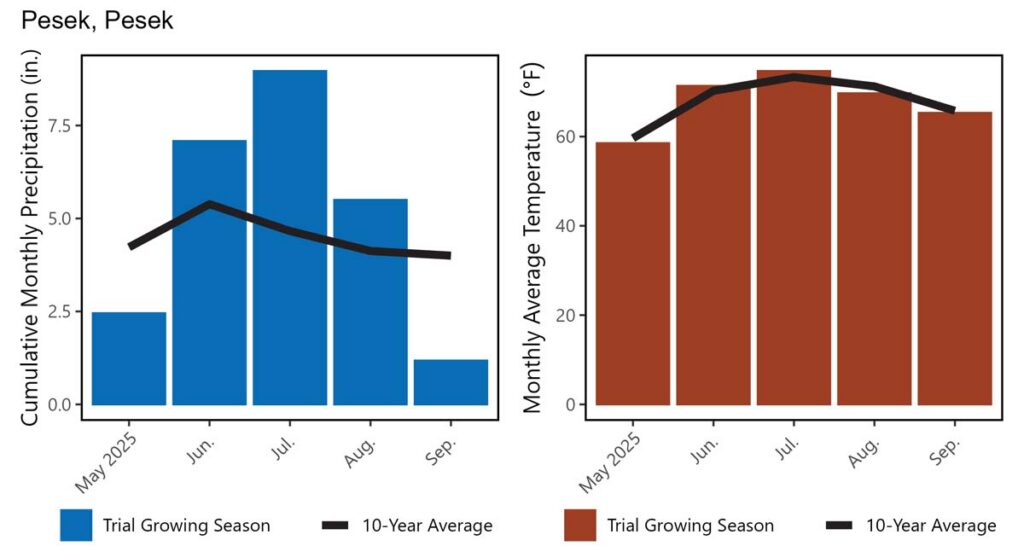
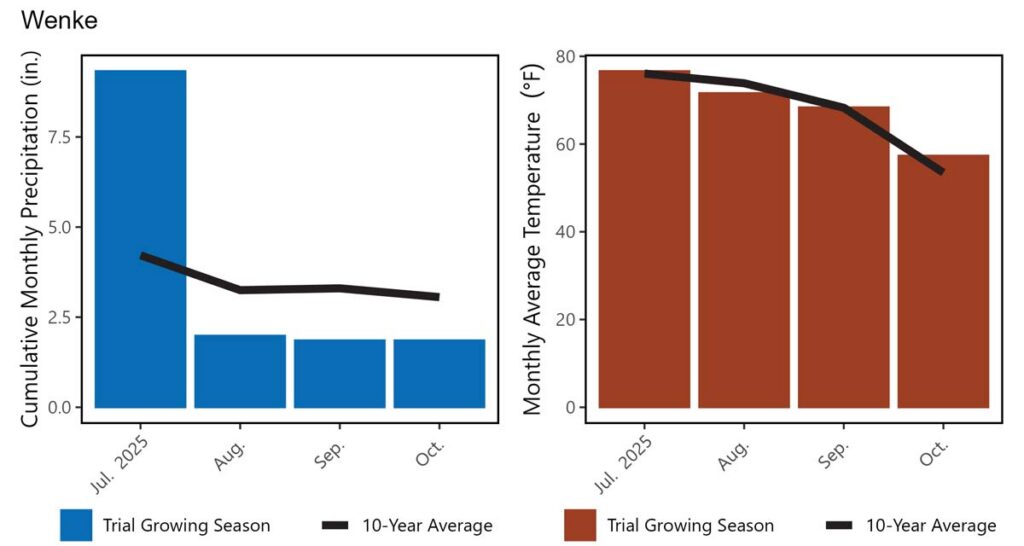
study period and the ten-year historic averages. Data is from the NasaPOWER climate dataset [3], [4]. Click to enlarge.
References
- T. Tabler, F. D. Clark, J. R. Moyle, M. Farnell, and J. Wells, “Deep Pectoral Myopathy (Green Muscle Disease) in Broilers,” 2020, [Online]. Available: https://extension.msstate.edu/publications/deep-pectoral-myopathy
- R Core Team, R: A language and environment for statistical computing. (2025). Foundation for Statistical Computing, Vienna, Austria.
- A. Sparks, nasapower: NASA-POWER Data from R. (2024). [Online]. Available: https://CRAN.R-project.org/package=nasapower
- A. H. Sparks, “nasapower: A NASA POWER Global Meteorology, Surface Solar Energy and Climatology Data Client for R,” J. Open Source Softw., vol. 3, no. 30, p. 1035, Oct. 2018, doi: 10.21105/joss.01035.