Funded by Ceres Trust and USDA-NRCS.
In a Nutshell:
- For several years, Hannah Breckbill and Emily Fagan have been experimenting with tarping to control weeds on their no-till farm [1], [2]. Through PFI experiments and their own observations, they have found that tarping does not effectively control perennial weeds, which are a major problem on their farm.
- A fellow PFI member suggested that tarping could be combined with allelopathic cover crops during a fallow year and potentially offer more effective perennial weed control.
- Breckbill & Fagan conducted a 2-year trial where they planted an allelopathic sunflower cover crop and terminated it with tarping in Year 1 (2024) and then assessed weed presence in Year 2 (2025).
Key Findings:
- Growing a sunflower cover crop was challenging because birds ate most of the sunflower seed. As a result, Breckbill & Fagan are unsure if their results are conclusive because their sunflower stand was not as robust as they hoped.
- They found that the sunflower cover crop combined with tarping in a fallow year did not significantly affect groundcover composition compared to tarping alone.
Background
Many low-till and no-till vegetable farmers eventually develop significant problems with perennial weeds on their farms. These farms often rely on occultative tarping, the practice of covering ground with thick black plastic sheets for several weeks to months, as a bed preparation and primary weed control method. Occultative tarping creates a stale seed bed and can be very effective for annual weed control but does not seem to significantly control perennial weeds that are already established.
Hannah Breckbill and Emily Fagan run a no-till farm and over the years have watched Canada thistle spread across their fields. They have previously tested whether tarping treatment lengths of up to four weeks can help control the perennial weed and have found that it always regrows within a few weeks of tarp removal [1], [2]. However, PFI member Jenny Horner suggested to them that tarps could be used in conjunction with sunflower, which has allelopathic properties, to potentially better control thistles. Breckbill & Fagan decided to conduct a 2-year trial to test whether combining a summer sunflower cover crop and tarping could control thistle. At the outset of the trial, Fagan reported that “If this is a viable way to slow down Canada thistles, we'll be able to structure our crop rotation to let us implement it across our vegetable field.”
Methods
Design
Breckbill & Fagan compared the weed control efficacy of two different fallow year treatments, Sunflower + Tarp and Tarp. They were limited to including two replications of each treatment because the area they had for the trial was fairly small, and the tall sunflower cover crop needed to be located away from other crops (Figure A1).
In Year 1 (2024), they tarped both treatments for one month between late April and late May. They then planted a sunflower cover crop in the Sunflower + Tarp treatment in early June and left the Tarp treatment uncovered and fallow. They again tarped both treatments from July 30 – September 20 and then planted an oat and pea cover crop to both treatments on Sept. 20, 2024. They broadcast seeded all cover crops by hand.
Measurements
Breckbill & Fagan chose ten random locations in each replicate, an increase in number of observations to their previous tarping and groundcover trials because they could not fully replicate the trial. At each location, they estimated groundcover percent coverage of the following categories within ring of a known size (ex. a hula hoop): intended cover crop (summer 2024 only), living annual weeds, dead annual weeds, living perennial weeds, dead perennial weeds, and bare soil. Breckbill & Fagan performed these measurements twice: before terminating the sunflower cover crop in summer 2024 and before bed preparation in spring 2025.
Data Analysis
We used an ANOVA (Analysis of Variance) at a 90% confidence level to determine if there were significant differences in groundcover composition between Sunflower + Tarp and Tarp treatments. The 90% confidence level means any effects we declare statistically significant would be expected to occur at least 9 times out of 10 if the experiments were carried out in identical conditions.
Results and Discussion
Breckbill & Fagan found no significant differences in weed composition between Sunflower + Tarp and Tarp treatments in either July 2024, just before sunflower cover crop termination, or April 2025, before bed preparation (Figure 1). Intended cover crop coverage in summer 2024 was quite low and was patchy because birds ate a lot of the broadcast sunflower cover crop seed (top panel of Figure 1).

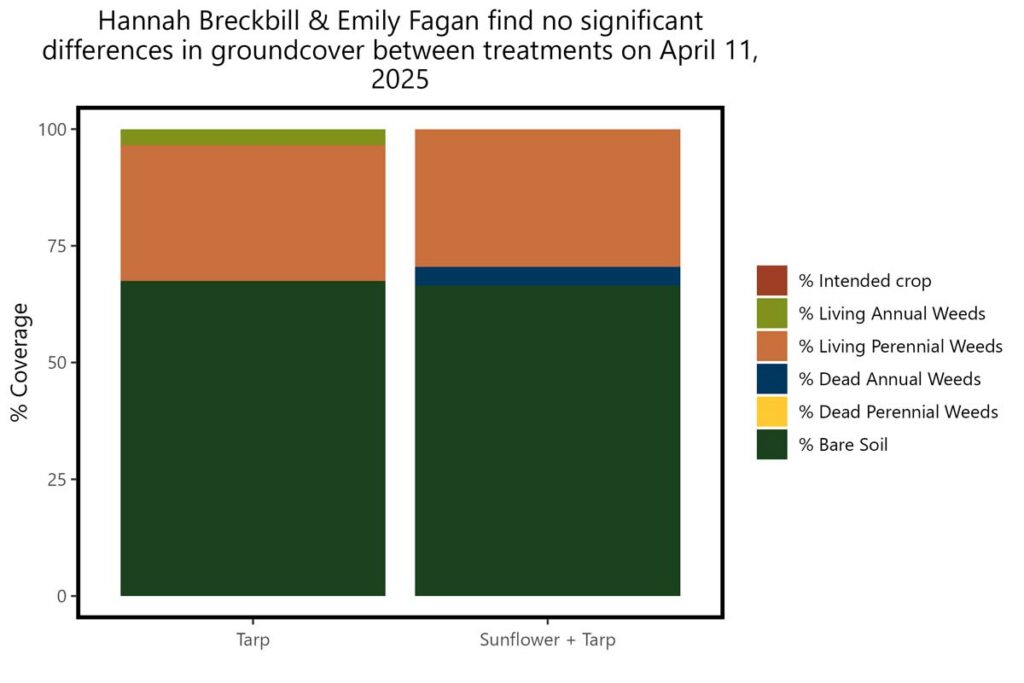
just before termination of sunflower cover crop (top), and April 2025, before bed
preparation for planting (bottom). There were no statistical differences in groundcover
types between treatments at the 90% confidence level. Click to enlarge.
Conclusions and Next Steps
Breckbill & Fagan reported that the trial was inconclusive for them because they did not have a robust a sunflower cover crop. Though they would like to find a way to control perennial weeds, they are still not sure if Sunflower + Tarping works and are not sure if they will try it again given the rotation and seeding challenges.
Appendix - Trial Design and Weather Conditions


Funding Acknowledgement
This material is based upon work supported by the U.S. Department of Agriculture, under agreement number NR226114XXXXG004. Any opinions, findings, conclusions, or recommendations expressed in this publication are those of the author(s) and do not necessarily reflect the views of the U.S. Department of Agriculture. In addition, any reference to specific brands or types of products or services does not constitute or imply an endorsement by the U.S. Department of Agriculture for those products or services.
References
- E. Link, H. Breckbill, E. Fagan, and M. Mormann, “Two Types of Tarping to Suppress Weeds - Practical Farmers of Iowa,” Practical Farmers of Iowa, 2024. Accessed: Jun. 11, 2026. [Online]. Available: https://practicalfarmers.org/resources/research-reports/two-types-of-tarping-to-suppress-weeds/
- E. Link, E. Fagan, and H. Breckbill, “Tarping for No-TIll Cover Crop Termination,” Practical Farmers of Iowa, 2023. [Online]. Available: https://practicalfarmers.org/research/tarping-for-no-till-cover-crop-termination/
- A. H. Sparks, “nasapower: A NASA POWER Global Meteorology, Surface Solar Energy and Climatology Data Client for R,” J. Open Source Softw., vol. 3, no. 30, p. 1035, Oct. 2018, doi: 10.21105/joss.01035.
- A. Sparks, nasapower: NASA-POWER Data from R. (2024). [Online]. Available: https://CRAN.R-project.org/package=nasapower