Funded by Walton Family Foundation.
In a Nutshell:
- Many organic vegetable farmers use purchased organic certified fertilizers to boost their yields. However, they are often unsure about how much fertilizer to add, especially if they also apply compost or manure to their fields.
- Hannah Breckbill assessed the yield impact of three different N fertilizer rates applied to their brussels sprouts. They used feathermeal, a slow-releasing N fertilizer, for the trial.
Key Findings:
- Breckbill found no statistically significant differences in brussels sprout yield between N treatments.
- However, the yield seemed more stable in the replicates with the highest N rate (2.4 lb/1000 ft2)
- Through on-farm trials and observations, Breckbill is feeling more confident about application rates of nitrogen fertilizers on their farm.
Background
When many people think of fertility plans on organic farms, they think only of manure and compost. However, many organic vegetable farmers also apply additional purchased organic fertilizer products to fine-tune plant nutrient availability and boost their yields. Many organic vegetable farms are limited in N, and an at-plant application of N in addition to the farm’s existing compost/manure regime can significantly increase vegetable yields.
There are a variety of organic-certified fertilizers available ranging from single-component products like bone meal, blood meal and fish emulsion to mix products like Sustane, which can be adjusted to provide a customized nutrient profile. Unlike compost and manure, which can vary significantly in their nutrient content, fertilizer product packaging tells farmers exactly how much nitrogen, phosphorous, potassium and other macro- or micro-nutrients the product contains by weight. However, vegetable farmers often have questions about how much fertilizer they need to apply. Technical recommendations on nutrient application rates for specific vegetable crops can be hard to find and are often a broad range rather than a specific number. And if a farm also applies compost and manure, they might not know how much nutrient content those sources already provide.
PFI farmers including Hannah Breckbill have previously conducted trials on fertilization rates for broccoli and fertilization for potatoes [1], [2]. This year, Breckbill wanted to fine-tune their N fertilization rate for brussels sprouts. Breckbill trialed three different N rates; Control (no extra N); 1.2 lb N/1,000 ft2; and 2.4 lb N/1,000 ft2. They used feathermeal as the N source, which contains about 12% N by weight and releases plant-available N slowly. Breckbill reports that the trial “will help us understand what rates we want to fertilize at--or whether to bother with a nitrogen fertilizer at all!”
Methods
Design
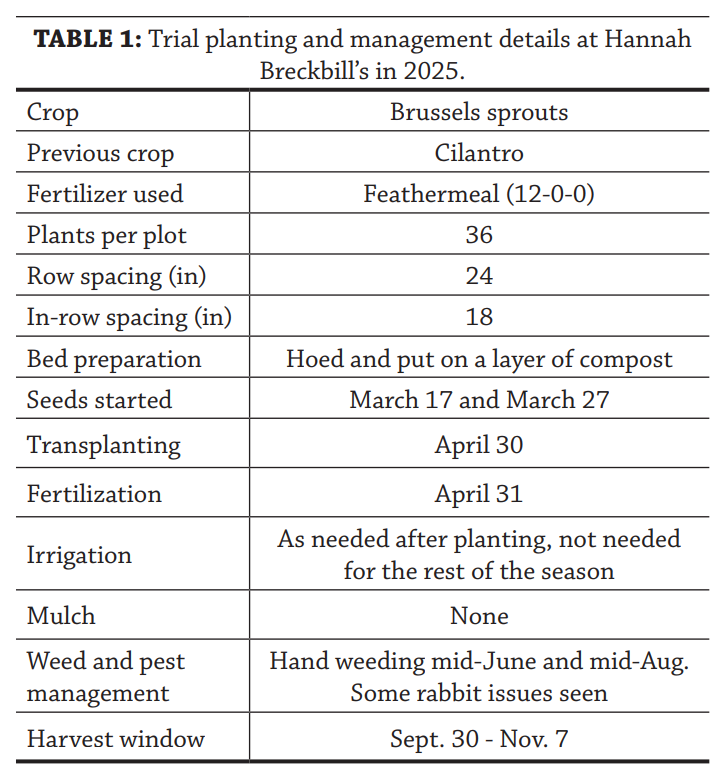
Breckbill planted four replicates of each of her three fertilization treatments: Control (no N); 1.2 lb N/1,000 ft2; and 2.4 lb N/1,000 ft2 (Figure A1). Trial planting and management details are shown in Table 1.
Measurements
At each harvest date, Breckbill harvested the brussels sprouts that were of adequate size. They weighed the brussels sprouts from each plot and recorded the harvest date and weight.
Data Analysis
We used an ANOVA (Analysis of Variance) at a 90% confidence level to determine if there were significant differences in yield between fertilization rates at Breckbill’s. 90% confidence means any effects we declare statistically significant would be expected to occur at least 9 times out of 10 if the experiments were carried out in identical conditions.
We could perform statistical analysis because Breckbill used a replicated and randomized experimental design (Figure A1).
Results and Discussion
Breckbill found that there was no statistically significant difference in yield between the three feathermeal fertilization rates (Figure 1). However, yields were much more uniform and there were fewer low-yielding plots in the 2.4 lb treatment compared to the 1.2 lb and control treatments (see points in Figure 1). Breckbill also reported that “there was a clear visual difference in the field between treatments in terms of the height of the brussels sprouts,” with taller stalks in the 2.4 lb. treatment. They plan to move forward using the 2.4 lb/1000 ft2 rate.
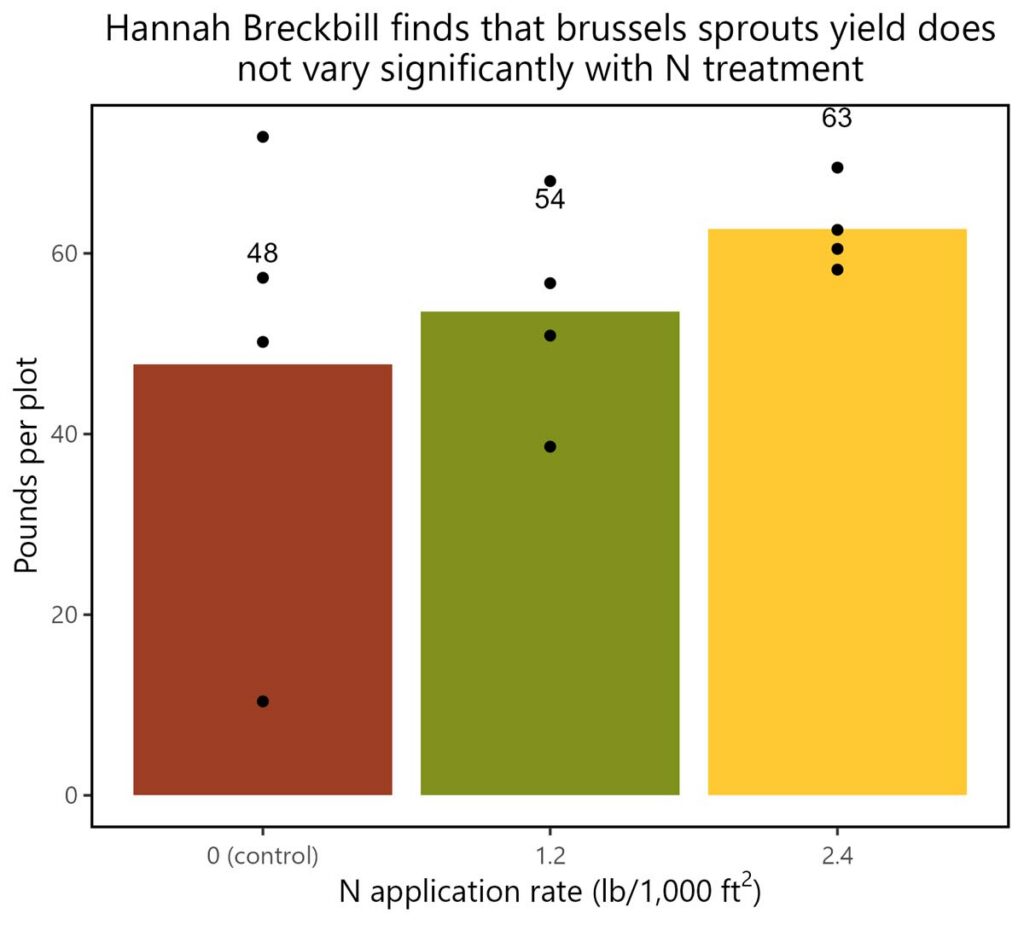
at Hannah Breckbill’s in 2025. Columns represent the average yield for each treatment.
Points represent yield from each individual plot. There were no statistical differences in yield
between treatments at the 90% confidence level. Click to enlarge.
Conclusions and Next Steps
While yield will always vary with weather conditions and with heterogeneity in fertility across a field, on-farm research trials give farmers a better chance of applying the right amount of fertilizer to meet their financial and yield goals. After this trial, Breckbill feels more confident with their N application to vegetable crops. They write “I think we're getting closer to having an actual N fertilization protocol for our farm.”
Appendix - Trial Design and Weather Conditions


References
- S. Gailans, H. Breckbill, E. Fagan, K. Edwards, M. Quee, and A. Kuntz, “Fine-Tuning Fertility for Better Broccoli - Practical Farmers of Iowa,” 2022. Accessed: Jun. 30, 2026. [Online]. Available: https://practicalfarmers.org/resources/research-reports/fine-tuning-fertility-for-better-broccoli/
- E. Link, K. Edwards, J. Grimm, and T. Troxel, “Organic Fertilizer for Potatoes - Practical Farmers of Iowa,” Apr. 2024. Accessed: Jun. 30, 2026. [Online]. Available: https://practicalfarmers.org/resources/research-reports/organic-fertilizer-for-potatoes/
- A. Sparks, nasapower: NASA-POWER Data from R. (2024). [Online]. Available: https://CRAN.R-project.org/package=nasapower
- A. H. Sparks, “nasapower: A NASA POWER Global Meteorology, Surface Solar Energy and Climatology Data Client for R,” J. Open Source Softw., vol. 3, no. 30, p. 1035, Oct. 2018, doi: 10.21105/joss.01035.