Funded by Builders Vision Philanthropy.
In a Nutshell:
- Creep feeding is a technique of introducing solid food early into young ruminants’ diets.
- Adam Ledvina tested creep feeding goat kids against two other treatments—grazing rye cover crop and maternal access to high quality hay with no creep feeding.
Key Findings:
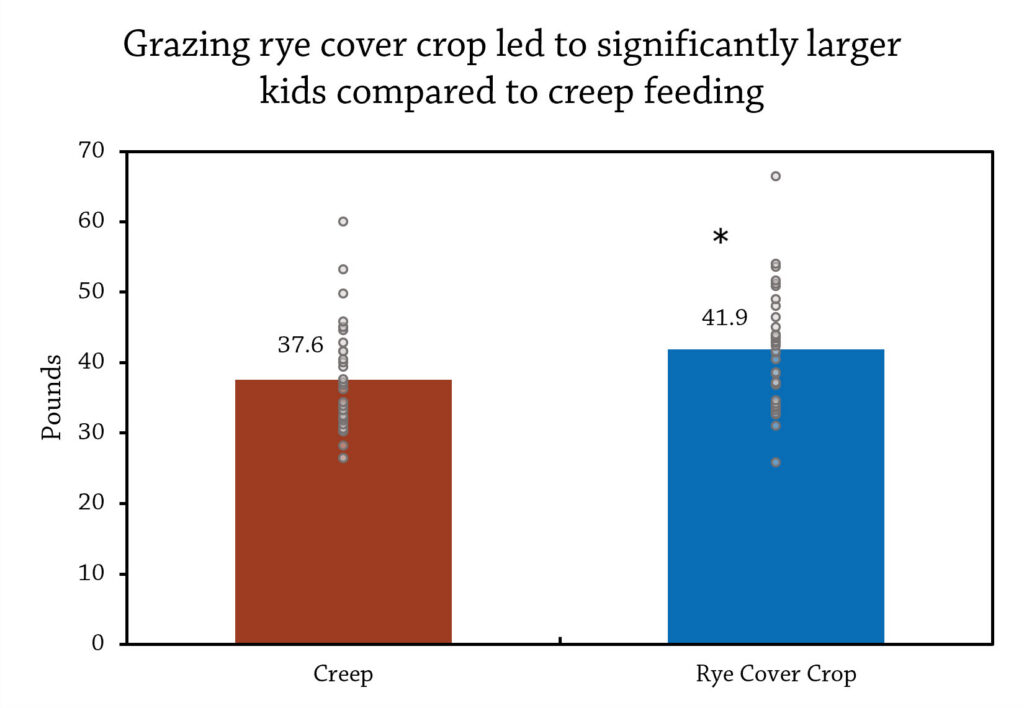
- Kids that had been creep fed were significantly smaller than their compatriots who were put out to graze rye cover crops.
- Creep feeding also significantly underperformed a maternal diet of higher quality hay with alfalfa without creep access to grain for kids.
Background
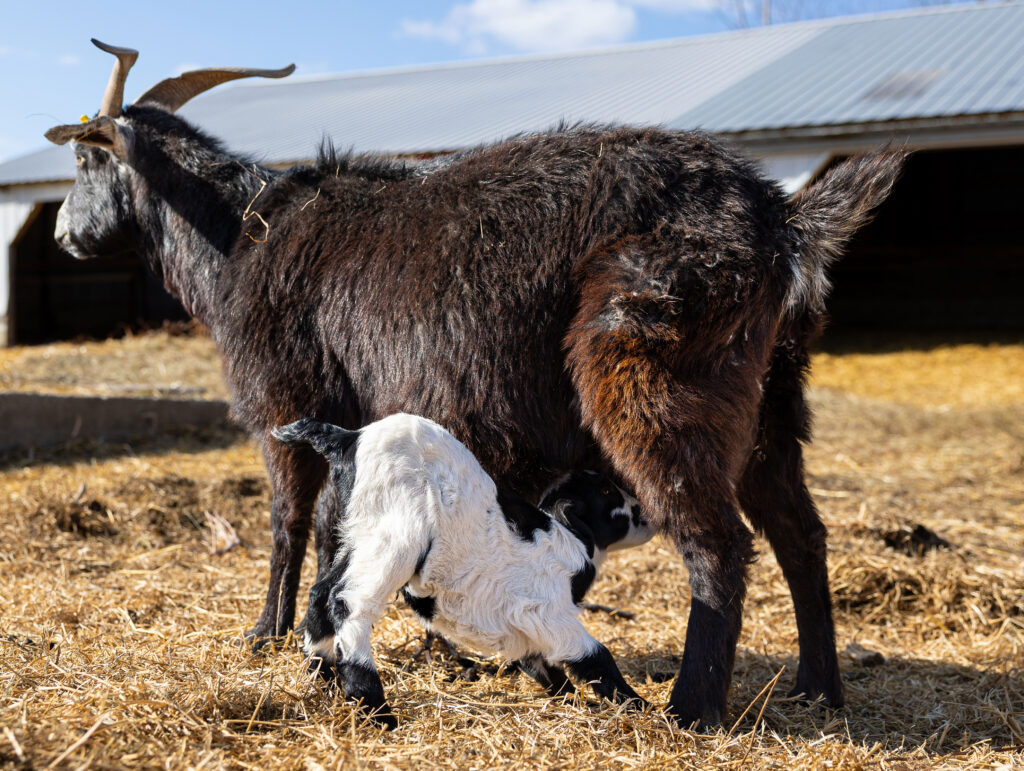
Creep feeding is the practice of providing supplemental feed to nursing kids in a space that adult does cannot enter. In a typical setup, a small pen or gated area is built with openings sized for young goats, and a palatable grain or pellet concentrate ration is offered free-choice. This system can give kids a jumpstart in the transition from milk to solid feed. Extension resources commonly describe it as a way to increase preweaning gains, improve weaning readiness and help animals reach market weight earlier [1], [2].
Beyond feed access, the creep area can serve several management purposes. Because kids can be gathered separately from their mothers, the space can make it easier to observe young animals, provide veterinary care, tag or tattoo kids and create physical conditions better suited to their needs. Depending on the season and housing system, this may include warmer, drier bedding, better ventilation or other adjustments that support young animals during a vulnerable stage of growth [2].
Early solid-feed management involves tradeoffs. Grain-based creep feed can support fast early growth, which is especially valuable in markets that reward young, heavy suckling kids. However, young goats are still developing their rumen and broader digestive system [3]. The balance of starch, fiber and forage in the early diet may influence rumen microbial development, digestive function and the kind of weight gain producers observe [4]. For farms that retain animals beyond the suckling market, rapid early gain may not be the only measure of success.
In spring 2025, Adam Ledvina tested whether alternatives to conventional creep feeding could improve goat kid growth and health. The trial compared creep feeding with two forage-based strategies: turning mothers and kids onto high-quality rye cover crop growth, and improving the hay available to nursing mothers while kids remained with them. Together, these treatments asked whether kid performance was better supported by early access to concentrate feed, by fresh forage and exercise, or by improving the maternal diet that supports milk production.
Methods
Design
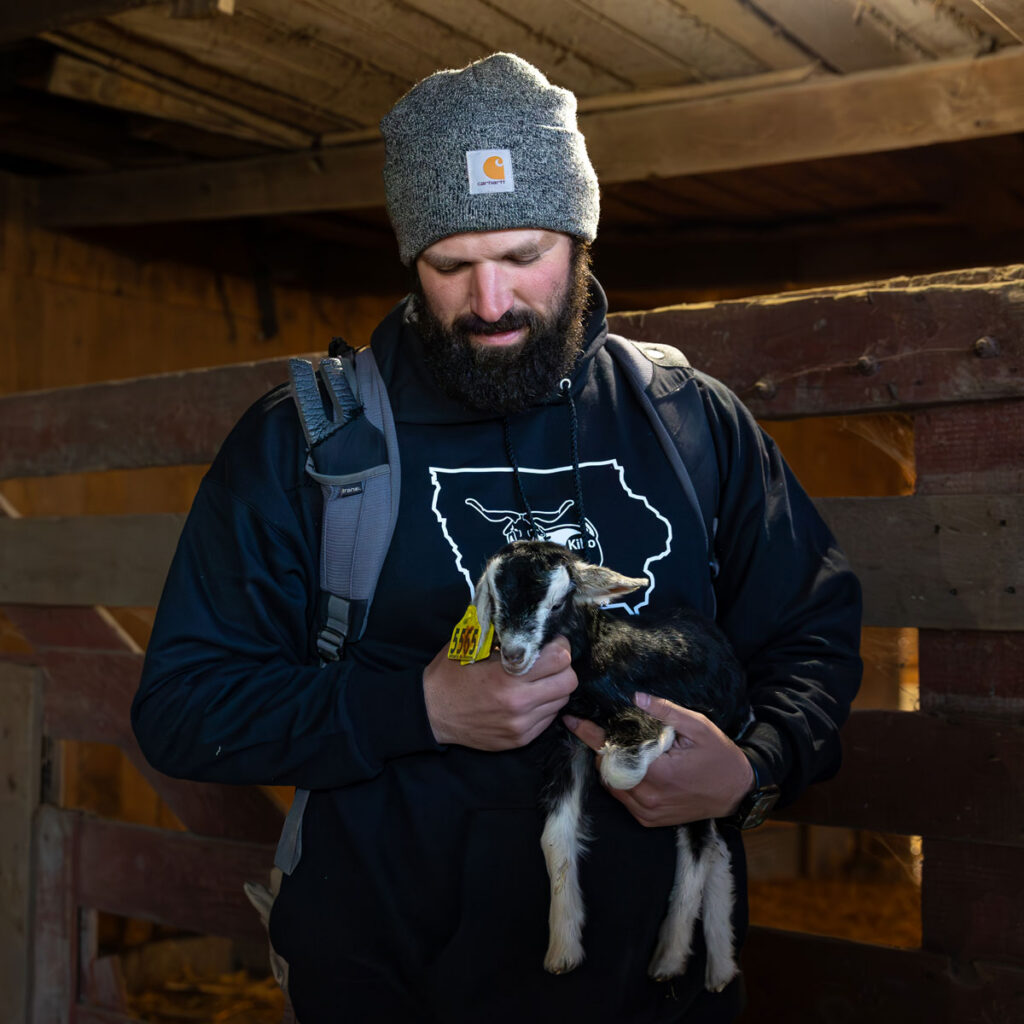
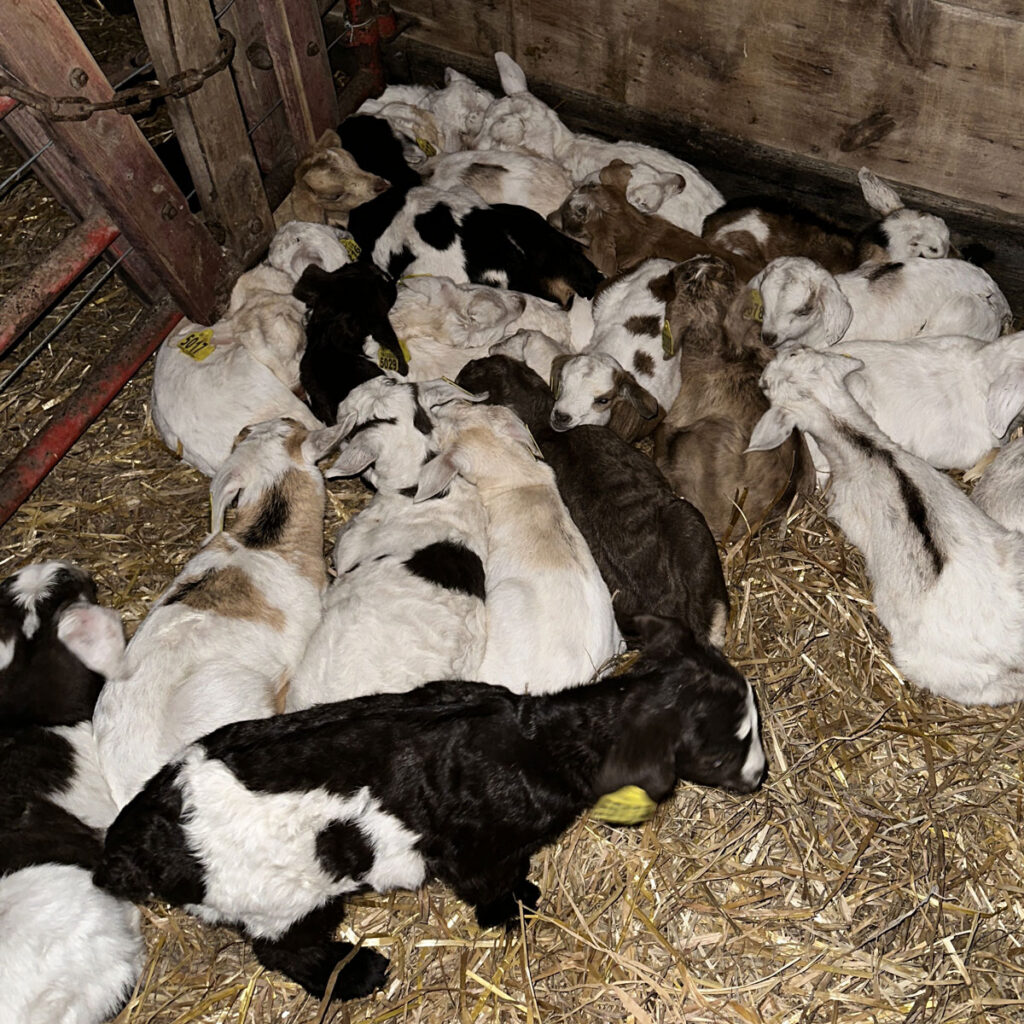
This experiment evaluated feeding strategies’ effects on growth and health in goat kids during early life. A total of 130 kids and their mothers were included. For the first 30 days after birth, all animals were managed under the same conditions so that treatment comparisons would begin from a common baseline. After this period, the herd was divided into two trials based on whether the does were first-time or experienced mothers.
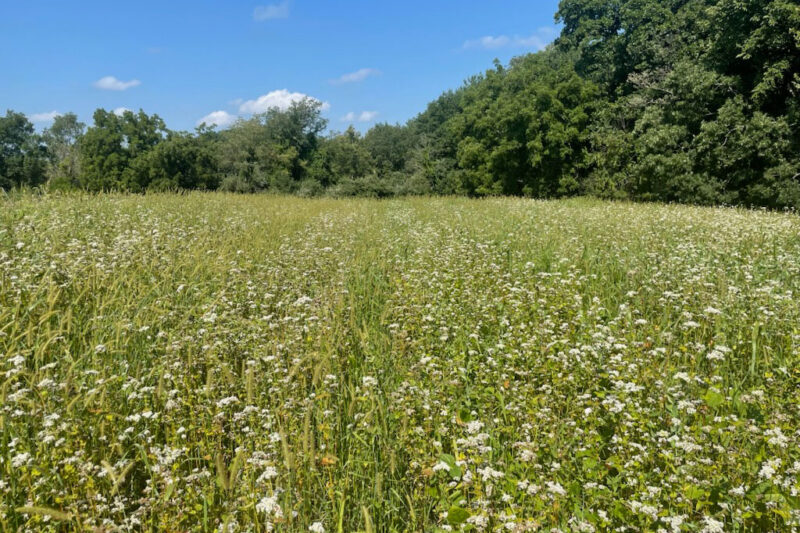
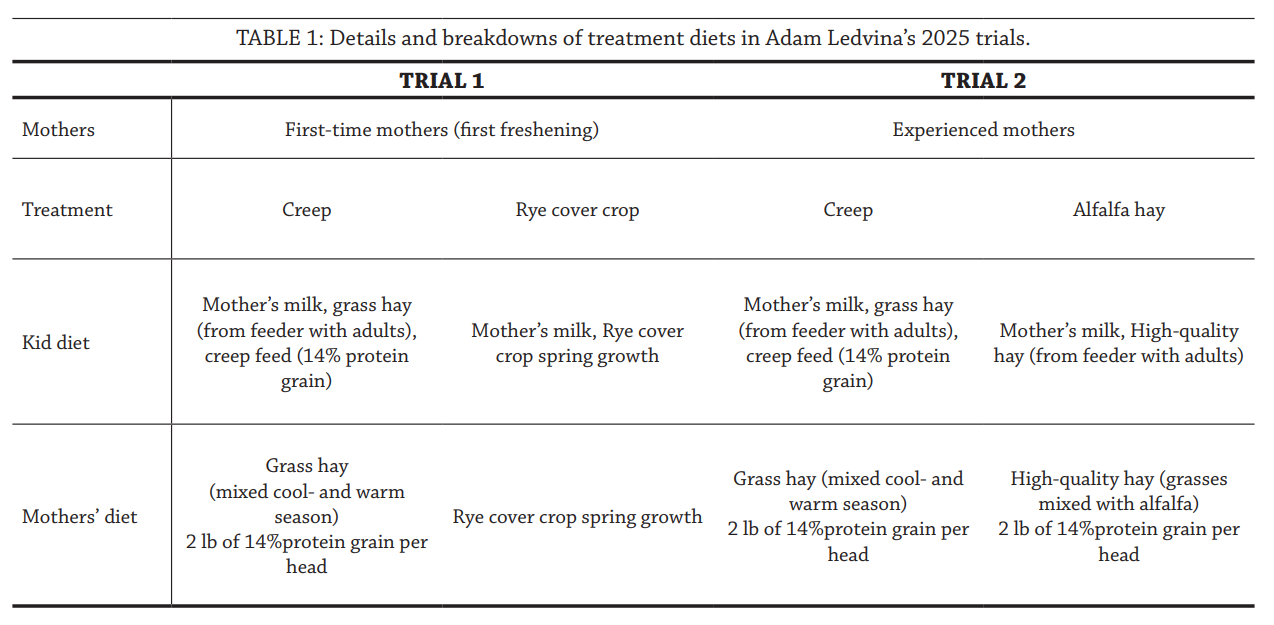
In Trial 1, first-time mothers and their kids were randomly assigned to one of two treatments. One group grazed rye cover crops out in the field, while the other group remained on a standard grain-and-hay ration and the kids were given access to a creep feeder, a kid-only area that provided supplemental 14% protein grain while they continued nursing.
Trial 2 included experienced mothers and their kids. These families were assigned to either a creep-and-hay treatment, in which mothers received the standard hay and grain diet and kids had access to 14% protein creep feed, or a high-quality hay treatment, in which mothers received high-quality alfalfa hay and kids were not offered separate feed. Details about treatments in both trials can be seen in Table 1. The design of these two trials enabled the comparison of different feeding approaches within each maternal cohort. The general design of the trials, including the number of kids in each treatment group is shown in Figure A1.
Measurements
Kid weights were measured at birth, and then at 90 days. Variation at birth is low, with almost all kids weighing between 5 and 7 pounds, averaging about 6 pounds, according to Ledvina. In this trial, individual birthweights were not collected as data points. Individual family histories were not collected for each kid. Average litter size is larger for experienced does and the does in trial 2 had more twins and triplets, with smaller average kid sizes. Each kid was weighed at 90 days old.
Data Analysis
We used Student’s T-Test at a 90% confidence level to determine if there were significant differences in kid weight between treatments in each trial. Any effects we declare statistically significant would be expected to occur at least 9 times out of 10 if the experiment was carried out in identical conditions. We could perform these analyses because the does within each life history cohort were randomly assigned to treatments with their kids (Figure A1).
Results and Discussion
Both trials saw creep feeding underperform the alternative treatment by both quantitative and qualitative measures. Trial 1 showed that kids grazing and nursing from mothers also grazing cover crops achieved better gains than kids on creep feed and nursing from mothers fed hay (Figure 1). Ledvina noted the mothers and kids grazing on cover crops to be more muscular, mobile, and energetic, whereas creep-fed kids appeared less agile, and more ‘pot-bellied’.
Trial 2 showed that feeding nursing mothers high-quality alfalfa hay led to higher kid weights at 90 days than a maternal diet of grain and the standard mixed cool- and warm season hay (Figure 2). In this trial not only were the mothers’ diets shifted, the kids diets were functionally restricted to only mother’s milk and hay in the ‘Alfalfa hay’ treatment, as they did not have access to the creep area and concentrate grain feed.
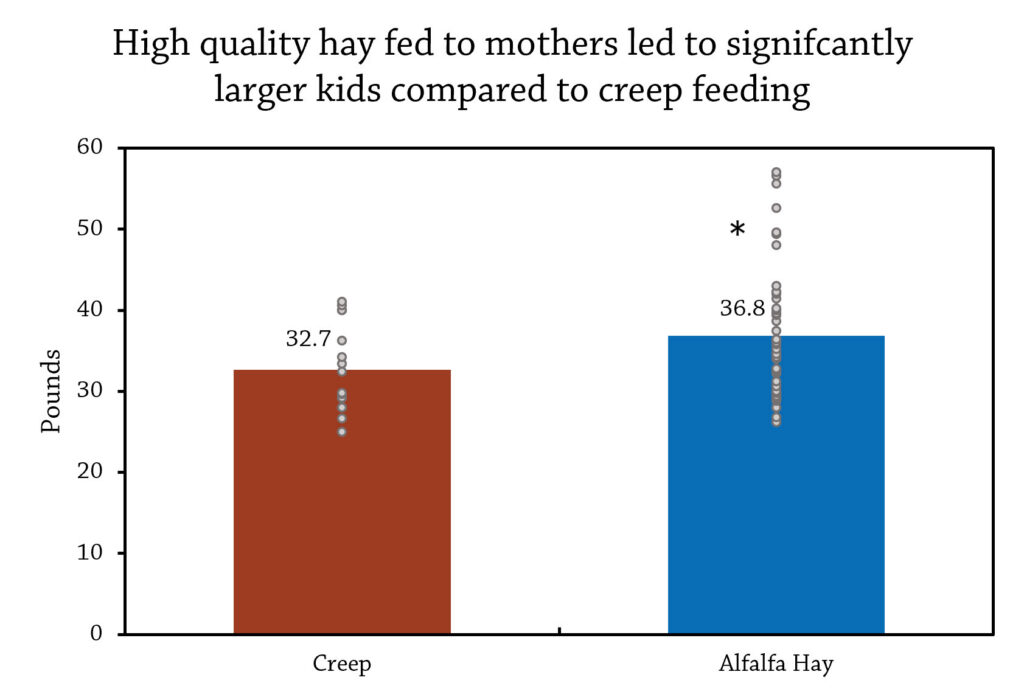
significantly larger than kids who had access to a creep feed area as well as their mothers and standard grass hay at the 90% confidence level. Click to enlarge.
The suckling kid market incentivizes creep feeding. With time as a limiting factor, getting more calories in and metabolized helps to bulk goats out to selection grades that fetch higher prices [2], [5]. Some practices are therefore designed to maximize early calorie intake. However, that is not Ledvina’s target market.
Where trial 1 introduced a difference in environment and ‘lifestyle’ between the treatments, trial 2 goats had the same ‘lifestyle’ with different food going to the mothers. This suggests that the quality of the maternal diet is more important than an early switch to solid food for long term kid goat growth. Ledvina wrote in his reflection that “From this trial, I learned that animals can gain as well or better by consuming a high-quality forage hay rather than grain if given the right conditions.”
These results should be understood in the context of the market and management goals behind creep feeding. In a suckling kid market, where goats need to reach size quickly, creep feeding can make sense because it gives young animals extra calories during a short production window [1], [3]. Some farms use creep feed specifically to push early gains and help kids reach higher selection grades. Ledvina, however, is managing for healthy animals that grow well and remain functional beyond the early kid stage.
That distinction matters because research on creep feeding in meat goats is limited, and results have been mixed [2]. Creep feeding has been studied more often in other livestock species, but meat goat production has a smaller market and research base in the United States. Whether it pays depends on the feed, forage, mothers, market and overall management system.
There was no way of measuring how much the eaten diet differed between kids in any of the trials. Fresh spring rye biomass is presumably a tempting forage option for a young goat starting to eat solid food, but we cannot know how much fresh rye biomass those kids might have eaten. Nor do we know what fraction of the creep fed kids’ caloric intake was coming from grain, as opposed to their mothers’ milk or the hay that they could have pulled from the feeders.
Differences in the amounts of roughage kids eat as part of or in addition to creep-fed grain concentrates has been shown to affect the structure and the chemical permeability of young goats intestines [4], [6], [7].
Because intake was not measured, the results cannot say precisely which part of each treatment caused the weight differences. They do show, however, that the forage-based systems worked well as whole systems under Ledvina’s farm conditions.
The balance of grain and roughage may also help explain why the treatments produced different-looking animals. Studies in young goats have found that the amount of roughage eaten alongside creep feed can affect intestinal development and function [4], [5], [6]. Too much starch and too little fiber can challenge the rumen and digestive tract. In severe cases, overeating grain can contribute to enterotoxemia, but even less dramatic digestive stress may matter when kids are developing the microbial communities and gut function they will rely on later in life.
Ledvina saw those differences in more than just the scale weights. Reflecting on the trial, he wrote, “The most valuable aspect of conducting this trial was noticing the health of the animals. Average daily gain only tracks weight but there is healthy weight gain and unhealthy weight gain… The animals that were on cover crops had a noticeably different build compared to those on creep feed. The animals on cover crop were more muscular and toned. They could cover more ground on a given day and they moved more light footedly. Whereas the creep fed animals gained more of a pot belly and they didn't move as well over the course of the year.” His observation fits the broader pattern of the trial: high-quality forage, maternal nutrition and room to move may support the kind of growth that matters most for his farm. By turning mothers and kids onto spring rye cover crop, Ledvina combined feed quality with exercise and access to fresh forage. In this trial, that approach produced heavier kids and animals he considered healthier and more functional.
Conclusions and Next Steps
This trial suggests that forage-based early-life feeding strategies can support kid growth as well as, and in these comparisons better than, conventional creep feeding. In both trials, kids without access to creep feed outperformed creep-fed kids: first when mothers and kids grazed spring rye cover crop together, and again when experienced mothers were fed higher-quality alfalfa hay while kids remained with them. These results point to the importance of overall diet quality, maternal nutrition, movement and access to high-quality forage—not simply early access to grain concentrate—in supporting healthy kid development.
For Ledvina, the trial also informed whole-farm management decisions. His observations of stronger gains, better mobility and improved animal condition in the forage-based treatments reinforced his interest in shifting acres from high-input row crops toward alfalfa, rye and other forage or cover crop options that can be grazed or harvested depending on weather and market conditions. Future trials in 2026 will further test the advantages of grazing cover crops and help determine how consistently these benefits can be achieved under farm conditions.
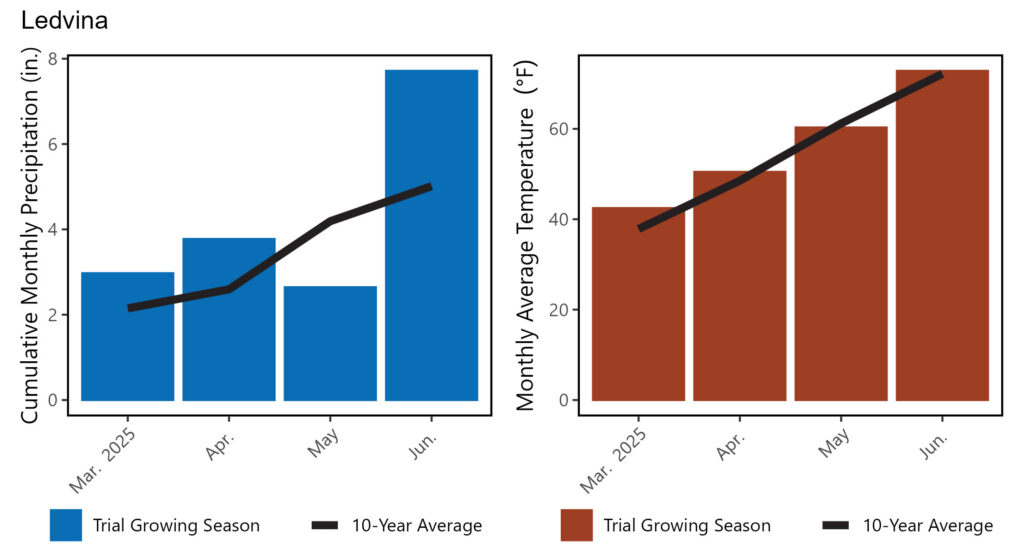
Appendix - Trial Design and Weather Conditions

was random. Click to enlarge.
References
- E. G. Hayes, R. V. Lourençon, and R. Browning Jr, “Effects of creep feeding and its interactions with other factors on the performance of meat goat kids and dams when managed on pasture,” Transl. Anim. Sci., vol. 3, no. 4, pp. 1466–1474, Jul. 2019, doi: 10.1093/tas/txz122.
- T. Stanton, “Fact Sheet Series on Meat Goat Herd Management Practices”, [Online]. Available: http://goatdocs.ansci.cornell.edu/Resources/GoatArticles/Factsheets/FeedFactSheet.pdf
- A. Hardcastle and A. Lear, “Fundamentals of Feeding Goats,” Univ. Tennesse Vet. Med. Cent., Feb. 2020, [Online]. Available: https://vetmed.tennessee.edu/wp-content/uploads/sites/4/UTCVM_LACS-FeedingGoats.pdf
- N. Htoo, B. Zeshan, A. Tun, T. Kyaw, E. Aklilu, and M. Khan, “Creep Feeding Supplemented with Roughages Improve Rumen Morphology in Pre-Weaning Goat Kids,” Pak. J. Zool., vol. 50, Mar. 2018, doi: 10.17582/journal.pjz/2018.50.2.703.709.
- “Education - Sheep & Goat Marketing Directory.” Accessed: Jun. 24, 2026. [Online]. Available: http://sheepgoatmarketing.info/education/negrades.php
- H. M. Vickery, R. A. Neal, S. Stergiadis, and R. K. Meagher, “Gradually weaning goat kids may improve weight gains while reducing weaning stress and increasing creep feed intakes,” Front. Vet. Sci., vol. 10, Jun. 2023, doi: 10.3389/fvets.2023.1200849.
- N. N. Htoo et al., “Enhancement of growth performance in pre-weaning suckling Boer kids supplemented with creep feed containing alfalfa,” Vet. World, vol. 8, no. 6, pp. 718–722, Jun. 2015, doi: 10.14202/vetworld.2015.718-722.
- A. H. Sparks, “nasapower: A NASA POWER Global Meteorology, Surface Solar Energy and Climatology Data Client for R,” J. Open Source Softw., vol. 3, no. 30, p. 1035, Oct. 2018, doi: 10.21105/joss.01035.
- A. Sparks, nasapower: NASA-POWER Data from R. (2024). [Online]. Available: https://CRAN.R-project.org/package=nasapower