Our 2026 member survey is a goldmine of insight into our members’ wants and needs
This past winter, over 1,300 households from Practical Farmers’ membership completed our 2026 member survey. Thank you to everyone who took part!
We send this survey once every three years to gather feedback from our full membership. What we receive helps us analyze our work over the previous three years, identify present priorities and build our programming for our members’ future goals over the short- and long-term.
This survey data, along with the strategic listening sessions we held in the spring, will inform our 2027-2029 strategic plan. Even though we halved the length of the member survey, we collected a massive amount of valuable data.
The following are some snapshots of what we learned. While they don’t reflect the full breadth of what we gathered – and what we’ll be digging into further over the coming weeks and months – they provide some helpful insights into who our members are, what matters to you and what PFI can do to help.
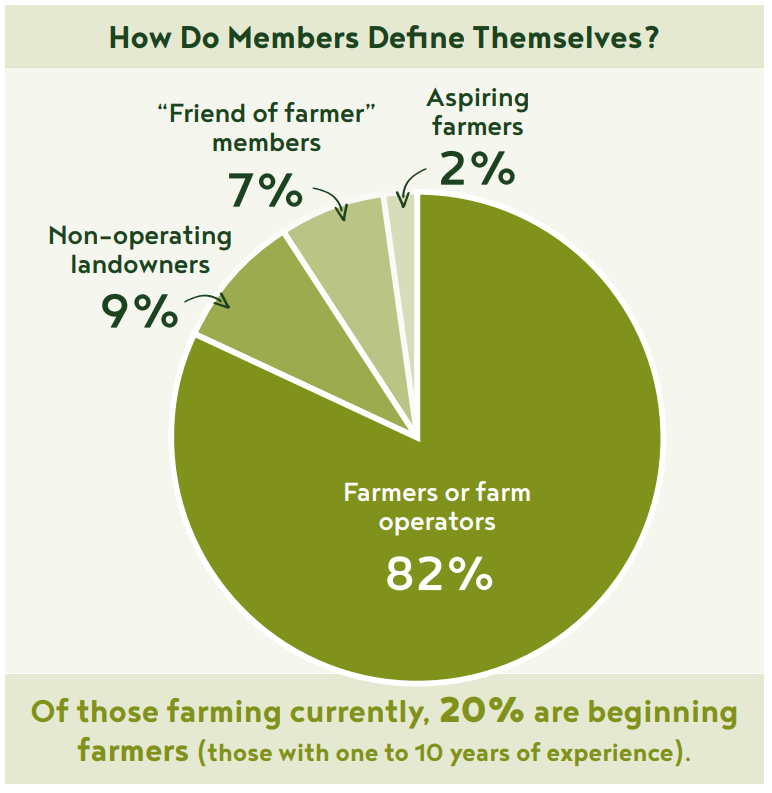
Who Are Our Members?
The 1,300-plus households that completed the member survey represent 30% of PFI’s overall membership.
What Do Members Raise?
Of the 1,200 respondents who were farmers and/or landowners
- 58% had field crops enterprises
- 42% had livestock enterprises
- 11% had horticulture enterprises
Top Enterprises
Corn, soybeans, beef cattle, hay, small grains, custom work, swine, annual fruits and vegetables

How is PFI Doing at Serving Your Needs?
In this version of the member survey, we asked a few questions centered around how PFI staff are serving the needs of our members. As our big tent grows ever bigger, we need to scale our programs intentionally to serve farmers and those around them.
Since the last survey, our staff grew from 34 to 58 personnel, a 70% jump. Our membership grew from around 6,300 to nearly 10,000, a 60% jump.
This growth has meant many new faces among both staff and members. When asked on the survey, “Through my association with PFI, I feel like PFI staff know me,” 56% agreed or strongly agreed. The response reflects a balance PFI needs to strike between continuing to grow and help more farmers and making our current membership feel seen, heard and helped.
Despite this rapid growth, the survey data shows that PFI staff are making members feel acknowledged:
Over 90% of members agree or strongly agree that when they reach out to PFI:
- The information staff provide is accurate
- They feel satisfied with the service they receive
- Their inquiry is welcome
Perception of PFI as an organization is equally important and strong:
- 94% of respondents agree or strongly agree that PFI is a good steward of farmer data
- 96% agree or strong agree that PFI staff are professional
Empowering Farmers + Community
Of those who responded to the member survey:
- 75% agree or strongly agree that they feel a sense of community
through their association with PFI. - 66% agree or strongly agree that they could help make a difference
in their local communities - 80% feel they can make a difference to bigger landscape issues, like water quality, through their association with PFI
Where Should PFI Place the Most Emphasis?
This year, our most vital question for steering PFI’s priorities came in open-ended form. The survey inclued three text boxes for respondents to list what was most important to them. We then combed through these answers and identified three thematic groups and one throughline:
It’s not enough to know what to change. PFI should provide the enabling conditions to make change doable.
Theme 1: Cover Crops | Water Quality | Nitrate Loss | Erosion Control | Soil Health
Helping farmers implement sustainable practices was the most repeated theme.
Cover Crops
PFI should continue to help farmers adopt, establish and get the most out of cover crops for their operation.
PFI should also address the real-world barriers to using cover crops – like cost, timing, termination, species choice and yield impacts.
Water Quality + Soil Health
Members want to use conservation practices to:
- Control soil and nitrate runoff
- Build organic matter and soil biology
- Prevent erosion (wind and water)
- Improve long-term resilience
Challenges
The positive effects of regenerative practices can be costly, and in some cases, can take years to be tangible. PFI’s cost-share programs for these practices are designed to help by giving members the breathing room to try new things.
Theme 2: Diversifying Beyond Corn and Soybeans | Livestock and Grazing | Horticulture and Local Food Systems
Diversifying
This theme underlined how PFI must keep focusing on helping farmers diversify their farms: small grains, perennials and agroforestry.
Respondents also stressed the importance of fruit and vegetable growers in the state, and having local markets for these products.
Bringing Livestock Back to the Land
Members expressed the importance of livestock in a resilient agricultural landscape via:
- Grazing cover crops
- Rotational grazing
- Pasture-based systems
- Integrating animals into row crops
Challenges
- Lack of markets for new products
- Prohibitive prices
- Crop timing
Theme 3: Education | Peer Learning | Community-Building
The third broad theme speaks to PFI’s bread-and-butter work: farmer-to-farmer learning. Respondents were clear that PFI’s on-farm events, annual conference, peer learning, mentorship and more are necessary.
PFI members also continue to emphasize the need to support beginning farmers, land access, farm transition and those seeking help with landowner-tenant dynamics.
Questions? Feedback?
If you have questions about any of the member survey data – or you have other thoughts to share – we welcome your feedback anytime. Contact Steve Carlson, membership manager, at gro.sremraflacitcarp@noslrac.evets.