Research That Paved the Way
Before this trial, Sam conducted other research that showed how a cereal rye cover crop can control weeds without sacrificing profitability in soybeans. By using a cover crop, he was able to reduce herbicide costs and increase his return on investments by $4.14 per acre. Earlier research by PFI members first tested the limits of older recommendations for terminating rye, which advised farmers to kill it two to three weeks before planting soybeans. In 2015 and 2016, participating farmers showed that delaying termination until near the date of planting soybeans, as opposed to two weeks prior, could result in better weed control and a nearly $50 per acre increase in return on investments. Encouraged by those results, Tim and Jack Boyer, of Reinbeck, pushed those limits further in 2018 by testing the effects of delaying termination until two to three weeks after planting soybeans. Both found that delaying termination lowered soybean yields, but Tim was pleased the strategy allowed him to reduce his use of herbicides. Although the cost-savings from reducing herbicides was not enough to pay for the yield drag that year, it showed the potential boon to weed suppression of the termination strategy and encouraged Sam, Tim and Jon to test the strategy in 2019 under different conditions.
Encouraging Results
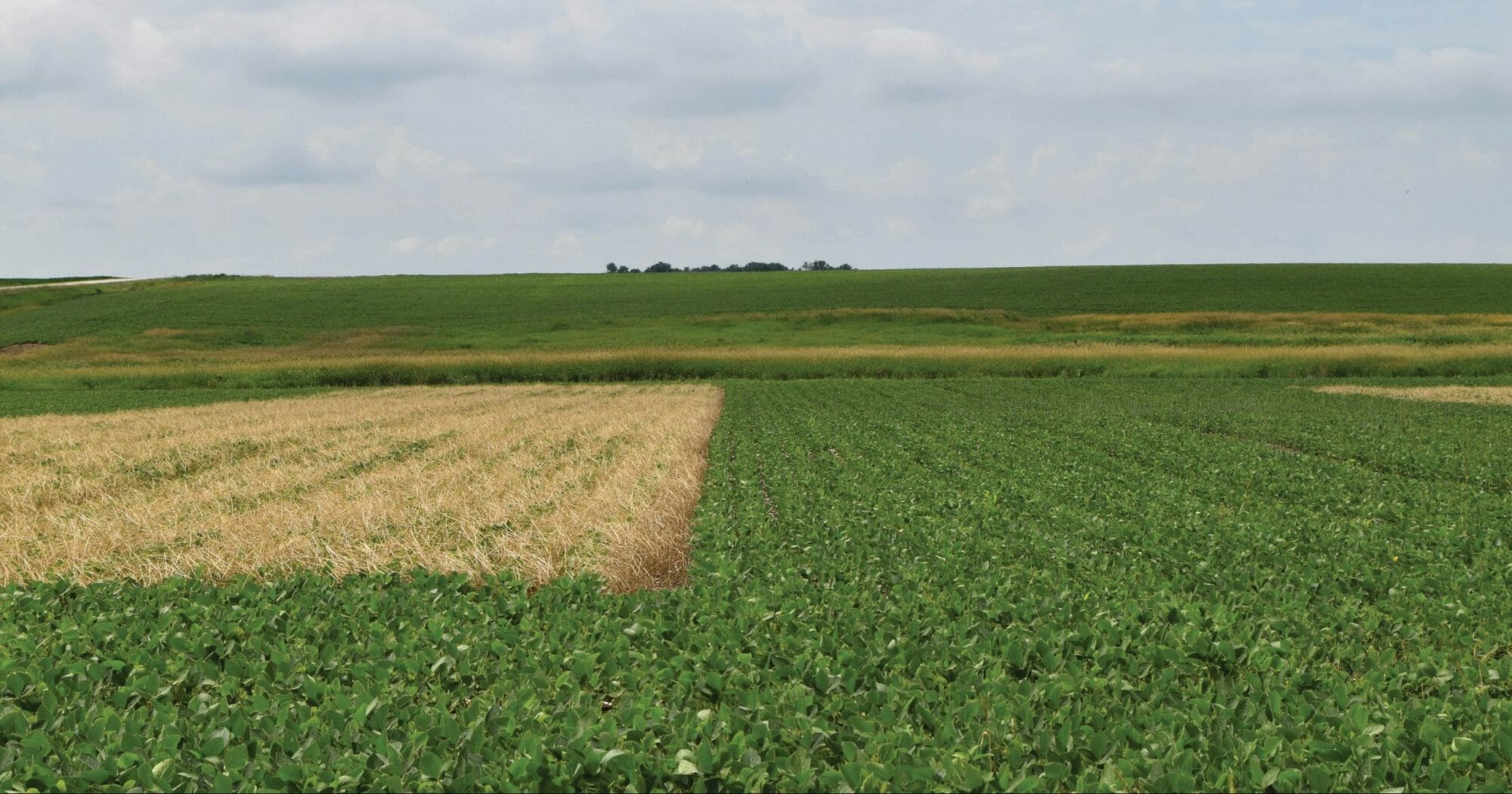
To test their shared hypothesis, all three drilled cereal rye after harvesting corn in fall 2018. The following spring, they terminated rye in multiple strips on two different dates – one near the date of planting soybeans, and another date as much as 52 days after planting soybeans. By the end of the season, the farmers had collected data on rye biomass, soybean stand counts and soybean yields in each strip. In northwest Iowa, Sam was pleased to find that delaying termination until 27 days after planting soybeans did not reduce his soybean yields and produced more rye biomass. “I'd like to see the USDA Risk Management Agency remove the restrictions on cover crop termination dates as they apply to soybean crop insurance eligibility,” he says, referring to rules informed by Natural Resources Conservation Service research that require farmers to terminate cover crops on or before the date of planting soybeans in the western third of Iowa, and before soybean emergence in the eastern two-thirds of Iowa, to remain eligible for crop insurance. In eastern Iowa, Tim likewise found his soybean yields were unaffected by delaying termination until 16 days after planting soybeans. As in 2018, he observed less weed pressure in the strips where he delayed termination and was happy to again use less herbicide. The results have encouraged him to continue waiting longer before killing rye in his soybeans. “I plan to use more rye cover as a replacement for the first residual herbicide pass,” Tim says. “I've been seeing weed control advantages in my use of covers in soybeans. Now I have numbers that prove it works.” On Jon's southwest Iowa farm, wet weather in spring 2019 prevented him from killing the rye at soybean planting time. As a result, he was only able to test the effects of terminating it 24 and 52 days after planting. This spring, however, Jon was pleasantly surprised to find green cereal rye growing in the strips where he had terminated rye the previous year 52 days after planting soybeans. The rye in those strips had fully matured and dropped seed before he was able to terminate it, which produced a free cover crop this spring ahead of corn. Initially, his experience during the trial prompted him to feel a need “be more careful about letting cereal rye go too long before termination.” Seeing the self-seeded cover crop this spring, however, has inspired him to think about other ways he can continue pushing the limits of delaying rye termination in soybeans.“I plan to use more rye cover as a replacement for the first residual pass. I've been seeing weed control advantages in my use of covers in soybeans. Now I have numbers that prove it works.” – Tim Sieren