In a Nutshell:
- Cowpeas are tropical legumes that grow well in the heat and humidity of the Iowa summer.
- They fix nitrogen and produce biomass; as they grow, they compete with and can choke out weeds that would otherwise spread or persist to cause problems for cash crops.
- Kate Edwards and Hannah Breckbill decided to test different cowpea varieties to investigate which one(s) produced the best stand and best suppressed weeds.
Key Findings:
- Both farms saw varietal differences. Edwards saw the highest yield and weed suppression from Red Ripper. Breckbill saw Iron & Clay significantly outperform Black-eyed peas.
- These may have been due to differences in seed size leading to different planting populations, as the smallest seed performed best in all measures.
Background
Cowpeas are warm-season annual legumes that fit well into summer cover-crop windows in Iowa vegetable systems, especially after early-season crops or before fall plantings [1], [2]. As cover crops, cowpeas can provide multiple benefits to vegetable growers, including rapid summer growth, nitrogen fixation, soil cover, and added biomass [1], [2], [3]. In vegetable plots, where weed pressure can build quickly during warm weather, an effective cowpea cover crop should establish evenly, cover the soil quickly, and compete with weeds before they dominate the bed [1], [3]. Cowpea varieties differ in traits that may affect their cover-crop performance, including seed size, germination, vine growth, canopy closure, biomass production, and ground coverage [3], [4].
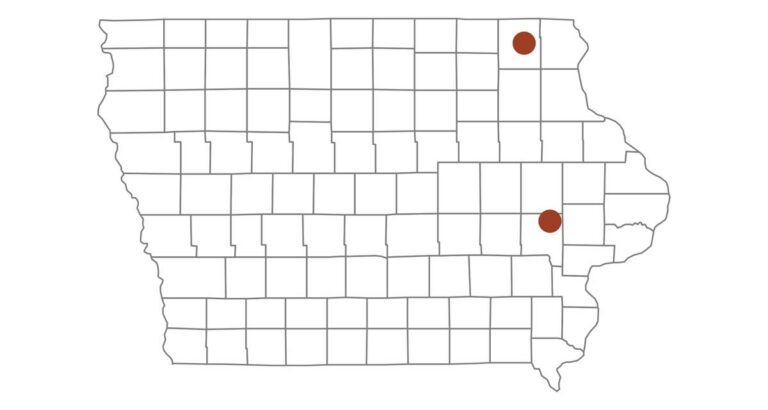
Because these variety differences could influence both cowpea stand density and weed suppression, farmers need practical information about which varieties are best suited for short summer cover-crop windows in vegetable rotations. To address this question, two farmers—Hannah Breckbill in Decorah and Kate Edwards in Solon—trialed different cowpea varieties in vegetable plots to compare establishment, ground cover, biomass or plant counts, and weed competition. The trial was designed to help identify cowpea varieties with the strongest potential for use as summer cover crops that can reliably cover soil and suppress weeds in vegetable production systems.
Methods
Design
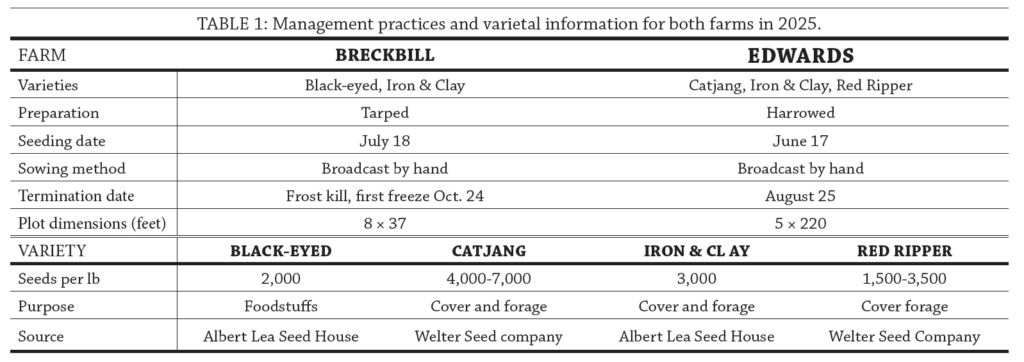
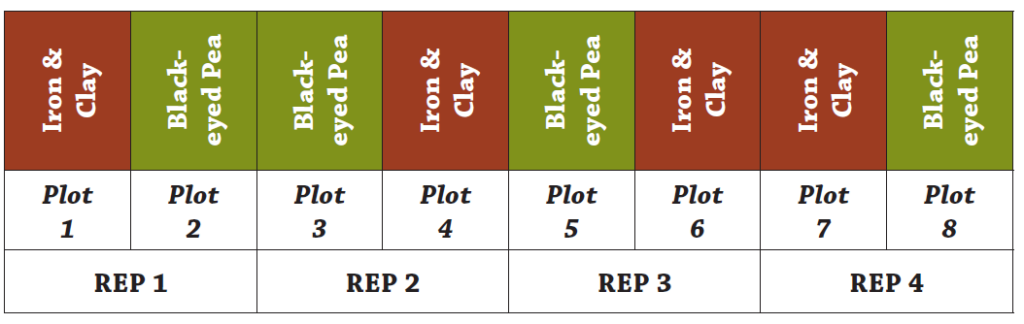
Each farm selected two or three cowpea varieties to test. Both farms grew Iron & Clay, which is the most commonly available variety. Their other choices were more constrained by seed availability. Breckbill’s choice of Black-eyed peas, a food-grade variety, particularly reflected the limited options available to them. The growers planted four replicate plots of each variety. For a sample experimental layout, see Figure A1. Each farm set their own planting rate and managed the plots in accordance with the needs and norms of their operation. Detailed management information for each operation is available in Table 1.
Measurements
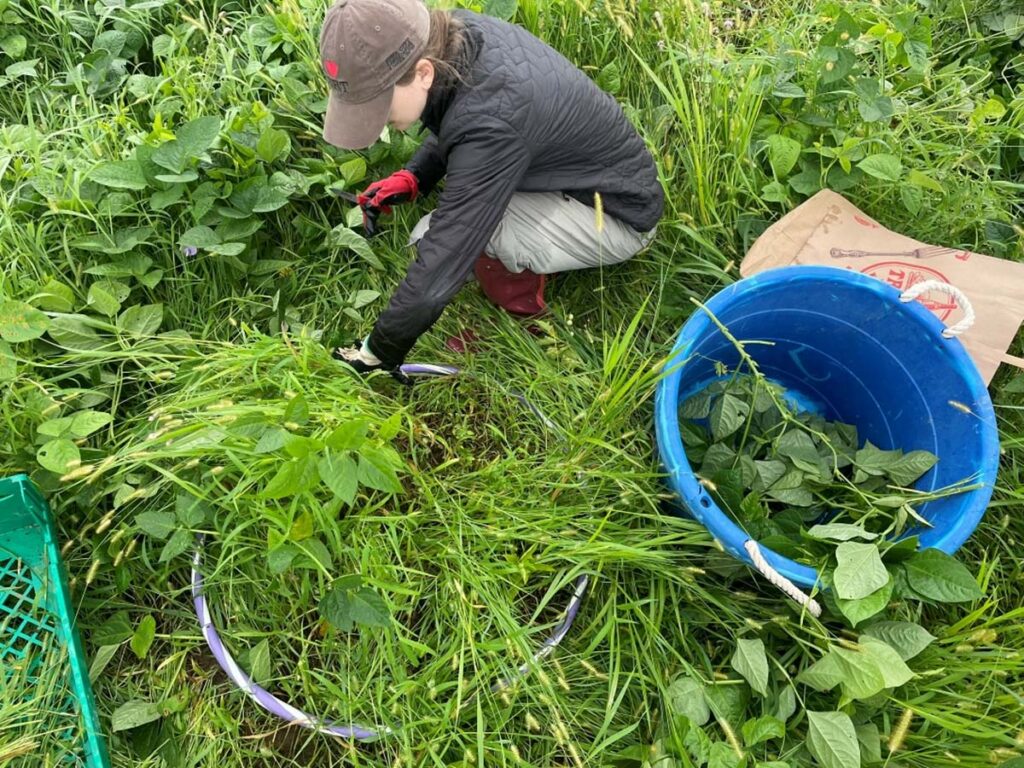
In August, sample measurement areas were designated by throwing out a 40-in. diameter hula hoop (8.73 ft2) into the plot. Multiple samples were collected within each plot, with the samples averaged together for each plot for analysis.
The two farms took different measurements of the samples within the hula hoops. Breckbill counted the number of cowpea plants within each hoop area and visually estimated the amount of the area that was covered by cowpeas, weeds, and bare earth. Edwards cut all the biomass within the hoop down to the ground and separated the weeds from the cowpeas. She then dried the cowpea and weed biomasses separately for each sample before weighing them. She reported the cowpea biomass and weed biomass, from which we also calculated the cowpea-to-weed biomass ratio.
Data analysis
We used analysis of variance (ANOVA) to test whether cowpea variety affected each measured response variable at each farm and used Tukey’s honestly significant difference (HSD) test to compare treatment means at the 90% confidence level. This means the observed treatment differences were unlikely to have occurred by chance under the conditions of the trial, and farmers can expect similar differences to occur 9 out of 10 times under similar conditions. We could perform this analysis because the cooperators used completely randomized and replicated experimental designs (Figure A1).
Results and Discussion
Breckbill saw clear differences between the two cowpea varieties that she trialed. She only counted an average of one Black-eyed pea plant within each sample hoop area, whereas she counted an average of 8.5 Iron & Clay plants. Although this did translate into much higher rates of ground coverage by Iron & Clay (41%) compared to Black-eyed pea plots (8%) (Figure 1), both varieties had very low rates of recruitment.
Differences in bare ground between Breckbill's treatments were driven primarily by differences in cowpea establishment and ground cover (Figure 1). In plots planted to Iron & Clay, weeds covered 29% of the sampled area, compared with 43% in plots planted to Black-eyed pea. However, the 34 percentage-point reduction in cowpea cover between the two varieties corresponded to only a 14 percentage-point increase in weed cover in the Black-eyed pea plots. Most of the remaining difference was accounted for by increased bare ground in the Black-eyed pea plots. This pattern suggests that differences in cowpea performance were not translated directly into increased weed growth. Instead, factors affecting cowpea establishment and biomass production, such as poor germination or stand density, may have played a larger role than direct competition between cowpeas and weeds in determining ground cover outcomes at Breckbill's farm.
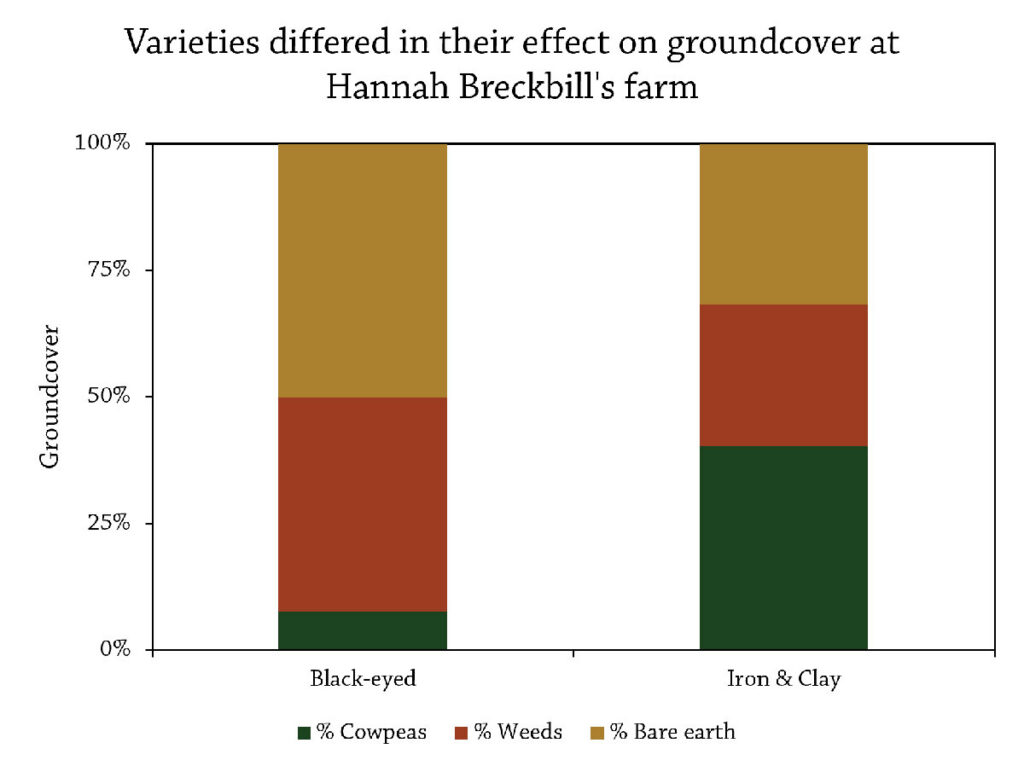
and Black-eyed Pea plots at Hannah Breckbill’s. Bars represent treatment means for each cover category. Iron
& Clay plots had significantly greater cowpea cover, significantly lower weed cover, and significantly less bare
ground than Black-eyed Pea plots at a 90% confidence level. Click to enlarge.
Much of the difference in performance can probably be attributed to poor germination. The plant count noted above shows that both varieties had very poor recruitment, although the Black-eyed peas’ was significantly worse. This was probably affected by how the seeds were sown. Cowpeas are large seeds that benefit from lots of contact with the soil to germinate, although hand sowing was the only practicable way to seed these plots at this scale and with the equipment available, it probably affected recruitment and these results.
Edwards also saw significant differences between the three varieties that she trialed. Variety affected cowpea biomass, weed biomass and the cowpea-to-weed ratio at the 90% confidence level. Red Ripper performed best overall, producing the most cowpea biomass, the least weed biomass, and the highest cowpea-to-weed biomass ratio (Figure 2). Red Ripper plots had significantly less weed biomass and a significantly higher cowpea-to-weed ratio than Iron & Clay Pea plots at a 90% confidence level, although there was no significant difference between Red Ripper and Catjang. These results suggest that Red Ripper did the best job of competing with and suppressing the weeds at Edwards’ farm.
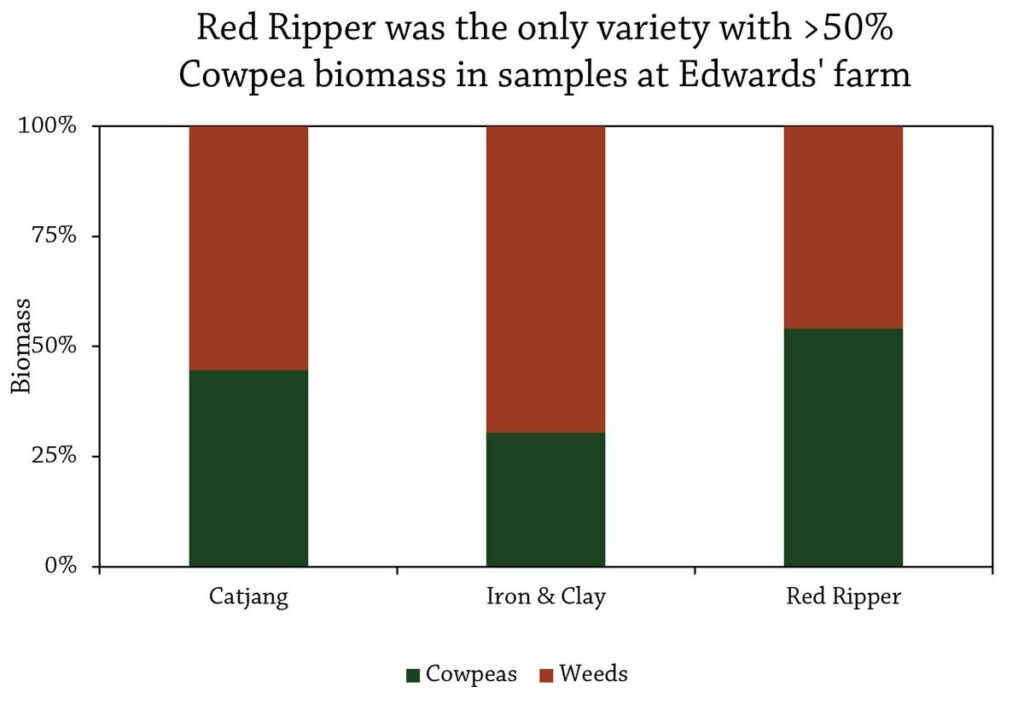
Ripper Pea plots at Edwards’ Wild Wood Farm. Bars represent treatment means for each cover category. Red
Ripper plots had significantly less weed biomass and a significantly higher cowpea to weed ratio than Iron &
Clay Pea plots at a 90% confidence level, although there was no significant difference between Red Ripper and
Catjang. Click to enlarge.
Both farms sowed the seeds by hand. Breckbill scattered a set volume of seeds over each plot, while Edwards weighed out the same weight of seeds of each variety for each plot.
Cowpea varieties differ in seed size, so both practices led to different seeding densities between varieties. Sources vary in the number of seeds per pound for a given variety [4], [8], [9], [10], [11], and weighing out a counted number of seeds will be an important step in future work to get a consistent planting rate. The general relative order of size from smallest to largest of the varieties that were used this year was Red Ripper, Catjang, Iron & Clay, and Black-eyed peas being the largest. We see that this size data lines up with how well each variety did, generally speaking; the trend seems to be that smallest seeds at each farm (Iron & Clay at Breckbill’s; Red Ripper at Edwards’) led to better ground cover, weed suppression, and biomass. Given the way that the farmers seeded the varieties to their plots—a consistent volume (Breckbill) or weight (Edwards) to each plot for all varieties—this suggests that the ‘variety’ effects that we are seeing are in fact introduced effects of varied planting populations.
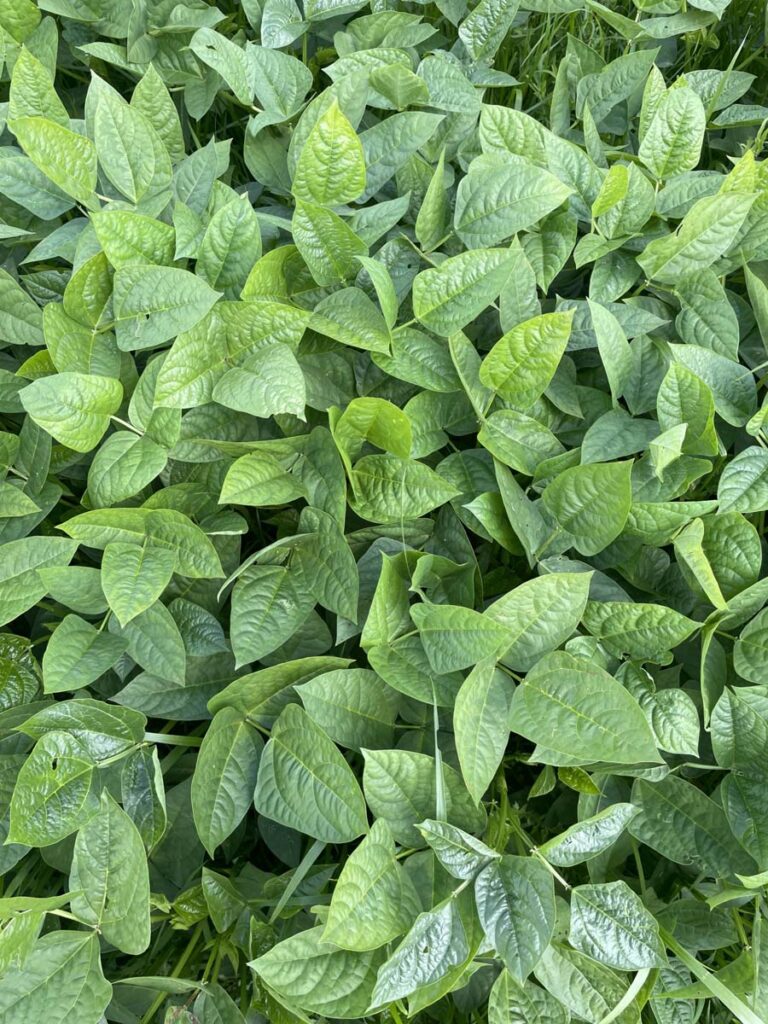
Although cowpea varieties vary in their seed sizes, all are relatively large seeds. Compared to broadcasting by hand, drilling in the seed can increase seed-soil contact, as well as regularizing spacing, both of which improve recruitment. Both farms broadcast their seed by hand because they did not have seed drills and such equipment would not be usable for setting out trial plots at the scale at which they exist in horticulture production systems.
Conclusions and Next Steps
Going forward, seed size and planting rate should probably be considered because they likely affected the plant density and groundcover results in this project. These trials will continue in 2026. More farms are joining the investigation, including field crop farmers who are planning on laying out larger research plot with seed drills to measure biomass production for livestock forage. Investigations include farmers planting single varieties at different seeding rates, and multiple varieties at a single seeding rate.
Appendix - Trial Design and Weather Conditions
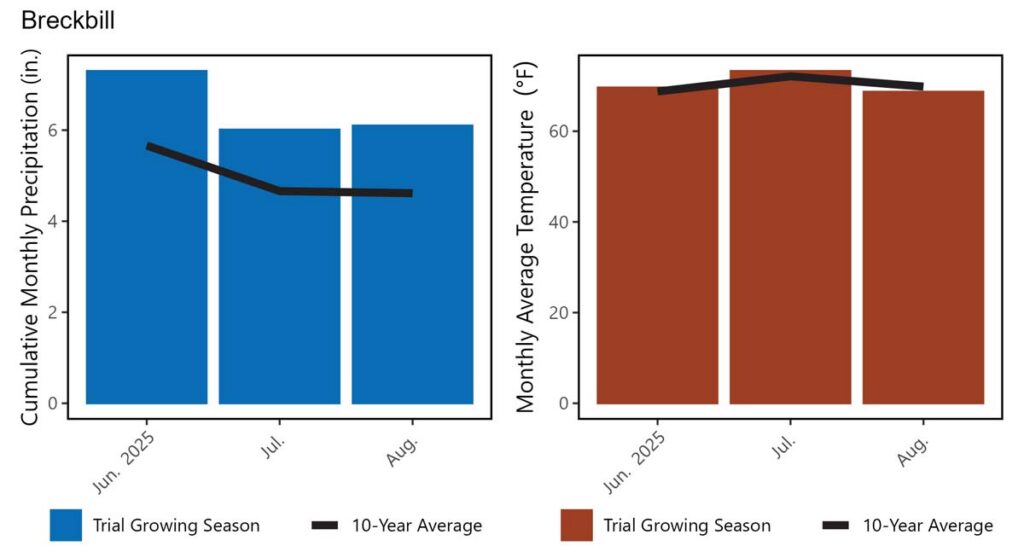
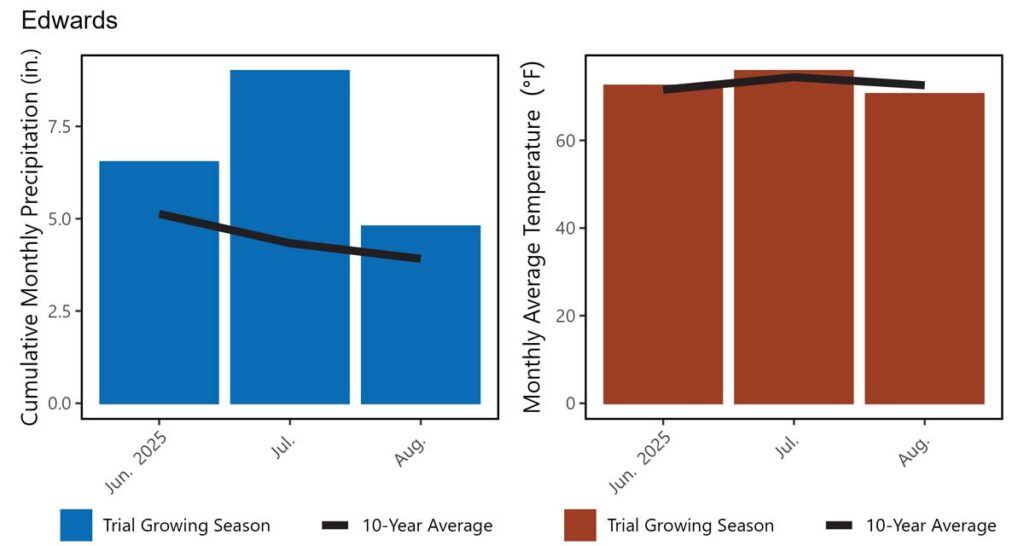
and 10-year averages (lines) for Decorah and Solon, IA [12], [13]. Click to enlarge.
References
- M. Licht, “Cowpeas as a cover crop,” Integrated Crop Management. Accessed: Aug. 17, 2026. [Online]. Available: https://crops.extension.iastate.edu/encyclopedia/cowpeas-cover-crop
- J. Johnson, “Cowpea Cover Crop Fact Sheet for Iowa,” May 2025, [Online]. Available: https://www.usda.gov/sites/default/files/guidance-documents/NRCS.Cowpea%20Crop%20Fact%20Sheet.pdf
- S. Outreach, “Cowpeas,” Managing Cover Crops Profitably, vol. 3rd Edition, Sustainable Agriculture Research and Education, Online, 2007. Accessed: Aug. 17, 2026. [Online]. Available: https://www.sare.org/publications/managing-cover-crops-profitably/legume-cover-crops/cowpeas/
- “Cowpea | Iowa State University Extension and Outreach Alternative Agriculture.” Accessed: Aug. 17, 2026. [Online]. Available: https://www.extension.iastate.edu/alternativeag/cowpea
- R. C. Muchow, M. J. Robertson, and B. C. Pengelly, “Accumulation and partitioning of biomass and nitrogen by soybean, mungbean and cowpea under contrasting environmental conditions,” Field Crops Res., vol. 33, no. 1, pp. 13–36, Apr. 1993, doi: 10.1016/0378-4290(93)90092-2.
- T. Ayalew, T. Yoseph, and G. Cadisch, “Symbiotic N2 fixation in cowpea varieties is markedly enhanced by inoculation with elite Bradyrhizobium strains,” Rhizosphere, vol. 32, p. 100976, Dec. 2024, doi: 10.1016/j.rhisph.2024.100976.
- R. Chikowo, P. Mapfumo, P. Nyamugafata, and K. E. Giller, “Mineral N dynamics, leaching and nitrous oxide losses under maize following two-year improved fallows on a sandy loam soil in Zimbabwe,” Plant Soil, vol. 259, no. 1, pp. 315–330, Feb. 2004, doi: 10.1023/B:PLSO.0000020977.28048.fd.
- “Cowpea - Red Ripper,” turnerseed. Accessed: Aug. 17, 2026. [Online]. Available: https://www.turnerseed.com/mm5/merchant.mvc?Screen=PROD&Product_Code=61
- “Red Ripper Pea,” HOSS. Accessed: Aug. 17, 2026. [Online]. Available: https://growhoss.com/products/red-ripper-pea
- “Cowpea << Cover Crops,” Stock Seed Farms. Accessed: Aug. 18, 2026. [Online]. Available: https://www.stockseed.com/Shop/cover-crops/cowpea
- “Iron and Clay, Cowpea Seeds | Cowpea.” Accessed: Aug. 18, 2026. [Online]. Available: https://www.ufseeds.com/product/iron-and-clay-cowpea-seeds/CPIC.html
- A. H. Sparks, “nasapower: A NASA POWER Global Meteorology, Surface Solar Energy and Climatology Data Client for R,” J. Open Source Softw., vol. 3, no. 30, p. 1035, Oct. 2018, doi: 10.21105/joss.01035.
- A. Sparks, nasapower: NASA-POWER Data from R. (2024). [Online]. Available: https://CRAN.R-project.org/package=nasapower