In a Nutshell:
- Dick Sloan hoped to determine which of two clover green manure mixes interseeded to an established winter small grain crop would be more profitable and sustainable in his soybean-small grain-corn rotation. The objective of this trial was to compare corn yield and profitability between two green manure mixes – one that overwinters (medium red/alsike clover) and one that winterkills (crimson/berseem clover).
- Sloan hypothesized the winterkill mix would produce similar results to the overwinter mix but would save the cost and labor of a burndown pass.
Key Findings:
- The overwinter mix generated significantly more fall biomass and total nitrogen than the winterkill mix. The following spring, winterkill strips required a burndown pass because of the presence of volunteer rye. Corn in the overwinter strips yielded significantly greater than in the winterkill strips.
- After conducting this trial, Sloan commented, “I will continue to use medium red and alsike clovers by interseeding them to my winter small grains. A better use for berseem and crimson clover would be to plant them as part of a diverse mix following a small grain harvest.”
Background
Expanding a corn-soybean crop rotation to include a small grain such as rye or wheat after soybean creates opportunities to seed a nitrogen-fixing green manure between the small grain and corn crops. Through conducting previous PFI on-farm trials, Wade Dooley and Dick Sloan found that interseeding clover-containing green manure mixes to an established cereal rye grain crop translated to greater corn yields the subsequent year compared to seeding cloverless mixes after cereal rye grain harvest.[1,2] Ever-interested in improving his system, Sloan was curious to determine how two different clover mixes – one that overwinters and one that winterkills – would compare when interseeded to an established winter small grain crop. The objective of this trial was to compare corn yield and profitability between two treatments:
- Overwinter – medium red/alsike clover blend interseeded to cereal rye grain in spring and terminated the subsequent spring
- Winterkill – crimson/berseem clover blend interseeded to cereal rye grain in spring
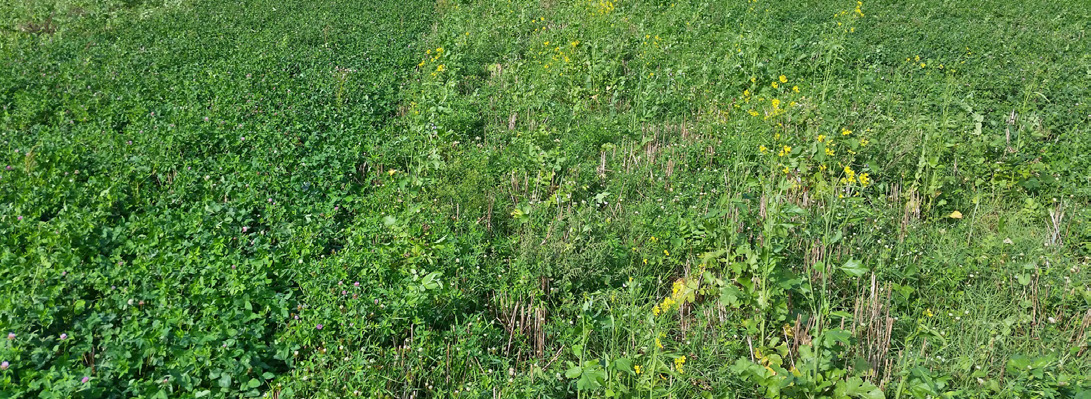
Sloan hypothesized the winterkill clover mix would perform equally well while saving the cost of a burndown pass. He commented, “I’ve played around with several summer mixes and had variable results, but it’s hard to beat the medium red and alsike blend drilled in April into established winter small grains. The berseem and crimson clovers are not supposed to overwinter, so it’s an experiment. I want to determine the most profitable and sustainable system for my farm.”
Methods
Design
On Oct. 20, 2018, Sloan drilled cereal rye into soybean stubble in 7.5-in. rows at a rate of 100 lb/ac.
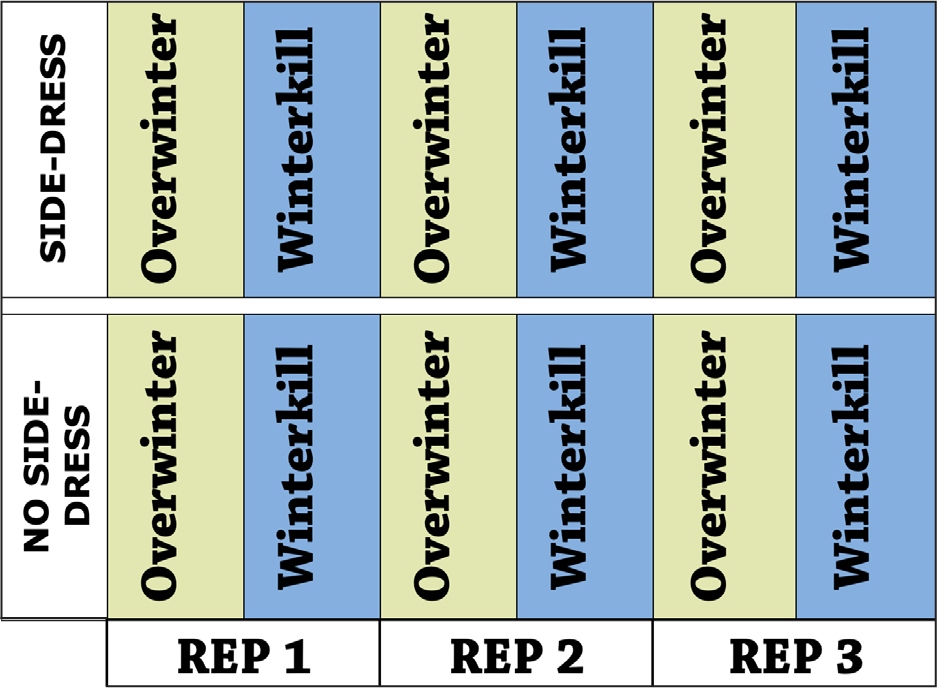
Sloan established treatment strips on April 15, 2019, by interseeding a 60/40 blend of red and alsike clovers at a rate of 7.2 lb/ac. The following day, Sloan interseeded a 50/50 blend of crimson and berseem clovers into neighboring strips at a rate of 14 lb/ac. Both blends were drilled in 7.5-in. rows with skip zones on 30-in. centers.
Sloan harvested rye grain on July 24, 2019. Sloan’s rye yield averaged 37.4 bushels/ac. On Aug. 5, he interseeded a winterkill summer-mix cover crop into the 30-in. skip zones in all strips at a rate of 7 lb/ac (30% forage pea, 9% soybean, 12% spring triticale, 12% buckwheat, 6% badger radish, 15% crimson clover, 15% berseem clover and 1.5% brown mustard).
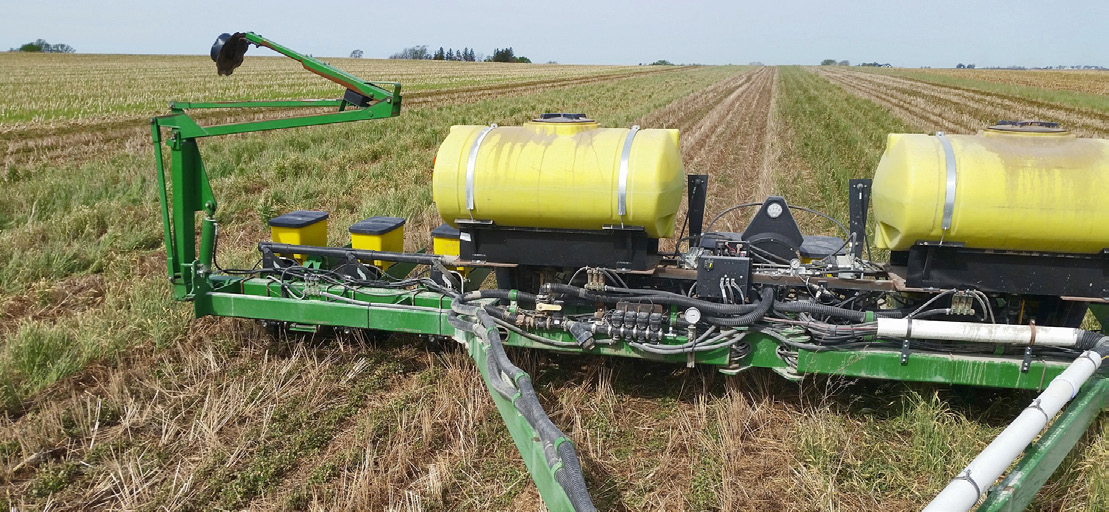
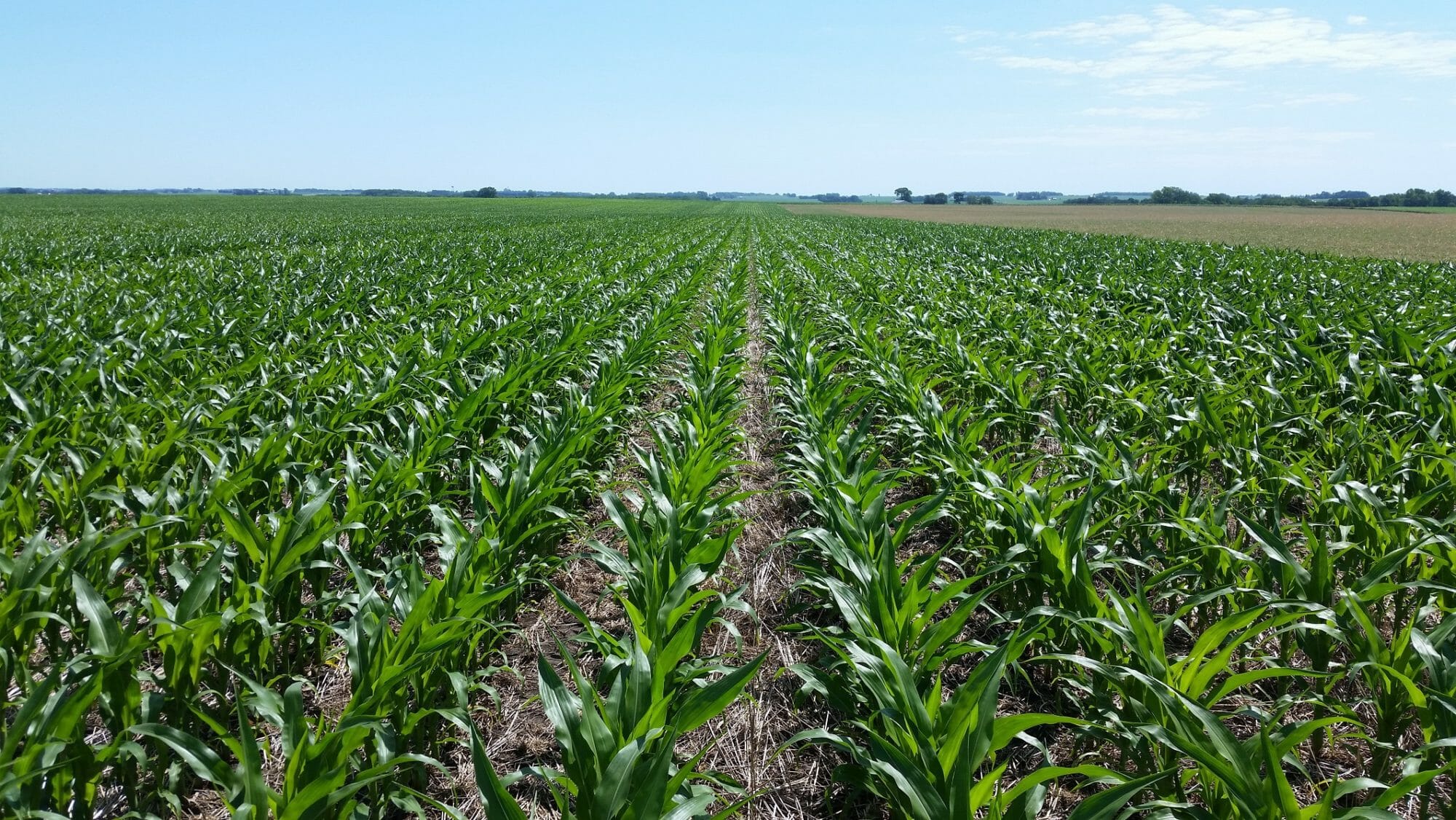
The following year, on April 7, 2020, Sloan applied 11 lb N/ac, 52 lb P/ac and 90 lb K/ac. Nearly 1 month later, on May 2, Sloan applied a tank mix of Gramoxone (3 pt/ac), atrazine (1 lb/ac) and Dicamba (1 pt/ac) to all treatment strips. This mix was applied to terminate the overwinter clover and to terminate volunteer cereal rye that became predominant in the winterkill strips by that time. Sloan planted corn into the 30-in. skip zones of all strips at a rate of 34,000 seeds/ac on May 4. In the same pass, Sloan applied starter fertilizer (32 lb N/ac, 18 lb P/ac, 5 lb K/ac, 15 lb S/ac).
Results and Discussion
Green manure biomass – Fall 2019, spring 2020
In Fall 2019, the overwinter clover treatment generated significantly more total biomass, carbon and nitrogen than the winterkill treatment (Table 1). Biomass in the overwinter treatment consisted predominantly of red and alsike clover while biomass in the winterkill treatment consisted of crimson and berseem clovers as well as some of the summer-mix cover crop. The summer-mix cover crop grew well in the winterkill crimson and berseem clovers but did not seem to grow well with the red and alsike clovers. The carbon to nitrogen ratio was widest in the winterkill treatment.
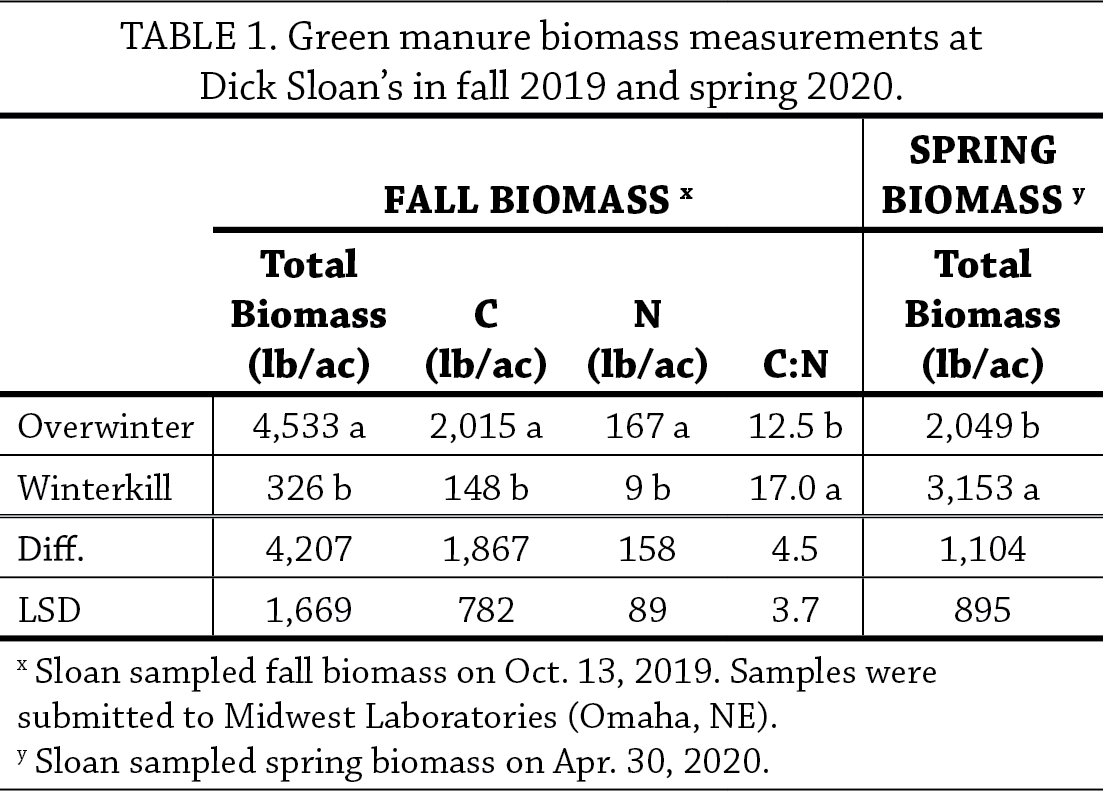 In spring 2020, total biomass was greatest in the winterkill treatment; however, Sloan noted that biomass samples in the winterkill strips consisted mainly of volunteer cereal rye while the overwinter treatment consisted mainly of red and alsike clover. By that time in the experiment, the winterkill clovers had winterkilled leaving only volunteer cereal rye.
Late-spring soil nitrate
Both treatments were potentially deficient in soil nitrate in early June according to test recommendations (Table 2). While Sloan hypothesized the winterkill treatment would need more side-dress nitrogen than the overwinter strips, soil nitrate tests revealed no difference between treatments (Table 2).
In spring 2020, total biomass was greatest in the winterkill treatment; however, Sloan noted that biomass samples in the winterkill strips consisted mainly of volunteer cereal rye while the overwinter treatment consisted mainly of red and alsike clover. By that time in the experiment, the winterkill clovers had winterkilled leaving only volunteer cereal rye.
Late-spring soil nitrate
Both treatments were potentially deficient in soil nitrate in early June according to test recommendations (Table 2). While Sloan hypothesized the winterkill treatment would need more side-dress nitrogen than the overwinter strips, soil nitrate tests revealed no difference between treatments (Table 2).
 Stalk nitrate
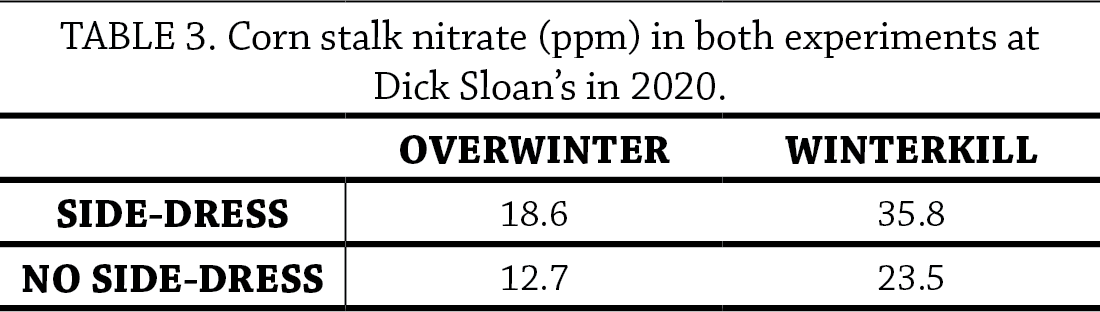
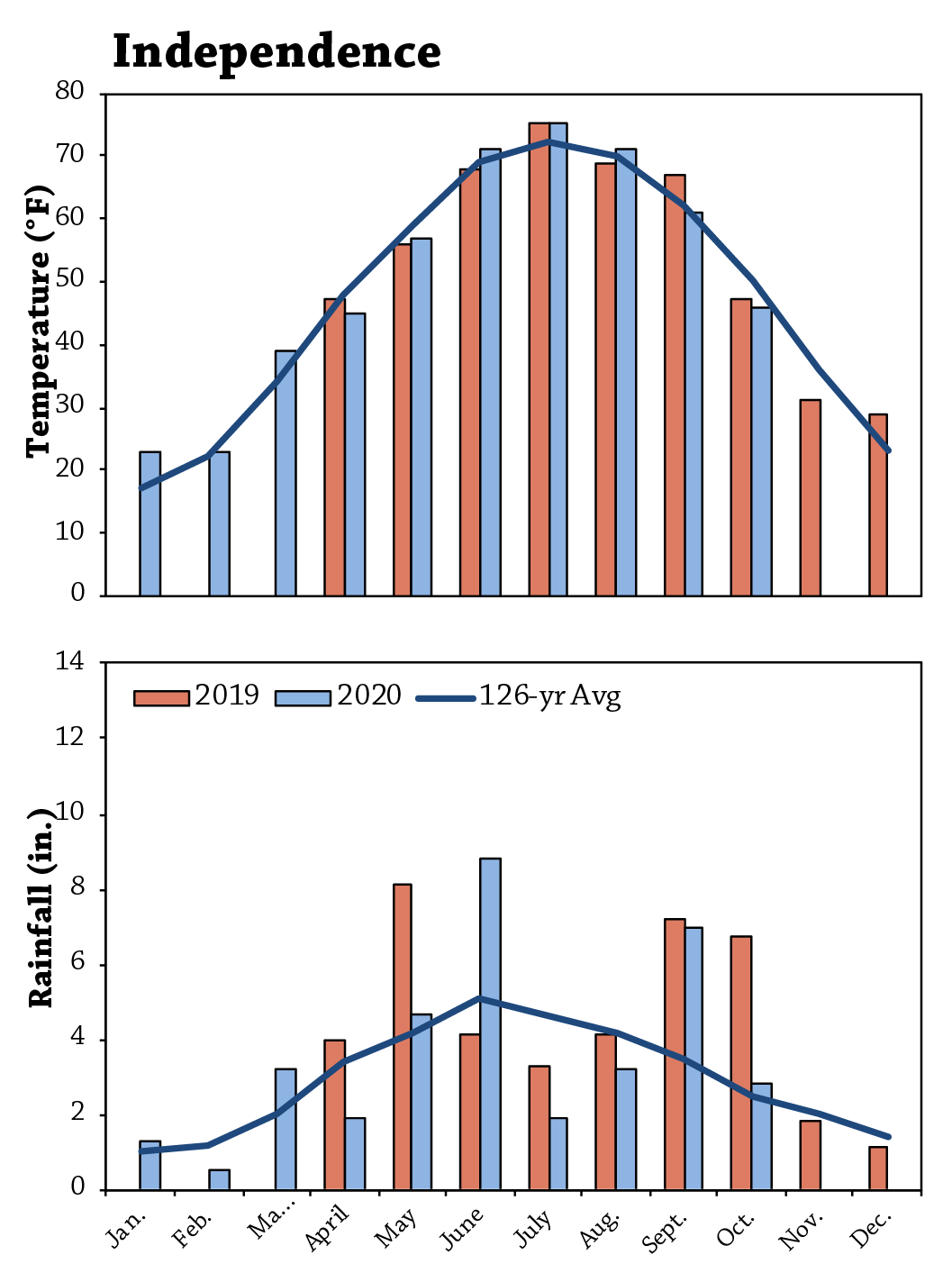
After side-dressing one half of the field, subsequent corn stalk nitrate tests revealed low stalk nitrate levels in both treatments and both experiments (Table 3). Levels below 250 ppm can mean corn would have benefitted from additional nitrogen; however, rainfall much below the historical average in July and August may have limited corn nitrogen uptake (Figure A2).[3] It is not possible to make statistical comparisons of stalk nitrate between treatments because stalk samples from each treatment were combined; however, stalk nitrate levels did increase in both treatments as a result of side-dressing (Table 3). The increase was greatest in the winterkill treatment.
Stalk nitrate
After side-dressing one half of the field, subsequent corn stalk nitrate tests revealed low stalk nitrate levels in both treatments and both experiments (Table 3). Levels below 250 ppm can mean corn would have benefitted from additional nitrogen; however, rainfall much below the historical average in July and August may have limited corn nitrogen uptake (Figure A2).[3] It is not possible to make statistical comparisons of stalk nitrate between treatments because stalk samples from each treatment were combined; however, stalk nitrate levels did increase in both treatments as a result of side-dressing (Table 3). The increase was greatest in the winterkill treatment.
 Corn yields
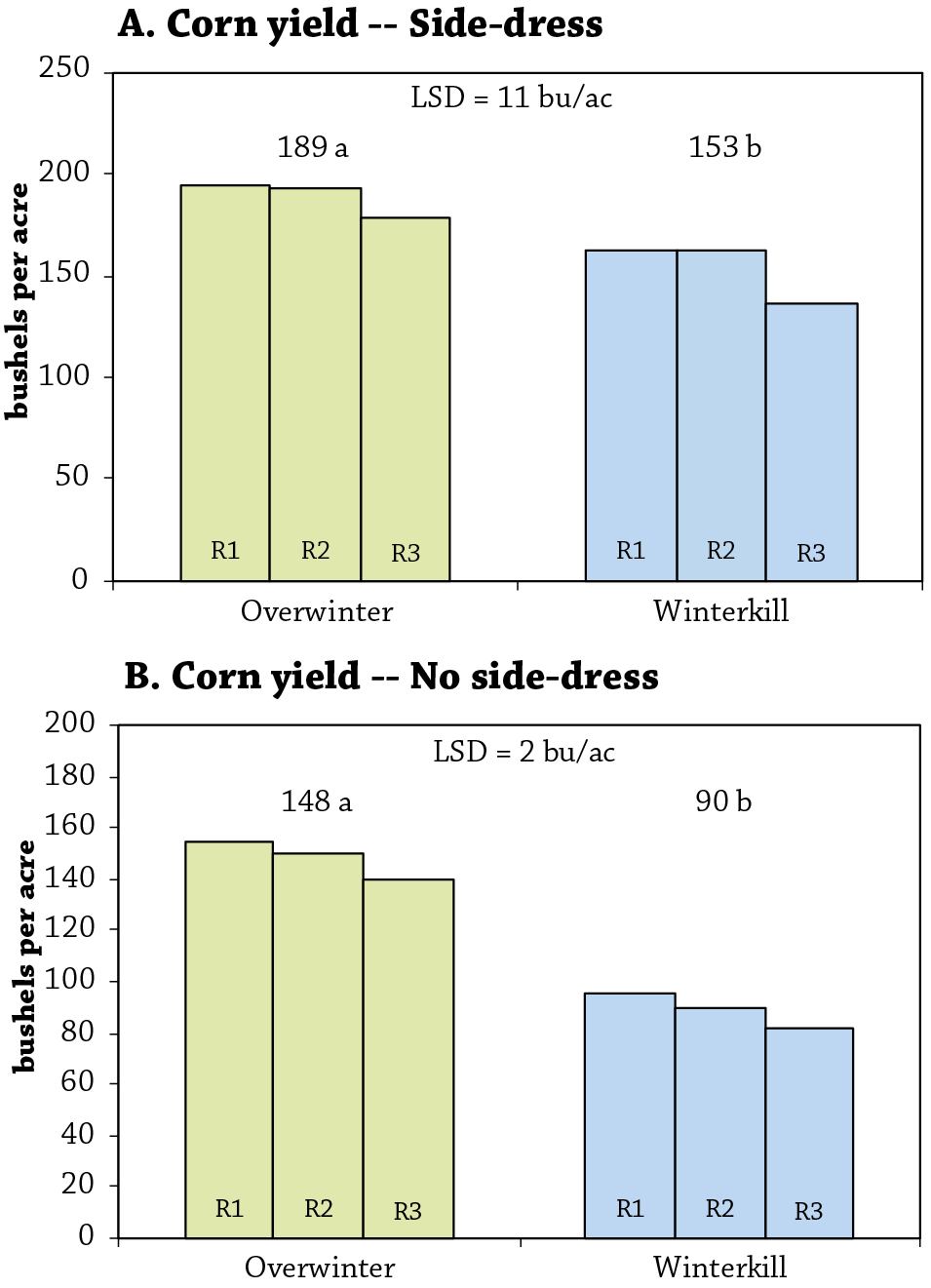
In both experiments, corn in the overwinter treatment yielded significantly greater than corn in the winterkill treatment (Figure 1). The additional nitrogen generated by the red and alsike clovers in the overwinter treatment likely contributed to this yield advantage. Corn yield in the overwinter treatment of the side-dress experiment (189 bu/ac) exceeded the historical average corn yields for Buchanan county (188 bu/ac) while the other yield responses ranged from 35 to 98 bu/ac less than the historical county average.[4] Both treatments appear to have benefitted from side-dressing. As occurred with stalk nitrate levels, the yield gain that occurred within each treatment following side-dressing was greatest for the winterkill treatment.
Corn yields
In both experiments, corn in the overwinter treatment yielded significantly greater than corn in the winterkill treatment (Figure 1). The additional nitrogen generated by the red and alsike clovers in the overwinter treatment likely contributed to this yield advantage. Corn yield in the overwinter treatment of the side-dress experiment (189 bu/ac) exceeded the historical average corn yields for Buchanan county (188 bu/ac) while the other yield responses ranged from 35 to 98 bu/ac less than the historical county average.[4] Both treatments appear to have benefitted from side-dressing. As occurred with stalk nitrate levels, the yield gain that occurred within each treatment following side-dressing was greatest for the winterkill treatment.
Conclusions and Next Steps
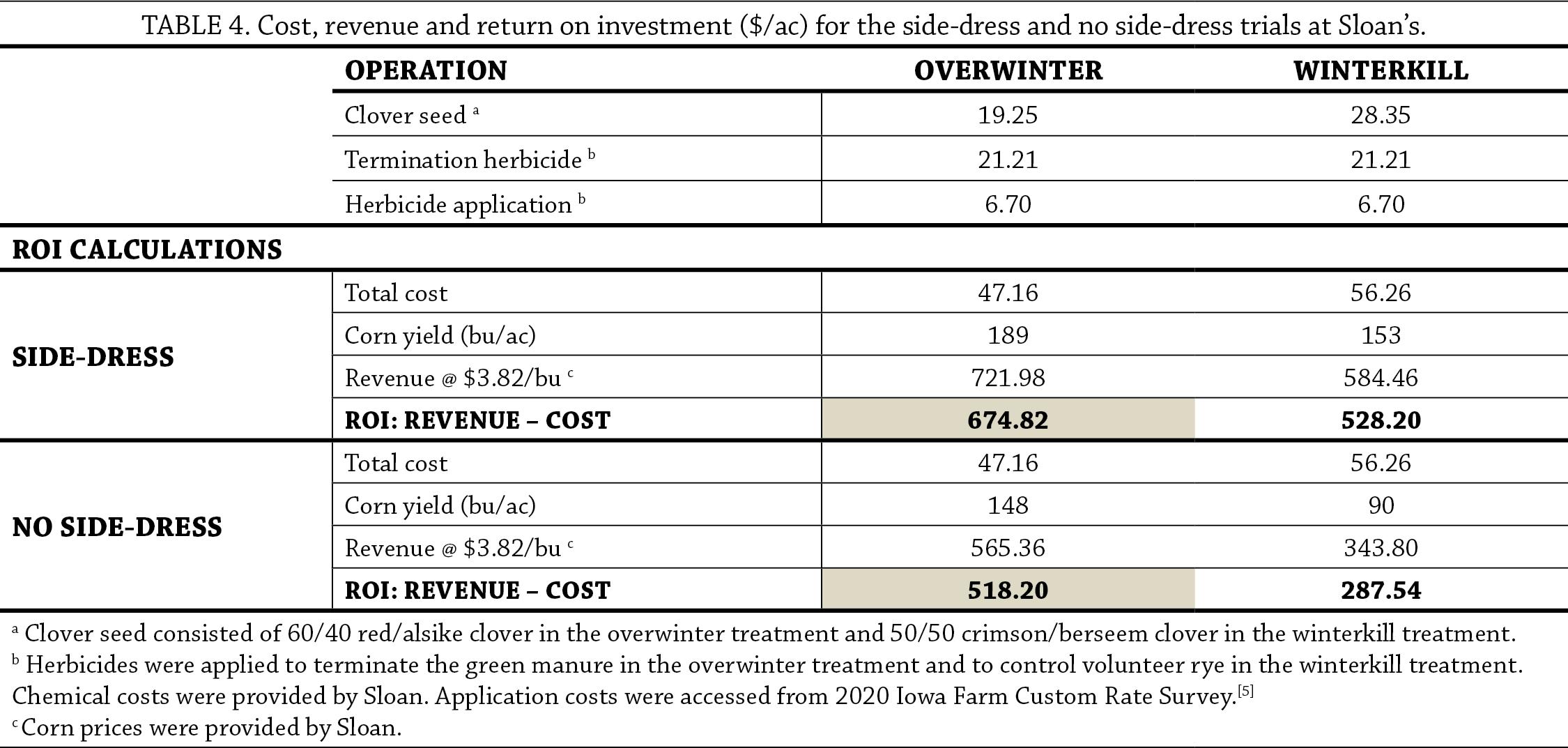
After conducting these trials, Sloan commented, “I will continue to use medium red and alsike clovers by interseeding them to my winter small grains. A better use for berseem and crimson clover would be to plant them as part of a diverse mix following a small grain harvest.” While Sloan expected the crimson/berseem mix to be more competitive with the red/alsike mix, he observed that “the timing of planting different types of clover can greatly affect their productivity and usefulness. It’s good to try new things – even if it doesn’t work out the way I expect. I always learn something from on-farm research.”
Appendix – Trial Design and Weather Conditions
References
- Gailans, S. and W. Dooley. 2016. Effect on corn of green manure cover crops established with cereal rye seed crop. Practical Farmers of Iowa Cooperators’ Program. https://practicalfarmers.org/research/effect-on-corn-of-green-manure-cover-crops-established-with-cereal-rye-seed-crop/ (accessed October 2020).
- Gailans, S. and D. Sloan. 2015. Corn Following Green Manure Cover Crops Established with Small Grain. Practical Farmers of Iowa Cooperators’ Program. https://practicalfarmers.org/research/corn-following-green-manure-cover-crops-established-with-small-grain/ (accessed October 2020).
- Sawyer, J.E. and A.P. Mallarino. 2018. Use of the End-of-Season Corn Stalk Nitrate Test in Iowa Corn Production. CROP 3154. Iowa State University Extension and Outreach. https://store.extension.iastate.edu/Product/5089 (accessed February 2021).
- Johanns, A. 2020. Historical Corn Yields by County in Iowa. A1-12. Ag Decision Maker. Iowa State University Extension and Outreach. https://www.extension.iastate.edu/AgDM/crops/pdf/a1-12.pdf (accessed January 2021).
- Plastina, A., A. Johanns and O. Massman. 2020. 2020 Iowa Farm Custom Rate Survey. FM1 1698. Ag Decision Maker. Iowa State University Extension and Outreach. https://www.extension.iastate.edu/agdm/crops/html/a3-10.html (accessed November 2020).
- Iowa Environmental Mesonet. 2021. IEM “Climodat” Reports. Iowa State University Department of Agronomy. https://mesonet.agron.iastate.edu/climodat/ (accessed January 2021).