Funded by USDA.
In a Nutshell:
- Though customers love it, growing broccoli in the summer is a tall task for Iowa farmers. Broccoli generally yields poorly in high heat and wet or intensely humid conditions.
- PFI farmers have previously trialed different varieties of cabbage, cauliflower and broccoli for summer production. A trial in 2016 showed that Imperial broccoli outyielded Belstar and Gypsy [1], [2], [3], [4].
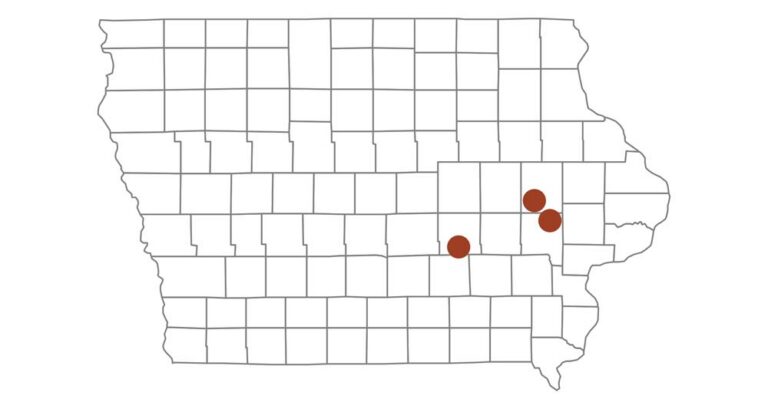
- Farmers Carmen & Maja Black, Kate Edwards, and Ashley & Zach Wenke all decided to trial 3-4 different broccoli varieties on their farms in the summer of 2025. They evaluated yield of each variety and noted growth habits and marketability.
Key Findings:
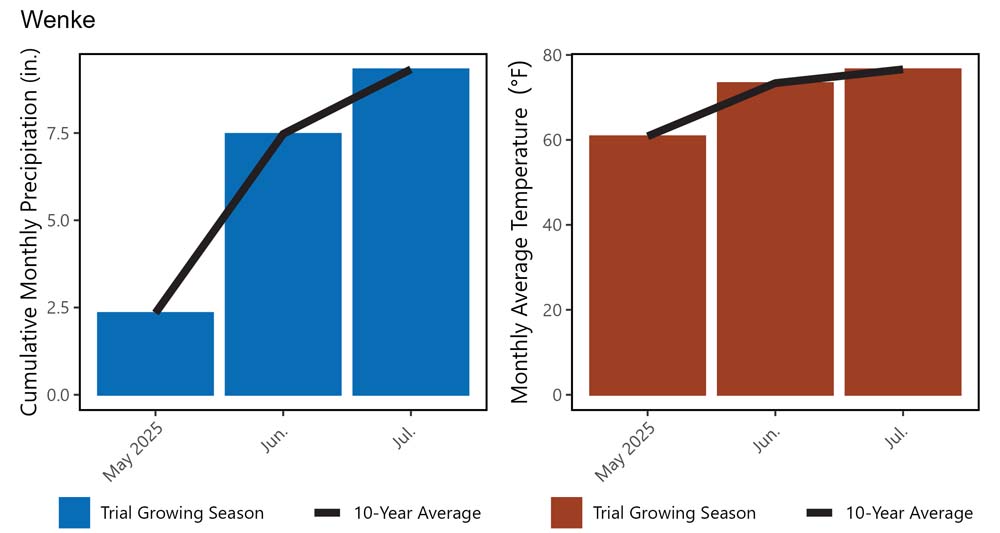
- 2025 was a historically wet early summer and broccoli yields were poor for all varieties trialed.
- Green Magic produced significantly more marketable broccoli yield than Covina and Imperial at the Blacks’. It also produced more unmarketable broccoli yield than other varieties at the Wenkes’.
- Farmers concluded that while their was no definitively better broccoli variety, the trial gave them an opportunity to pay more attention to their broccoli crop, learn to take better records, and collaborate with other farmers.
Background
Growing broccoli to harvest in the middle of summer is a challenge for Iowa farmers. Heat negatively impacts yield and crown quality of this cool-loving crop, and it is very susceptible to disease in wet conditions. Some research suggests that yield and head quality of broccoli is negatively impacted when temperatures are consistently above 70°F in the weeks prior to harvest [5].
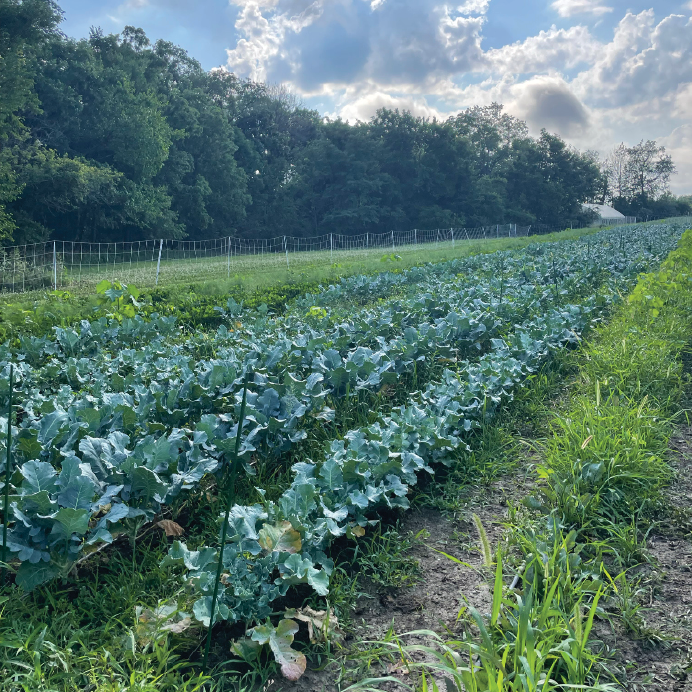
2025.
Other research shows that broccoli is mostly sensitive to heat above 85-95°F, and only when the plant is shifting into the crown production growth phase [6]. Regardless, Iowa farmers are almost guaranteed to experience these sorts of hot conditions and/or very wet conditions that lead to brassica diseases in late May and June, just in time to negatively impact their summer broccoli crop [7].
In past variety trials, PFI farmers have investigated how specific varieties of brassicas perform in summer production, and they have identified varieties that work best for their farms [2]. For example, farmers participating in a 2016 PFI summer broccoli variety trial found that Imperial broccoli outyielded Belstar and Gypsy. Since 2016, plant breeders have released new broccoli varieties that are intended to be more heat resilient [1]. Hoping to find a superior summer broccoli variety among those currently available, Carmen & Maja Black, Kate Edwards, and Ashley & Zach Wenke each trialed 3-4 different broccoli varieties on their farms in the summer of 2025. They were generally motivated, in Ashley Wenke’s words, to identify “the correct types of broccolis to have consistent, reliable summer harvest.” Edwards added that she frequently plants a lot of extra summer broccoli to ensure that she has enough for her CSA and would like her trial to result in “some assurance of yield to save time from over planting.”
Methods
Design
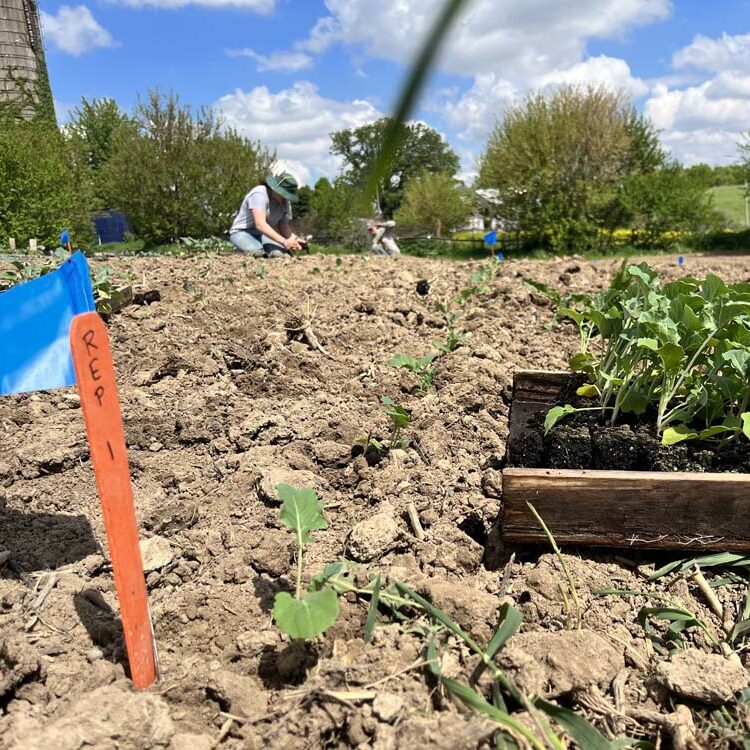
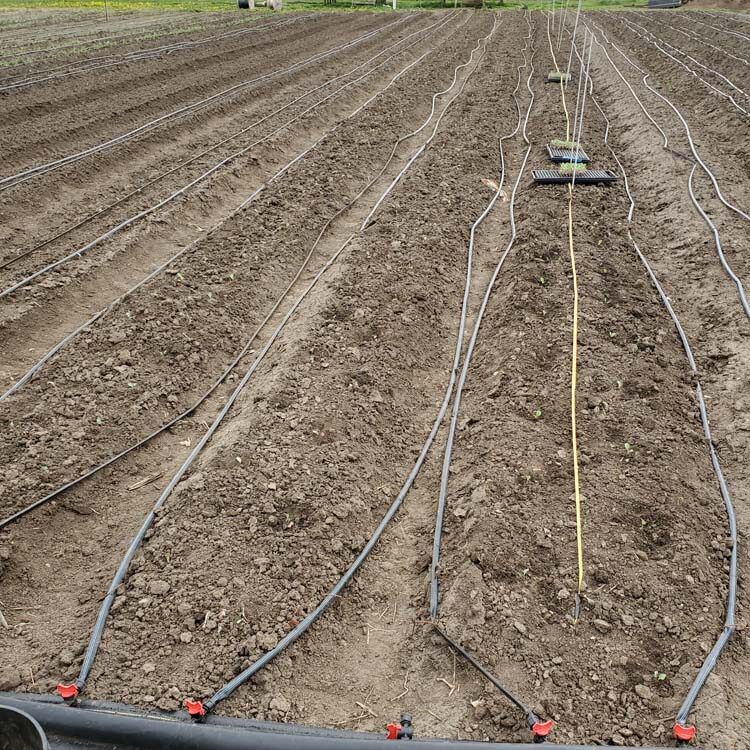
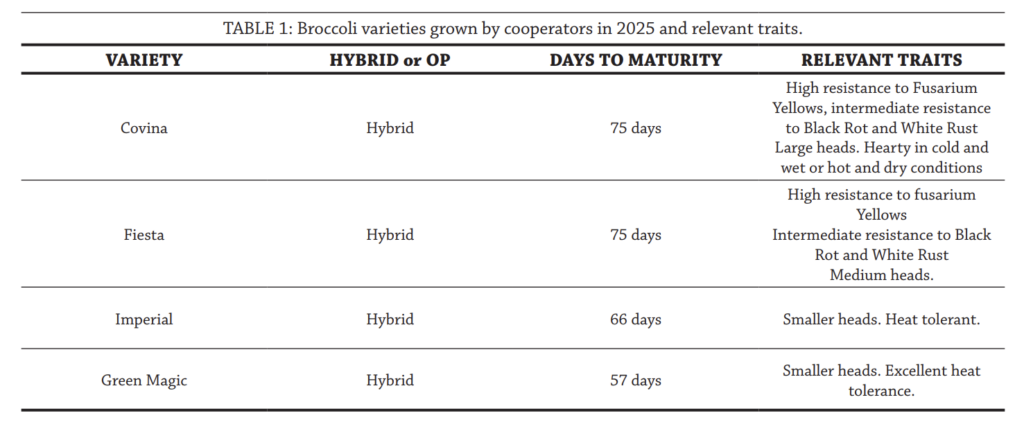
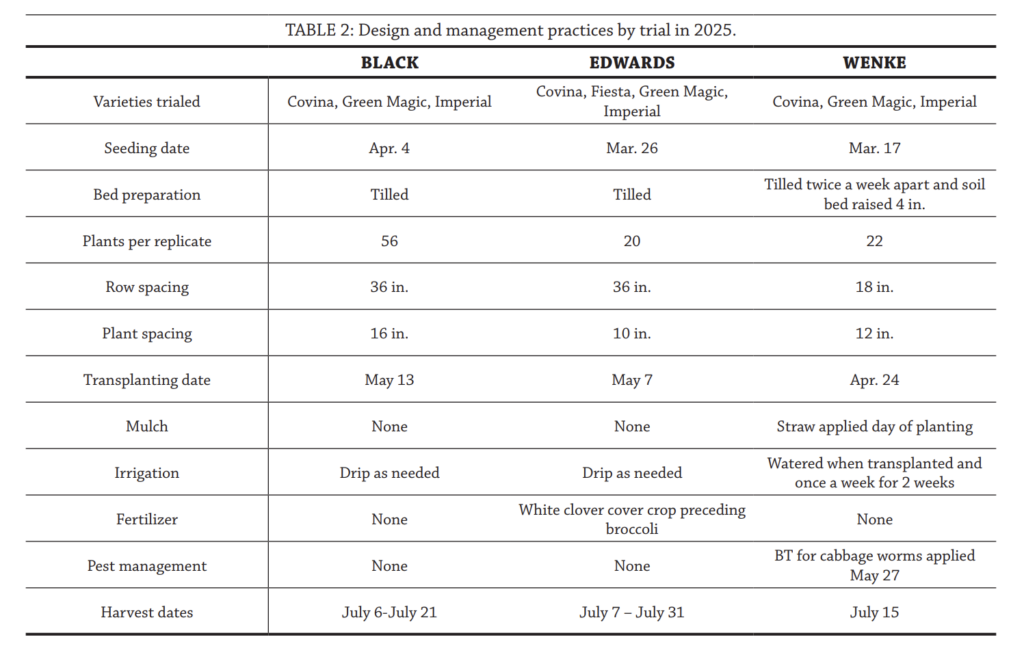
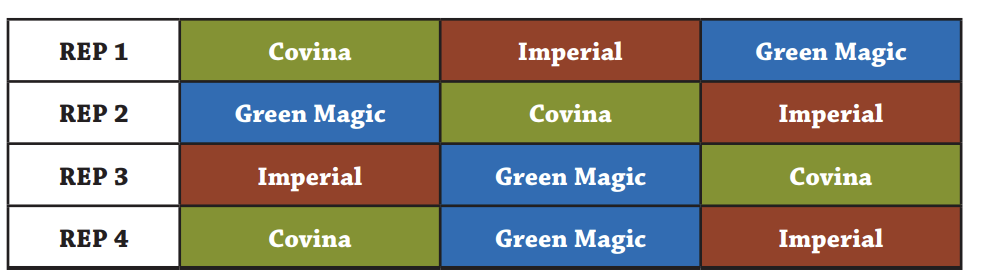
The Blacks planted three replicates, Edwards planted four replicates, and the Wenkes planted seven replicates of each variety they trialed. All cooperators used a block design and randomly assigned variety treatments within each block. Relevant traits about each trialed variety are found in Table 1, and trial planting and management details for each farm are shown in Table 2.
Measurements
At each harvest date, farmers weighed broccoli yield from each replicate, dividing the harvest into marketable and unmarketable categories. Farmers used their discretion when deciding what broccoli was marketable and when to harvest. Edwards also counted the number of marketable and unmarketable heads as she generally sells to a CSA, and the number of heads is important for counting the number of shares she can add broccoli to.
Data Analysis
We used an ANOVA (Analysis of Variance) at a 90% confidence level to determine if there were significant differences in total and marketable yield between varieties at each of the three farms. This means any varieties we declare statistically different would be expected to occur at least 9 times out of 10 if the experiments were carried out in identical conditions. When ANOVA identified significant variance in yield by variety, we followed those ANOVA with a Tukey’s Honest Significant Difference test (HSD). We could perform statistical analysis at these farms because they had replicated and randomized experimental designs (Figure A1).
Results and Discussion
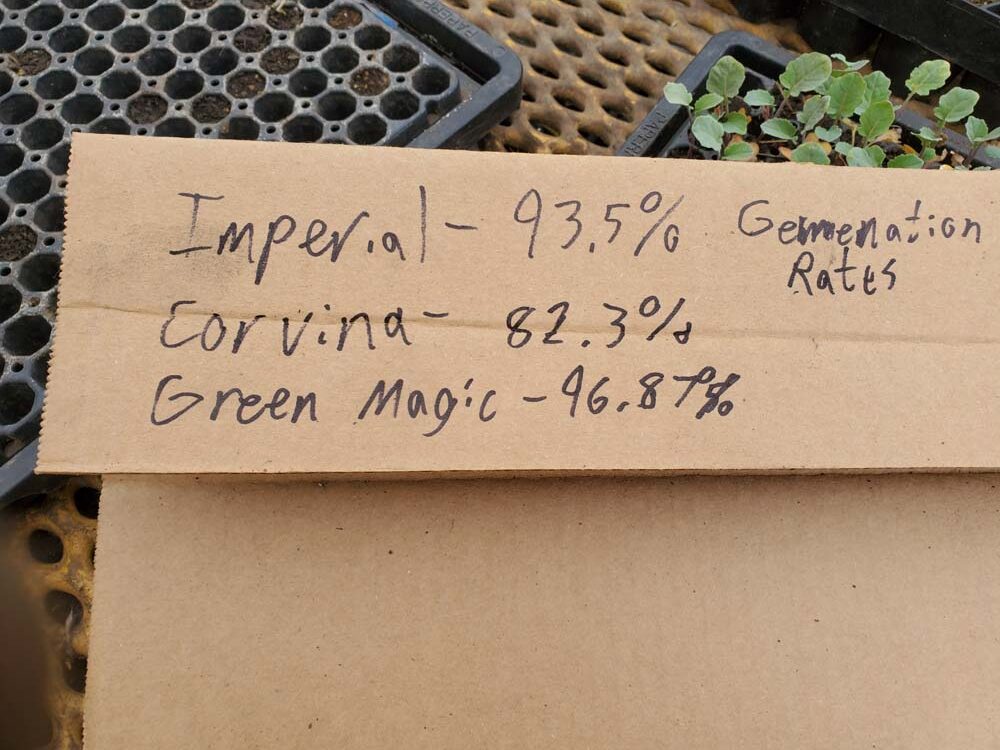
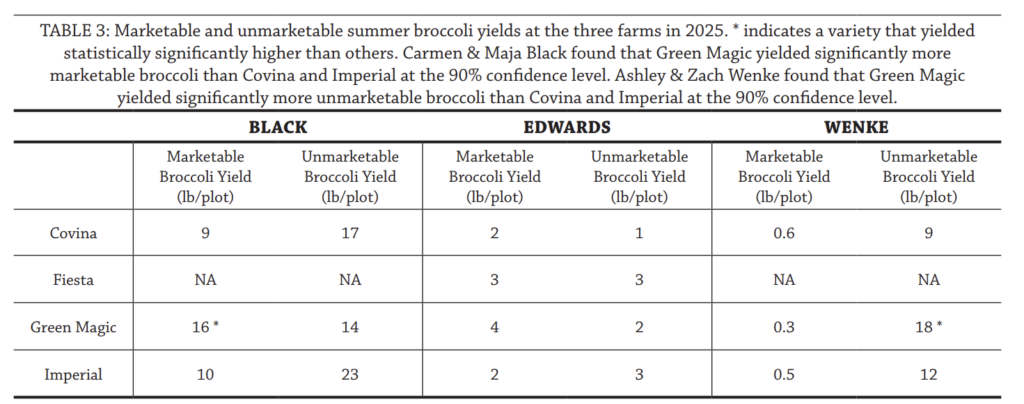
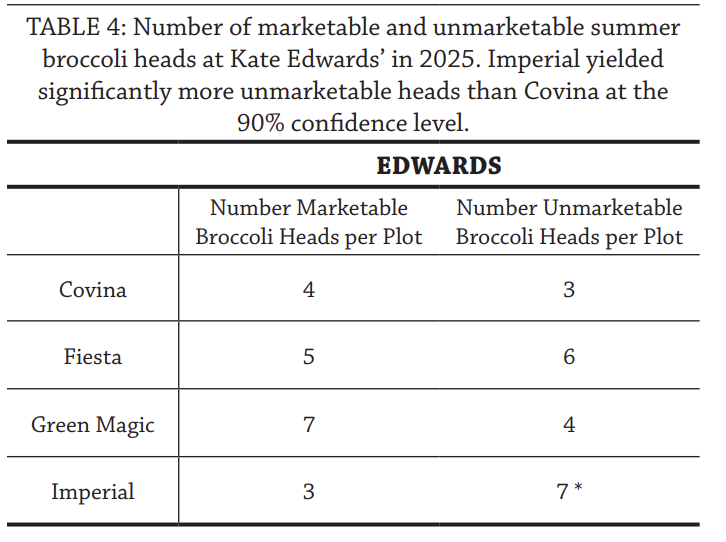
Cooperators generally considered their yields poor across all varieties of broccoli, but generally it seemed that Green Magic may have performed a bit better than other varieties. The Blacks found that Green Magic yielded significantly more marketable yield by weight (16 lb/plot) than Covina (9 lb/plot) and Imperial (10 lb/plot) at the 90% confidence level (Table 3). Edwards and the Wenkes found no significant differences in marketable broccoli yields by weight (both farms) and number of heads (Edwards) across varieties.
Cooperators also tracked weight of unmarketable broccoli heads. The Wenkes did find that Green Magic yielded significantly more unmarketable broccoli (18 lb/plot) than Covina (9 lb/plot) and Imperial (12 lb/plot) at the 90% confidence level (Table 3). This indicates that even if the heads were not salable, Green Magic produced more or larger heads under challenging conditions than Covina and Imperial. The Blacks and Edwards found no differences in unmarketable broccoli yields across variety, though Edwards found that Imperial yielded significantly more unmarketable heads than Covina but Imperial or Green Magic (Table 4).
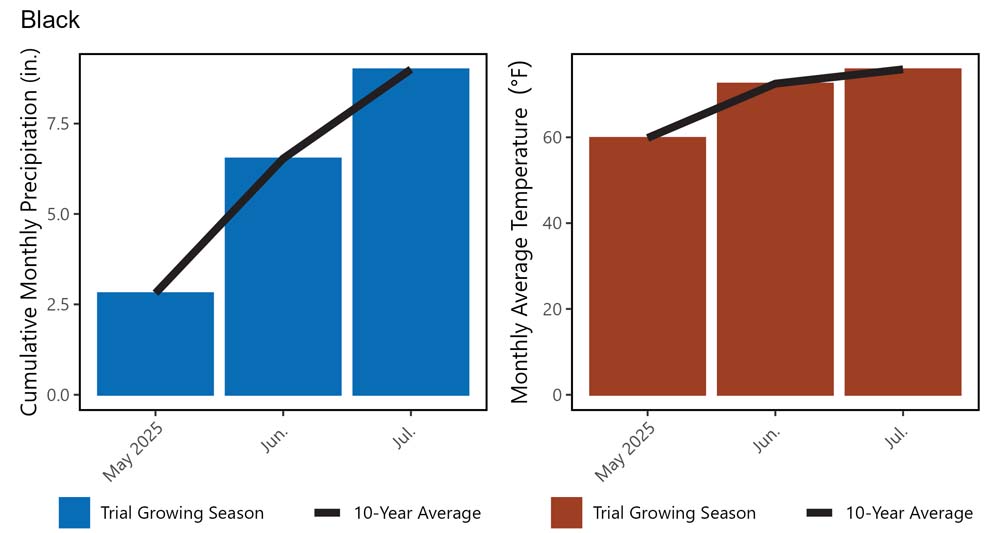
When reviewing project results, Carmen Black reflected that “Since the weather was uniquely challenging for summer broccoli, I'm not sure how representative this data will be. It was the 2nd wettest July on record, and this really impacted the broccoli in particular. I think we learned some things from growing broccoli in these conditions, but I don't feel conclusive about which varieties I'd like to continue growing or not growing from the data we collected.” The Wenkes and Edwards echoed these sentiments. The Blacks also attributed the fact that they harvested any summer broccoli at all in 2025 to the trial and the extra attention they paid to the broccoli because of it. “Without the trial I fear we may have given up on the crop because of the poor weather conditions.”
Despite not reaching their goal of identifying a superior summer broccoli variety, the Wenkes, who were new to on-farm research in 2025, found the experience of conducting a trial to be quite helpful for their farm. Ashley reports that “Zach and I showing each other and our crew the importance of both observing and collecting data was very beneficial for our daily systems. We developed clearer ways of using our white boards in our pack shed and double checking when things were done being collected or ready to be erased.” She also reported that the trial created a sense of camaraderie between participating farms in a challenging weather year. “I would have believed the bad broccoli harvest was only on our farm if I didn't reach out to fellow producers to know they were experiencing similar issues.”
Conclusions and Next Steps
In an extremely wet summer, none of the trialed broccoli varieties truly shone above the rest. However, participating farmers still reflected that conducting the trial was a valuable experience as it allowed them to pay more attention to their summer broccoli growing practices, develop new systems for tracking management information and harvest data, and collaborate with other participating farms. The farmers will not repeat this trial in 2026 but may revisit the question of summer broccoli varieties again in the future.
Appendix - Trial Design and Weather Conditions
Funding Acknowledgement
Funding for this project was made possible by a grant/cooperative agreement from the U.S. Department of Agriculture (USDA) Agricultural Marketing Service. Its contents are solely the responsibility of the authors and do not necessarily represent the official views of the USDA.
References
- L. Kolbe et al., “Summer Broccoli Variety Trial,” Practical Farmers of Iowa, 2016.
- E. Liddle, M. Black, C. Black, H. Breckbill, E. Fagan, and A. McGary, “Cabbage Variety Trial,” Practical Farmers of Iowa, May 2021. [Online]. Available: https://practicalfarmers.org/research/cabbage-variety-trial-2/
- L. Kolbe, M. Quee, and S. Shellz, “Cauliflower Variety Trial,” Practical Farmers of Iowa, 2019. [Online]. Available: https://practicalfarmers.org/research/cauliflower-variety-trial/
- A. Carrey et al., “Fall Cauliflower Variety Trial,” Practical Farmers of Iowa, 2022. [Online]. Available: https://practicalfarmers.org/resources/research-reports/fall-cauliflower-variety-trial/
- A. Kałużewicz, W. Krzesiński, and M. Knaflewski, “Effect of Temperature on the Yield and Quality of Broccoli Heads,” J. Fruit Ornam. Plant Res., vol. 71, no. 1, pp. 51–58, Jan. 2010, doi: 10.2478/v10032-009-0026-7.
- “Broccoli and Summer Heat : Vegetable : Center for Agriculture, Food, and the Environment (CAFE) at UMass Amherst.” Accessed: Mar. 30, 2026. [Online]. Available: https://www.umass.edu/agriculture-food-environment/vegetable/fact-sheets/broccoli-summer-heat
- “Broccoli Production in the Midwest.” Accessed: Mar. 30, 2026. [Online]. Available: https://shop.iastate.edu/extension/farm-environment/crops-and-soils/vegetable-crops/hort3130.html
- A. H. Sparks, “nasapower: A NASA POWER Global Meteorology, Surface Solar Energy and Climatology Data Client for R,” J. Open Source Softw., vol. 3, no. 30, p. 1035, Oct. 2018, doi: 10.21105/joss.01035.
- A. H. Sparks et al., nasapower: NASA POWER API Client. (May 18, 2024). Accessed: Sep. 11, 2024. [Online]. Available: https://cran.r-project.org/web/packages/nasapower/index.html