
Innovating and Collaborating To Clean Our Water
There’s only one exactly like it. It’s in Grundy County, Iowa, on Clark Porter’s farm. Field day attendees got to see this novelty – an experimental conservation practice that shows strong potential to clean water leaving crop fields – at the field day Clark and his wife Sharon held last September.
Clark started off his field day talking about the responsibility he and other farmland owners carry. “Farmers don’t want regulations. If we don’t have regulation, it’s farmers’ responsibility to figure out our water quality issues.” Clark explained that 80% of water quality issues in Iowa are due to agriculture – which shouldn’t be surprising, since 85% of our total land base is devoted to agriculture. The recently published Central Iowa Water Source Research Assessment (CIWSRA) backs up Clark’s claim.
“Responsibility is layered,“ Clark said. “Everyone needs to do something, and most people need to do multiple things, taking a layered approach.”
That’s what Clark is doing on his farm. He discussed in-field practices like cover crops, no-till and split- and variable-rate applications. He also showed his saturated buffer, an edge-of-field practice that has the potential to remove 50% of nitrates from water diverted through it. But these buffers, while effective, have specific landscape requirements that limit where they can be installed.
Enter the new tool researchers are testing on Clark’s farm: a saturated grass waterway. It’s basically a modification of a standard grass waterway, which slows and channels surface water. Standard grass waterways manage erosion and surface water runoff, but don’t treat nitrates in subsurface drainage tiles. The saturated grass waterway, however, does both. Water flows slightly up slope and stairsteps through water gates, slowing the tile water so it can be denitrified through natural processes.
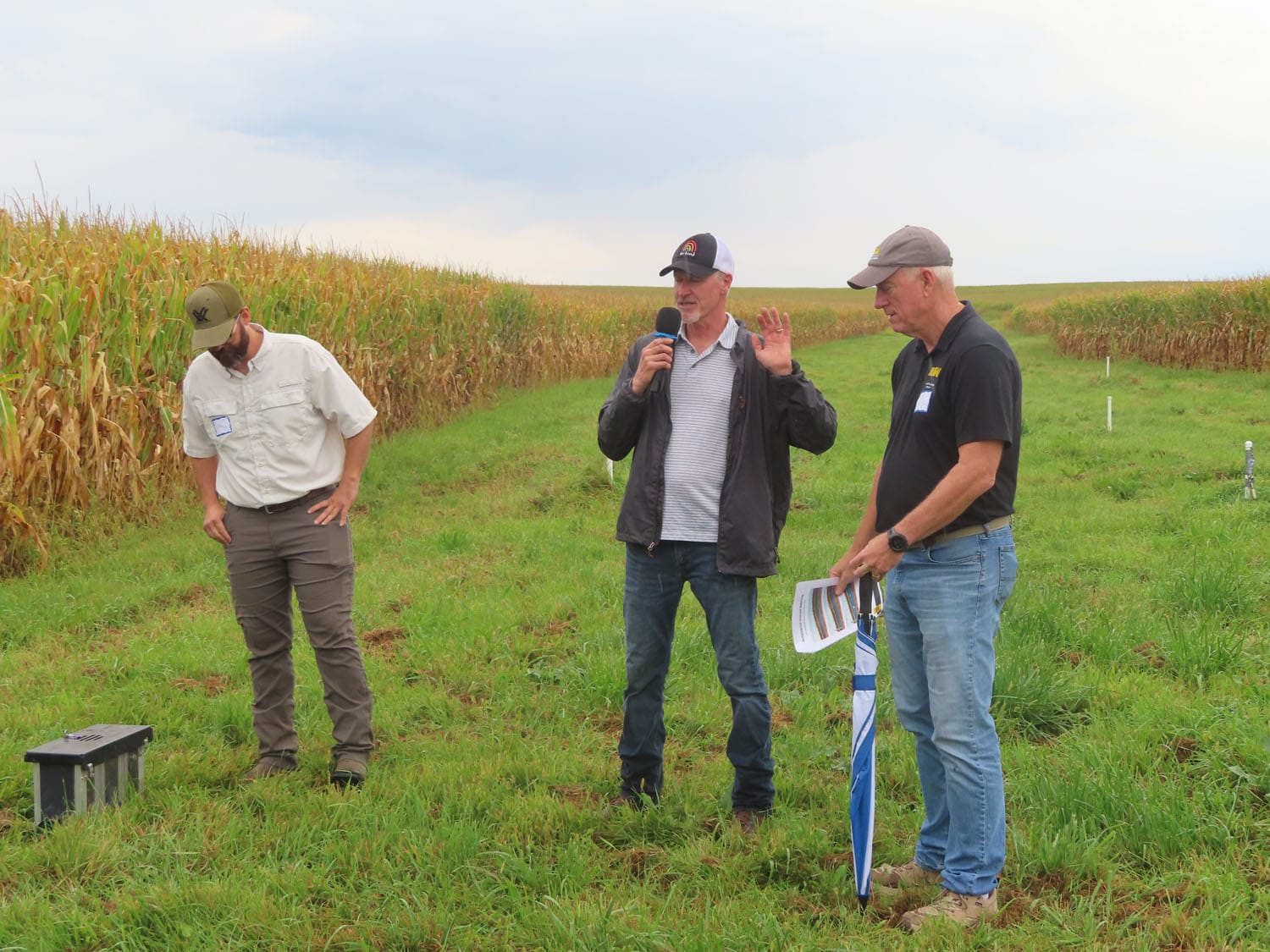
This is (left to right) Matthew Streeter (Iowa Geological Survey at University of Iowa), Clark Porter and Keith Schilling (Iowa Geological Survey at University of Iowa). They are standing in Clark’s saturated grass waterway.
On Clarks’ farm, the waterway – arguably the first of its kind – has effectively reduced nitrate by 69% since being installed in 2023. The concept was designed by Keith Schilling, state geologist of Iowa, and colleagues at the Iowa Geological Survey at University of Iowa. And since it can be installed where standard grass waterways are suited, the design could be used more widely on waterways across the Midwest. But first, Keith’s crew will expand their research on other sites to gather more data.
Many farmers in PFI’s network like Clark take responsibility for the water that comes off their farms. Equally important, they share their experiences, helping spread the adoption of clean water practices.
You can see photos of farmers who generously shared their knowledge at PFI field days. Many of these farmers – and others in the PFI network – are using practices that help our water quality. You can read how Andy Getting and Aaron Alons, and Mark and Dawn Madison, are maximizing the benefit of cover crops while improving their water quality. Thank you all for working to provide us clean water. It’s seen and it’s important.
Water quality is a pressing issue. In addition to the July release of CIWSRA’s findings, Iowa’s nitrate levels have been at a record high. The situation caused Central Iowa Water Works to institute its first-ever watering ban over the summer. Simultaneously, more concerns are being raised about Iowa’s cancer rates and what is in our drinking water.
As 2025 comes to an end and we embark on a new year, PFI is embarking on a new strategic plan. As we reflect on how we should focus our work the next few years, water will certainly be on our mind. You will have an opportunity to provide input on how and where we focus our energy next year through a member survey and some listening sessions—stay tuned.
I’m grateful to know stewards like Clark and so many others I’ve met through PFI’s network, and I look forward to being inspired and informed by many of you at our upcoming conference. Thanks for your leadership, and I hope to see you there!