Cows and Calves
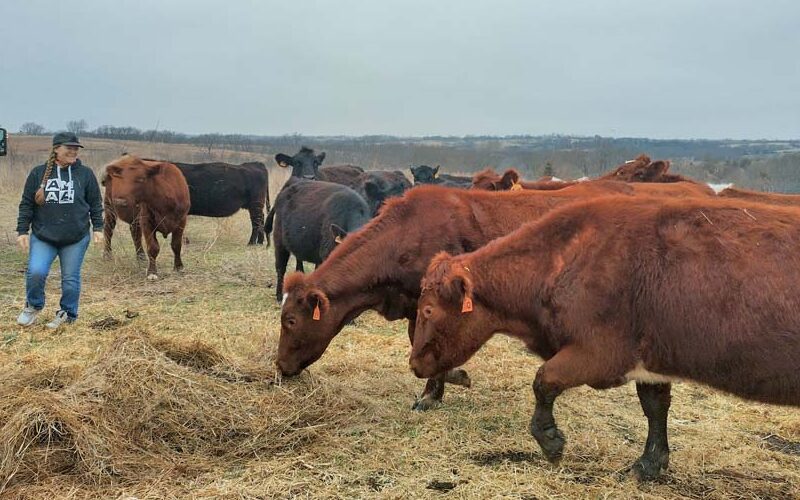
Four farmers shared their cover crop and grazing records so PFI's Cooperators' Program team could calculate the economic impact of grazing gestating cows and cow-calf pairs. Wesley Degner of Lytton, Iowa; Bill Frederick of Jefferson, Iowa; Zak Kennedy of Atlantic, Iowa; and Seth Smith of Nemaha, Iowa, submitted data from 2019 to 2021. Each farmer grazed cereal rye between their corn and soybean rotations, and the bulk of grazing took place from November to December and again from April to May. When cows are out grazing during these months, farmers have to feed less hay (or other stored feeds) – and saving money on hay translates to profits. Across the four farms, profits ranged from $37 to $124 per acre. On average, farmers saved $2.68 per animal unit (1,000 pounds of animal) per day in hay expenses when grazing cover crops. Over the entire cover crop grazing season, farmers saved a total dollar amount ranging from $3,000 to $31,000 in feed expenses. Wesley Degner, who was new to cover crops at the start of this project, now has six years of experience. “We're planning to continue grazing cows on cereal rye that we aerial-seed around the Labor Day timeframe each year,” he says. “It makes our life easier in the winter. We have less feed costs and grazing gives the cows exercise before spring calving.”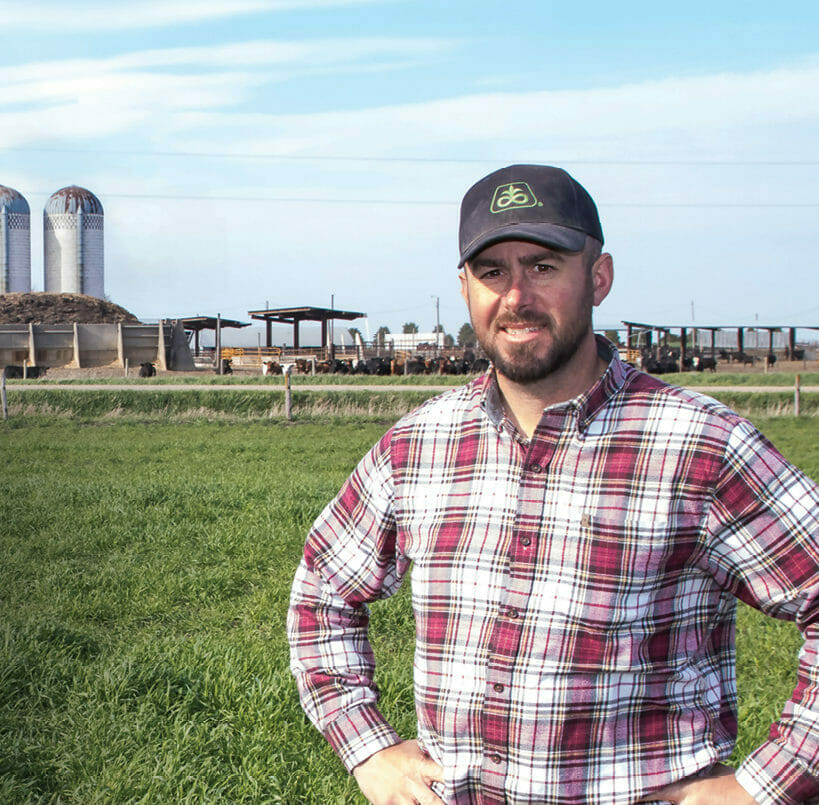
Feedlot Steers
While grazing cover crops is becoming standard practice for cow-calf producers, it has been implemented to a lesser degree in feedlots. In new research, Ben Albright of Lytton showed how a cover crop field adjacent to his feedlot could provide supplemental forage simply by opening a gate and letting finishing cattle graze the field. The fresh forage allowed Ben to back off the amount of total mixed ration he fed to his steers, saving an estimated $0.05 per animal per day. This added up to an average savings of $46 per acre – or $16 per animal. In total, Ben saved an average of $3,850 in feed each year by giving his cattle access to cover crops, and without sacrificing animal gain or carcass quality. “The numbers show that grazing covers is a no-brainer for cattle producers,” Ben says.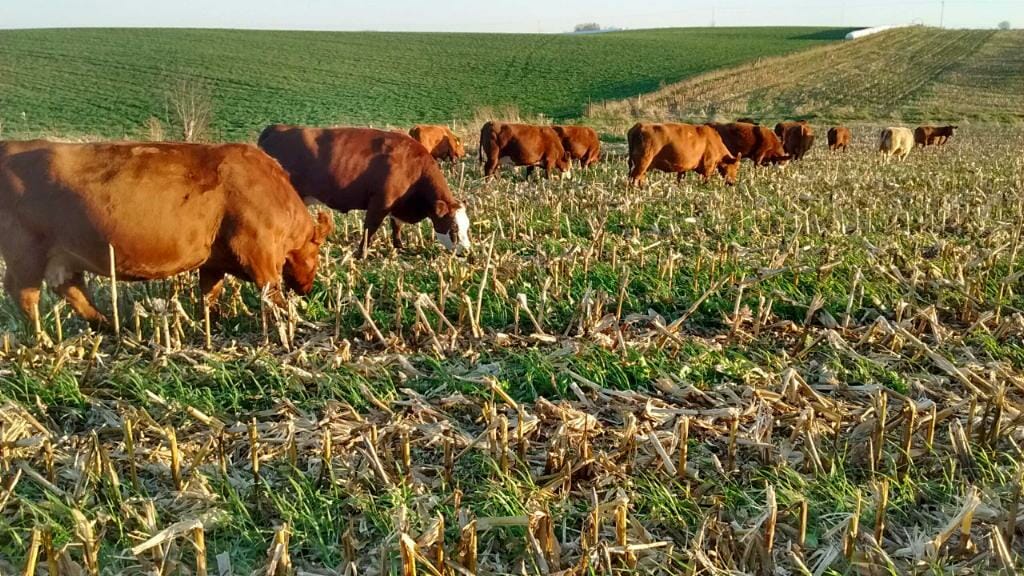
Different Cover Crop Mixes
Mark Glawe, who farms near Garber in northeast Iowa, has experimented with planting and grazing different cover crop mixes. In one field following an oat and pea crop, he planted a nine-species mix that included mung beans, crimson clover, winter peas, pearl millet, cereal rye, sorghum-sudan grass, turnip, rapeseed and sunflowers. In other fields he planted cereal rye and oats. The cost to establish a cover crop totaled $62 per acre for the nine-species mix, and $38 per acre for the rye and oats. “Only four or five species did really good in the nine-species mix,” Mark says, “because they seemed to drown out the less vigorous ones.” He has determined that his preferred mix would include cereal rye for spring grazing, oats for fall grazing, turnips (“because cows love them”), sorghum-sudan grass and pearl millet. Overall, Mark ended up reaping more profit from his less expensive cover crops due to vigorous growth and large windows of opportunity for spring grazing. Mark's profits ranged from $41 to $403 per acre. “Out of the last 10 years, 2020-2021 was my best year yet,” he says. “On average, I profit about $50 per acre each year. Usually I don't get that much spring grazing, but spring 2021 was dry, so we weren't having to take the cows off because of rain.” Another perk is that Mark's profits help subsidize the cost of cover crops in fields he is unable to graze for one reason or another. Cover crops are important on Mark's farm, which is located on D and E slopes in Iowa's Driftless region. In the standard hillslope classification system, a slope's steepness– which influences how quickly water will run off, as well as potential for soil to erode, among other things – is described using the letters A to F, where D slopes are “strongly sloping” (at an angle of 13-18%) and E slopes are “moderately steep” (at an angle of 19-25%). In Clayton County, Mark says his neighbors are catching on. “Last year [the county] had 2,000 acres of cover crops seeded, and two-thirds of those acres were used for grazing,” he says.Contract Grazing